논문 해설
PDO Drug Screening Data for Evaluating and Training AI Drug Response Prediction Models
AI 약물 반응 예측 모델의 평가와 학습을 위한 PDO 약물 스크리닝 데이터
- 연구 문제 환자 종양 반응을 예측하려면 세포주 기반 DRP 모델이 PDO에서도 작동해야 하지만, 세포주와 PDO의 차이 때문에 이 적용이 어렵습니다.
- 연구 방법 PDO 스크리닝 데이터를 새로 만들고, CCL 단독, CCL과 PDO 결합, CCL pre-training 후 PDO 미세조정의 세 전략으로 여섯 DRP 모델을 학습해 비교합니다.
CCL 데이터와 PDO 사이의 간극
대부분의 약물 반응 예측(DRP) 모델은 CCLE, GDSC 같은 불멸화 암 세포주 데이터로 학습됩니다. 세포주는 장기간 2차원 배양을 거치며 분자 특성이 달라지고, 환자 종양의 세포 이질성이나 3차원 조직 구조를 잘 재현하지 못합니다. 실제로 예측하려는 대상은 환자 종양의 반응이므로 이 차이가 모델 적용의 걸림돌이 됩니다. 이 논문은 환자 유래 오가노이드(PDO)에서 약물 스크리닝 데이터를 새로 만들고, 기존 DRP 모델이 PDO 반응을 얼마나 예측하는지 확인합니다. 저자들은 PDO 데이터가 DRP 연구에서 아직 제한적이라는 점을 문제로 봅니다.
PDO 스크리닝 데이터 구축
네 개의 PDO 스크리닝 연구가 대장암, 두경부암, 육종 PDO를 대상으로 수행되었습니다. IMPROVE 데이터셋 1에서 3은 공통 실험을 공유하도록 설계되어 실험 플랫폼 사이의 재현성을 비교할 수 있습니다. Pilot 1 데이터셋은 대장암 PDO 27개와 두경부암 PDO 20개를 포함합니다. 반응값은 용량-반응 곡선 아래 면적을 정규화한 AUC로 기록되며, 측정 방법은 3D 고함량 이미징, ATP 방출 기반 생존도 측정, 세포 생존율 이미징으로 연구마다 다릅니다. 세포주 데이터는 IMPROVE 벤치마크에서 가져온 CCLE, CTRPv2, GDSCv1, GDSCv2, gCSI입니다.
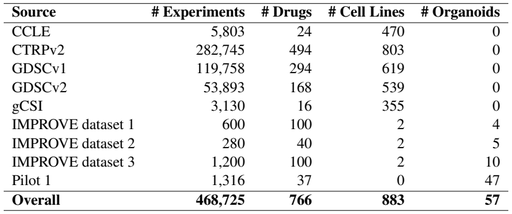
Table 1 : Summary of datasets and experimental sources. The final row reports the total number of unique experiments, drugs, cell lines, and organoids across all sources.
원문 · CC BY 4.0 · Y. Zhu, K. Marlor, V. Lavelle, T. S. Brettin, M. Sacco, C. Siniscalchi, H. W. Raeder, M. R. Weil, R. L. Stevens · PDO Drug Screening Data for Evaluating and Training AI Drug Response Prediction Models · 원문 그림 인용 · 원본 PDF 3쪽에서 그림 영역을 추출했습니다.세 가지 학습 전략과 분할 방식
모델 입력은 유전자 발현과 약물 특성이며, 여섯 개의 공개 DRP 모델(UNO, IGTD, GraphDRP, HiDRA, DeepTTC, LGBM)을 사용했습니다. 첫째 전략은 CCL 데이터로만 학습하고 PDO에 바로 적용하는 방식입니다. 둘째는 CCL 데이터와 PDO 학습 분할을 합쳐 학습하는 결합 학습입니다. 셋째는 CCL로 사전 학습한 뒤 PDO 데이터로 미세조정하는 전이 학습입니다. 분할은 무작위 분할과 암 증례를 분리하는 cancer-blind 분할 두 가지이며, cancer-blind 분할에서는 학습과 검증, 테스트 세트가 암 증례를 공유하지 않습니다. 전이 학습은 GraphDRP와 LGBM에 적용되었습니다.
GraphDRP에서는 앞쪽 층을 고정하고 뒤쪽 층을 갱신하며, 학습 가능한 층 수를 differential evolution으로 최적화했습니다. LGBM에서는 pre-training 모델에 부스팅 단계를 추가했습니다.
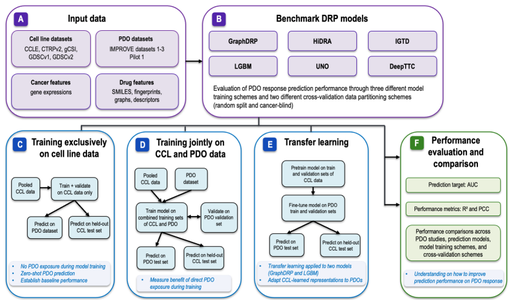
Figure 2 : Overview of the DRP analysis framework. Six DRP models were used to predict PDO drug response using three learning strategies: cell line-only training, joint cell line and PDO training, and transfer learning with pretraining on cell lines followed by fine-tuning on PDOs. Random splits performed 10-fold cross-validations, whereas cancer-blind splits usedN-fold data partitioning, where on IMPROVE datasets Nis the number of PDO lines in the dataset and on Pilot 1 datasetNis 10.
원문 · CC BY 4.0 · Y. Zhu, K. Marlor, V. Lavelle, T. S. Brettin, M. Sacco, C. Siniscalchi, H. W. Raeder, M. R. Weil, R. L. Stevens · PDO Drug Screening Data for Evaluating and Training AI Drug Response Prediction Models · 원문 그림 인용 · 원본 PDF 8쪽에서 그림 영역을 추출했습니다.CCL 단독 학습의 PDO 예측 성능
CCL로만 학습한 모델은 무작위 분할에서 CCL 테스트 세트의 평균 R2가 0.77이었습니다. 같은 모델을 PDO에 적용하자 평균 PDO R2는 IMPROVE 데이터셋 1에서 0.25, 데이터셋 2에서 −0.26, 데이터셋 3에서 0.24, Pilot 1에서 0.07로 떨어졌습니다. 데이터셋 2에서는 음수 R2가 나타났고, 이는 평균값만 예측하는 기준보다 나쁘다는 뜻입니다. 저자들은 세포주와 PDO의 생물학적 차이와 실험 프로토콜 차이가 함께 작용한다고 해석합니다. 모델 구조에 따른 차이는 CCL 테스트 세트보다 PDO에서 더 크게 나타났습니다.
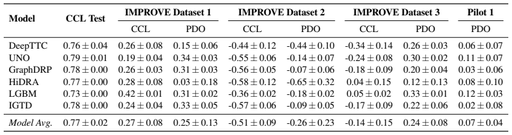
Table 2 : Prediction performance (R 2, mean±s.d.) of models trained exclusively on CCL data in random split cross-validations. CCL Test indicates the test set of CCL data. Prediction performance on CCL exper- iments and PDO experiments in IMPROVE datasets 1-3 are listed separately.
원문 · CC BY 4.0 · Y. Zhu, K. Marlor, V. Lavelle, T. S. Brettin, M. Sacco, C. Siniscalchi, H. W. Raeder, M. R. Weil, R. L. Stevens · PDO Drug Screening Data for Evaluating and Training AI Drug Response Prediction Models · 원문 그림 인용 · 원본 PDF 11쪽에서 그림 영역을 추출했습니다.전이 학습의 효과와 CCL 성능 손실
무작위 분할에서 결합 학습 대비 전이 학습은 GraphDRP와 LGBM의 PDO 예측 성능을 0.03에서 0.11 범위로 더 높였습니다. 반면 CCL 테스트 세트 성능은 결합 학습보다 크게 떨어졌습니다. 저자들은 이를 전이 학습이 이전에 학습한 CCL 약물 반응 패턴을 잊는 대가로 해석합니다. cancer-blind 분할에서도 전이 학습은 PDO 성능을 높였고, CCL 성능은 떨어졌습니다. 이 결과는 GraphDRP와 LGBM에 한정된 것이며 나머지 네 모델에 전이 학습을 적용한 결과는 본문에 없습니다.

Table 4 : Prediction performance (R 2, mean±s.d.) of models trained using CCL and PDO data jointly in random split cross-validations. CCL Test indicates the test set of CCL data. Study CCL and Study PDO indicate the CCL experiments and the test set of PDO experiments in a PDO drug screening study, respectively.
원문 · CC BY 4.0 · Y. Zhu, K. Marlor, V. Lavelle, T. S. Brettin, M. Sacco, C. Siniscalchi, H. W. Raeder, M. R. Weil, R. L. Stevens · PDO Drug Screening Data for Evaluating and Training AI Drug Response Prediction Models · 원문 그림 인용 · 원본 PDF 12쪽에서 그림 영역을 추출했습니다.
Table 12 : Transfer learning prediction performance (PCC, mean±s.d.) of models in random split cross- validations. CCL Test indicates the test set of CCL data. Study CCL and Study PDO indicate the CCL experiments and the test set of PDO experiments in a PDO drug screening study, respectively. Pilot 1 study does not include Study CCL experiments.
원문 · CC BY 4.0 · Y. Zhu, K. Marlor, V. Lavelle, T. S. Brettin, M. Sacco, C. Siniscalchi, H. W. Raeder, M. R. Weil, R. L. Stevens · PDO Drug Screening Data for Evaluating and Training AI Drug Response Prediction Models · 원문 그림 인용 · 원본 PDF 22쪽에서 그림 영역을 추출했습니다.IMPROVE 연구 간 재현성
IMPROVE 연구들은 공통 실험을 공유하므로 정규화 AUC의 연구 간 상관을 비교할 수 있었습니다. 상관은 데이터셋 1과 3 사이에서 PCC 0.645(n=594), 데이터셋 1과 2 사이에서 0.547(n=240), 데이터셋 2와 3 사이에서 0.371(n=280)이었습니다. 세 값은 모두 중간 수준이며, 연구 간 측정 변동이 여전히 크다는 뜻으로 해석됩니다. 저자들은 이 결과가 약물 스크리닝 실험의 재현성 개선이 필요하다는 근거라고 봅니다.
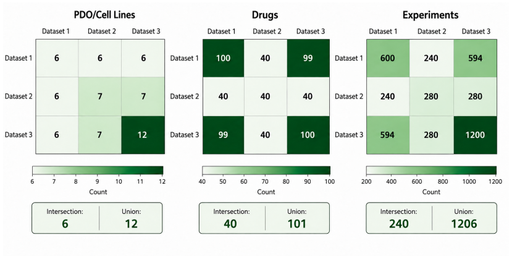
Figure 1 : Overlap of samples, experiments, and drugs across the three IMPROVE datasets. Diagonal entries indicate the total number of elements in each set, while off-diagonal entries indicate pairwise intersections. The intersection and union across all three sets are shown below each matrix.
원문 · CC BY 4.0 · Y. Zhu, K. Marlor, V. Lavelle, T. S. Brettin, M. Sacco, C. Siniscalchi, H. W. Raeder, M. R. Weil, R. L. Stevens · PDO Drug Screening Data for Evaluating and Training AI Drug Response Prediction Models · 원문 그림 인용 · 원본 PDF 4쪽에서 그림 영역을 추출했습니다.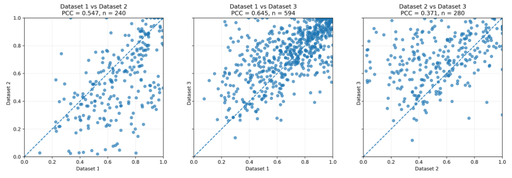
Figure 3 : Pairwise comparison of drug response measurements across the three IMPROVE studies. Scatter- plots show the normalized AUC values of matched experiments between a pair of IMPROVE datasets. Each point represents an experiment measured in both studies. PCC and the number of matched experiments are reported for each comparison.
원문 · CC BY 4.0 · Y. Zhu, K. Marlor, V. Lavelle, T. S. Brettin, M. Sacco, C. Siniscalchi, H. W. Raeder, M. R. Weil, R. L. Stevens · PDO Drug Screening Data for Evaluating and Training AI Drug Response Prediction Models · 원문 그림 인용 · 원본 PDF 10쪽에서 그림 영역을 추출했습니다.처음 보는 암 증례에서의 한계
cancer-blind 분할에서 CCL 테스트 세트의 평균 R2는 0.68로, 무작위 분할의 0.77보다 낮았습니다. PDO 예측 성능도 전반적으로 무작위 분할보다 낮았습니다. 저자들은 이를 처음 보는 암 증례로의 일반화가 더 어려운 과제라는 뜻으로 해석합니다. 결합 학습이 PDO 성능을 높이기는 했지만 cancer-blind 분할의 성능은 무작위 분할보다 낮았습니다.

Table 5 : Prediction performance (R 2, mean±s.d.) of models trained using CCL and PDO data jointly in cancer-blind cross-validations. CCL Test indicates the test set of CCL data. Study CCL and Study PDO indicate the CCL experiments and the test set of PDO experiments in a PDO drug screening study, respectively.
원문 · CC BY 4.0 · Y. Zhu, K. Marlor, V. Lavelle, T. S. Brettin, M. Sacco, C. Siniscalchi, H. W. Raeder, M. R. Weil, R. L. Stevens · PDO Drug Screening Data for Evaluating and Training AI Drug Response Prediction Models · 원문 그림 인용 · 원본 PDF 12쪽에서 그림 영역을 추출했습니다.IMPROVE 데이터셋 2의 낮은 성능
데이터셋 2는 여러 모델에서 PDO 예측 성능이 가장 낮았고 일부 R2는 음수였습니다. 저자들은 배지 혼합이 불충분해 웰마다 세포 파종이 고르지 않았고, 이로 인해 데이터에 상당한 잡음이 들어갔다고 판단합니다. 같은 경우에도 PCC는 중간에서 높은 수준을 보여, 모델이 상대적 순위는 일부 포착했지만 크기는 정확히 맞히지 못했다는 해석이 가능합니다.
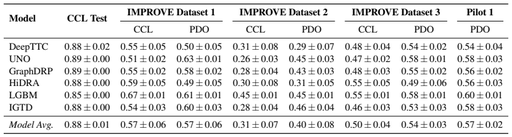
Table 8 : Prediction performance (PCC, mean±s.d.) of models trained exclusively on CCL data in random split cross-validations. CCL Test indicates the test set of CCL data. Prediction performance on CCL exper- iments and PDO experiments in IMPROVE datasets 1-3 are listed separately.
원문 · CC BY 4.0 · Y. Zhu, K. Marlor, V. Lavelle, T. S. Brettin, M. Sacco, C. Siniscalchi, H. W. Raeder, M. R. Weil, R. L. Stevens · PDO Drug Screening Data for Evaluating and Training AI Drug Response Prediction Models · 원문 그림 인용 · 원본 PDF 21쪽에서 그림 영역을 추출했습니다.논문 정보
- 저자
- Y. Zhu, K. Marlor, V. Lavelle, T. S. Brettin, M. Sacco, C. Siniscalchi, H. W. Raeder, M. R. Weil, R. L. Stevens
- 학회·저널
- arXiv · 프리프린트
- 최초 공개일
- 2026년 11월 11일
- 등록일
- 2026년 11월 13일
- 수정일
- 2026년 11월 11일
- 버전
- v1
- arXiv
- 2611.15769
- 분류
- q-bio.QM · cs.AI
- 원문 이용 조건
- CC BY 4.0
- 제공 범위
- 논문 정보, 해설, 허용된 원문 그림
AI 해설은 논문 원문과 별개의 설명이며 오류가 있을 수 있습니다. 원문과 그림은 각 출처의 이용 조건과 따로 표시된 권리를 따릅니다.
초록
Anti-cancer drug response prediction (DRP) is critically important for precision oncology and therapeutic development. Currently, most DRP models are developed using drug screening data from immortalized cancer cell lines, which can differ substantially from patient tumors at the genomic and molecular levels, even though patient tumor response is the ultimate prediction target. To help bridge this gap and bring DRP models closer to their intended clinical application, we conducted four drug screening studies using patient-derived organoids (PDOs), which more faithfully recapitulate patient tumors than immortalized cell lines. These studies generated data for improving and evaluating DRP models, including multi-omics profiles of PDO lines, drug feature data, and treatment response measurements. Using these data, we retrained and evaluated multiple publicly available DRP models under three model-building scenarios: training models using cell line data only, training models using combined cell line and PDO data, and pretraining models on cell line data followed by fine-tuning on PDO data. We then evaluated and compared model prediction performance on PDOs across these analysis scenarios. In addition, we also assessed the consistency of drug screening viability data generated by different laboratories using different assay technologies and/or experimental protocols.
원문 인용
Y. Zhu, K. Marlor, V. Lavelle, T. S. Brettin, M. Sacco, C. Siniscalchi, H. W. Raeder, M. R. Weil, R. L. Stevens (2026). PDO Drug Screening Data for Evaluating and Training AI Drug Response Prediction Models. arXiv:2611.15769v1. https://arxiv.org/abs/2611.15769v1
BibTeX
@misc{zhu2026drug,
  title = {{PDO Drug Screening Data for Evaluating and Training AI Drug Response Prediction Models}},
  author = {Y. Zhu and K. Marlor and V. Lavelle and T. S. Brettin and M. Sacco and C. Siniscalchi and H. W. Raeder and M. R. Weil and R. L. Stevens},
  year = {2026},
  eprint = {2611.15769},
  archivePrefix = {arXiv},
  url = {https://arxiv.org/abs/2611.15769v1}
}