논문 해설
VibePrevisBench: Evaluating Agentic Coding for 4D Scene Generation in Blender
VibePrevisBench: Blender에서 4D 장면 생성을 위한 에이전트형 코딩 평가
- 연구 문제 기존 벤치마크는 실사 비디오나 정적 장면만 평가해, 다중 샷 장면을 구성하는 코딩 에이전트의 능력을 충분히 보지 못합니다.
- 연구 방법 코딩 에이전트가 만든 Blender 프로그램을 재실행해 4D 장면을 내보내고, 숨겨진 GT 사실과 프록시 비디오를 두 단계로 채점합니다.
- 주요 결과 GPT-6 Astra가 종합 점수 77.7로 가장 높았고, 텍스트 스크립트에서 최고와 최저 에이전트의 Rule 점수 차이는 12.0점, 사진에서는 19.9점이었습니다.
코딩 에이전트 평가의 빈틈
이 논문은 코딩 에이전트가 짧은 브리프를 Blender에서 실행 가능한 4D 장면으로 바꾸고, 그 장면을 렌더링한 프록시 비디오까지 만드는 능력을 평가합니다. 프록시 비디오는 실사 비디오 생성 모델이 외형을 입히는 그레이박스 입력이라서, 장면 구성의 오류가 최종 실사 비디오까지 그대로 이어집니다. 기존 벤치마크는 대부분 실사 비디오만 채점하거나, 정적 장면이나 짧은 클립만 다루거나, 여러 사람이 등장하는 다중 샷 장면을 정답과 대조하지 않았습니다. 이 빈틈을 메우기 위해 저자들은 VibePrevisBench를 구성했습니다. 이 벤치마크는 스크립트, 사진, 연속 장면, 참조 비디오의 네 입력 종류와 242개 태스크로 이루어져 있습니다.
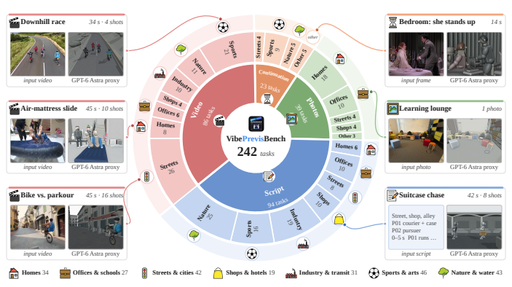
Figure 3 .Overview of VibePrevisBench.The 242 tasks span four input kinds (inner ring) and seven scene domains (outer ring), with spans proportional to task counts. Each card is a real task with its input and a frame of GPT-6 Astra’s proxy video.
원문 · CC BY 4.0 · Yuzhe Chen, Muxi Diao, Lele Yang, Wenbin Xu, Xuyang Liu, Qile Su, Changyi Liu, Jiankang Chen, Kaiyu Jiang, Haoyu Zhang, Hongyi Fu, Jianxiong Wang, Tianke Zhang, Haonan Fan, Yingxin Li, Bingyi Li, Xu Wang, Xuanyu Zheng, Bin Wen, Tingting Gao, Wentao Zhang, Jiale Cao · VibePrevisBench: Evaluating Agentic Coding for 4D Scene Generation in Blender · 원문 그림 인용 · 원본 PDF 5쪽에서 그림 영역을 추출했습니다.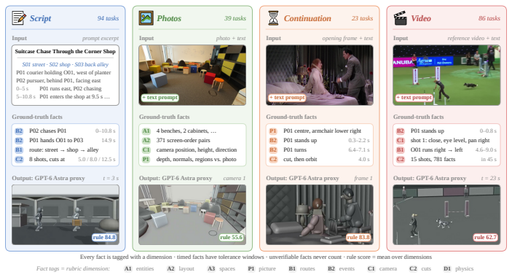
Figure 11 .The four kinds of input.One task of each kind.T op:what the agent receives (a script ex- cerpt, a photo, an opening frame, a reference video); photo, continuation and video tasks also come with a text brief.Middle: some of the hidden GT facts for that task, each tagged with its rubric dimen- sion. Bottom: a frame of the proxy video delivered by GPT-6 Astra, with its Rule-based Scene Check score. Timed facts carry tolerance windows, and facts the ground truth cannot verify never count.
원문 · CC BY 4.0 · Yuzhe Chen, Muxi Diao, Lele Yang, Wenbin Xu, Xuyang Liu, Qile Su, Changyi Liu, Jiankang Chen, Kaiyu Jiang, Haoyu Zhang, Hongyi Fu, Jianxiong Wang, Tianke Zhang, Haonan Fan, Yingxin Li, Bingyi Li, Xu Wang, Xuanyu Zheng, Bin Wen, Tingting Gao, Wentao Zhang, Jiale Cao · VibePrevisBench: Evaluating Agentic Coding for 4D Scene Generation in Blender · 원문 그림 인용 · 원본 PDF 18쪽에서 그림 영역을 추출했습니다.두 가지 채점 방식
채점은 두 단계로 나뉩니다. 먼저 Rule-based Scene Check는 에이전트의 프로그램을 새 샌드박스에서 다시 실행하고, 장면 S를 프레임별로 내보내 숨겨진 GT 사실과 대조합니다. 사실은 장면의 주체 존재, 위치, 경로, 카메라, 컷, 물리적 타당성 등 아홉 개 차원으로 나뉩니다. 이 단계에서 통과한 사실만 다음 단계로 넘어갑니다. VLM-based Screen Check는 판정 모델이 프록시 비디오를 보고, 통과한 항목이 시청자에게 실제로 인식되는지 no, partial, yes로 판정합니다. 최종 종합 점수는 두 점수의 평균입니다. 실행 실패는 두 검사 모두 0점으로 처리됩니다.
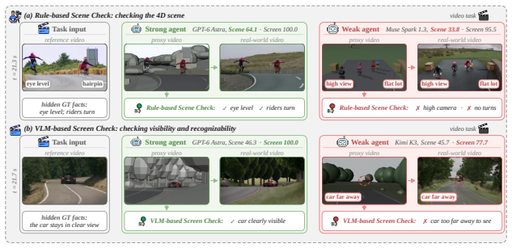
Figure 2 . Two complementary evaluation dimensions. Each panel compares a reference video with strong and weak agents’ proxy videos and the corresponding real-world videos generated by Seedance 2.5. (a) Rule-based Scene Check evaluates the 4D scene, and detects the weak agent’s high camera and missed turns. (b) VLM-based Screen Check assesses visibility and recogniz- ability: the weak agent’s car passes the in-frame and turning checks but is too distant to rec- ognize clearly. The real-world videos inherit their proxy videos’ errors. In addition, we note that the generated real-world videos keep the errors of their proxy videos, demonstrating the importance of proxy video generation quality.
원문 · CC BY 4.0 · Yuzhe Chen, Muxi Diao, Lele Yang, Wenbin Xu, Xuyang Liu, Qile Su, Changyi Liu, Jiankang Chen, Kaiyu Jiang, Haoyu Zhang, Hongyi Fu, Jianxiong Wang, Tianke Zhang, Haonan Fan, Yingxin Li, Bingyi Li, Xu Wang, Xuanyu Zheng, Bin Wen, Tingting Gao, Wentao Zhang, Jiale Cao · VibePrevisBench: Evaluating Agentic Coding for 4D Scene Generation in Blender · 원문 그림 인용 · 원본 PDF 2쪽에서 그림 영역을 추출했습니다.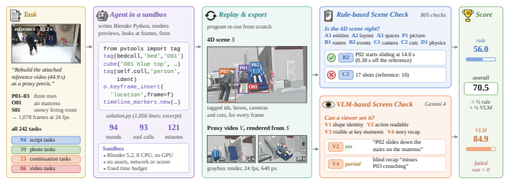
Figure 4 . One task through the evaluation pipeline(video task M50_049, solved by GPT-6 Astra). The agent writes Blender Python in a sandbox and inspects its own renders. We re-run the delivered programfromscratch. Thereplayexportsthe4Dscene S,thetaggedboxes,camerasandcutsofevery frame, and renders the proxy videoV from it. Rule-based Scene Check comparesS with the hidden GT facts, two of 805 checks shown; VLM-based Screen Check asks the VLM judge aboutV , only for items the rules passed, two verdicts shown.
원문 · CC BY 4.0 · Yuzhe Chen, Muxi Diao, Lele Yang, Wenbin Xu, Xuyang Liu, Qile Su, Changyi Liu, Jiankang Chen, Kaiyu Jiang, Haoyu Zhang, Hongyi Fu, Jianxiong Wang, Tianke Zhang, Haonan Fan, Yingxin Li, Bingyi Li, Xu Wang, Xuanyu Zheng, Bin Wen, Tingting Gao, Wentao Zhang, Jiale Cao · VibePrevisBench: Evaluating Agentic Coding for 4D Scene Generation in Blender · 원문 그림 인용 · 원본 PDF 6쪽에서 그림 영역을 추출했습니다.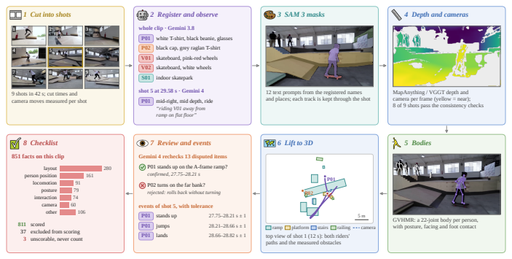
Figure 10 . Hidden ground truth facts for a video task.The eight pipeline steps on one clip: shots, registration and per-shot observation, masks, depth and cameras, bodies, lifting to 3D, review and events, and the final checklist of facts with their tolerance windows.
원문 · CC BY 4.0 · Yuzhe Chen, Muxi Diao, Lele Yang, Wenbin Xu, Xuyang Liu, Qile Su, Changyi Liu, Jiankang Chen, Kaiyu Jiang, Haoyu Zhang, Hongyi Fu, Jianxiong Wang, Tianke Zhang, Haonan Fan, Yingxin Li, Bingyi Li, Xu Wang, Xuanyu Zheng, Bin Wen, Tingting Gao, Wentao Zhang, Jiale Cao · VibePrevisBench: Evaluating Agentic Coding for 4D Scene Generation in Blender · 원문 그림 인용 · 원본 PDF 17쪽에서 그림 영역을 추출했습니다.주요 결과와 입력 종류별 차이
GPT-6 Astra는 Table 2에서 전체 종합 점수 77.7로 가장 높았고, GPT-6.1 Sol은 76.1을 기록했습니다. 입력 종류별로 보면 텍스트만 있는 스크립트에서 최고 에이전트와 최저 에이전트의 Rule-based Scene Check 차이가 12.0점이었고, 사진에서는 19.9점으로 커졌습니다. 저자들은 이 차이가 주로 공간과 카메라 이해에서 생긴다고 봅니다. 다섯 개 항목 중 인접한 쌍의 상당수는 쌍별 부트스트랩으로 구분되지 않았습니다. 이 결과는 Table 2의 설정과 Gemini 4 판정 모델을 기준으로 합니다.
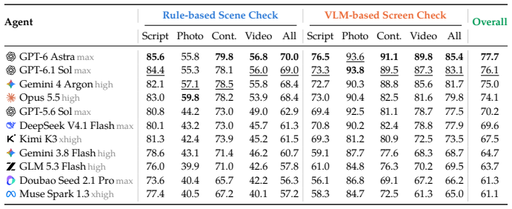
Table 2 .Main results on 242 tasks.Rule-based Scene Check and VLM-based Screen Check per input kind and over all tasks (All); VLM-based Screen Check uses the Gemini 4 judge, which rates only recognition on photos;Overallis their mean. Failed runs score 0. Per column, the best score is inbold and the second best is underlined. The reasoning effort of each agent is given in gray.
원문 · CC BY 4.0 · Yuzhe Chen, Muxi Diao, Lele Yang, Wenbin Xu, Xuyang Liu, Qile Su, Changyi Liu, Jiankang Chen, Kaiyu Jiang, Haoyu Zhang, Hongyi Fu, Jianxiong Wang, Tianke Zhang, Haonan Fan, Yingxin Li, Bingyi Li, Xu Wang, Xuanyu Zheng, Bin Wen, Tingting Gao, Wentao Zhang, Jiale Cao · VibePrevisBench: Evaluating Agentic Coding for 4D Scene Generation in Blender · 원문 그림 인용 · 원본 PDF 8쪽에서 그림 영역을 추출했습니다.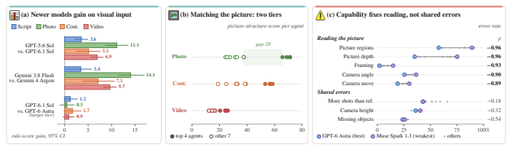
Figure 8 . Where agents improve, and where they do not.(a) Rule-based Scene Check gain of the second model over the first in each pair, per input kind, paired over tasks; whiskers show 95% boot- strap intervals. The top two pairs are successive generations of one family, while the bottom pair is a step up in tier within one generation at about five times the cost. (b) Picture-structure score per agent and input kind, which matches each shot’s depth, normals and segmentation to the reference frames; filled dots mark the four agents with the highest overall score. (c) Error rates of the best and the weakest agent, the other nine in gray;ρ is the Spearman correlation with the overall score, and Sec.C.2 defines each rate.
원문 · CC BY 4.0 · Yuzhe Chen, Muxi Diao, Lele Yang, Wenbin Xu, Xuyang Liu, Qile Su, Changyi Liu, Jiankang Chen, Kaiyu Jiang, Haoyu Zhang, Hongyi Fu, Jianxiong Wang, Tianke Zhang, Haonan Fan, Yingxin Li, Bingyi Li, Xu Wang, Xuanyu Zheng, Bin Wen, Tingting Gao, Wentao Zhang, Jiale Cao · VibePrevisBench: Evaluating Agentic Coding for 4D Scene Generation in Blender · 원문 그림 인용 · 원본 PDF 9쪽에서 그림 영역을 추출했습니다.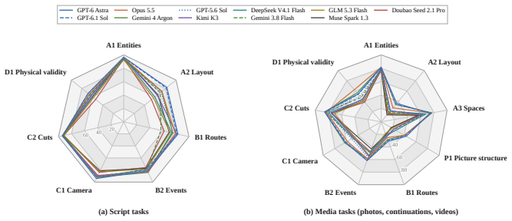
Figure 12 .Capability profiles of all 11 agents.Rule-based Scene Check score per dimension (0–100, failed runs count 0) on (a) script tasks and (b) media tasks. Exact values per agent are in Fig.13.
원문 · CC BY 4.0 · Yuzhe Chen, Muxi Diao, Lele Yang, Wenbin Xu, Xuyang Liu, Qile Su, Changyi Liu, Jiankang Chen, Kaiyu Jiang, Haoyu Zhang, Hongyi Fu, Jianxiong Wang, Tianke Zhang, Haonan Fan, Yingxin Li, Bingyi Li, Xu Wang, Xuanyu Zheng, Bin Wen, Tingting Gao, Wentao Zhang, Jiale Cao · VibePrevisBench: Evaluating Agentic Coding for 4D Scene Generation in Blender · 원문 그림 인용 · 원본 PDF 21쪽에서 그림 영역을 추출했습니다.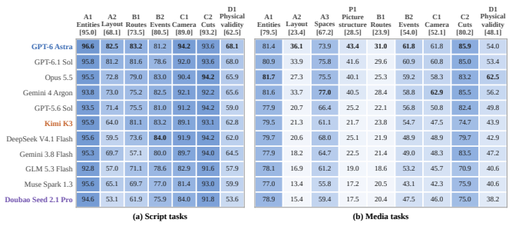
Figure 13 . Rule-based Scene Check score per dimension(failed runs count 0; column means in brackets; best per column in bold). (a) Script tasks. (b) Media tasks (photos, continuations, videos). Rows sorted by Rule-based Scene Check score over all tasks.
원문 · CC BY 4.0 · Yuzhe Chen, Muxi Diao, Lele Yang, Wenbin Xu, Xuyang Liu, Qile Su, Changyi Liu, Jiankang Chen, Kaiyu Jiang, Haoyu Zhang, Hongyi Fu, Jianxiong Wang, Tianke Zhang, Haonan Fan, Yingxin Li, Bingyi Li, Xu Wang, Xuanyu Zheng, Bin Wen, Tingting Gao, Wentao Zhang, Jiale Cao · VibePrevisBench: Evaluating Agentic Coding for 4D Scene Generation in Blender · 원문 그림 인용 · 원본 PDF 21쪽에서 그림 영역을 추출했습니다.
Table 6 .Within-family Rule-based Scene Check gainsper input kind, paired over tasks, with 95% bootstrap intervals. Task counts are given in brackets.
원문 · CC BY 4.0 · Yuzhe Chen, Muxi Diao, Lele Yang, Wenbin Xu, Xuyang Liu, Qile Su, Changyi Liu, Jiankang Chen, Kaiyu Jiang, Haoyu Zhang, Hongyi Fu, Jianxiong Wang, Tianke Zhang, Haonan Fan, Yingxin Li, Bingyi Li, Xu Wang, Xuanyu Zheng, Bin Wen, Tingting Gao, Wentao Zhang, Jiale Cao · VibePrevisBench: Evaluating Agentic Coding for 4D Scene Generation in Blender · 원문 그림 인용 · 원본 PDF 22쪽에서 그림 영역을 추출했습니다.도전적 요청과 자기 점검의 한계
저자들은 실패 원인을 두 가지로 분석했습니다. 첫째, 낮은 시점에서 촬영한 참조에 대해 66%의 샷이 눈높이로 나왔고, 흔한 요청인 눈높이 샷은 9%만 틀렸습니다. 프로즈에서만 언급된 객체는 35%가 누락되었습니다. 둘째, 에이전트는 렌더를 여러 번 보지만 렌더가 맞다고 말한 실행과 그렇지 않은 실행에서 오류율 차이가 작았습니다. 저자들은 도전적 요청이 학습 데이터에서 드물기 때문에 에이전트가 흔한 선택으로 기운다고 해석하지만, 이는 검증한 원인이 아니라 저자들의 해석입니다.
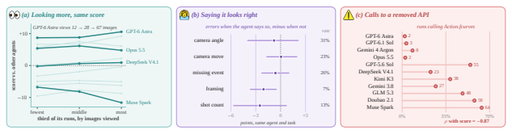
Figure9 . Howagentslook,judgeandcode. (a) Scorerelativetotheotheragents’taskmean,bythird of an agent’s runs ranked by images viewed.(b) Error rate in runs where the agent says its render matches or looks right, minus runs where it does not, with agent and task held fixed; whiskers show 95% bootstrap intervals andrateis the mean error rate.(c) Share of runs callingAction.fcurves, removed in Blender 5. Rows sorted by overall score.
원문 · CC BY 4.0 · Yuzhe Chen, Muxi Diao, Lele Yang, Wenbin Xu, Xuyang Liu, Qile Su, Changyi Liu, Jiankang Chen, Kaiyu Jiang, Haoyu Zhang, Hongyi Fu, Jianxiong Wang, Tianke Zhang, Haonan Fan, Yingxin Li, Bingyi Li, Xu Wang, Xuanyu Zheng, Bin Wen, Tingting Gao, Wentao Zhang, Jiale Cao · VibePrevisBench: Evaluating Agentic Coding for 4D Scene Generation in Blender · 원문 그림 인용 · 원본 PDF 10쪽에서 그림 영역을 추출했습니다.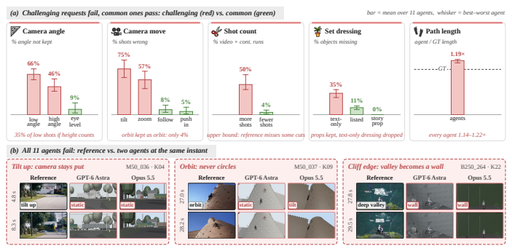
Figure 14 .Shared failure modes.(a) Error rates on a challenging request (red) and a common one (green),averagedoverthe11agents;whiskersshowthebestandworstagent. Camera angleand camera move: shots whose angle or move type differs from the reference.Shot count: video and continuation runs with more or fewer shots than the reference, an upper bound since the reference misses some cuts. Set dressing: objects missing from the scene.Path length: median ratio of agent path to GT path, pooled over all input kinds. (b) Shots that the rules mark wrong for all 11 agents: the reference frame and two agents at the same instant; tags describe what each one shows.
원문 · CC BY 4.0 · Yuzhe Chen, Muxi Diao, Lele Yang, Wenbin Xu, Xuyang Liu, Qile Su, Changyi Liu, Jiankang Chen, Kaiyu Jiang, Haoyu Zhang, Hongyi Fu, Jianxiong Wang, Tianke Zhang, Haonan Fan, Yingxin Li, Bingyi Li, Xu Wang, Xuanyu Zheng, Bin Wen, Tingting Gao, Wentao Zhang, Jiale Cao · VibePrevisBench: Evaluating Agentic Coding for 4D Scene Generation in Blender · 원문 그림 인용 · 원본 PDF 22쪽에서 그림 영역을 추출했습니다.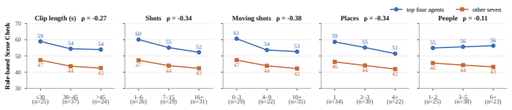
Figure 15 . What makes a reference video hard.The 86 video tasks fall into three bins along five properties of the reference clip, task counts under each bin. Lines give the mean Rule-based Scene Checkscoreofthetopfouragentsbyoverallscoreandoftheotherseven; ρistheSpearmancorrelation between the property and the task’s mean score over all 11 agents. Failed runs count 0.
원문 · CC BY 4.0 · Yuzhe Chen, Muxi Diao, Lele Yang, Wenbin Xu, Xuyang Liu, Qile Su, Changyi Liu, Jiankang Chen, Kaiyu Jiang, Haoyu Zhang, Hongyi Fu, Jianxiong Wang, Tianke Zhang, Haonan Fan, Yingxin Li, Bingyi Li, Xu Wang, Xuanyu Zheng, Bin Wen, Tingting Gao, Wentao Zhang, Jiale Cao · VibePrevisBench: Evaluating Agentic Coding for 4D Scene Generation in Blender · 원문 그림 인용 · 원본 PDF 23쪽에서 그림 영역을 추출했습니다.논문 정보
- 저자
- Yuzhe Chen, Muxi Diao, Lele Yang, Wenbin Xu, Xuyang Liu, Qile Su, Changyi Liu, Jiankang Chen, Kaiyu Jiang, Haoyu Zhang, Hongyi Fu, Jianxiong Wang, Tianke Zhang, Haonan Fan, Yingxin Li, Bingyi Li, Xu Wang, Xuanyu Zheng, Bin Wen, Tingting Gao, Wentao Zhang, Jiale Cao
- 학회·저널
- arXiv · 프리프린트
- 최초 공개일
- 2026년 11월 11일
- 등록일
- 2026년 11월 13일
- 수정일
- 2026년 11월 11일
- 버전
- v1
- arXiv
- 2611.15789
- 분류
- cs.CV · cs.AI
- 원문 이용 조건
- CC BY 4.0
- 제공 범위
- 논문 정보, 해설, 허용된 원문 그림
AI 해설은 논문 원문과 별개의 설명이며 오류가 있을 수 있습니다. 원문과 그림은 각 출처의 이용 조건과 따로 표시된 권리를 따릅니다.
초록
Controllable real-world video generation models can condition on a rendered graybox proxy video, which fixes layout, motion and camera. Coding agents can build such videos by reconstructing a 4D scene in Blender, yet no benchmark checks both these videos and the long, multi-shot scenes behind them. We introduce VibePrevisBench, a benchmark for 4D scene reconstruction: an agent turns a brief into an executable 4D scene and renders its proxy video. Its 242 tasks span four input kinds, including scripts, photos, continuations, and reference videos. Each delivery is scored along two evaluation dimensions. Rule-based Scene Check re-runs the code and compares the exported 4D scene with hidden ground truth facts in nine dimensions. VLM-based Screen Check asks a VLM judge whether the facts that pass can be recognized in the proxy video. We analyze the evaluation results and trajectories of 11 frontier coding agents and identify three key observations. First, multimodal understanding separates the agents, especially in understanding space and camera motion. Second, all agents seem to already master basic camera work and staging, and fail at challenging requests. Third, agents inspect their own renders but fail to correct their errors. Agents thus need better visual understanding of space and camera, explicit checks for challenging requests, and item-by-item verification of renders against the brief.
원문 인용
Yuzhe Chen, Muxi Diao, Lele Yang, Wenbin Xu, Xuyang Liu, Qile Su, Changyi Liu, Jiankang Chen, Kaiyu Jiang, Haoyu Zhang, Hongyi Fu, Jianxiong Wang, Tianke Zhang, Haonan Fan, Yingxin Li, Bingyi Li, Xu Wang, Xuanyu Zheng, Bin Wen, Tingting Gao et al. (2026). VibePrevisBench: Evaluating Agentic Coding for 4D Scene Generation in Blender. arXiv:2611.15789v1. https://arxiv.org/abs/2611.15789v1
BibTeX
@misc{chen2026vibeprevisbench,
  title = {{VibePrevisBench: Evaluating Agentic Coding for 4D Scene Generation in Blender}},
  author = {Yuzhe Chen and Muxi Diao and Lele Yang and Wenbin Xu and Xuyang Liu and Qile Su and Changyi Liu and Jiankang Chen and Kaiyu Jiang and Haoyu Zhang and Hongyi Fu and Jianxiong Wang and Tianke Zhang and Haonan Fan and Yingxin Li and Bingyi Li and Xu Wang and Xuanyu Zheng and Bin Wen and Tingting Gao and Wentao Zhang and Jiale Cao},
  year = {2026},
  eprint = {2611.15789},
  archivePrefix = {arXiv},
  url = {https://arxiv.org/abs/2611.15789v1}
}