논문 해설
The Neighbour's Label: Opposite Subgroup Effects of Same-Dialogue Exposure in Next-Act Evaluation
이웃의 레이블: Next-Act 평가에서 같은 대화 노출의 상반된 하위집단 효과
- 연구 문제 테스트 대상의 바로 앞 라벨 행이 학습이나 시연에 들어가면 연속과 전이 셀에서 반대 부호의 효과가 생기고, 집계 점수는 이를 가려 버릴 수 있습니다.
- 연구 방법 공식 분할이 깨끗한 SGD, STAR, AMI에서 lag-1 행의 존재를 무작위화하고, TF-IDF 검색 시연의 노출 풀과 필터링 풀을 비교합니다.
- 주요 결과 TF-IDF 분류기는 세 말뭉치에서 연속 대상에 양의 lag-1 효과를, 전이 대상에 음의 효과를 보였고 AMI에서는 연속 +0.2209 nats, 전이 −0.0722 nats였습니다.
윈도우 기반 평가에서 이웃 라벨이 새는 문제
다음 행위 예측 평가는 앞선 다섯 발화 창과 그 뒤 대상의 행위를 짝지어 학습·평가합니다. 같은 대화의 연속 창은 텍스트를 대부분 공유하고, 한 창의 대상 라벨이 다음 창의 이전 행위가 됩니다. 그래서 행 단위로 무작위 분할하면 테스트 대상 바로 앞의 라벨 있는 행이 학습 세트에 들어갈 수 있습니다. 이 논문은 이 노출이 대상이 이전 행위를 이어 가는지 바꾸는지에 따라 반대 부호의 효과를 낸다고 봅니다. 연속 대상에서는 이웃의 라벨이 정답이지만, 전이 대상에서는 틀린 답이기 때문입니다. 그래서 두 셀을 합친 집계 값은 방향이 상쇄되거나 뒤집혀 보일 수 있습니다.
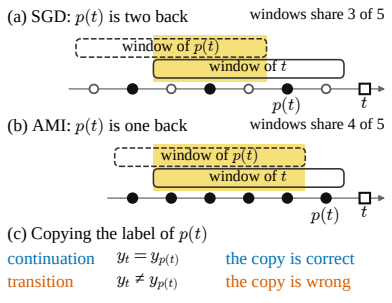
Figure 2 : (a, b) Labelled predecessor p(t) of target t (square) and the five-utterance windows of t and p(t); shaded: utterances in both; filled: labelled turns, open: unlabelled user turns. STAR: two back for most targets. (c) Copying the label ofp(t). Schematic; no corpus text.
원문 · CC BY 4.0 · Ali Amini, Masoumeh Chapariniya, Rytis Maskeliunas, Robertas Damaševičius · The Neighbour's Label: Opposite Subgroup Effects of Same-Dialogue Exposure in Next-Act Evaluation · 원문 그림 인용 · 원본 PDF 2쪽에서 그림 영역을 추출했습니다.무작위화된 존재 설계와 lag-1 계수
무작위화된 존재 설계는 각 평가 폴드에서 대상을 무작위 그룹으로 나누고, 그룹 학습 세트와 같은 크기의 노출 학습 세트를 만듭니다. 노출 세트는 라벨이 맞는 학습 행을 다른 그룹의 창으로 바꿔 넣으므로 크기와 라벨 분포는 거의 같고, 대상의 lag-1 행이 들어 있는지만 대상 안에서 무작위로 달라집니다. 식 (2)는 노출 점수와 그룹 점수의 차이 D를 대상 고정 효과와 lag-1 존재 지표 L, 다음 대상 지표 L′, 같은 대화의 나머지 행 수 N으로 회귀합니다. 셀마다 맞춘 β_c가 lag-1 효과입니다. 기본 학습자는 TF-IDF 1–2그램 로지스틱 회귀이며, RoBERTa-base 미세조정 인코더는 두 번째 학습자로 함께 씁니다.
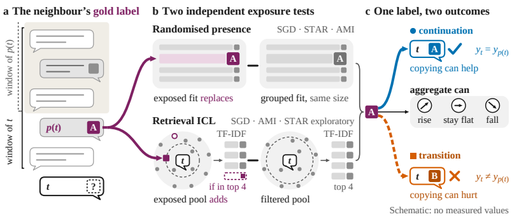
Figure 1 : Graphical overview (schematic, not measured values). (a) The labelled predecessor p(t) can expose its gold label; earlier unlabelled dialogue text is not itself gold-label leakage. (b) Independent tests: randomly controlled, equal-size training-set replacement (SGD, STAR, AMI), and TF-IDF top-four retrieval from exposed versus filtered demonstration pools (SGD, AMI; exploratory STAR). (c) Copying yp(t) can help continuations, hurt transitions, and mask subgroup effects in the aggregate. All exposure is induced on officially clean splits; the dense retriever was used for prevalence only.
원문 · CC BY 4.0 · Ali Amini, Masoumeh Chapariniya, Rytis Maskeliunas, Robertas Damaševičius · The Neighbour's Label: Opposite Subgroup Effects of Same-Dialogue Exposure in Next-Act Evaluation · 원문 그림 인용 · 원본 PDF 2쪽에서 그림 영역을 추출했습니다.무작위화 설계에서 나타난 셀 비대칭
TF-IDF 분류기에서 lag-1 계수는 세 말뭉치 모두에서 연속 대상에 양수, 전이 대상에 음수로 나타났습니다. SGD에서는 LRAP 기준 연속 +0.0285, 전이 −0.0129였고, AMI에서는 nats 기준 연속 +0.2209, 전이 −0.0722였습니다. 같은 대화의 인접한 두 행을 제거하면 연속 이득의 84–93%가 사라졌지만, 라벨이 맞는 다른 행을 같은 수만큼 제거한 경우에는 −2%에서 +1%의 변화만 있었습니다. 플라시보 행은 연속 대상에서 탐지되는 효과가 없었고, 미세조정 인코더는 세 말뭉치 모두에서 효과가 탐지되지 않았습니다. 이는 효과가 없다는 증거가 아니라 결론을 유보한 것입니다.
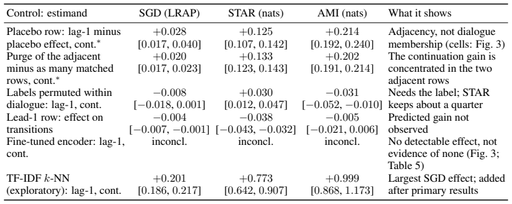
Table 1 : Controls of the randomised presence design (TF-IDF classifier unless stated), 95% cluster-bootstrap intervals; cont.: continuation targets; ∗prespecified decision criterion. All estimands: Tables 4–5.
원문 · CC BY 4.0 · Ali Amini, Masoumeh Chapariniya, Rytis Maskeliunas, Robertas Damaševičius · The Neighbour's Label: Opposite Subgroup Effects of Same-Dialogue Exposure in Next-Act Evaluation · 원문 그림 인용 · 원본 PDF 5쪽에서 그림 영역을 추출했습니다.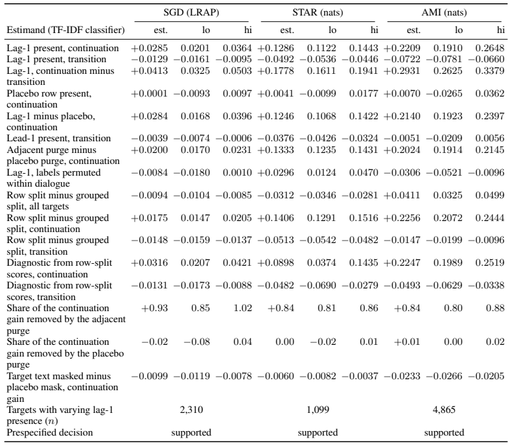
Table 4 : Complete estimands of the randomised presence design for the TF-IDF classifier. The row-split contrasts compare a naive 5-fold row-level split with the grouped split on the same targets; the diagnostic contrasts test targets whose lag-1 row fell into the training fold with those whose lag-1 row did not, using only row-split scores.
원문 · CC BY 4.0 · Ali Amini, Masoumeh Chapariniya, Rytis Maskeliunas, Robertas Damaševičius · The Neighbour's Label: Opposite Subgroup Effects of Same-Dialogue Exposure in Next-Act Evaluation · 원문 그림 인용 · 원본 PDF 14쪽에서 그림 영역을 추출했습니다.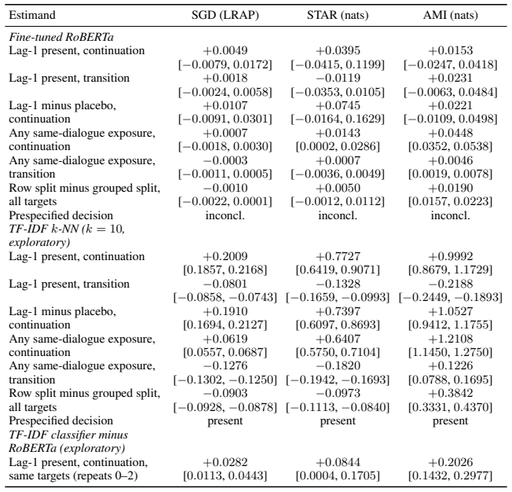
Table 5 : Learner dependence. The encoder shows no detectable adjacency effect (inconclusive, not falsified; the SGD encoder is near ceiling); the k-NN learner has the largest effect on the bounded LRAP of SGD, but its log scores are unbounded below, so magnitudes are not comparable across learners on STAR and AMI. Last row: paired difference between the TF-IDF classifier and the encoder on the same targets (exploratory).
원문 · CC BY 4.0 · Ali Amini, Masoumeh Chapariniya, Rytis Maskeliunas, Robertas Damaševičius · The Neighbour's Label: Opposite Subgroup Effects of Same-Dialogue Exposure in Next-Act Evaluation · 원문 그림 인용 · 원본 PDF 15쪽에서 그림 영역을 추출했습니다.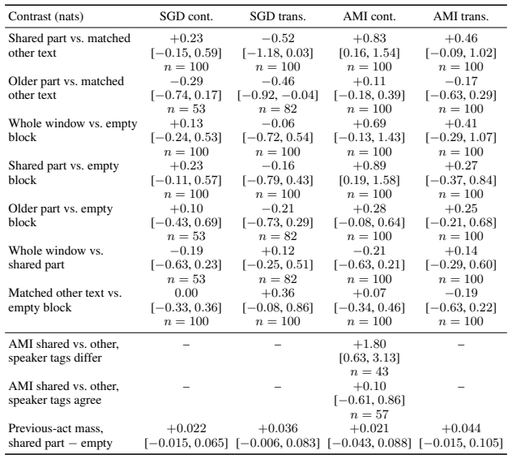
Table 11 : Follow-up decomposition of the unlabelled lag-1 window into the part already inside the query window and the older part (one model; new queries not used in the control above). Placebos are token-matched excerpts from other dialogues; all length checks passed. The speaker-tag strata are descriptive and not randomised.
원문 · CC BY 4.0 · Ali Amini, Masoumeh Chapariniya, Rytis Maskeliunas, Robertas Damaševičius · The Neighbour's Label: Opposite Subgroup Effects of Same-Dialogue Exposure in Next-Act Evaluation · 원문 그림 인용 · 원본 PDF 18쪽에서 그림 영역을 추출했습니다.검색 시연과 노출 필터링의 비용
TF-IDF로 상위 네 개 시연을 고르는 실험에서 Qwen과 Mistral은 여덟 개 모델-말뭉치-샘플 조건 모두에서 같은 방향을 보였습니다. 연속 점수는 노출 풀에서 올라갔고 전이 점수는 내려갔습니다. 다만 한 재현에서는 일부만 확인되었고, 단일 셀 구간 가운데 네 개는 0을 포함했습니다. 이 값은 셀 효과가 상쇄되거나 뒤집혀 보일 수 있다는 점을 보여 주며, 집계 비교만으로는 누출 검사가 되지 않습니다. 필터링은 SGD에서 정확도를 탐지 가능하게 낮추지는 않았지만, AMI에서는 Mistral이 제로샷보다 낮았습니다.
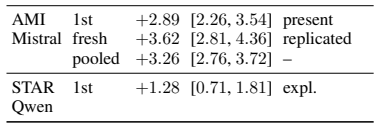
Table 2 : Interaction, continuation minus transition ef- fect, and the decision fixed before scoring:present (gain and interaction),replicated(every Qwen first- sample finding),partial(a component missed); expl.: exploratory arm. AMI samples share all 36 series; all cells in Table 6.
원문 · CC BY 4.0 · Ali Amini, Masoumeh Chapariniya, Rytis Maskeliunas, Robertas Damaševičius · The Neighbour's Label: Opposite Subgroup Effects of Same-Dialogue Exposure in Next-Act Evaluation · 원문 그림 인용 · 원본 PDF 7쪽에서 그림 영역을 추출했습니다.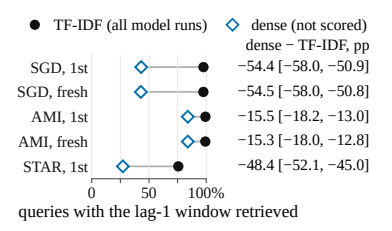
Figure 6 : Previous-act copying on transition queries, where predicting the previous act is always incorrect. The left panel shows copy rates under zero-shot, filtered, and exposed retrieval; the right panel shows the paired exposed-minus-filtered difference with its 95% cluster- bootstrap interval. Each sample contains 450 transition queries. Numerical results are reported in Table 13.
원문 · CC BY 4.0 · Ali Amini, Masoumeh Chapariniya, Rytis Maskeliunas, Robertas Damaševičius · The Neighbour's Label: Opposite Subgroup Effects of Same-Dialogue Exposure in Next-Act Evaluation · 원문 그림 인용 · 원본 PDF 7쪽에서 그림 영역을 추출했습니다.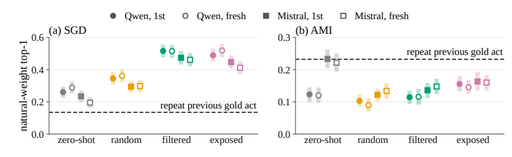
Figure 8 : Cost of the filter: natural-weight top-1 accuracy by demonstration condition (categories, not a sequence) for each model and sample, with 95% cluster-bootstrap intervals (bands); dashed: repeating the previous gold act, a baseline in Setting B, inadmissible in Setting A. Values: Table 12.
원문 · CC BY 4.0 · Ali Amini, Masoumeh Chapariniya, Rytis Maskeliunas, Robertas Damaševičius · The Neighbour's Label: Opposite Subgroup Effects of Same-Dialogue Exposure in Next-Act Evaluation · 원문 그림 인용 · 원본 PDF 19쪽에서 그림 영역을 추출했습니다.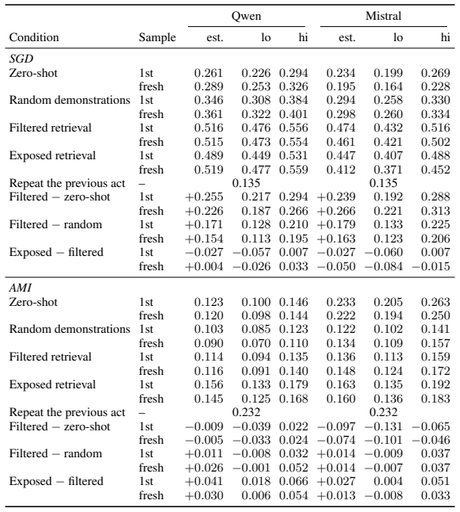
Table 12 : Utility of the provenance filter: top-1 accuracy at natural cell weights (levels, then paired differences) with 95% cluster-bootstrap bounds. Repeating the previous act scores 1 on continuations and 0 on transitions, so its natural-weight accuracy equals the continuation share. It is an admissible model only when the previous act is genuinely observed.
원문 · CC BY 4.0 · Ali Amini, Masoumeh Chapariniya, Rytis Maskeliunas, Robertas Damaševičius · The Neighbour's Label: Opposite Subgroup Effects of Same-Dialogue Exposure in Next-Act Evaluation · 원문 그림 인용 · 원본 PDF 19쪽에서 그림 영역을 추출했습니다.검색 파이프라인별 노출 빈도
STAR에서는 75.6%였습니다. 같은 질의와 풀에서 pre-training 밀집 인코더로 검색하면 AMI에서는 83.9%, SGD에서는 43.2%, STAR에서는 27.2%만 검색되었습니다. 두 파이프라인은 표현과 모델이 모두 다르므로 밀집 검색과 어휘 검색을 일반적으로 비교한 결과로 볼 수 없습니다. 이 비교에서는 밀집 파이프라인으로 얻은 시연에 언어 모델을 실행하지 않았습니다.
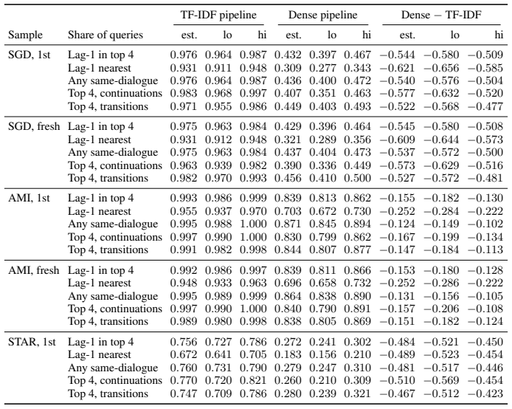
Table 14 : Retrieval structure under two pipelines (750 queries per sample; SGD and STAR clusters are dialogues or near-duplicate groups, AMI clusters are meeting series), with 95% cluster-bootstrap bounds. For SGD and AMI, the dense-only lag-1 retrieval count was zero in both the first and fresh samples (0 of 750 queries per corpus and sample). No language model was run on dense-retrieved demonstrations.
원문 · CC BY 4.0 · Ali Amini, Masoumeh Chapariniya, Rytis Maskeliunas, Robertas Damaševičius · The Neighbour's Label: Opposite Subgroup Effects of Same-Dialogue Exposure in Next-Act Evaluation · 원문 그림 인용 · 원본 PDF 20쪽에서 그림 영역을 추출했습니다.남은 문제와 적용 범위
모든 노출은 공식 분할이 깨끗한 말뭉치에 인위적으로 만든 것이며, 공개된 특정 시스템의 결과를 다시 측정하지 않았습니다. 언어 모델 결과는 두 개의 7B 명령어 튜닝 모델, 한 가지 프롬프트 형식, 네 개의 시연, TF-IDF 검색에 한정되며, 밀집 검색으로 얻은 동일 대화 시연에 같은 반응이 나타나는지는 확인하지 않았습니다. AMI의 36개 회의 시리즈가 모든 표본에 공유되므로 새 참가자에게 일반화된다고 볼 수 없습니다. pre-training 오염은 배제할 수 없으며, 절대 정확도는 능력 추정치로 해석하지 않습니다.
논문 정보
- 저자
- Ali Amini, Masoumeh Chapariniya, Rytis Maskeliunas, Robertas Damaševičius
- 학회·저널
- arXiv · 프리프린트
- 최초 공개일
- 2026년 11월 11일
- 등록일
- 2026년 11월 13일
- 수정일
- 2026년 11월 11일
- 버전
- v1
- arXiv
- 2611.15194
- 분류
- cs.CV · cs.CL
- 원문 이용 조건
- CC BY 4.0
- 제공 범위
- 논문 정보, 해설, 허용된 원문 그림
AI 해설은 논문 원문과 별개의 설명이며 오류가 있을 수 있습니다. 원문과 그림은 각 출처의 이용 조건과 따로 표시된 권리를 따릅니다.
초록
Window-based next-act evaluation often aims to measure generalisation across dialogues, yet overlapping windows and similarity retrieval can expose labelled examples from the test dialogue. The nearest such example is the target's labelled predecessor, whose act is correct when the target continues it and wrong when the target changes act; a model that copies it can gain and lose in two subgroups that one aggregate averages. We induce this exposure under controlled designs on SGD, STAR and AMI, whose official splits are clean. Randomly including the predecessor's row in training raises a lexical classifier's continuation scores and lowers its transition scores in all three corpora, and purging the adjacent rows removes most of the gain. With TF-IDF-retrieved demonstrations, two 7B instruction-tuned models show the same opposite pattern in all eight model-corpus-sample arms (some single-cell intervals include zero; one replication is partial), while natural-weight accuracy changes by only -0.05 to +0.04. Exposure frequency depends on the retrieval pipeline. We evaluate two diagnostic comparisons without model retraining and find that excluding the test dialogue does not detectably reduce accuracy on SGD. All exposure is induced; no published system was re-evaluated.
원문 인용
Ali Amini, Masoumeh Chapariniya, Rytis Maskeliunas, Robertas Damaševičius (2026). The Neighbour's Label: Opposite Subgroup Effects of Same-Dialogue Exposure in Next-Act Evaluation. arXiv:2611.15194v1. https://arxiv.org/abs/2611.15194v1
BibTeX
@misc{amini2026neighbour,
  title = {{The Neighbour's Label: Opposite Subgroup Effects of Same-Dialogue Exposure in Next-Act Evaluation}},
  author = {Ali Amini and Masoumeh Chapariniya and Rytis Maskeliunas and Robertas Damaševičius},
  year = {2026},
  eprint = {2611.15194},
  archivePrefix = {arXiv},
  url = {https://arxiv.org/abs/2611.15194v1}
}