Paper commentary
Federated Dataset Simulation: Inducing Label-Free Heterogeneity Across Tasks
- Problem Dirichlet label skew is the usual way to turn a centralized dataset into federated clients, but it reduces heterogeneity to one axis and cannot be applied to segmentation or detection.
- Method Splits a centralized dataset in two stages: a representation function maps each sample into a latent space, and an assignment mechanism allocates samples to clients. The two label-free instantiations are k-means on pretrained embeddings and a VLM-LLM criterion pipeline with product-of-Dirichlets assignment.
- Results FedAvg top-1 accuracy fell to 64.84 under geometric partitioning, against 74.63 under random splitting.
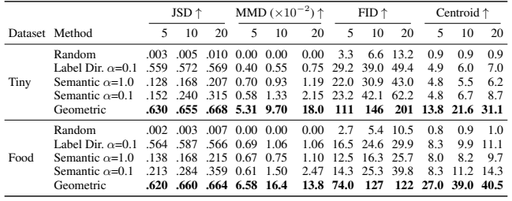
Table 1 : Heterogeneity metrics on classification datasets across client counts K ∈ {5, 10, 20}. JSD measures label-distribution divergence; MMD, FID, and centroid distance measure feature- distribution divergence (computed in InceptionV3 activation space). Higher values indicate greater heterogeneity. Geometric partitioning uses no labels yet induces the highest heterogeneity across all metrics, including JSD.
Original paper · CC BY 4.0 · Vasilis Siomos, Lam Ngo, Jonathan Passerat-Palmbach, Giacomo Tarroni · Federated Dataset Simulation: Inducing Label-Free Heterogeneity Across Tasks · Original paper figure · Extracted the figure area from page 5 of the original PDF.Why label skew is a narrow test
Most federated learning studies evaluate on small centralized classification datasets that are split into virtual clients by Dirichlet label skew. Real federated datasets are few, and the heterogeneity they carry is often tied to one dataset and does not transfer easily to other tasks. Dirichlet partitioning reduces the several kinds of shift seen in real federations to a single axis, the class proportions each client holds.
The same mechanism works on sample-level class labels, so it cannot split tasks where a sample carries several labels, spatial labels, or no single class, such as segmentation and detection. For those tasks, practitioners have been limited to random partitions or ad-hoc splits. Conclusions drawn under such splits about performance, convergence, fairness and robustness may therefore not carry over to deployed systems.
Separating representation from assignment
Because Φ reads raw inputs rather than annotations, the framework needs no labels, and label-based Dirichlet partitioning appears as a special case of it.
The representation function maps inputs X × Y into a latent space Z, and the assignment mechanism uses the representations to split the samples into clients. Client parameters ω can be computed from the data, drawn from a prior, or both, and each sample goes to the client whose parameters match its representation best. Label-skew Dirichlet partitioning is recovered when Φ(x) = y and each client's class proportions are drawn from a Dirichlet, with α moving the split from IID as α grows large to nearly class-disjoint as α shrinks toward zero.
Heterogeneity is measured as the average divergence over all pairs of clients, computed on their distributions in the representation space. For labels, the Jensen–Shannon divergence is used because it is symmetric and bounded.
Geometric partitioning in embedding space
Partitioning uses k-means with K equal to the number of target clients, computed from all representations, and each sample is sent to its nearest centroid.
The reasoning is that pretrained encoders group semantically related inputs, so cutting the embedding space along cluster boundaries creates covariate shift tied to visual and semantic content, and no labels are needed. Fewer clients give broader clusters, and more clients give finer clusters with larger divergence between them, so K works as an implicit heterogeneity knob.
Among DINOv2, CLIP and MAE variants, the default was chosen by average MMD rank across datasets. The default uses DINOv2-B, with the CLS tokens of the final four layers concatenated and reduced with UMAP before clustering. The authors describe this default as a strong and computationally tractable choice across classification, segmentation and detection.
Semantic partitioning through VLM criteria
The semantic representation maps each image to a tuple of categorical labels, one per human-interpretable criterion, such as cuisine origin or texture for food photographs. Criteria are picked by inspecting each dataset for meaningful axes, then checked by querying the VLM on a subset to confirm the label distributions are not degenerate.
For each criterion, the VLM writes a short description focused on that criterion, and an LLM reduces the description to a single-word raw label. The LLM then clusters the raw labels into a fixed number of canonical categories and assigns each description to one of them. The pipeline uses Intern-VL3.5 as the VLM and Llama 3.3 70B as the LLM, with extracted labels cached for reuse, and the precomputed criterion labels for the four datasets are released.
Each client draws a preference vector for every criterion from a Dirichlet whose concentration is α times a vector of ones over that criterion's categories. A sample's probability of going to client m is proportional to the product over criteria of the preference that m places on the sample's label, written as \(\pi_m \propto \prod_{c} p_{m,c}[\ell_c(x_i)]\).
Because the product is high only when a sample matches a client's preferences on every criterion at once, α acts as the heterogeneity control, as it does in label skew.
Heterogeneity compared with label skew
Label skew changes which classes each client holds far more than it changes features, whereas the geometric split changes both, and geometric partitioning gives the highest value on every metric in this classification table, JSD included.
At K = 10 and K = 20 on Tiny ImageNet, α = 0.1 is above α = 1.0 for JSD, MMD, FID and centroid distance, so a smaller α raises heterogeneity.
Label Dirichlet partitioning does not apply to ADE20K or PASCAL VOC, so random splitting is the only baseline for those tasks. On ADE20K at K = 10, geometric partitioning reached MMD 16.5 (×10^-2) and FID 191, against 0.00 and 21.8 for random splits.
Effect on FedAvg accuracy and mIoU
FedAvg is run with 1 local epoch for 100 communication rounds for each partition. On Tiny ImageNet at K = 10, geometric partitioning reached 64.84 top-1 with a drop of 9.79, against 74.63 under random splits, the largest drop in that block. Food101 at K = 10 follows a similar pattern, with geometric partitioning at 63.15 (11.28) against 74.43 for random, although label Dirichlet at α = 0.1 reached 66.45 (7.98).
Every non-random partition lowered the reported metric relative to random splitting in every dataset and client count, which the authors take as evidence that the client differences are more than artifacts of the heterogeneity metrics. Geometric partitioning gave the largest drop on Tiny ImageNet and ADE20K at each client count, and on PASCAL VOC at K = 5 and K = 10, and on Food101 at K = 5 and K = 10.
On classification, label skew at α = 0.1 remains a strong baseline, while the two FDS instantiations still degrade dense tasks, where label skew does not apply.
ResNet-18 is used for classification, DeepLabv3 with ResNet-50 for segmentation, and Faster R-CNN with ResNet-50-FPN for detection, all initialized from pretrained weights. Hyperparameters were tuned with Optuna on a held-out subset and then fixed across partitioning methods. The metrics are top-1 accuracy for Tiny ImageNet and Food101, mIoU for ADE20K and mAP@50 for PASCAL VOC.
Rankings of aggregation methods
Seven aggregation methods, FedAvg, FedDyn, FedNova, FedProx, FedSAM, SCAFFOLD and FedLC, are compared on Tiny ImageNet with 10 clients under label skew, semantic and geometric partitioning, from random or ImageNet initialization. From random initialization, FedSAM ranks first under geometric partitioning with 25.97 ±0.10, while FedNova ranks last with 20.03 ±7.69.
The geometric ranking correlates with the label-skew ranking at -0.571 from random initialization and 0.179 from pretrained weights.
From pretrained weights, the seven methods lie within 2.57 points under label skew but span 19.34 points under geometric partitioning, or 9.25 points without FedNova.
Comparison with natural federations
The geometric partition is compared with three naturally federated datasets at the same number of clients. Fed-ISIC2019 has 6 clients, FEMNIST has 3,550 users, and Office-Caltech10 has one client for each of its four domains. Heterogeneity is measured by JSD, MMD and k-NN consistency, the average fraction of a sample's nearest feature-space neighbours that come from the same client.
On FEMNIST, the geometric split reaches feature MMD 0.465 and k-NN consistency 0.654, against 0.043 and 0.127 for the natural split. Office-Caltech10 shows the same direction, with MMD 0.334 and k-NN consistency 0.982 for the geometric split, against 0.016 and 0.446 for the natural split. On Fed-ISIC2019 the natural split has the larger label JSD, 0.115 against 0.028, while the geometric split has the larger feature MMD, 0.192 against 0.027.
Which criteria and projections drive heterogeneity
In the pure-criterion ablation, each criterion alone defines one client per value, with all samples sharing a value kept together and no Dirichlet assignment. Across the four datasets, content criteria such as main object, scene and cuisine produce larger feature divergence than appearance criteria such as lighting, color and size.
The same ordering appears in FL: on Tiny ImageNet, main_object gives the lowest FedAvg accuracy at 67.58%, while time gives 72.06%. The main_object result is close to the geometric split at K = 5, which reached 67.41%. Across the five criteria, MMD and accuracy degradation are reported as perfectly correlated, which is tied to the mutual information between each criterion and the task.
Geometric partitions have no criteria, so they are compared with the criterion partitions: at K = 10 the mean AMI is 0.377 for main object, scene and cuisine, and 0.060 for lighting, color, camera and size. Removing the top p principal components before clustering changes which property the partition follows: for DINOv2 the NMI with texture rises from 0.035 at p = 0 to 0.428 at p = 10, while the NMI with shape falls from 0.928 to 0.186.
For MAE, the NMI with color rises from 0.073 to 0.496 at p = 5, which is far beyond the variation across k-means seeds. The encoder's pretraining sets what a representation can express, and the projection sets what it does express.
Reading the two instantiations together
Feature-space and label-space divergence are not interchangeable, since label skew can create clients that differ in classes but not in appearance.
Dense prediction gains the most from the framework, since random splitting was the only baseline there. Against random splits, geometric partitioning cut ADE20K mIoU by up to 7.88 points and PASCAL VOC mAP@50 by up to 9.91 points.
Semantic partitioning trades peak difficulty for controllable α and criteria that can be read and selected, and Appendix H gives practical guidance on choosing between them.
Limitations
The evaluation is restricted to computer vision tasks, and text, tabular and multi-modal data are left to future work. Larger feature divergence or larger FedAvg drops alone do not guarantee that a benchmark is more realistic or useful.
The pipeline is computationally expensive, which is why precomputed criterion labels are included in the release.
Paper info
- Authors
- Vasilis Siomos, Lam Ngo, Jonathan Passerat-Palmbach, Giacomo Tarroni
- Venue
- arXiv · Preprint
- First published
- 2026-11-15
- Added
- 2026-11-17
- Updated
- 2026-11-15
- Version
- v1
- arXiv
- 2611.19975
- Category
- cs.LG · cs.AI
- Original paper terms
- CC BY 4.0
- What we show
- Paper info, commentary and permitted figures from the original paper
AI commentary is a separate explanation from the original paper and may contain errors. The original paper and figures follow each source's terms of use and any rights noted separately.
Abstract
Federated Learning enables collaborative model training across decentralized clients without sharing raw data. While the field has seen rapid growth, the datasets underpinning FL evaluation have not kept pace: real federated datasets remain scarce, and most studies rely on small-scale centralized classification datasets partitioned via Dirichlet label skew, a one-dimensional proxy for the multi-dimensional heterogeneity present in real federations. Moreover, label-based partitioning is by construction inapplicable to non-classification tasks such as segmentation and detection, for which no principled simulation method exists. We cast the conversion of centralized datasets into federated benchmarks as the task of Federated Dataset Simulation (FDS), and decompose it into a representation function $Φ$ and an assignment mechanism $π$. We provide two label-free instantiations -- geometric partitioning via pretrained model embeddings and semantic partitioning via vision-language model-derived criteria -- applicable to classification and dense prediction tasks alike. We evaluate across four datasets spanning classification, segmentation, and detection, and show that both methods induce heterogeneity that matches or exceeds that of label-skew partitioning, with measurable impact on downstream FL performance. We release fds, a modular open-source package for end-to-end federated dataset simulation, heterogeneity measurement, and FL training, at https://github.com/siomvas/fds.
Quote from the paper
Vasilis Siomos, Lam Ngo, Jonathan Passerat-Palmbach, Giacomo Tarroni (2026). Federated Dataset Simulation: Inducing Label-Free Heterogeneity Across Tasks. arXiv:2611.19975v1. https://arxiv.org/abs/2611.19975v1
BibTeX
@misc{siomos2026federated,
  title = {{Federated Dataset Simulation: Inducing Label-Free Heterogeneity Across Tasks}},
  author = {Vasilis Siomos and Lam Ngo and Jonathan Passerat-Palmbach and Giacomo Tarroni},
  year = {2026},
  eprint = {2611.19975},
  archivePrefix = {arXiv},
  url = {https://arxiv.org/abs/2611.19975v1}
}