Paper commentary
Reasoning in the loop: antibody lead optimization by probing mechanism and measurement
- Problem Lab-in-the-loop antibody optimization can only be as good as the metrics that define its target. A metric computed from an instrument signal can measure something other than its name suggests, and then more data or a better model does not fix the problem.
- Method The study reads the raw binding and thermal curves, fits a physical model of unfolding and aggregation to them, and picks a metric suited to each scaffold. It then varies protein load and heating rate to test the model against predictions written in advance.
- Results The VHH lead reached a 1.15 nM dissociation constant against 10.3 nM for its parent, and an identified melt of 70.6 °C against 62.2 °C, on the DR3 run.
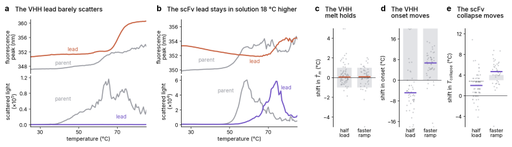
Figure 5 : Parents and leads, and the test of the model. (a) VHH and (b) scFv fluorescence (top) and 266 nm scattered light (bottom) against temperature, averaged over each molecule’s wells in one round. The scFv parent is from round 1 and its lead from round 2. (c–e) Paired shifts per design at half the protein concentration (half load) and at the faster ramp, for the VHH identified melt, the VHH scattering onset and the scFv collapse temperature. An equilibrium quantity should hold and a kinetic one should move. Bars are medians, gray bands are predicted ranges (in d, the predicted direction), the dotted line is a predicted value, and points beyond the axes are drawn at the edge ( 𝑛 = 74 and 55, 49 and 49, 74 and 42).
Original paper · CC BY 4.0 · Samuel Stanton, Aaron Solomon, Emily Delaney, Melanie Montgomery, Crystal Humphries, Timothy Acker, Ryan Henrici, Charbel Eid, Eddie Abrams, Peyton Greenside · Reasoning in the loop: antibody lead optimization by probing mechanism and measurement · Original paper figure · Extracted the figure area from page 8 of the original PDF.Why a metric can mislead an optimizer
Most program goals cannot be measured during lead optimization, so the specification is written on in vitro readouts that act as proxies, such as a few-hour thermal readout standing in for long-term storage behavior. The specification is usually fixed before the first round, which makes the whole campaign depend on how closely each proxy tracks the true goal.
A metric is not read directly off the instrument; it is the output of an analysis of a recorded signal, and that analysis rests on assumptions about the signal. If the analysis reports a different quantity from the one the optimizer needs, a stronger predictor or more replicates cannot correct the label. Finding such a failure means returning to the raw traces and checking what the analysis assumed, a task the study places with an assay specialist rather than with a model.
A research team and Claude, a general-purpose AI agent, ran seven rounds covering about 1,010 design variants, and the agent took part in both the library design and the reading of the measurements. The two campaigns used 1,232 wells in total.
How the binding and thermal assays turn curves into metrics
Biolayer interferometry follows an antibody as it associates with its antigen and then dissociates from a sensor, and a kinetic model fitted to the whole curve gives the on-rate, the off-rate and the dissociation constant. The study reports the off-rate as the negative base-10 logarithm, so a higher value means slower dissociation and tighter binding.
The thermal assay, nanoDSF, heats a capillary of protein at a steady rate under UV light and records two signals: intrinsic tryptophan fluorescence, whose emission shifts as the protein unfolds, and light scattered by particles that form as molecules clump together.
The physical model treats each molecule as folded, unfolded or aggregated, with reversible unfolding settling to equilibrium at each temperature, so the folded fraction is given by \\[ \\phi_N(T)=\\left[1+\\exp\\left(\\frac{\\Delta H}{R}\\left(\\frac{1}{T_m}-\\frac{1}{T}\\right)\\right)\\right]^{-1} \\] Here \\(\\Delta H\\) is the enthalpy of unfolding, \\(R\\) is the gas constant, and \\(T_m\\) is the thermodynamic melting temperature, where half the molecules are folded.
Aggregation is irreversible, so the amount aggregated depends on the history of the sample and can start from folded or unfolded protein, not on the current temperature alone. In the model the loss of non-aggregated protein depends on protein concentration, a temperature-dependent rate constant and the heating rate, so faster heating or less protein moves the onset of aggregation to higher temperature.
An optimizer sees only a label, written \\( y_i = f(x_i;\\omega)+\\epsilon_i \\), where \\(\\omega\\) collects the protocol, such as the instrument, the sample concentration and the heating rate. The apparent melting temperature estimates the thermodynamic one only when unfolding is two-state, reversible and at equilibrium, and otherwise it can shift with concentration or heating rate.
Prior work and the gap it leaves
Developability is usually approximated with panels of rapid biophysical assays, and a surrogate is useful only when its effects predict effects on the endpoint. Selecting hard on a proxy can break the relationship that justified it.
Recent agent campaigns have used a general-purpose agent mainly to orchestrate pre-existing design tools under a written protocol, with biologists writing the protocol and configuring the experiments. The study differs by asking whether the measured values reflect the intended property, and by letting the agent change what is measured during the campaign.
Platform, campaigns and the decision record
All experimental and computational work sat in one system of record, Reccy, and an MCP connector let the agent reach it along with the raw instrument traces stored beside the summary metrics and quality-control flags.
The VHH ran four design rounds and the scFv three, between 29 June and 4 September 2026, with 176 wells per round and results usually back in 9 to 10 days. The agent was Claude in Claude Code, directed by one researcher.
An append-only journal recorded each design, analysis, finding and decision along with an author field, and it holds 387 records through the lead decisions.
Designing libraries from lineage, scans and factorials
Each part of a library tested a stated hypothesis: the agent proposed hypotheses and mutations, while the research team set the design strategy and chose what went on each plate.
The starting point was lineage: the VHH matched Alb8 at all 115 positions, and the scFv differed from Medarex clone 7B1 at eight positions, so relatives already carrying useful changes supplied a ready-made library. On the scFv, all five reversions of the three CDR-H3 differences bound, three of them beyond the assay's dissociation floor, and the G230Y reversion gave the largest affinity gain.
On the VHH, a related complex with albumin bounded the search by showing which changes could be made without touching the binding mode.
Substitutions were treated as chemical questions: each of eight CDR-H3 tyrosines was replaced by phenylalanine, which keeps the ring and removes the hydroxyl, or by serine, which keeps the hydroxyl and removes the ring. All eight phenylalanine variants bound, against one of eight serine variants, which points to the aromatic ring as the part binding relies on.
Alanine scans of the CDRs and the Vernier-zone framework positions mapped what each position contributed.
On the scFv, the packing repairs Q91A and S245A were each worth 6–7 °C on the collapse temperature, and the authors conjecture that they help the variable domains stay together. E1A together with S30R left the melt near the parent's and cut the scattering rise about sixfold, and surface cationic mutations lowered aggregation with little gain in melt.
Mutations acting through separate mechanisms can be combined as modules, so a gain in one can offset a cost in another. In round 1 of the scFv, designs carrying the germline reversions bound in 0 of 7 cases without G230Y and Y238A, and in 14 of 15 cases with them.
Combinatorial libraries place each design at a point on a Boolean lattice, and Bayesian linear regression in the Walsh basis gives each mutation or combination its own coefficient and uncertainty. The final-round scFv factorial gave A182D, V196F and T187Y increases of 8.1, 4.2 and 2.0 °C in collapse temperature.
Reading whole thermal curves with a two-process model
The first sign of a problem came from prediction: after the first VHH round, models trained on round 0 predicted the round-1 off-rate with a Spearman correlation of 0.59. Models of the reported apparent melting temperature and aggregation onset, built from sequence, structural and protein-language-model features, did not exceed 0.07 for any of seven models.
Simple summaries of the same VHH curves could be predicted across rounds with a Spearman correlation of 0.38, so the curves carried signal that the reported metrics missed. BigHat's quality controls had flagged 491 of 916 VHH wells as aggregating before an apparent melting temperature call.
Fluorescence is modeled as an average over folded and unfolded populations, each with its own linear baseline, so the observed signal is weighted by the folded fraction: \\[ F(T)=(a_N+s_N T)\\,\\phi_N(T)+(a_U+s_U T)\\,[1-\\phi_N(T)] \\] Fitting this to the curve adjusts the baselines, \\(T_m\\) and \\(\\Delta H\\); the fitted \\(T_m\\), called the identified melt \\(\\hat{T}_m\\), sets where the curve crosses between the two baselines, and \\(\\Delta H\\) sets how sharply.
Scattering is modeled as particles accumulating in the two states, so its slope above the instrument baseline is \\[ \\frac{dS}{dT}=\\kappa_N\\,\\phi_N(T)^2+\\kappa_U\\,[1-\\phi_N(T)]^2 \\] Below the melt \\(\\phi_N\\) is close to one, so the slope is \\(\\kappa_N\\), the growth rate from folded protein, and above the melt it is close to zero, so the slope is \\(\\kappa_U\\), the growth rate from unfolded protein.
Where the sample precipitates before unfolding finishes, the scattering peak \\(T_{peak}\\) is corrected to a reference concentration \\(c_{ref}\\) to give the collapse temperature, \\(T_{collapse} = T_{peak} - \\gamma_c \\ln(c/c_{ref})\\). The approach assumes each curve separates into one equilibrium process and one kinetic process, which is what allows each metric to be tied to one physical event.
The model implies a sharp test: equilibrium quantities should not move with protein concentration or heating rate, while kinetic quantities should.
Testing the model with a protocol perturbation
In the final round each design ran at neat and at one-half load on one plate, and on the other plate at two ramp rates, with the agent asking for a faster second ramp of 1.0 °C/min. The agent's reasoning was that a fast ramp outruns aggregation, so the kinetic and equilibrium quantities should separate under the change.
On the VHH the onset sat near 40 °C regardless of the melt, with a median of 40.2 °C and a rank correlation of −0.11 with the melt across 129 wells in the final round. Wells with the same onset differed by more than tenfold in the folded-state scattering rate \\(\\kappa_N\\).
The ramp result is the weaker evidence, because 43 of 88 fast-ramp capillaries never collapsed within the window, and paired conditions ran on different days except for the scFv load pair. Not every prediction held on either scaffold.
What the VHH lead gained
The VHH lead has a dissociation constant of 1.15 nM against 10.3 nM for its parent, and its identified melt is 70.6 °C against 62.2 °C. The lead carries eight mutations from Alb8, and its off-rate is 0.90 log slower than the parent's on two wells. The specification asked for a dissociation constant of at most 1.6 nM and a melt of at least 70 °C.
The parent's aggregation onset sat in the 40–45 °C range, while the lead showed no onset up to 85 °C, so the lead's aggregation onset is recorded as a bound. Aggregation for the lead was +2.00 on one identified well against −0.39 for the parent, and no high-molecular-weight species were detected. The aggregation value rests on that single well, which the authors flag as a caveat.
The lead passes the original dissociation constant, melt and yield constraints, with yield at 51 µg/mL. The tightest VHH design reads 0.85 nM on three wells, which the study describes as 12 times tighter than the parent. Binder rates, counting controls, were 48, 58, 93 and 99% on the VHH.
What the scFv lead gained and why its melt was replaced
An equilibrium midpoint was resolved in only 37% of wells, so the reported apparent melt and aggregation onset are two summaries of one collapse event, about 10 °C apart in the final round. The study did not observe domain separation directly, although this fits the known coupling of domain separation and unfolding in the format.
The lead has a dissociation constant of 0.63 nM against 3.7 nM for the DR1 parent, and a collapse temperature of 74.2 °C against 56.3 °C. Its off-rate is 1.00 log slower on two wells, and its reported aggregation onset rose to 57.7 °C, short of the original 65 °C. Two of the lead's mutations are the packing repairs Q91A and S245A, and G230Y carried the largest affinity gain.
Against the DR0 parent the collapse temperature gained 18 °C, which the study calls substantial for a format known for instability.
Revising the specification and reading the frontier
The goal stayed the same, but the measurement changed: on the VHH a \\(p k_{agg} \\ge 1.72\\) limit replaced the aggregation onset, and the melt constraint moved to the identified melt. On the scFv a collapse temperature of at least 70 °C replaced the apparent melt and aggregation onset, with HMW limits of 5% and 3% added on both scaffolds.
None of the 113 final-round scFv designs passes against the original specification with a measured dissociation constant, and the study records that the scFv threshold did not choose the lead.
The leads are read as points on trade-off frontiers, with the scFv plotted as off-rate against collapse temperature and the VHH as off-rate against the aggregation metric. One scFv design keeps close to the parent's affinity at 3.3 nM and collapses at 81.2 °C on three wells, while another collapses at 77.0 °C with \\(p k_{off} \\ge 4.3\\) on a single well.
The lead, at 0.63 nM and 74.2 °C, sits just inside this frontier and is the more stable of two designs with a measured dissociation constant inside the constraint.
Limitations
On the scFv the 2400 s window ran in the final round, and 51 of 113 designs are reported at the 4.3 floor. Ordering among designs at that floor replicated only weakly across plates, with a Spearman value of +0.23 on the measured signal drop.
Paired conditions ran on different days except for the scFv load pair, and the ramp shifts are the weaker evidence.
What reasoning in the loop changes for agents and specialized models
In the researcher's account the agent was often hasty and leaned on models where direct reasoning was available, though once prompted it read every curve on both scaffolds. Of the 387 journal records, 27 carry the researcher in the author field.
The authors frame the choice between a general model orchestrating specialized tools and a general model reasoning about molecules directly as one of resources more than capability.
Paper info
- Authors
- Samuel Stanton, Aaron Solomon, Emily Delaney, Melanie Montgomery, Crystal Humphries, Timothy Acker, Ryan Henrici, Charbel Eid, Eddie Abrams, Peyton Greenside
- Venue
- arXiv · Preprint
- First published
- 2026-11-15
- Added
- 2026-11-17
- Updated
- 2026-11-15
- Version
- v1
- arXiv
- 2611.19812
- Category
- cs.LG · cs.AI · q-bio.BM
- Original paper terms
- CC BY 4.0
- What we show
- Paper info, commentary and permitted figures from the original paper
AI commentary is a separate explanation from the original paper and may contain errors. The original paper and figures follow each source's terms of use and any rights noted separately.
Abstract
Lab-in-the-loop systems, in which a model proposes molecules, automated assays measure their properties and the results retrain the model, are a popular approach to antibody lead optimization. These systems optimize for a specification defined with metrics computed from instrument signals, so their success depends on how well those metrics serve as proxies for the properties a drug candidate needs. When a metric is a poor proxy, neither a better model nor more data will fix it, and identifying the problem usually requires expert review. We report two campaigns run on BigHat Biosciences' Milliner platform, one on an anti-albumin nanobody (VHH) and one on an anti-mesothelin single-chain variable fragment (scFv), in which a research team and a general-purpose AI agent, Claude, brought scientific reasoning into the loop. Over seven rounds and about 1,010 design variants we built libraries from antibody lineage, structure and biophysics, and found from the raw curves that on each scaffold one thermal metric did not measure what its name implied. The libraries were built as controlled comparisons, so the results also show what each mutation contributes to each property. We fit a physical model of the curves, used it to choose metrics suited to each scaffold, and changed the experimental protocol, varying protein concentration and heating rate, to test the model against pre-registered predictions. Both leads improve on their parents in affinity, thermal stability and aggregation while improving or maintaining yield and purity.
Quote from the paper
Samuel Stanton, Aaron Solomon, Emily Delaney, Melanie Montgomery, Crystal Humphries, Timothy Acker, Ryan Henrici, Charbel Eid, Eddie Abrams, Peyton Greenside (2026). Reasoning in the loop: antibody lead optimization by probing mechanism and measurement. arXiv:2611.19812v1. https://arxiv.org/abs/2611.19812v1
BibTeX
@misc{stanton2026reasoning,
  title = {{Reasoning in the loop: antibody lead optimization by probing mechanism and measurement}},
  author = {Samuel Stanton and Aaron Solomon and Emily Delaney and Melanie Montgomery and Crystal Humphries and Timothy Acker and Ryan Henrici and Charbel Eid and Eddie Abrams and Peyton Greenside},
  year = {2026},
  eprint = {2611.19812},
  archivePrefix = {arXiv},
  url = {https://arxiv.org/abs/2611.19812v1}
}