論文解説
Reasoning in the loop: antibody lead optimization by probing mechanism and measurement
ループ内の推論:メカニズムと測定を探る抗体リード最適化
- 課題 測定指標が必要な物理的性質を表していないと、モデルやデータを増やしても最適化は改善しません。
- 手法 nanoDSFの生の熱曲線を平衡融解モデルと凝集速度モデルに分けて読み、濃度と昇温速度を変えて指標を検証しました。
- 結果 VHHリードはKD 1.15 nMと同定された融解温度70.6 °Cを、scFvリードはKD 0.63 nMと崩壊温度74.2 °Cを記録しました。
モデル最適化ループが測定指標に依存する問題
抗体のリード最適化では、モデルが分子を提案し、自動実験が結果を測定してモデルを再学習させる、lab-in-the-loopの方法が広く使われています。この方法がうまくいくかは、最適化の対象となる測定指標が、必要な性質をどれだけよく表しているかで決まります。指標が良い代理変数でなければ、より良いモデルやデータを加えても問題は解決しません。この論文は、この難しさを、抗体リード最適化における熱指標Tapp mとTaggの意味を生の曲線で確かめ直す問題として扱っています。
熱曲線を物理モデルで読み直す
nanoDSFは蛍光と静的光散乱を同時に記録し、蛍光の中心波長のシフトはタンパク質の展開を、光散乱信号の上昇は粒子形成を示します。論文では、蛍光信号を折りたたみ状態と展開状態の平均とみなし、平衡融解温度を推定しました。光散乱は、展開状態と折りたたみ状態で蓄積される速度項としてモデル化しました。凝集は不可逆的な過程なので、濃度と昇温速度によって結果が変わります。この違いを利用して、平衡指標と速度論的指標を区別しました。
親配列付近の設計とBoolean格子
ライブラリは、抗体の系統情報と構造情報から得た置換をもとに設計しました。VHHではAlb23とAlb系統の置換を、scFvでは生殖細胞系列への復帰を、最初のライブラリとして用いました。組み合わせの効果を見るため、変異の有無をBoolean格子で表し、Sobol準乱数標本で格子の一部を抽出しました。この方法では、各変異が標本のおよそ半分に現れるため、係数の推定が安定します。効果はWalsh基底上のベイズ線形回帰で推定しました。
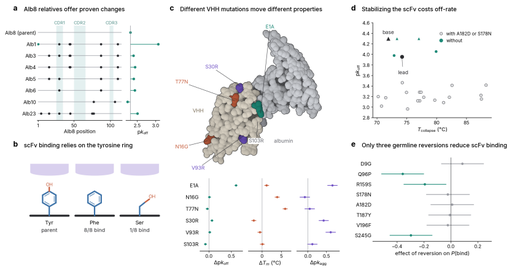
Figure 3 : Evidence for each design strategy . (a) Published relatives of Alb8. Dots mark substitutions (E1A in teal), shading marks the CDRs, and the right panel gives each molecule’s round-0 off-rate. (b) Schematic of the tyrosine scan on the scFv , with the fraction of variants that bound. (c) The six mutations of the VHH final-round factorial on the Alb8:albumin structure (PDB 8Z8V ; Mima et al. , 2024), colored by the property each moves most (teal off-rate, orange melt, purple aggregation), and the effect of adding each one, ±2𝜎 (𝑛 = 63 , 52 and 57 designs). (d) The scFv final-round factorial on the base design (the round 1 control), by collapse temperature (where the sample falls out of solution) and off-rate. Triangles have p 𝑘off ≥ 4.3 . (e) Effect of reverting each somatic mutation to germline on the probability of binding, ±2𝜎 (𝑛 = 58 ). Positions that carry binding are in teal.
出典 · CC BY 4.0 · Samuel Stanton, Aaron Solomon, Emily Delaney, Melanie Montgomery, Crystal Humphries, Timothy Acker, Ryan Henrici, Charbel Eid, Eddie Abrams, Peyton Greenside · Reasoning in the loop: antibody lead optimization by probing mechanism and measurement · 論文の図を引用 · 元のPDFの6ページ目から図の部分を抽出しています。プロトコル変更による指標の検証
論文では、最終ラウンドでタンパク質濃度と昇温速度を変え、同じ設計を2回測定しました。平衡融解温度は濃度が変わってもほとんど動かないはずで、速度論的な凝集指標は動くはずだと、事前に予測していました。VHHで同定された融解温度は約0.1 °Cしか動かず、予測と一致しました。scFvの崩壊温度は半分の濃度で2.0 °C上昇し、予測の2.8 °Cと同じ向きでした。速い昇温では4.7 °C上昇しました。一部の予測は一致しませんでした。昇温の比較は測定日と絡んでいるため、弱い証拠とみなすべきです。
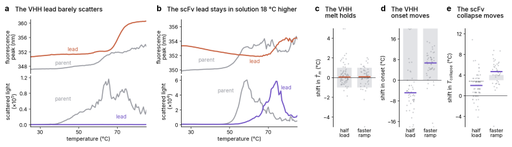
Figure 5 : Parents and leads, and the test of the model. (a) VHH and (b) scFv fluorescence (top) and 266 nm scattered light (bottom) against temperature, averaged over each molecule’s wells in one round. The scFv parent is from round 1 and its lead from round 2. (c–e) Paired shifts per design at half the protein concentration (half load) and at the faster ramp, for the VHH identified melt, the VHH scattering onset and the scFv collapse temperature. An equilibrium quantity should hold and a kinetic one should move. Bars are medians, gray bands are predicted ranges (in d, the predicted direction), the dotted line is a predicted value, and points beyond the axes are drawn at the edge ( 𝑛 = 74 and 55, 49 and 49, 74 and 42).
出典 · CC BY 4.0 · Samuel Stanton, Aaron Solomon, Emily Delaney, Melanie Montgomery, Crystal Humphries, Timothy Acker, Ryan Henrici, Charbel Eid, Eddie Abrams, Peyton Greenside · Reasoning in the loop: antibody lead optimization by probing mechanism and measurement · 論文の図を引用 · 元のPDFの8ページ目から図の部分を抽出しています。VHHリードとscFvリードの結果
VHHリードは、親に比べて結合解離速度が約0.90 log遅くなり、KDは10.3 nMから1.15 nMに下がりました。同定された融解温度は62.2 °Cから70.6 °Cに上昇しました。凝集指標の値は1つのウェルで測定されました。scFvリードは、崩壊温度が親の56.3 °Cから74.2 °Cに上がり、KDは3.7 nMから0.63 nMに下がりました。2つのリードの収量と純度は維持されました。どちらのリードの値も、この論文が自ら行った測定に基づくものであり、再現性の確認はまだ行われていません。
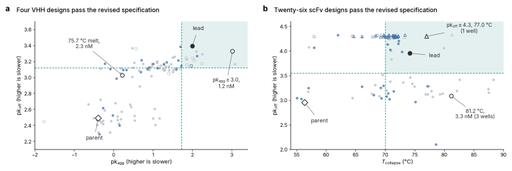
Figure 6 : Final-round designs against the revised specifications. (a) VHH: off-rate against the aggregation metric p 𝑘agg. (b) scFv: off-rate against 𝑇collapse, where the sample falls out of solution. Dashed lines are two of the constraints and shading marks designs that clear them. Open circles are aggregation rates at a fitting bound, and open triangles have p 𝑘off ≥ 4.3 . The scFv parent is from round 1. Gray points fail a constraint not plotted (melt, high-molecular-weight species, purity or yield). Of the 26 scFv designs that pass, 7 have a measured 𝐾𝐷 and 19 have p 𝑘off ≥ 4.3. Labeled designs mark the ends of each frontier (Section 7).
出典 · CC BY 4.0 · Samuel Stanton, Aaron Solomon, Emily Delaney, Melanie Montgomery, Crystal Humphries, Timothy Acker, Ryan Henrici, Charbel Eid, Eddie Abrams, Peyton Greenside · Reasoning in the loop: antibody lead optimization by probing mechanism and measurement · 論文の図を引用 · 元のPDFの9ページ目から図の部分を抽出しています。限界と残る確認事項
VHHリードの凝集値は1つのウェルに基づき、scFvリードの値は2つのウェルに基づいています。scFvの結合解離速度は測定ウィンドウの限界に近く、順位を確定するのは難しいです。著者らは、2つのリードについて確認実験と長期の速度論的測定が必要だと考えています。熱曲線モデルの2次項は経験的な形式であり、凝集の機構を直接証明したわけではありません。
論文情報
- 著者
- Samuel Stanton, Aaron Solomon, Emily Delaney, Melanie Montgomery, Crystal Humphries, Timothy Acker, Ryan Henrici, Charbel Eid, Eddie Abrams, Peyton Greenside
- 学会・ジャーナル
- arXiv · プレプリント
- 公開日
- 2026年11月15日
- 登録日
- 2026年11月17日
- 更新日
- 2026年11月15日
- バージョン
- v1
- arXiv
- 2611.19812
- カテゴリ
- cs.LG · cs.AI · q-bio.BM
- ライセンス
- CC BY 4.0
- 掲載内容
- 論文情報・解説・論文の図
この解説は、Refivuの韓国語解説をAIで翻訳したものです。不正確な翻訳や誤りが含まれる可能性があります。論文と図の利用条件は各出典に従います。
アブストラクト
Lab-in-the-loop systems, in which a model proposes molecules, automated assays measure their properties and the results retrain the model, are a popular approach to antibody lead optimization. These systems optimize for a specification defined with metrics computed from instrument signals, so their success depends on how well those metrics serve as proxies for the properties a drug candidate needs. When a metric is a poor proxy, neither a better model nor more data will fix it, and identifying the problem usually requires expert review. We report two campaigns run on BigHat Biosciences' Milliner platform, one on an anti-albumin nanobody (VHH) and one on an anti-mesothelin single-chain variable fragment (scFv), in which a research team and a general-purpose AI agent, Claude, brought scientific reasoning into the loop. Over seven rounds and about 1,010 design variants we built libraries from antibody lineage, structure and biophysics, and found from the raw curves that on each scaffold one thermal metric did not measure what its name implied. The libraries were built as controlled comparisons, so the results also show what each mutation contributes to each property. We fit a physical model of the curves, used it to choose metrics suited to each scaffold, and changed the experimental protocol, varying protein concentration and heating rate, to test the model against pre-registered predictions. Both leads improve on their parents in affinity, thermal stability and aggregation while improving or maintaining yield and purity.
この論文を引用
Samuel Stanton, Aaron Solomon, Emily Delaney, Melanie Montgomery, Crystal Humphries, Timothy Acker, Ryan Henrici, Charbel Eid, Eddie Abrams, Peyton Greenside (2026). Reasoning in the loop: antibody lead optimization by probing mechanism and measurement. arXiv:2611.19812v1. https://arxiv.org/abs/2611.19812v1
BibTeX
@misc{stanton2026reasoning,
  title = {{Reasoning in the loop: antibody lead optimization by probing mechanism and measurement}},
  author = {Samuel Stanton and Aaron Solomon and Emily Delaney and Melanie Montgomery and Crystal Humphries and Timothy Acker and Ryan Henrici and Charbel Eid and Eddie Abrams and Peyton Greenside},
  year = {2026},
  eprint = {2611.19812},
  archivePrefix = {arXiv},
  url = {https://arxiv.org/abs/2611.19812v1}
}