論文解説
From Local Prediction Error to Final Outputs: A Theory of Expert Sharing in Multi-Step Reasoning
局所予測誤差から最終出力まで:多段推論における専門家共有の理論
- 課題 専門家共有によって局所的な予測誤差は減らせますが、その利点が最終出力まで残るかは別の問題です。
- 手法 線形回帰の設定では、分離推定と共通推定を正確なリスク式で比較し、固定された線形伝播マップによって最終出力まで移して検討しています。
- 結果 3つの役割の例では、完全プーリングにより局所平均リスクは1から5/6に下がりましたが、最終リスクは6から9に上がりました。
局所誤差の改善が最終出力につながるか
複数の層や計算段階が同じ専門家パラメータを共有すると、学習情報が集まり、局所的な予測誤差が減ることがあります。しかし、多段のシステムは結局のところ最終出力で評価されます。この論文は、局所的な誤差の改善が合成の過程を経ても残るかを問い、共有が局所推定を改善する条件と、その利点が最終出力まで保たれる条件を分けて分析しています。
中心となるのは、共有が推定の分散を減らす一方で、役割ごとに異なる目標を無理に一つにまとめることでバイアスが生じる点です。局所平均リスクが下がっても、その誤差の方向が最終段階で増幅されると、最終リスクはむしろ大きくなりえます。著者らは、この逆転が同じ固定線形伝播マップの下でも起こりうると考えています。
部分プーリングと正確なリスク比較
線形推定の設定では、各役割aの目標演算子A_aについてOLS推定hat A_aを求めます。複数の役割の平均推定hat A_poolを作り、λ∈[0,1]で二つの推定を混ぜた部分プーリング推定hat A(λ)_a = (1−λ) hat A_a + λ hat A_poolを用います。λ=0なら分離推定、λ=1なら完全共有です。
定理1は、役割目標の分散 B = (1/M) Σ‖A_a − Ā‖²_F と、除去可能な分散 C = V(1−1/M) を用いて、リスクを正確に表します。ここで V = pdσ²/n です。完全再利用が分離推定よりも低いリスクを持つためには、B < C である必要があります。B+C > 0 のとき、最適係数は λ* = C/(B+C) です。この式は、設計が固定され、テスト入力が等方的な条件で成り立ちます。また論文では、データから同じ資料を使ってλを推定する方法は、この恒等式では正当化されないと述べられています。
最終出力での逆転
最終出力を共通の固定線形マップGで定義すると、係数誤差が最終誤差へと伝播します。Proposition 47の3つの役割の例では、独立な中心化適合誤差の分散は1で、目標はθ=(1/2,−1,1/2)です。伝播マップはG=(1,−2,1)です。
この例では、均一な完全プーリングによって局所平均リスクは1から5/6に下がります。しかし最終リスクは6から9に上がります。プーリングされた成分はG1=0のため消え、残る二乗バイアス(Gθ)²=9が最終リスクになります。同じ例で、部分プーリングR_H(λ)=6−12λ+15λ²は、なお助けになりえます。これは、局所的な利得と最終的な利得が異なる幾何の上で測られることを示しています。
統制実験で確認した逆転
付録の統制実験では、同じ推定値を局所的な幾何と最終的な幾何の両方で評価しています。20,000回のノイズ反復では、完全プーリングにより観測された役割平均二乗誤差が1.0090から0.8359に下がりました。同じ推定の最終出力二乗誤差は6.0086から9.0000に上がりました。最適なプーリング強度も異なり、局所的な幾何では4/7、最終的な幾何では2/5でした。
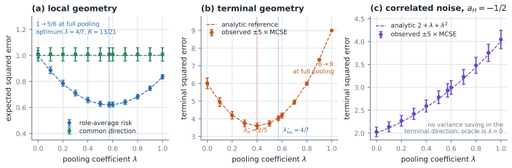
Figure 3 :Controlled local-to-final risk reversal.The same estimates are evaluated in local and final-output geometries. Markers are reported means with ±5 MCSE over 20,000 noise repetitions; dashed curves are analytic references. Full pooling helps locally but hurts the final output, and the optimal pooling strengths differ. The correlated-noise case isolates a further limit of pooling. Panels (a) and (b) use the same three-role estimates; (c) is a separate two-dimensional model. The common-direction normalization and both constructions are specified in Section G.2.
出典 · CC BY 4.0 · Tiantong Wang, Zhiren Gong, Yixin Wang, Tiantong Wu, Wei Yang Bryan Lim · From Local Prediction Error to Final Outputs: A Theory of Expert Sharing in Multi-Step Reasoning · 論文の図を引用 · 元のPDFの39ページ目から図の部分を抽出しています。この結果は、3つの役割モデルの固定線形マップの中で確認されたものです。相関のあるノイズを使う別の二次元モデルも併せて報告されていますが、これは同じ実験設定を一般化したものではありません。
訓練されたTransformerの一段階の利得と最終出力
著者らは、Z31上の4つの演算を合成する小型Transformerを学習し、同じ観察を確認しました。教師強制の1段階誤差では、tied構造は64件の訓練トレースにおいて3.49~7.72パーセントポイント低い誤差を示しました。一方、自由実行の最終出力の差は−0.186~+0.192ポイントで、すべての区間が0を含んでいました。
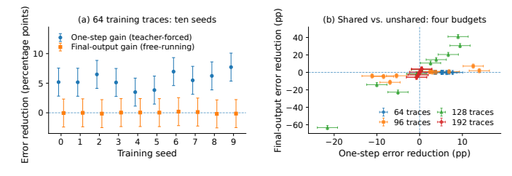
Figure 1 :Local and final gains in trained Transformers.Positive differences mean lower error for tied experts. (a) At 64 traces, one-step gains are supported, while the final-output difference is not statistically resolved. (b) All forty tying contrasts at 64, 96, 128, and 192 traces. Bars retain the reported simultaneous intervals of the full 240-endpoint follow-up family ( N= 32768 , 480 tails, δ= 0.05, radius= 2.3657)
出典 · CC BY 4.0 · Tiantong Wang, Zhiren Gong, Yixin Wang, Tiantong Wu, Wei Yang Bryan Lim · From Local Prediction Error to Final Outputs: A Theory of Expert Sharing in Multi-Step Reasoning · 論文の図を引用 · 元のPDFの9ページ目から図の部分を抽出しています。そのため、この実験は、局所的な利得があっても最終的な利得が統計的に確認されない事例を示しています。最終的な差の方向は予算とシードによって異なり、この結果は当該のタスクと低データ条件に限られます。
正解ラベルと演算の実装の違い
Proposition 5は、正解予測と正解ルートのラベルがあっても、専門家が実際に演算を実装していると断定できないことを示しています。構成されたモデルでは、共有経路が答えを計算し、専門家の寄与は0です。そのため、別の専門家indexを強制的に選んでも出力は変わりません。したがって、観察の整合性だけで再利用を主張するのは難しいです。
この結果は、介入の忠実性と十分な事前状態情報が必要だという条件を強調しています。論文は、この結果は実験的な介入による証拠に代わるものではないと考えています。
論文情報
- 著者
- Tiantong Wang, Zhiren Gong, Yixin Wang, Tiantong Wu, Wei Yang Bryan Lim
- 学会・ジャーナル
- arXiv · プレプリント
- 公開日
- 2026年11月13日
- 登録日
- 2026年11月16日
- 更新日
- 2026年11月13日
- バージョン
- v1
- arXiv
- 2611.17879
- カテゴリ
- cs.LG · cs.AI
- ライセンス
- CC BY 4.0
- 掲載内容
- 論文情報・解説・論文の図
この解説は、Refivuの韓国語解説をAIで翻訳したものです。不正確な翻訳や誤りが含まれる可能性があります。論文と図の利用条件は各出典に従います。
アブストラクト
Mixture-of-experts (MoE) models can share experts across layers or computational steps, pooling training information from different contexts. This can reduce local prediction error, but multi-step systems are ultimately evaluated by their final outputs. We study when these local gains survive composition. In specified linear regression models, we derive exact sharing and merging criteria by balancing variance savings against bias from sharing across roles with different target behavior. Under a common fixed linear propagation map, we characterize expected squared final-output risk, retaining error directions and correlations. We construct cases where sharing lowers average local error yet increases final-output error. Within this setting, we also identify when orthogonal full pooling with isotropic noise preserves every local improvement at the final output. For general routed computations, we derive conditional end-to-end error bounds that account for distribution shifts, errors in surrounding components, and changes in expert selection. Separately, we show that correct predictions and route labels alone do not establish that individual experts implement the attributed operations. Controlled experiments realize a strict local-to-final risk reversal. In low-data symbolic settings, trained Transformers exhibit statistically supported teacher-forced one-step gains without statistically resolved free-running final-output gains. Separate intervention tests distinguish successful multi-layer actions from single-expert attribution and generalization to unseen transitions. Together, these results distinguish when sharing improves local estimation, when those gains survive to the final output, and what evidence is needed to attribute reusable operations to individual experts.
この論文を引用
Tiantong Wang, Zhiren Gong, Yixin Wang, Tiantong Wu, Wei Yang Bryan Lim (2026). From Local Prediction Error to Final Outputs: A Theory of Expert Sharing in Multi-Step Reasoning. arXiv:2611.17879v1. https://arxiv.org/abs/2611.17879v1
BibTeX
@misc{wang2026from,
  title = {{From Local Prediction Error to Final Outputs: A Theory of Expert Sharing in Multi-Step Reasoning}},
  author = {Tiantong Wang and Zhiren Gong and Yixin Wang and Tiantong Wu and Wei Yang Bryan Lim},
  year = {2026},
  eprint = {2611.17879},
  archivePrefix = {arXiv},
  url = {https://arxiv.org/abs/2611.17879v1}
}