논문 해설
Reasoning in the loop: antibody lead optimization by probing mechanism and measurement
루프 속 추론: 메커니즘과 측정을 탐색하는 항체 리드 최적화
- 연구 문제 측정 지표가 실제 필요한 물리 성질을 대변하지 않으면 모델과 데이터를 더해도 최적화가 개선되지 않습니다.
- 연구 방법 nanoDSF의 원시 열 곡선을 평형 용융 모델과 응집 속도 모델로 나눠 읽고, 농도와 승온 속도를 바꿔 지표를 검증했습니다.
- 주요 결과 VHH 리드는 KD 1.15 nM과 식별 용융 온도 70.6 °C를, scFv 리드는 KD 0.63 nM과 붕괴 온도 74.2 °C를 기록했습니다.
모델 최적화 루프가 측정 지표에 기대는 문제
항체 리드 최적화에서는 모델이 분자를 제안하고 자동 실험이 결과를 측정해 모델을 다시 학습시키는 lab-in-the-loop 방식이 널리 쓰입니다. 이 방식의 성공은 최적화 대상이 되는 측정 지표가 실제 필요한 성질을 얼마나 잘 대변하는지에 달려 있습니다. 지표가 좋은 대리변수가 아니면 더 좋은 모델이나 데이터를 추가해도 문제가 해결되지 않습니다. 이 논문은 이 어려움을 항체 리드 최적화에서 열 지표인 Tapp m과 Tagg의 의미를 원시 곡선으로 다시 확인하는 문제로 다룹니다.
열 곡선을 물리 모델로 다시 읽기
nanoDSF는 형광과 정적 광산란을 함께 기록하며, 형광 중심 파장의 이동은 단백질 펼침을, 광산란 신호의 상승은 입자 형성을 나타냅니다. 논문은 형광 신호를 접힘 상태와 펼침 상태의 평균으로 보고 평형 용융 온도를 추정했습니다. 광산란은 펼침 상태와 접힘 상태에서 쌓이는 속도 항으로 모델링했습니다. 응집은 되돌릴 수 없는 과정이므로 농도와 승온 속도에 따라 달라지고, 이 차이를 이용해 평형 지표와 동역학 지표를 구분했습니다.
부모 근처 설계와 Boolean 격자
라이브러리는 항체 계통 정보와 구조 정보에서 얻은 치환을 바탕으로 설계했습니다. VHH에서는 Alb23과 Alb 계열의 치환을, scFv에서는 생식계열 되돌림을 첫 라이브러리로 사용했습니다. 조합 효과를 보려고 돌연변이의 존재와 부재를 Boolean 격자로 표현하고, Sobol 준난수 표본으로 격자의 일부를 뽑았습니다. 이 방식은 각 돌연변이가 표본의 약 절반에 나타나도록 하여 계수 추정을 안정시킵니다. 효과는 Walsh 기저의 베이지안 선형 회귀로 추정했습니다.
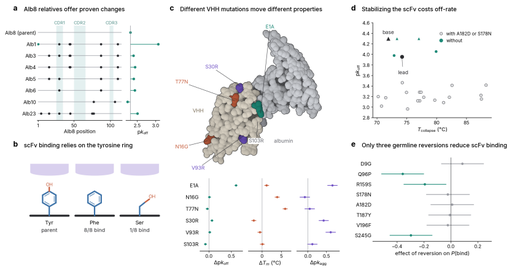
Figure 3 : Evidence for each design strategy . (a) Published relatives of Alb8. Dots mark substitutions (E1A in teal), shading marks the CDRs, and the right panel gives each molecule’s round-0 off-rate. (b) Schematic of the tyrosine scan on the scFv , with the fraction of variants that bound. (c) The six mutations of the VHH final-round factorial on the Alb8:albumin structure (PDB 8Z8V ; Mima et al. , 2024), colored by the property each moves most (teal off-rate, orange melt, purple aggregation), and the effect of adding each one, ±2𝜎 (𝑛 = 63 , 52 and 57 designs). (d) The scFv final-round factorial on the base design (the round 1 control), by collapse temperature (where the sample falls out of solution) and off-rate. Triangles have p 𝑘off ≥ 4.3 . (e) Effect of reverting each somatic mutation to germline on the probability of binding, ±2𝜎 (𝑛 = 58 ). Positions that carry binding are in teal.
원문 · CC BY 4.0 · Samuel Stanton, Aaron Solomon, Emily Delaney, Melanie Montgomery, Crystal Humphries, Timothy Acker, Ryan Henrici, Charbel Eid, Eddie Abrams, Peyton Greenside · Reasoning in the loop: antibody lead optimization by probing mechanism and measurement · 원문 그림 인용 · 원본 PDF 6쪽에서 그림 영역을 추출했습니다.프로토콜 변경으로 지표를 검증
논문은 최종 라운드에서 단백질 농도와 승온 속도를 바꿔 같은 설계를 두 번 측정했습니다. 평형 용융 온도는 농도 변화에도 거의 움직이지 않아야 하고, 동역학적 응집 지표는 움직여야 한다고 사전에 예측했습니다. VHH에서 식별된 용융 온도는 약 0.1 °C만 움직여 예측과 맞았습니다. scFv에서 붕괴 온도는 절반 농도에서 2.0 °C 상승해 예측 2.8 °C와 같은 방향이었고, 빠른 승온에서는 4.7 °C 상승했습니다. 일부 예측은 맞지 않았으며, 승온 비교는 측정 날짜와 얽혀 있어 약한 증거로 봐야 합니다.
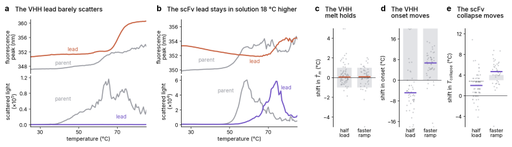
Figure 5 : Parents and leads, and the test of the model. (a) VHH and (b) scFv fluorescence (top) and 266 nm scattered light (bottom) against temperature, averaged over each molecule’s wells in one round. The scFv parent is from round 1 and its lead from round 2. (c–e) Paired shifts per design at half the protein concentration (half load) and at the faster ramp, for the VHH identified melt, the VHH scattering onset and the scFv collapse temperature. An equilibrium quantity should hold and a kinetic one should move. Bars are medians, gray bands are predicted ranges (in d, the predicted direction), the dotted line is a predicted value, and points beyond the axes are drawn at the edge ( 𝑛 = 74 and 55, 49 and 49, 74 and 42).
원문 · CC BY 4.0 · Samuel Stanton, Aaron Solomon, Emily Delaney, Melanie Montgomery, Crystal Humphries, Timothy Acker, Ryan Henrici, Charbel Eid, Eddie Abrams, Peyton Greenside · Reasoning in the loop: antibody lead optimization by probing mechanism and measurement · 원문 그림 인용 · 원본 PDF 8쪽에서 그림 영역을 추출했습니다.VHH 리드와 scFv 리드의 결과
VHH 리드는 부모 대비 결합 해리 속도가 약 0.90 log 느려졌고 KD는 10.3 nM에서 1.15 nM로 낮아졌습니다. 식별된 용융 온도는 62.2 °C에서 70.6 °C로 올라갔고, 응집 지표의 값은 한 웰에서 측정되었습니다. scFv 리드는 붕괴 온도가 부모의 56.3 °C에서 74.2 °C로 올랐고, KD는 3.7 nM에서 0.63 nM로 줄었습니다. 두 리드의 수율과 순도는 유지되었습니다. 두 리드 값 모두 이 논문의 자체 측정에 기반하며 재현 확인은 아직 수행되지 않았습니다.
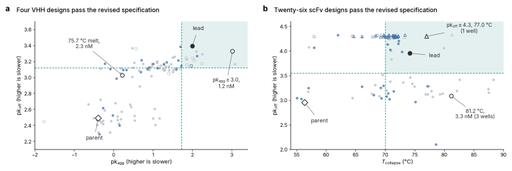
Figure 6 : Final-round designs against the revised specifications. (a) VHH: off-rate against the aggregation metric p 𝑘agg. (b) scFv: off-rate against 𝑇collapse, where the sample falls out of solution. Dashed lines are two of the constraints and shading marks designs that clear them. Open circles are aggregation rates at a fitting bound, and open triangles have p 𝑘off ≥ 4.3 . The scFv parent is from round 1. Gray points fail a constraint not plotted (melt, high-molecular-weight species, purity or yield). Of the 26 scFv designs that pass, 7 have a measured 𝐾𝐷 and 19 have p 𝑘off ≥ 4.3. Labeled designs mark the ends of each frontier (Section 7).
원문 · CC BY 4.0 · Samuel Stanton, Aaron Solomon, Emily Delaney, Melanie Montgomery, Crystal Humphries, Timothy Acker, Ryan Henrici, Charbel Eid, Eddie Abrams, Peyton Greenside · Reasoning in the loop: antibody lead optimization by probing mechanism and measurement · 원문 그림 인용 · 원본 PDF 9쪽에서 그림 영역을 추출했습니다.한계와 남은 확인
VHH 리드의 응집 값은 한 웰에 기반하고, scFv 리드의 값들은 두 웰에 기반합니다. scFv 결합 해리 속도는 측정 창의 한계에 가까워 순위를 확정하기 어렵습니다. 두 리드의 확인 실험과 장기 동역학 측정이 필요하다고 저자들은 봅니다. 열 곡선 모델의 2차항은 경험적 형식이며, 응집 메커니즘을 직접 증명하지는 않았습니다.
논문 정보
- 저자
- Samuel Stanton, Aaron Solomon, Emily Delaney, Melanie Montgomery, Crystal Humphries, Timothy Acker, Ryan Henrici, Charbel Eid, Eddie Abrams, Peyton Greenside
- 학회·저널
- arXiv · 프리프린트
- 최초 공개일
- 2026년 11월 15일
- 등록일
- 2026년 11월 17일
- 수정일
- 2026년 11월 15일
- 버전
- v1
- arXiv
- 2611.19812
- 분류
- cs.LG · cs.AI · q-bio.BM
- 원문 이용 조건
- CC BY 4.0
- 제공 범위
- 논문 정보, 해설, 허용된 원문 그림
AI 해설은 논문 원문과 별개의 설명이며 오류가 있을 수 있습니다. 원문과 그림은 각 출처의 이용 조건과 따로 표시된 권리를 따릅니다.
초록
Lab-in-the-loop systems, in which a model proposes molecules, automated assays measure their properties and the results retrain the model, are a popular approach to antibody lead optimization. These systems optimize for a specification defined with metrics computed from instrument signals, so their success depends on how well those metrics serve as proxies for the properties a drug candidate needs. When a metric is a poor proxy, neither a better model nor more data will fix it, and identifying the problem usually requires expert review. We report two campaigns run on BigHat Biosciences' Milliner platform, one on an anti-albumin nanobody (VHH) and one on an anti-mesothelin single-chain variable fragment (scFv), in which a research team and a general-purpose AI agent, Claude, brought scientific reasoning into the loop. Over seven rounds and about 1,010 design variants we built libraries from antibody lineage, structure and biophysics, and found from the raw curves that on each scaffold one thermal metric did not measure what its name implied. The libraries were built as controlled comparisons, so the results also show what each mutation contributes to each property. We fit a physical model of the curves, used it to choose metrics suited to each scaffold, and changed the experimental protocol, varying protein concentration and heating rate, to test the model against pre-registered predictions. Both leads improve on their parents in affinity, thermal stability and aggregation while improving or maintaining yield and purity.
원문 인용
Samuel Stanton, Aaron Solomon, Emily Delaney, Melanie Montgomery, Crystal Humphries, Timothy Acker, Ryan Henrici, Charbel Eid, Eddie Abrams, Peyton Greenside (2026). Reasoning in the loop: antibody lead optimization by probing mechanism and measurement. arXiv:2611.19812v1. https://arxiv.org/abs/2611.19812v1
BibTeX
@misc{stanton2026reasoning,
  title = {{Reasoning in the loop: antibody lead optimization by probing mechanism and measurement}},
  author = {Samuel Stanton and Aaron Solomon and Emily Delaney and Melanie Montgomery and Crystal Humphries and Timothy Acker and Ryan Henrici and Charbel Eid and Eddie Abrams and Peyton Greenside},
  year = {2026},
  eprint = {2611.19812},
  archivePrefix = {arXiv},
  url = {https://arxiv.org/abs/2611.19812v1}
}