論文解説
The Flip Test: Video World Models Fail to Learn the World State
The Flip Test:ビデオ世界モデルが世界状態を学習できない理由
- 課題 ビデオ世界モデルは、初期状態のわずかな変化で未来が反転するとき予測も一緒に変わるのかを、既存の映像評価では確認できていません。
- 手法 境界の両側にあるほぼ同じ初期フレームの組、同じ側の対照群、境界付近に密に配置したsweepを使い、モデルの予測の変化を検査します。
- 結果 最も強いビデオモデルの平均ペア精度は18.3%でした。実際の場面ではGemini Omni Flash 1.1が31.3%を記録しました。
ビデオ世界モデルは状態の差に反応するか
ビデオ世界モデルは、現在の場面の初期フレームから未来の映像を生成します。ここで重要なのは、映像がもっともらしく見えるかどうかよりも、初期状態がわずかに変わって未来の結果が反転したとき、モデルの予測も一緒に反転するかどうかです。既存の評価は各映像を個別に見て、一般的な物理的妥当性を採点することが多いため、2つの場面の実際の未来が逆なのに同じ映像を生成してしまう失敗を捉えにくいです。この論文は、この盲点を狙って境界付近で未来を反転させる最小の変化を作り、モデルがその違いを区別できるかを検証します。
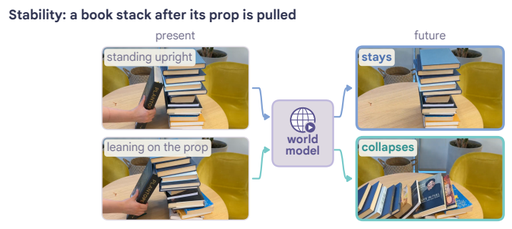
Figure 1 | A small change to the initial frame flips the correct future.Two nearly identical initial frames sit on opposite sides of a physical boundary, so the correct outcome differs. A model passes only if its two predictions also differ.
出典 · CC BY 4.0 · Mi Luo, Lijun Yu, Adams Wei Yu, Ang Cao, Baochen Sun, Ming-Hsuan Yang, Nan Hua, Yuan Hao, Alex Dimakis, Ya Xu, Ed H. Chi, Xuezhi Wang, Yinxiao Liu · The Flip Test: Video World Models Fail to Learn the World State · 論文の図を引用 · 元のPDFの2ページ目から図の部分を抽出しています。FlipTestの3段階の構成
FlipTestは、物理的な余白m(s)の符号で結果が決まる境界を基準に作られます。最小ペアは m(s−)<0<m(s+) を満たす2つの状態で構成され、2つの初期フレームはほぼ同じですが、実際の未来y(s−)とy(s+)は互いに異なる必要があります。Level 1はこのペアを300組使い、10個のシミュレーションタスクと15個の実世界タスクに分けて構成します。Level 2は、シミュレーションタスクごとに等間隔の4つの状態を置き、真ん中の1段階だけが境界を越えるように対照群を作ります。Level 3は、同じシミュレーションタスクで境界付近に集中させた30個の状態をサンプリングし、応答曲線を見ます。
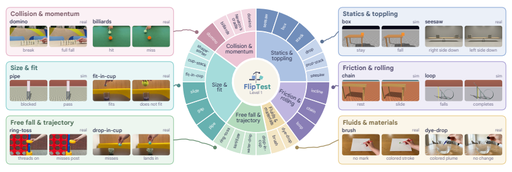
Figure 2 | FlipTest-Level 1 at a glance.It has 300 minimal pairs (600 initial frames) over 25 tasks (outer ring), grouped into six physical families (inner ring). Dark wedges are simulated tasks and light wedges are real tasks, with 150 pairs and 300 initial frames each. Each callout shows two example pairs from one family. Each pair has two opposite outcomes.
出典 · CC BY 4.0 · Mi Luo, Lijun Yu, Adams Wei Yu, Ang Cao, Baochen Sun, Ming-Hsuan Yang, Nan Hua, Yuan Hao, Alex Dimakis, Ya Xu, Ed H. Chi, Xuezhi Wang, Yinxiao Liu · The Flip Test: Video World Models Fail to Learn the World State · 論文の図を引用 · 元のPDFの3ページ目から図の部分を抽出しています。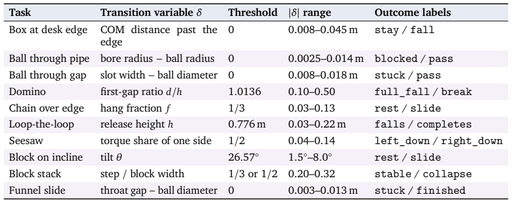
Table 1 | Simulated tasks(15 pairs each). The two members of a pair sit at±|𝛿| around the threshold and differ only in the transition variable. The 15 pairs of a task span the full|𝛿| range, from knife-edge to clear-cut cases.
出典 · CC BY 4.0 · Mi Luo, Lijun Yu, Adams Wei Yu, Ang Cao, Baochen Sun, Ming-Hsuan Yang, Nan Hua, Yuan Hao, Alex Dimakis, Ya Xu, Ed H. Chi, Xuezhi Wang, Yinxiao Liu · The Flip Test: Video World Models Fail to Learn the World State · 論文の図を引用 · 元のPDFの18ページ目から図の部分を抽出しています。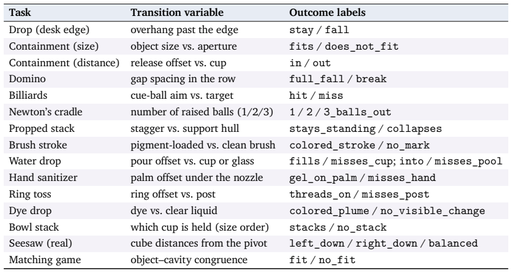
Table 2 | Real-world tasks(10 pairs, 20 frames each).
出典 · CC BY 4.0 · Mi Luo, Lijun Yu, Adams Wei Yu, Ang Cao, Baochen Sun, Ming-Hsuan Yang, Nan Hua, Yuan Hao, Alex Dimakis, Ya Xu, Ed H. Chi, Xuezhi Wang, Yinxiao Liu · The Flip Test: Video World Models Fail to Learn the World State · 論文の図を引用 · 元のPDFの19ページ目から図の部分を抽出しています。結果の読み取りと指標
生成された映像の結果は、2つの審査モデルが読み取ります。Level 1のペアは、両方の審査モデルが正解を読み取り、両方のフレームが正しいときだけ正解とみなします。判定が食い違うものやunclearは不正解として扱います。選択的感度は SS=CFR−SFR で定義します。CFRは境界を越える段階での反転率、SFRは同じ側の段階での反転率です。定数予測やランダムな反転のモデルでは、この値は0になります。Level 3では、余白に応じた応答曲線 P(event|m) を描き、境界の位置と鋭さを見ます。
ビデオモデルのペア失敗と選択性の不足
シミュレーションタスクでは、どのビデオモデルも5.3%を超えられず、実際の場面では同じモデルが31.3%を記録しました。判定可能なペアのうち、2つのフレームが同じ結果になったのは、実際の場面で72%、シミュレーションでは89%でした。Level 2では、直接VLMが交差段階の61%、非交差段階の15%を反転させ、選択的感度は+0.46(95% CI [0.36, 0.56])でした。
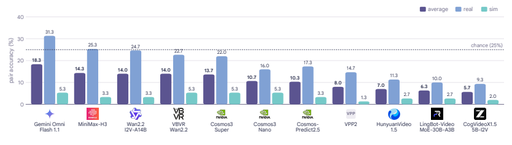
Figure 3 | Video world models rarely pass FlipTest Level 1.We show pair accuracy (%) of 11 video models on real scenes, simulation, and their average. The models are sorted by their average. A frame counts as correct only if both judges (Gemini 3.8 Flash and Gemini 3.6 Flash) read the ground-truth outcome from its video. A pair is solved only if both frames are correct. The dashed line marks chance (25%).
出典 · CC BY 4.0 · Mi Luo, Lijun Yu, Adams Wei Yu, Ang Cao, Baochen Sun, Ming-Hsuan Yang, Nan Hua, Yuan Hao, Alex Dimakis, Ya Xu, Ed H. Chi, Xuezhi Wang, Yinxiao Liu · The Flip Test: Video World Models Fail to Learn the World State · 論文の図を引用 · 元のPDFの4ページ目から図の部分を抽出しています。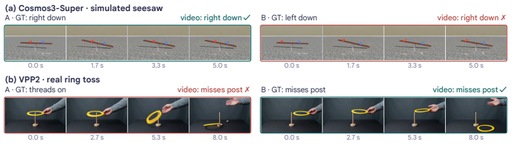
Figure 6 | Failure mode: one future for both frames.Four evenly spaced frames of the generated videos for two minimal pairs, (a) Cosmos3-Super on the simulated seesaw and (b) VPP2 on real ring toss, labeled with the outcome both judges read. Each model shows the same outcome for both frames of its pair, so one of the two videos is wrong (red border).
出典 · CC BY 4.0 · Mi Luo, Lijun Yu, Adams Wei Yu, Ang Cao, Baochen Sun, Ming-Hsuan Yang, Nan Hua, Yuan Hao, Alex Dimakis, Ya Xu, Ed H. Chi, Xuezhi Wang, Yinxiao Liu · The Flip Test: Video World Models Fail to Learn the World State · 論文の図を引用 · 元のPDFの9ページ目から図の部分を抽出しています。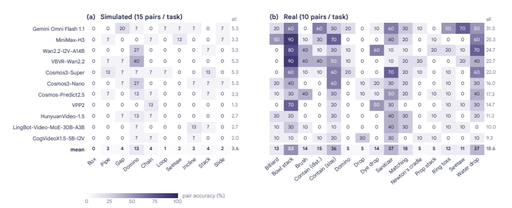
Figure 15 | Per-task pair accuracy (%) of the 11 video models.(a) The 10 simulated tasks (15 pairs each); (b) the 15 real tasks (10 pairs each). Rows are sorted as in Fig. 3, the last row is the mean over models, and theallcolumn shows the split-level pair accuracy. A frame counts as correct only if both judges (Gemini 3.8 Flash and Gemini 3.6 Flash) read the ground-truth outcome, as in Fig. 3.
出典 · CC BY 4.0 · Mi Luo, Lijun Yu, Adams Wei Yu, Ang Cao, Baochen Sun, Ming-Hsuan Yang, Nan Hua, Yuan Hao, Alex Dimakis, Ya Xu, Ed H. Chi, Xuezhi Wang, Yinxiao Liu · The Flip Test: Video World Models Fail to Learn the World State · 論文の図を引用 · 元のPDFの27ページ目から図の部分を抽出しています。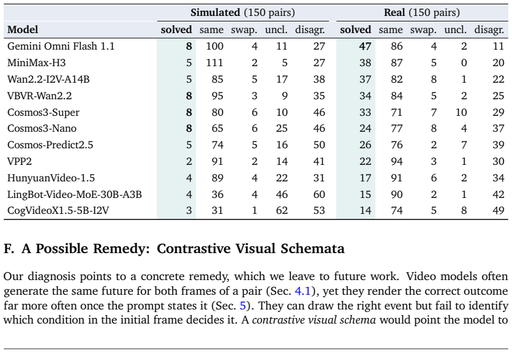
Table 3 | Outcome of every pair, per model and split.Forsolved, both judges read the ground truth on both frames, and the pair accuracy of Fig. 3 is this count over 150. Forsame, both judges agree and the model shows the same outcome for both frames. Forswap., both opposite outcomes appear on the wrong frames, a category that also includes the few pairs with a different wrong outcome on a three-outcome task. Foruncl., both judges agree and at least one frame isunclear. Fordisagr., the judges disagree on at least one frame. Shaded columns give the solved counts, with the best count per split in bold.
出典 · CC BY 4.0 · Mi Luo, Lijun Yu, Adams Wei Yu, Ang Cao, Baochen Sun, Ming-Hsuan Yang, Nan Hua, Yuan Hao, Alex Dimakis, Ya Xu, Ed H. Chi, Xuezhi Wang, Yinxiao Liu · The Flip Test: Video World Models Fail to Learn the World State · 論文の図を引用 · 元のPDFの27ページ目から図の部分を抽出しています。境界スイープにおける応答曲線
Level 3のsweepでは、ビデオモデルのP(event|m)曲線は境界付近でほぼ平坦なままでした。一方、2つのVLMはS字型の遷移を示し、その差はGemini 4 Argonが+0.62、Gemini 3.8 Flashが+0.58でした。ただし、VLMの曲線はm=0より前で先に上がっており、境界付近で事象を過大予測していました。著者らは、ビデオモデルは境界をまったく捉えられておらず、VLMは系統的なずれを持ったまま境界を検出していると解釈しています。
状態の読み取りとレンダリングの切り分け
著者らは、失敗がどこで起きるかを分けるため、知覚、力学、レンダリングを分けた予測器を比較しました。結果ラベルをプロンプトに明示すると、Gemini Omni Flash 1.1のペア精度は18.3%から73.7%に上がりましたが、実際のペアの4分の1以上は依然として見逃していました。測定エージェントは画像から画素の幾何を測定し、実際のペアの93.3%を正解しました。シミュレーションエージェントは、測定後にMuJoCoのロールアウトを行い、761回の実行のうち4回でのみ、事前の判断を覆しました。この結果は、初期フレームに決定状態が含まれていることを示しており、ビデオモデルの主なボトルネックは状態の読み取りで、副次的にレンダリングであるという著者らの解釈を裏付けています。
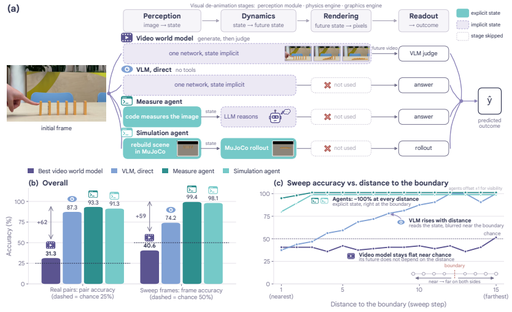
Figure 7 | Making the state explicit closes the gap.(a) Predictors mapped onto the three stages of Visual De-animation (Wu et al., 2017a), with every pipeline terminating in a binary outcome label scored against ground truth. (b) Pair accuracy on the 150 real pairs and frame accuracy on the 480 sweep frames, comparing the best video world model, the direct VLM, the Measure agent, and the Simulation agent against chance (dashed lines: 25% for pairs, 50% for frames). (c) Sweep accuracy as a function of distance from the boundary, pooled over four tasks, four scenes, and both boundary sides (32 frames per step; invalid agent runs count as wrong).
出典 · CC BY 4.0 · Mi Luo, Lijun Yu, Adams Wei Yu, Ang Cao, Baochen Sun, Ming-Hsuan Yang, Nan Hua, Yuan Hao, Alex Dimakis, Ya Xu, Ed H. Chi, Xuezhi Wang, Yinxiao Liu · The Flip Test: Video World Models Fail to Learn the World State · 論文の図を引用 · 元のPDFの11ページ目から図の部分を抽出しています。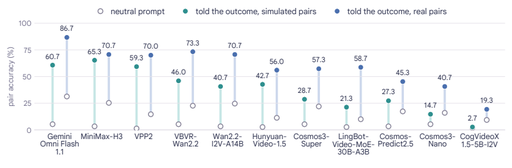
Figure 8 | Told the outcome, every video model improves.Pair accuracy (%) with the neutral prompt (hollow, as in Fig. 3) and with the ground-truth outcome stated in the prompt (filled; teal for simulated pairs, blue for real pairs). A pair counts only when both videos show the told outcome, scored by Gemini 3.8 Flash withunclear rollouts counted as wrong.
出典 · CC BY 4.0 · Mi Luo, Lijun Yu, Adams Wei Yu, Ang Cao, Baochen Sun, Ming-Hsuan Yang, Nan Hua, Yuan Hao, Alex Dimakis, Ya Xu, Ed H. Chi, Xuezhi Wang, Yinxiao Liu · The Flip Test: Video World Models Fail to Learn the World State · 論文の図を引用 · 元のPDFの12ページ目から図の部分を抽出しています。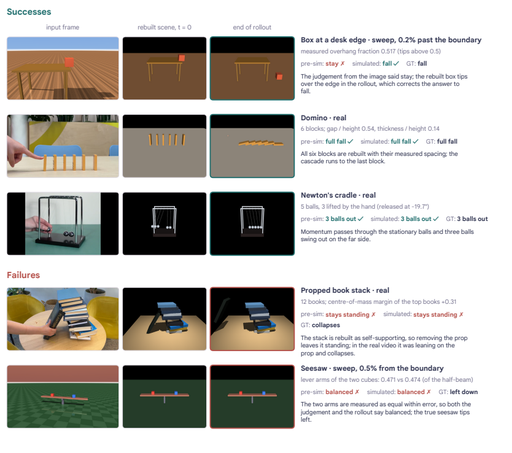
Figure 10 | Simulation agent case studies.For each run, we show the input frame and the agent’s rebuilt MuJoCo scene at𝑡= 0and at the end of the rollout, re-rendered offline from the submitted scene.xml, together with the key measurement, the pre-simulation judgement, the simulated outcome, and the ground truth. Top: the rollout corrects a wrong judgement (box) or confirms a correct one in multi-body scenes (domino, Newton’s cradle). Bottom: the errors come from the reconstruction, where the scene misses a support (propped book stack) or reads two lever arms closer than the measurement error as equal (seesaw).
出典 · CC BY 4.0 · Mi Luo, Lijun Yu, Adams Wei Yu, Ang Cao, Baochen Sun, Ming-Hsuan Yang, Nan Hua, Yuan Hao, Alex Dimakis, Ya Xu, Ed H. Chi, Xuezhi Wang, Yinxiao Liu · The Flip Test: Video World Models Fail to Learn the World State · 論文の図を引用 · 元のPDFの22ページ目から図の部分を抽出しています。単一の決定要因という範囲
FlipTestが主に扱うのは、単一の初期フレームで1つの決定要因が変わる剛体の臨界動力学です。複数の相互作用要因が時間とともに同時に展開する場面は、直接は扱っていません。対照的な視覚スキーマは、論文では今後の課題としてのみ挙げられており、この論文では検証されていません。
論文情報
- 著者
- Mi Luo, Lijun Yu, Adams Wei Yu, Ang Cao, Baochen Sun, Ming-Hsuan Yang, Nan Hua, Yuan Hao, Alex Dimakis, Ya Xu, Ed H. Chi, Xuezhi Wang, Yinxiao Liu
- 学会・ジャーナル
- arXiv · プレプリント
- 公開日
- 2026年11月15日
- 登録日
- 2026年11月17日
- 更新日
- 2026年11月15日
- バージョン
- v1
- arXiv
- 2611.19822
- カテゴリ
- cs.CV · cs.AI · cs.RO
- ライセンス
- CC BY 4.0
- 掲載内容
- 論文情報・解説・論文の図
この解説は、Refivuの韓国語解説をAIで翻訳したものです。不正確な翻訳や誤りが含まれる可能性があります。論文と図の利用条件は各出典に従います。
アブストラクト
Video world models promise to predict the future of a scene from its present. Do current models keep this promise? We probe this question counterfactually. When a small change to the present flips the future, such as a box resting a few millimeters before or past a table edge, a model that tracks the state of the world must flip its prediction too. We build FlipTest, a three-level hierarchy of increasingly strict tests over 1,680 initial frames from 10 simulated and 15 real-world tasks. At the base, visual minimal pairs, two nearly identical frames whose true futures differ, test whether predictions change across the boundary; matched controls go further and test whether they change only where the future does; and dense sweeps, the strictest level, locate exactly where they change. All 11 video world models we evaluate fall short. The best averages 18.3% pair accuracy over real and simulated scenes, below the 25% of random guessing. Models flip as often on steps that leave the future unchanged as on steps that change it, and their response stays flat across the sweeps. On the same frames, a vision-language model is selective and traces a near S-shaped curve near the boundary, and a coding agent that measures the image comes close to the true boundary. This implies that the deciding information is in the frame, and video models just miss it. We therefore urge the community to rethink world modeling as pure video prediction. Next-frame prediction must do more than draw plausible pixels; it must also identify the causal states that control future dynamics.
この論文を引用
Mi Luo, Lijun Yu, Adams Wei Yu, Ang Cao, Baochen Sun, Ming-Hsuan Yang, Nan Hua, Yuan Hao, Alex Dimakis, Ya Xu, Ed H. Chi, Xuezhi Wang, Yinxiao Liu (2026). The Flip Test: Video World Models Fail to Learn the World State. arXiv:2611.19822v1. https://arxiv.org/abs/2611.19822v1
BibTeX
@misc{luo2026flip,
  title = {{The Flip Test: Video World Models Fail to Learn the World State}},
  author = {Mi Luo and Lijun Yu and Adams Wei Yu and Ang Cao and Baochen Sun and Ming-Hsuan Yang and Nan Hua and Yuan Hao and Alex Dimakis and Ya Xu and Ed H. Chi and Xuezhi Wang and Yinxiao Liu},
  year = {2026},
  eprint = {2611.19822},
  archivePrefix = {arXiv},
  url = {https://arxiv.org/abs/2611.19822v1}
}