Paper commentary
Decode Early, Verify Late: Streaming Offline Speech Recognizers Without Accuracy Loss
- Problem Offline ASR models are the most accurate open-weight recognizers, but they decode only after the turn ends, so the final transcript reaches a voice agent late.
- Method Not stated in the paper.
- Results At up to 64 streams, Qwen3-ASR-1.7B on one A100 gives its final a median of 22–26 ms after the commit, 2.7–3.9× sooner than the official streaming mode.
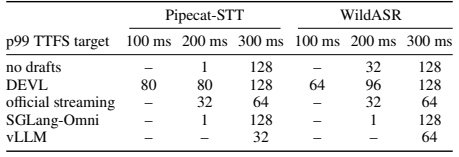
Table 4 :Qwen3-ASR streams per A100 at a p99 TTFS target.DEVL and no drafts ran at the loads in Table 3; other systems at 1, 8, 32, 64 and 128 streams. Capacity is the largest tested load meeting the target at that and every lower load; “–” means not met even at one stream.
Original paper · CC BY 4.0 · Doyeob Kim · Decode Early, Verify Late: Streaming Offline Speech Recognizers Without Accuracy Loss · Original paper figure · Extracted the figure area from page 7 of the original PDF.Why streaming offline recognizers is hard
The most accurate open-weight speech recognizers decode a complete utterance in one pass, and several of them sit at the top of the Open ASR Leaderboard as of November 2026. A streaming recognizer shows partial hypotheses while the user is still speaking and returns a final transcript when the turn ends, at the commit. TTFS, the gap between commit and final, is the time a voice agent waits before it can reply, so the speed of that final is what matters for the agent.
Existing streaming options give up either accuracy or latency. The Qwen3-ASR toolkit fixes earlier output as a prefix, while Whisper-Streaming keeps only the text on which consecutive hypotheses agree. Each of these has higher WER than offline decoding in the authors' engine, with a decoding-settings caveat for Whisper. The realtime mode of vLLM for Qwen3-ASR restates earlier segments and reaches 47.7% WER on Pipecat-STT and 54.2% on WildASR.
Engines such as vLLM and SGLang-Omni decode the complete utterance at the commit, which places the whole decode between the user's last word and the agent's reply.
Reusing partials as verified drafts
DEVL therefore keeps every partial as a draft instead of discarding it. At the commit, one forward pass checks the latest draft against the complete audio, in the manner of speculative decoding, and decoding resumes after the longest correct prefix.
At the commit the server prefills only the remaining tail, verifies the last draft in that same pass, and decodes only after the correct prefix.
What must match for an exact final
Each check needs the same encoder outputs, prompt, token positions and retained decoder state that an offline run on the same audio would produce. If newly arrived audio alters a cached representation, the server recomputes it.
Audio is split into fixed blocks counted from the start of the stream, so the client's chunk boundaries do not move them. The commit therefore has to process only the tail after the last cached block.
A checkpoint works on a copy of the stream's KV cache: it prefills the uncached audio and the prompt suffix, checks the previous draft with the same rule the final uses, decodes past the accepted prefix, and stores the result as the next draft together with the audio it saw.
Verification compares each draft token with the greedy argmax at the same position, and up to the first mismatch the draft matches greedy decoding. On a mismatch the server rolls the KV cache back to the accepted prefix, continues decoding, and can realign and re-verify the rest of the draft, with at most three repair rounds in the algorithm.
Under the stated conditions, finals equal G(x) in exact arithmetic, and only utterances without epoch cuts are covered by that statement. Epoch-cut finals are outside this guarantee. Batch-dependent GPU rounding is a separate issue, which the paper treats under its limitations.
Scheduling finals ahead of checkpoints
Checkpoints use whatever GPU time remains, and at most four streams are active at once unless epoch cuts require more. The engine uses a paged KV cache and CUDA graphs.
Utterances longer than 10 s are cut into epochs at sentence ends, which shortens the final decode. Finals produced after an epoch cut are excluded from the exactness claim.
Adapting the scheme to other model families
Table 1 maps the same choices onto Whisper, VibeVoice-ASR and NVIDIA-Nemotron-3.5-Transcribe. A windowed or causal encoder allows its audio representations to be reused, whereas a whole-clip encoder must process the full audio again at commit. For Whisper the whole clip is encoded at commit and the rollback overwrites the KV cache, while Nemotron's rollback replays its state.
VibeVoice-ASR is a causal chunked model whose encoder output is cached during speech, so only the tail is encoded at commit. To make its front end deterministic, input gain is removed and the mean acoustic latent is used.
Nemotron's recurrent Mamba-2 state is restored by replaying accepted inputs, following the ReplaySSM approach.
Accuracy of finals against offline decoding
Five recognizers are compared on Pipecat-STT and WildASR, each against its own offline decode of the same audio. Identical counts final transcripts whose text matches the offline transcript byte for byte.
DEVL keeps WER within 0.13 points of offline decoding across the five recognizers, and 95–100% of its finals match the offline text exactly, with single-stream finals arriving 1.5–7.3× sooner. For Qwen3-ASR-1.7B on Pipecat-STT, the offline WER is 1.78 and the DEVL WER is 1.77, with 98.0% of finals identical; on WildASR the offline WER is 4.75 and the DEVL WER is 4.65, with 98.5% identical.
Those Qwen3-ASR WER and identical figures come from the 64-stream run, while the median single-stream TTFS falls from 115→24 ms on Pipecat-STT and from 78→25 ms on WildASR when drafts are switched on.
The authors attribute most of the gap of Whisper-Streaming to its default decoding settings rather than to the streaming method itself. In Table 2 Whisper-Streaming reaches 10.72 WER on Pipecat-STT and 11.76 on WildASR for large-v3-turbo, against 3.45 and 5.70 offline.
Without drafts, batching alone changes up to 1.9% of Qwen3-ASR's finals at 128 streams. The DEVL finals that differ from offline output diverge first at a near-tie between the two highest-ranked tokens, where logits were recorded.
Qwen3-ASR latency as concurrency grows
Each stream in this closed-loop test sends its following utterance only after the previous final has come back. The engine is compared with the no-drafts server, the official streaming mode, SGLang-Omni 0.2.0 and vLLM 0.33.0, across concurrency from 1 to 128 streams.
DEVL's finals arrive 2.7–3.9× sooner than those of the official streaming mode, which keeps its earlier output as a fixed prefix and has higher WER in Table 2. Relative to the no-drafts server the median is 3.2–5.0× lower, and relative to SGLang-Omni and vLLM it is 4.1–8.3× lower.
Against a p99 TTFS target of 100 ms, DEVL is the only system tested that meets it, up to 80 streams on Pipecat-STT and 64 on WildASR. The other systems miss that target even at one stream, while at a 300 ms target DEVL, the no-drafts server and SGLang-Omni each hold up to 128 streams. No system had a failed request in these runs.
Drafts help only while checkpoints finish before the commit. The checked share is at least 98% at 64 streams and falls to 21–29% at 128 streams.
The hosted Qwen3-ASR service that uses DEVL placed first on median TTFS, 44 ms, and second on WER, 3.6%, in a September 2026 Coval ranking. That ranking is an external benchmark result and not a controlled comparison in this paper.
Other recognizers under concurrent load
The other recognizers were batched with finals ahead of checkpoints and measured with client-side timing. The other three recognizers miss that target even at one stream.
When the GPU is occupied by finals, checkpoints seldom complete before the commit, so drafts give little benefit. From 32 streams, VibeVoice-ASR's medians with and without drafts stay within 8% of one another, and from 64 streams Nemotron's median with drafts is up to 16% higher.
Drafts keep finals identical at 93.5–100% across loads, and the WER gap to the no-drafts arm is at most 0.3 points. The exception is a VibeVoice-ASR case in which only one arm transcribed a clip on which the model loops.
Endpointing with a silence timeout
A deployed client commits after a silence timeout rather than at the last speech chunk, so the authors appended 300 or 600 ms of silence before commit at 1, 32 and 64 streams.
Counted from the end of speech, DEVL's median TTFS is 59–108 ms lower than with the no-drafts server, and WER is the same in both. Under padding, 96.7–98.1% of the finals at 32 and 64 streams equal the offline decode of the padded audio.
Where DEVL sits among prior streaming work
Local agreement keeps text on which consecutive hypotheses agree, and the Qwen3-ASR toolkit fixes a prefix; neither re-scores earlier output with the model over the full recording. Two-pass designs run a second decoding pass with full context over what was streamed first, and they do not reuse the first pass to speed up an exact final.
On the draft side, speculative decoding preserves the target model's output rule, and SpecASR applies a separate draft recognizer to accelerate offline ASR. SSBD reuses earlier translations as drafts for growing text input, and Speculative Listening drafts under assumed silence for chunk-interleaved full-duplex models. DEVL applies the draft check to the streaming partials of an offline recognizer, together with the state invariants that make the final equal greedy output.
Limitations and open constraints
The benchmarks are English, and the Pipecat-STT references are machine-generated rather than written by people. Batch-dependent GPU rounding changes some finals, and the authors suggest batch-invariant kernels as a possible way to reduce this. DEVL depends on the model properties set out in Section 2.
The scheduler favours finals, so improving partial latency is left for future work. Finals from epoch cuts fall outside the exactness guarantee, and the Whisper-Streaming gap depends on its decoding settings. The other models are timed on the server in Table 2, while Qwen3-ASR is timed at the client, so their TTFS values are not directly comparable.
Paper info
- Authors
- Doyeob Kim
- Venue
- arXiv · Preprint
- First published
- 2026-11-15
- Added
- 2026-11-17
- Updated
- 2026-11-15
- Version
- v1
- arXiv
- 2611.20064
- Category
- cs.LG
- Original paper terms
- CC BY 4.0
- What we show
- Paper info, commentary and permitted figures from the original paper
AI commentary is a separate explanation from the original paper and may contain errors. The original paper and figures follow each source's terms of use and any rights noted separately.
Abstract
Voice agents need accurate transcripts soon after a user stops speaking. We propose Decode Early, Verify Late (DEVL), a training-free framework for streaming inference with offline ASR models. The server keeps partial transcripts as drafts and verifies the latest against the complete audio in one forward pass at turn end. Under stated input and decoding conditions, the final equals the model's greedy offline output in exact arithmetic. We adapt DEVL to four model families. In our five-recognizer comparison, 95-100% of final transcripts are byte-identical to the offline transcripts, WER stays within 0.13 points of offline, and single-stream time to final falls 1.5-7.3x. Serving Qwen3-ASR-1.7B on one A100, DEVL returns finals a median 22-26 ms after turn end at up to 64 streams, 2.7-3.9x sooner than the official streaming mode. It is the only system we tested that meets a 100 ms p99 target, up to 80 streams on Pipecat-STT and 64 on WildASR.
Quote from the paper
Doyeob Kim (2026). Decode Early, Verify Late: Streaming Offline Speech Recognizers Without Accuracy Loss. arXiv:2611.20064v1. https://arxiv.org/abs/2611.20064v1
BibTeX
@misc{kim2026decode,
  title = {{Decode Early, Verify Late: Streaming Offline Speech Recognizers Without Accuracy Loss}},
  author = {Doyeob Kim},
  year = {2026},
  eprint = {2611.20064},
  archivePrefix = {arXiv},
  url = {https://arxiv.org/abs/2611.20064v1}
}