Paper commentary
CECAR: Cache & Expert Co-Aware Routing Accelerates On-Device Inference of MoE LLMs
- Problem Cache hit rates stay bounded on-device: even Belady's optimal policy reaches only 84.2% with 24 of 128 experts cached per layer, and expert loading still dominates per-token latency.
- Method CECAR adds an eviction-aware logit bonus to cached experts during top-K selection, drops uncached low-ranked experts, and renormalizes the remaining weights against the original top-8 sum.
- Results On Qwen3-30B-A3B with 16 GB VRAM and SSD-fetched experts, it reached 12.5 ± 1.19 tokens/s, a 4.5× speedup over conventional MoE inference.
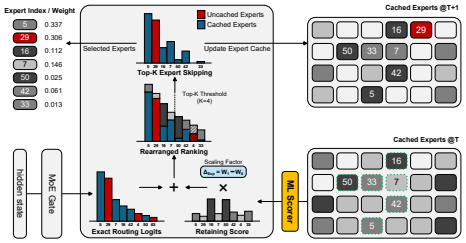
Figure 4 : Illustration of the CECAR Routing Algorithm. Darker colors denote experts that CECAR
Original paper · CC BY 4.0 · Byeongju Kim, Hoonki Lee, Byungjun Kim, Inyul Ra, Yongjin Kim, Yongseong Lee, Sangyeob Kim · CECAR: Cache & Expert Co-Aware Routing Accelerates On-Device Inference of MoE LLMs · Original paper figure · Extracted the figure area from page 5 of the original PDF.Why cache hit rate cannot close the on-device gap
On a consumer GPU with 16 GB of VRAM, experts that are not resident must be fetched from SSD, and that fetch sets the decoding pace. Typical devices have only 8-16 GB of DRAM, so most experts of a large MoE model cannot stay in memory.
Across several datasets on Qwen3-30B-A3B, the average cache hit rate was 67% for LRU and 45% for LFU. Belady's optimal policy reached 80% under the same conditions, so the two heuristics fell roughly 10 to 30 percentage points short.
The more important finding is that the optimal policy is itself bounded: with 24 of 128 experts cached per layer, Belady's policy averaged an 84.2% layer-wise hit rate. At that hit rate, expert loading still took over 75% of per-token latency, and decoding ran at around 5 tokens/s. The authors conclude that changing the replacement rule alone cannot remove this I/O cost, which motivates a change at the routing stage.
Binary cache-aware routing has a second problem: experts can stay cached long after their reuse has ended. Under MoCCE-style routing, 6.1% of cache residency periods were prolonged idle, with idle residency reaching 53 tokens. The authors read this as cache bias that compounds over time.
Biasing the top-K toward cached experts
CECAR keeps the router's ranking and changes only which experts enter the top-K selection. Cache residency enters as a logit bonus, and the final softmax weights are still computed from the original logits. The authors frame this as a way to cut SSD loads while staying close to the learned routing distribution.
The method sorts the router logits as \(z_{[1]} \ge z_{[2]} \ge \cdots \ge z_{[N]}\) and sets the routing margin \(\Delta = z_{[1]} - z_{[m]}\), where \(m\) is the margin index. For each cached expert \(e\) in the layer's cache \(C_\ell\), the coefficient is \(\delta_e = 1 - s_\ell(e)/\max_{e' \in C_\ell} s_\ell(e')\), and the adjusted logit is \(z'_e = z_e + \Delta \cdot \delta_e\).
Only experts resident in the cache receive this bonus.
Top-K is taken over the adjusted logits, which gives the candidate set \(E_{cand}\). A candidate is kept if it is cached or its rank \(j\) is no greater than the threshold \(\tau\), so uncached experts ranked below \(\tau\) are dropped. The top-K threshold is fixed per model, at 4 for Qwen3-30B-A3B and 3 for DeepSeek-V2-Lite-Chat. The surviving weights are normalized against the sum over the original top-8 experts.
Figure 4 traces a top-8 decision at cache size 24 in which three experts are not resident, so the expected hit rate starts at 5/8. The bonus removes expert 63 from the candidates, and top-k skipping with k = 4 removes expert 4, so the effective set holds only cached experts and the expected hit rate rises to 6/7.
Replacement runs after selection: each selected expert that is not cached takes the slot of the cached expert with the highest eviction score. The same eviction score therefore drives both the bonus and the choice of victim.
Eviction scores that adapt to cache size
FlashMoE's learned policy had two problems in this setting: it often fell below LRU on out-of-distribution inputs, and it degraded under small or varying cache sizes. The CECAR policy separates eviction prediction from expert indices, which the authors argue keeps it from fitting the access patterns of the training datasets. Its inputs are normalized recency and frequency signals for each expert.
It runs two reuse predictors, the hot expert detector FFN Hot and the cold expert detector FFN Cold, and combines them with weights that depend on cache size. Small caches, at 25% or less of the experts, weight the hot detector more heavily, and large caches, above 25%, shift weight toward the cold detector. The hot detector flags experts likely to be reused soon, and the cold detector flags experts unlikely to be reused.
Figure 5 illustrates the idea with 16 experts and top-2 routing, where expert indices 3, 5 and 11 serve as hot examples and 1, 4 and 13 as cold examples. The weighting, training targets and the comparison with FlashMoE are described in Appendix A.
Speed and accuracy across three MoE models
On Qwen3-30B-A3B, CECAR reached a cache hit rate of 96.6% and 12.5 ± 1.19 tokens/s, against 92.3% and 8.6 ± 1.80 for MoCCE. This is the 4.5× speedup over conventional MoE inference reported for the 16 GB VRAM setting.
CECAR does not get its speed from activating fewer experts: its average top-k is 7.13, while DES and ODP average 4.67 and 4.71 routed experts. The authors attribute the gap to hit rate, 70-73% for DES and ODP against 96.6% for CECAR, since DES and ODP prune by routing weight and still load many experts from SSD.
Across the 12 model-benchmark pairs, the mean accuracy change against the baseline is -0.5 points, 8 pairs fall within 1 point, and CECAR is best or second-best among cache-aware or pruning methods on 11 of 12.
A separate comparison places CECAR on 16 GB VRAM with 1 GB system DRAM against a baseline on the same GPU that keeps all expert parameters, about 56.7 GB, in system DRAM. That baseline reaches 7 tokens/s, and CECAR's throughput is reported as 1.8× higher, with the total memory footprint reduced by about 78.8%. The excerpt gives no measurement protocol for this comparison beyond the stated memory configuration.
Contribution of each component on DeepSeek-V2-Lite-Chat
The ablation runs on DeepSeek-V2-Lite-Chat with HumanEval, toggling the ML-based cache policy, bonus routing and pruning separately. The baseline reached 47.56 accuracy, a 54.83% hit rate and 3.40 tokens/s. Adding only the ML-based cache policy raised the hit rate to 57.95% and gave 3.54 tokens/s, with accuracy unchanged at 47.56.
Bonus routing alone raised the hit rate to 75.91% and speed to 5.45 tokens/s, but accuracy fell to 44.51. The authors attribute that accuracy loss to semantic distortion when routing is biased without eviction awareness. The ML-based policy combined with bonus routing reached 51.83 accuracy, a 76.57% hit rate and 5.60 tokens/s.
The ML-based policy combined with pruning reached 49.39 accuracy and 7.40 tokens/s, above pruning alone on both accuracy and speed. With all three components on, the run reached an 86.87% hit rate and 8.98 tokens/s at 49.39 accuracy. The authors conclude that bonus routing and pruning improve cache efficiency mainly when the ML-based policy guides them.
Each configuration is a single-seed HumanEval run, so accuracy differences of a few points are not separated from seed variation here.
Limitations
Accuracy comes from a virtual-cache executor in which all expert weights stay resident in VRAM, while hit rate and decode speed come from the SSD-offloading setup. Hit rate and speed use 100 sampled instances per benchmark, 400 in total, with host DRAM pinned to about 1 GB.
The ablation in Table 1 is a HumanEval-only run on DeepSeek-V2-Lite-Chat with one seed, while Table 3 accuracy averages 3 decoding seeds. Speed in Table 3 is a mean ± SD over repeated on-device runs.
The out-of-distribution comparison rests on HumanEval and MBPP. The top-K threshold is set empirically for Qwen3-30B-A3B and DeepSeek-V2-Lite-Chat, and the excerpt gives no threshold for OLMoE-1B-7B-0125-Instruct. No experiment combining CECAR with expert quantization is reported, although the authors state that the two can be combined.
Paper info
- Authors
- Byeongju Kim, Hoonki Lee, Byungjun Kim, Inyul Ra, Yongjin Kim, Yongseong Lee, Sangyeob Kim
- Venue
- arXiv · Preprint
- First published
- 2026-11-15
- Added
- 2026-11-17
- Updated
- 2026-11-15
- Version
- v1
- arXiv
- 2611.20119
- Category
- cs.LG · cs.AI
- Original paper terms
- CC BY 4.0
- What we show
- Paper info, commentary and permitted figures from the original paper
AI commentary is a separate explanation from the original paper and may contain errors. The original paper and figures follow each source's terms of use and any rights noted separately.
Abstract
Despite growing interest in on-device LLM deployment, large-scale Mixture-of-Experts (MoE) models remain impractical on resource-constrained devices, as sparse expert activation still requires all expert weights to be memory-resident. To address this, we identify three key observations for on-device MoE inference: (a) cache hit rates are fundamentally bounded even under Belady's optimal policy; (b) these bounds are insufficient for low-latency on-device inference; and (c) prior cache-aware routing based on binary cache presence can induce routing instability. Based on these insights, we propose CECAR (Cache & Expert Co-Aware Routing), a MoE inference system that jointly considers expert routing and cache management. Unlike prior cache-aware routing methods, CECAR uses an ML-based cache policy to predict the expected reuse distance of each expert and prioritizes routing and execution toward experts with smaller predicted reuse distances. On the Qwen3-30B-A3B model, CECAR achieves 12.5 tokens/s on a consumer-grade GPU with only 16 GB of VRAM, where non-resident experts are fetched from SSD, delivering a 4.5x speedup over conventional MoE inference and exceeding the decode speed of baselines that keep the entire model fully resident in DRAM. Code is available at https://github.com/hoonki2002/CECAR.
Quote from the paper
Byeongju Kim, Hoonki Lee, Byungjun Kim, Inyul Ra, Yongjin Kim, Yongseong Lee, Sangyeob Kim (2026). CECAR: Cache & Expert Co-Aware Routing Accelerates On-Device Inference of MoE LLMs. arXiv:2611.20119v1. https://arxiv.org/abs/2611.20119v1
BibTeX
@misc{kim2026cecar,
  title = {{CECAR: Cache & Expert Co-Aware Routing Accelerates On-Device Inference of MoE LLMs}},
  author = {Byeongju Kim and Hoonki Lee and Byungjun Kim and Inyul Ra and Yongjin Kim and Yongseong Lee and Sangyeob Kim},
  year = {2026},
  eprint = {2611.20119},
  archivePrefix = {arXiv},
  url = {https://arxiv.org/abs/2611.20119v1}
}