Paper commentary
High-Throughput Serving of Nemotron 3.5 Transcribe with Regime-Aware Megakernels and Kernel Fusion
- Problem Choosing one fusion depth for every pass is hard, because the work per pass changes with serving load and fusion costs registers and occupancy.
- Method Each pass chooses between a persistent megakernel and a chain of fused kernels, with the switch points set from pass sizes measured offline.
- Results Reached 4,345 RTFx on H100 SXM at 1,280 concurrent requests, 1.39× the peak of tuned vLLM.
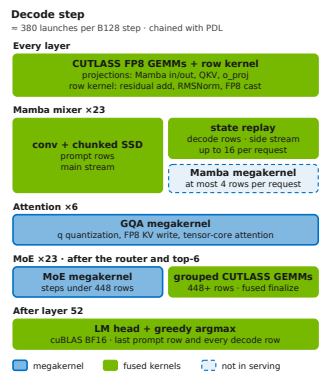
Figure 6 : Regime-aware kernel composition for the decoder step.
Original paper · CC BY 4.0 · Aditya Chatterjee, Sanjay Singh Chauhan, Mayank Jain, Arushi Dhingra, Sahin Chowdhury, Rahul Mittal · High-Throughput Serving of Nemotron 3.5 Transcribe with Regime-Aware Megakernels and Kernel Fusion · Original paper figure · Extracted the figure area from page 5 of the original PDF.Why fusion granularity is a serving problem
Under serving, batch composition shifts on each iteration, so the amount of work in a single pass keeps changing. The vLLM baseline runs each operator as its own kernel, or as a small group fused by torch.compile, and intermediate results pass through global memory between kernels. Those kernel boundaries cost memory traffic and synchronization, but fusing more work into one kernel constrains registers, occupancy and compute efficiency.
The engine therefore has to decide how far to fuse as the pass size moves across the range served.
The model pairs a speech encoder with an LLM backbone and a draft module, and it is served in two modes. Word error rate and character error rate are measured next to throughput, so every speedup is read against transcript accuracy.
The model and the workload it serves
The encoder produces 12.5 embeddings per second of audio, and the figure of the architecture shows how these pieces connect to the instruction text and the LLM.
The backbone, Nemotron 3.5 Lightning 30B-A3B, has 52 layers: 23 Mamba-2 layers, 23 MoE layers with 128 routed experts, top-6 routing and a shared expert, and 6 grouped-query attention layers. About 3.5B of its 31.6B parameters are active per token. A multi-token prediction module of 1.3B parameters serves as the draft model for speculative decoding, and a 50M-parameter CTC adapter on the ASR encoder aligns words to audio.
The primary benchmark is the English Bias corpus test split, which has 4,820 single-speaker recordings totaling 15.36 hours. Recordings run from 3.5 to 58.8 s, averaging 11.5 s, and the transcripts average 25 words. LibriSpeech test-clean and test-other serve as a second evaluation set, and a separate calibration set of 512 LibriSpeech dev utterances selects layers for the opt-in mode.
Choosing megakernels or fused kernels per pass
Each fused region has two implementations: a megakernel that runs the region in one persistent launch, and a conventional path with one kernel launch per operation, built from CUTLASS or cuBLASLt GEMMs and custom CUDA kernels.
Of the seven megakernels, two are stable and always run, and five are receding; three of the receding ones switch at runtime and two are set by the serving configuration. The ASR encoder and Sortformer switch at 384 tokens per encoder pass, and the MoE layer switches at 448 rows per decoder step. The prefill megakernel accepts at most 64 requests and 2,048 packed tokens per launch, and the Mamba decode megakernel handles at most four rows per request.
On H100, the megakernel speedup over fused kernels for the ASR encoder is 1.8× at 64 tokens, 1.0× at 384 tokens and 0.79× at 1,024 tokens. For the MoE layer the ratio runs from 1.16× at 64 rows to 1.0× at 448 rows and 0.88× at 1,024 rows.
Neither level alone is adequate: at 1,024 tokens the megakernel takes 7.66 ms per encoder pass against 6.05 ms for the fused path, while at small sizes fused kernels need 549 launches per encoder pass against four for the megakernel. Prefill rows take 24.1% to 46.2% of end-to-end time across batch sizes 1 to 512, so the prefill path matters across most of the load range.
Encoder passes on either side of 384 tokens
In the encoder, one pass covers all the audio admitted in that iteration, so the pass size is set by how much audio is admitted. In steady-state B128 serving, passes carry 1,218 to 1,798 tokens with a median of 1,690, and each takes 8.8 ms of the 55 ms iteration on H100 NVL. Under light load a 5- to 10-second utterance is 63 to 125 tokens, which falls well below the switch point.
At 64 tokens the projections expose only 10 to 40 output tiles, so split-K scheduling raises the parallel work to 50 to 80 tasks.
Each phase boundary costs a grid barrier rather than a kernel launch, so the whole pass needs four launches where the fused path needs 549.
Beyond 384 tokens each ASR layer runs as eight kernels: four CUTLASS SM90 FP8 GEMMs with epilogues that apply weight scales, bias, residuals and GELU, and four custom kernels for QK LayerNorm with RoPE, FlashAttention-3, and two LayerNorm plus FP8 steps. Programmatic dependent launch lets each kernel start while its producer runs, which gives the 258-kernel ASR chain per pass fewer launch gaps.
The Sortformer branch runs as 289 kernels, and the two branches share all SMs on two streams of equal priority rather than a fixed split.
One backbone step for prompt and decode rows
Prompt rows are 76% of backbone rows even after prefix reuse, and a transcript token costs about four times a prompt token (60 against 16 µs at B128). Prefill takes 1.6 times as long as decode, at 36% against 22% of serving time in tuned vLLM.
The prefill megakernel is one cooperative launch of 132 persistent CTAs that runs up to 64 prompts and 2,048 tokens through all 52 layers, with one pipeline shared by the Mamba-2, GQA and MoE operators.
A B128 decode step launches about 380 kernels, chained with PDL, and the GQA megakernel runs on every iteration. Below 448 rows the MoE layers use the MoE megakernel, and above that they use grouped CUTLASS GEMMs, with the shared expert treated as a 129th group.
Draft model and the argmax head
Mean acceptance length, written MAL(K), is one plus the sum over i from 1 to K of the product over j from 1 to i of the acceptance probabilities p_j, where p_j is acceptance at position j conditional on the earlier drafts being accepted. The measure counts emitted tokens per verification, including one bonus or correction token. With measured probabilities of 0.971, 0.977, 0.939, 0.931 and 0.931, MAL(5) is 5.41 tokens.
The draft runs as one cooperative launch of 264 persistent CTAs, two per SM, with up to 16 grid barriers separating the phases of the MTP block.
Six custom kernels feed and finish the draft megakernel, and the CTC hint head drafts from the encoder side.
Opt-in switches and their WER cost
Top-5 routing gave +1.5% at +1.7% relative WER and top-4 gave +3.5% at +6.2%.
Layer skipping removes whole MoE layers, with the layers chosen by greedy forward selection on 512 LibriSpeech dev utterances. Algorithm 1 implements this with a min-heap ordered by the WER increase of each candidate layer on the calibration set. The search selected 7 of 23 MoE layers (6, 8, 13, 20, 27, 38 and 43), giving 11% more throughput, and the Bias corpus is not used for the selection.
Enabling the switches together adds 13 to 16% throughput on B200 but raises WER from 1.92% to 3.44 to 3.48%. With all opt-in optimizations enabled, B200 reaches 7,414× at 1,280 requests.
Optimizations that did not pay off
The authors read the failures through a power argument: with the board drawing 400 W, time follows energy, roughly \(t \approx (e_b B + e_f \Phi)/P\), where B is bytes moved, Φ is total computation, e_b and e_f are the energy per byte and per operation, and P is the power available. Here P equals the power cap minus the static power, \(P = P_{\text{cap}} - P_{\text{static}}\), and over a full 1,280-request pass on H100 NVL board power stayed within 2% of the 400 W cap in 96% of 10 Hz samples.
The SM clock averaged 1.32 GHz against a 1.785 GHz maximum in that pass.
The classic roofline takes the longer of memory time and compute time, while the energy-roofline model adds the two, since memory and compute compete for the same power when that limit binds. The other two principles are the critical path, where the longer parallel branch sets completion time, and filling the GPU, where tiles must match the work.
H100 throughput and latency against vLLM
The vLLM baseline is NVIDIA's production configuration, vLLM 0.29.0 with the NeMo speech plugin and CUDA 13.0.2, serving the same ModelOpt FP8 checkpoint. Both systems ran on one GPU behind the same HTTP client, which sent the 4,820 requests in descending duration order with a 4 s ramp. Table 4 reports mean RTFx over three measured passes after a full-corpus warmup.
On H100 SXM at 1,280 concurrent requests the engine reached 4,345 RTFx, against 3,020 for vLLM. Throughput was 1.38 to 4.39× vLLM's on SXM and 1.40 to 2.39× on NVL, with peaks of 4,345× and 3,381×, or 1.39× and 1.40× vLLM's peak.
Under a p95 completion time limit of 400 ms, the engine serves 64 concurrent requests on H100 SXM, with 0.365 s at 64 and 0.545 s at 128, while vLLM meets the limit only up to 8. That is 8× as many requests inside the budget on H100 SXM.
The hosts differ in CPU generation and allocation, and the authors did not isolate which factor slows the SXM host path.
B200 results and the scheduler on a larger SM count
On B200 (144 SMs, 1,000 W) the engine reached 6,367 RTFx at 1,280 requests, against 3,894 for vLLM. The speedup was 3.07× at 32 requests, 3.85× at 64 and 1.64× at 1,280. From 512 requests on the gap narrows to 1.6 to 1.8×, and p95 completion time is 1.9 to 3.8× lower at every concurrency, for example 0.21 s against 0.63 s at 32. Peak GPU memory is 56.0 GiB against 73.3 GiB for vLLM.
B200 runs a separate SM100 build, because Blackwell has no wgmma, so the tensor-core paths are reimplemented with UMMA (tcgen05.mma) that accumulates in tensor memory. Persistent grids follow the 144-SM count, so the ASR and diarization megakernels split the GPU 72/72 instead of 94/38.
WER on B200 is 1.92 to 1.93% for the optimized serving, against 1.89 to 1.91% for vLLM, within 0.04 percentage points. The authors note that optimized serving on H100 SXM outperforms vLLM on B200, bridging a GPU generation with software changes alone.
LibriSpeech as a second corpus
LibriSpeech test-clean and test-other together hold 5,559 recordings totaling 10.75 hours, with a mean duration of 6.96 s against 11.47 s for the Bias corpus.
Across 32 to 1,280 concurrent requests the regime-aware serving reached 1.60× to 3.52× vLLM's throughput on H100 SXM 700 W and 1.82× to 3.90× on B200.
Combined WER is 2.437 to 2.457%, against 2.449 to 2.485% for vLLM. The authors read these results as support for applying the serving design beyond the original industrial workload, though this corpus has shorter recordings and shuffled arrivals.
Related work
Megakernel serving engines mostly target decode, whereas this engine targets a prefill-dominated workload and switches per pass, and RaMP dispatches MoE kernels from the live routing histogram rather than from pass size alone.
Limits of the measured scope
The opt-in switches trade accuracy for throughput, and with all of them enabled WER rises to 3.44 to 3.48% on B200, so they lie outside the accuracy-preserving result. The crossover thresholds were measured offline, and the authors list the question of an optimal online method for finding them as open. The authors also ask whether the operator-level granularity model suits all megakernel-receding architectures, a question this work does not test.
The H100 SXM gap at low concurrency is attributed to host behavior, but the cause was not isolated. The B200 peak of 6,367 RTFx is reported at the highest concurrency measured, and the B200 numbers come from a separate SM100 build. The LibriSpeech results use shorter recordings and shuffled arrivals, so they do not repeat the Bias corpus conditions.
The energy and roofline principles are lessons the authors draw from variants that did not land, not a fitted model of the engine.
Paper info
- Authors
- Aditya Chatterjee, Sanjay Singh Chauhan, Mayank Jain, Arushi Dhingra, Sahin Chowdhury, Rahul Mittal
- Venue
- arXiv · Preprint
- First published
- 2026-11-15
- Added
- 2026-11-17
- Updated
- 2026-11-15
- Version
- v1
- arXiv
- 2611.20095
- Category
- cs.PF · cs.DC · cs.LG · eess.AS
- Original paper terms
- CC BY 4.0
- What we show
- Paper info, commentary and permitted figures from the original paper
AI commentary is a separate explanation from the original paper and may contain errors. The original paper and figures follow each source's terms of use and any rights noted separately.
Abstract
Nemotron 3.5 Transcribe ranks first among open-weight models on the Hugging Face Open ASR leaderboards. Serving it efficiently takes more than fast operators: continuous batching changes the amount and mix of work at every iteration, and the best fusion granularity changes with it. We present a serving engine that, for every pass, chooses between persistent megakernels and chains of fused kernels at crossovers measured offline. On an H100 SXM GPU, throughput of our accuracy-preserving serving peaks at 4,345x real time, 1.39x the peak of tuned vLLM, and is up to 4.39x faster at low concurrency; on B200 it peaks at 6,367x, 1.64x vLLM at the highest concurrency we measured. Word error rate (WER) is 1.91 to 1.93% against 1.88 to 1.93% for vLLM. Within a 400 ms budget for p95 end-to-end completion time, it serves 8x as many concurrent requests. Choosing per pass beats either level alone: 23% higher throughput than always using megakernels at 128 concurrent requests, and 9% higher than always using fused kernels at 8. Opt-in switches, including greedy MoE layer skipping, add 13 to 16% throughput on B200 for offline jobs that can accept higher WER.
Quote from the paper
Aditya Chatterjee, Sanjay Singh Chauhan, Mayank Jain, Arushi Dhingra, Sahin Chowdhury, Rahul Mittal (2026). High-Throughput Serving of Nemotron 3.5 Transcribe with Regime-Aware Megakernels and Kernel Fusion. arXiv:2611.20095v1. https://arxiv.org/abs/2611.20095v1
BibTeX
@misc{chatterjee2026high,
  title = {{High-Throughput Serving of Nemotron 3.5 Transcribe with Regime-Aware Megakernels and Kernel Fusion}},
  author = {Aditya Chatterjee and Sanjay Singh Chauhan and Mayank Jain and Arushi Dhingra and Sahin Chowdhury and Rahul Mittal},
  year = {2026},
  eprint = {2611.20095},
  archivePrefix = {arXiv},
  url = {https://arxiv.org/abs/2611.20095v1}
}