論文解説
Federated Dataset Simulation: Inducing Label-Free Heterogeneity Across Tasks
Federated Dataset Simulation:ラベルを使わない異質性をタスク間で誘導する
- 課題 ラベルに基づくDirichlet分割は、分類以外のタスクには適用しにくいです。
- 手法 表現関数と割り当て機構に分けた枠組みで、事前学習済み埋め込みによる幾何学的分割と、VLMとLLMを基準にした意味的分割を用います。
- 結果 Tiny ImageNetのK=10では、幾何学的分割のMMDは9.70×10⁻²で、Dirichlet α=0.1の0.55×10⁻²より高くなりました。
ラベルに基づく分割の限界
連合学習の評価は、多くの場合、中央の分類データセットをDirichletのラベル偏りで仮想クライアントに分割して行われます。この方式は、クライアント間の違いをクラス比率という一つの軸に限定し、サンプルごとに一つのクラスラベルがあることを前提とします。そのため、分割、機械翻訳、音響イベント検出のように、サンプルが単一のカテゴリに属さないタスクには直接使えません。この論文は、このような状況で中央データセットを連合ベンチマークに変換する作業を、Federated Dataset Simulation(FDS)というタスクとして定式化しています。
Φとπで分ける分割の構造
FDSは、表現関数Φと割り当て機構πに分かれます。Φは入力を、異質性に関係する変動軸を含む潜在空間に写像し、πはその空間でサンプルを仮想クライアントに割り当てます。ラベルに基づくDirichlet分割は、Φ(x)=yという特殊な場合として表されます。この枠組みでは、幾何学的分割は事前学習済みエンコーダの埋め込みをΦgeoとして使い、k-meansでクラスタリングして、サンプルを最も近い中心に割り当てます。意味的分割は、VLMとLLMを使ってサンプルごとの基準ラベルのタプルを作り、product-of-Dirichletsの方法で割り当てます。どちらの方法もラベルを使わず、Φ(x)に依存します。
意味的分割では、クライアントmが基準cの値ℓを好む重みをpm,c[ℓ]と書き、サンプルの割り当て確率は基準ごとの選好の積に比例します。
異質性の指標とFL性能の比較
異質性は、ラベル空間のJSDと、固定したInceptionV3の活性値空間におけるMMD、FID、中心点間の距離で測定しました。Tiny ImageNetでK=10のとき、幾何学的分割はJSDが0.655、MMDが9.70×10⁻²でした。同じ条件のDirichlet α=0.1はJSDが0.572と高かったものの、MMDは0.55×10⁻²にとどまりました。これは、ラベル偏りの分割はクラス構成を変えても、サンプルの見た目はそれほど大きく変えないという著者らの解釈と一致します。密な予測タスクでは、Randomが唯一の既存ベースラインでした。
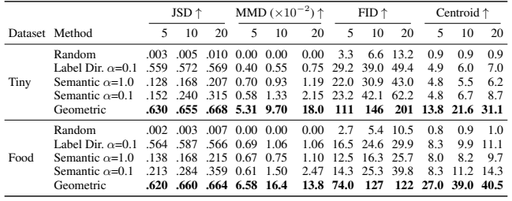
Table 1 : Heterogeneity metrics on classification datasets across client counts K ∈ {5, 10, 20}. JSD measures label-distribution divergence; MMD, FID, and centroid distance measure feature- distribution divergence (computed in InceptionV3 activation space). Higher values indicate greater heterogeneity. Geometric partitioning uses no labels yet induces the highest heterogeneity across all metrics, including JSD.
出典 · CC BY 4.0 · Vasilis Siomos, Lam Ngo, Jonathan Passerat-Palmbach, Giacomo Tarroni · Federated Dataset Simulation: Inducing Label-Free Heterogeneity Across Tasks · 論文の図を引用 · 元のPDFの5ページ目から図の部分を抽出しています。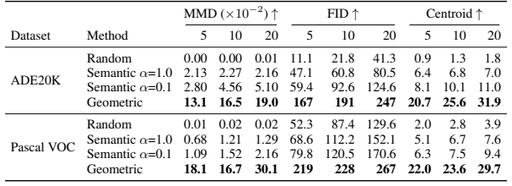
Table 2 : Heterogeneity metrics on dense prediction datasets. Dirichlet label-skew partitioning is inapplicable to segmentation and detection, so Random is the only existing baseline. Geometric and semantic partitioning are the first methods to produce non-trivial heterogeneity for these tasks.
出典 · CC BY 4.0 · Vasilis Siomos, Lam Ngo, Jonathan Passerat-Palmbach, Giacomo Tarroni · Federated Dataset Simulation: Inducing Label-Free Heterogeneity Across Tasks · 論文の図を引用 · 元のPDFの5ページ目から図の部分を抽出しています。適用範囲と残された課題
現在の評価はコンピュータビジョンのタスクに限られています。意味的分割のパイプラインはVLMとLLMの出力の品質と一貫性に依存するため、ノイズが混じる可能性があります。幾何学的分割が明らかにする違いは内容やシーンに近く、機器、センサー、圧縮といった取得要因には、別の表現関数が必要です。また著者らは、FLの性能が大きく下がることが、より現実的なベンチマークを意味するわけではないと見ています。
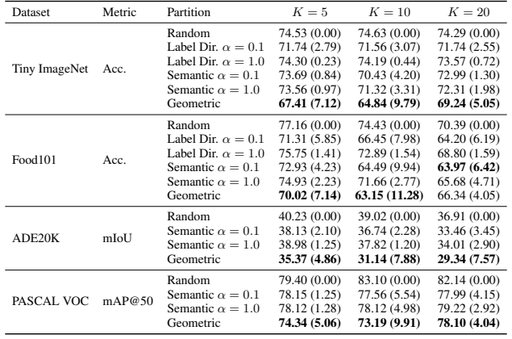
Table 3 : Downstream FL performance under FedAvg across datasets and client counts. Parentheses report degradation relative to random partitioning. Lower non-random performance within each dataset/client-count block in bold. Label Dirichlet baselines are omitted for dense prediction tasks because they do not provide a single sample-level class label.
出典 · CC BY 4.0 · Vasilis Siomos, Lam Ngo, Jonathan Passerat-Palmbach, Giacomo Tarroni · Federated Dataset Simulation: Inducing Label-Free Heterogeneity Across Tasks · 論文の図を引用 · 元のPDFの7ページ目から図の部分を抽出しています。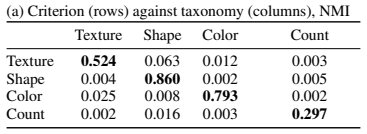
Table 7 : Clevr-4 validation of the semantic pipeline (InternVL3.5-38B and Llama 3.3-70B). (a) NMI between the partition produced for each criterion and each annotated taxonomy. (b) AMI between the four criterion partitions. (c) AMI between the four annotated taxonomies.
出典 · CC BY 4.0 · Vasilis Siomos, Lam Ngo, Jonathan Passerat-Palmbach, Giacomo Tarroni · Federated Dataset Simulation: Inducing Label-Free Heterogeneity Across Tasks · 論文の図を引用 · 元のPDFの23ページ目から図の部分を抽出しています。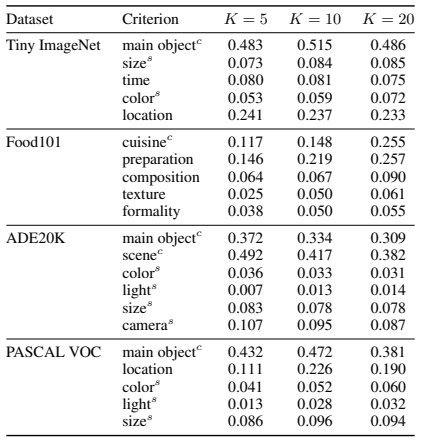
Table 8 : AMI between each geometric partition and the pure-criterion partition of each criterion, for K ∈ {5, 10, 20}. cContent criteria. sCriteria of lighting, color, camera, and size.
出典 · CC BY 4.0 · Vasilis Siomos, Lam Ngo, Jonathan Passerat-Palmbach, Giacomo Tarroni · Federated Dataset Simulation: Inducing Label-Free Heterogeneity Across Tasks · 論文の図を引用 · 元のPDFの24ページ目から図の部分を抽出しています。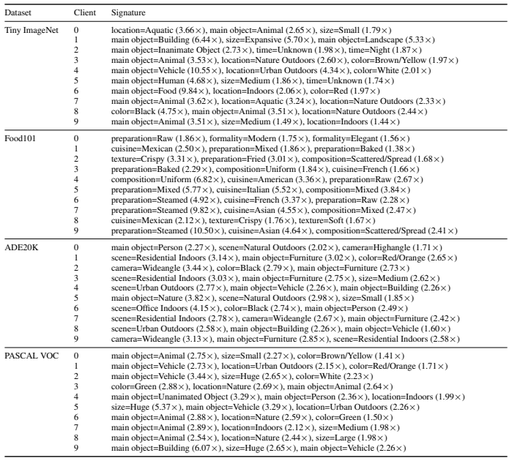
Table 9 : Client signatures of the geometric partitions at K = 10: for each client, the three criterion values with the largest lift (client rate over global rate) among values covering at least 5% of the client.
出典 · CC BY 4.0 · Vasilis Siomos, Lam Ngo, Jonathan Passerat-Palmbach, Giacomo Tarroni · Federated Dataset Simulation: Inducing Label-Free Heterogeneity Across Tasks · 論文の図を引用 · 元のPDFの25ページ目から図の部分を抽出しています。論文情報
- 著者
- Vasilis Siomos, Lam Ngo, Jonathan Passerat-Palmbach, Giacomo Tarroni
- 学会・ジャーナル
- arXiv · プレプリント
- 公開日
- 2026年11月15日
- 登録日
- 2026年11月17日
- 更新日
- 2026年11月15日
- バージョン
- v1
- arXiv
- 2611.19975
- カテゴリ
- cs.LG · cs.AI
- ライセンス
- CC BY 4.0
- 掲載内容
- 論文情報・解説・論文の図
この解説は、Refivuの韓国語解説をAIで翻訳したものです。不正確な翻訳や誤りが含まれる可能性があります。論文と図の利用条件は各出典に従います。
アブストラクト
Federated Learning enables collaborative model training across decentralized clients without sharing raw data. While the field has seen rapid growth, the datasets underpinning FL evaluation have not kept pace: real federated datasets remain scarce, and most studies rely on small-scale centralized classification datasets partitioned via Dirichlet label skew, a one-dimensional proxy for the multi-dimensional heterogeneity present in real federations. Moreover, label-based partitioning is by construction inapplicable to non-classification tasks such as segmentation and detection, for which no principled simulation method exists. We cast the conversion of centralized datasets into federated benchmarks as the task of Federated Dataset Simulation (FDS), and decompose it into a representation function $Φ$ and an assignment mechanism $π$. We provide two label-free instantiations -- geometric partitioning via pretrained model embeddings and semantic partitioning via vision-language model-derived criteria -- applicable to classification and dense prediction tasks alike. We evaluate across four datasets spanning classification, segmentation, and detection, and show that both methods induce heterogeneity that matches or exceeds that of label-skew partitioning, with measurable impact on downstream FL performance. We release fds, a modular open-source package for end-to-end federated dataset simulation, heterogeneity measurement, and FL training, at https://github.com/siomvas/fds.
この論文を引用
Vasilis Siomos, Lam Ngo, Jonathan Passerat-Palmbach, Giacomo Tarroni (2026). Federated Dataset Simulation: Inducing Label-Free Heterogeneity Across Tasks. arXiv:2611.19975v1. https://arxiv.org/abs/2611.19975v1
BibTeX
@misc{siomos2026federated,
  title = {{Federated Dataset Simulation: Inducing Label-Free Heterogeneity Across Tasks}},
  author = {Vasilis Siomos and Lam Ngo and Jonathan Passerat-Palmbach and Giacomo Tarroni},
  year = {2026},
  eprint = {2611.19975},
  archivePrefix = {arXiv},
  url = {https://arxiv.org/abs/2611.19975v1}
}