Paper commentary
Blind Spots Travel, Knowledge Stays Home: What RL Inherits from an LLM Judge
LLM judge doubts teach RL students to refuse whole question categories
- Problem LLM judges reward answers where no answer key exists, hoping their knowledge reaches the trained model. Instead, a judge's doubt about a question kind can teach the model to refuse that whole kind.
- Method The own vote rewards a student for the answer most of its own untrained samples agree on, with no labels and no judge.
- Results Own-vote training earned within 0.2 points of the answer key's reward on new questions, averaged over six student-dataset pairs.
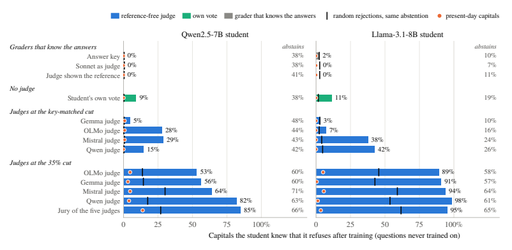
Figure 1 :What each grader does to a kind of question, at every level of abstention: capitals a student knew before training and refuses afterwards, on questions never used in training. Bars: 270 former states. Dots: 65 present-day states. Ticks: students trained with the answer key plus random rejections that abstain equally often. Right: the share of held-out PopQA questions the students abstain on. A judge’s cut is the threshold on its probability of correctness: the 35% cut accepts 35% of the untrained student’s answers, the key-matched cut as many as the answer key (for Qwen the same as the 50% cut). At the 35% cut every reference-free judge removes most former-state capitals and leaves the present-day ones. At the key-matched cut two of the four judges already cost Llama 38–42%, at an abstention close to that of the student’s own vote. Graders that know the answers remove at most 2%, and the student’s own vote removes one in ten.
Original paper · CC BY 4.0 · Liang Yue, Eric A. Vance · Blind Spots Travel, Knowledge Stays Home: What RL Inherits from an LLM Judge · Original paper figure · Extracted the figure area from page 2 of the original PDF.Where a judge's doubt goes
Where no answer key exists, an LLM judge reads the question and a candidate answer and returns a probability that the answer is correct. The hope is that the judge's knowledge reaches the model it trains, so the model learns to answer what is right and to abstain otherwise. The study asks what a student actually takes from such a grader onto questions it never saw in training.
The answer depends on whether a verdict concerns a single answer or a whole kind of question.
The sharpest case is the capitals of former states, where a judge's doubt became a refusal rule for the whole category. The training set held 17 questions about the capital of a former state, and the student answered twelve of them correctly. The judge rejected eleven of those twelve answers, so eleven examples taught the student to give up the category.
The judge was not ignorant, since it gave 0.96 to 'Rome' for the Roman Republic, but its strict cut accepts only answers scored above 0.98. Accuracy and abstention rates don't reveal this loss, because the student still knows the answers it now refuses.
Setup: students, graders and cuts
The student either answers a short factual question or says 'I don't know', and the reward is 1 for an accepted answer, 0 for a rejected one and 0.5 for refusal. Each run uses 750 training questions from TriviaQA, PopQA or NQ-open and is tested on about 750 other questions.
The answer key matches each answer against reference strings, while five reference-free judges of similar size return a probability of correctness. Sonnet and the Qwen judge shown the reference are stronger graders, and the student's own vote is the one grader that uses no labels at all. At the default threshold of 0.5 the Qwen judge accepts 70-80% of the untrained students' answers, so its students learn to answer nearly everything.
The authors therefore raise each judge's threshold until it accepts 50% or 35% of the untrained student's answers, and they also use a key-matched cut. Truth is the answer key or a Sonnet audit, and human annotators agreed with the audit on 93% of items.
The own vote samples 32 answers per question and pays the largest group of agreeing answers when that group has at least 20 members. When no group reaches 20, the question has no key and only 'I don't know' is paid.
Single verdicts stay home
On training questions the judge paid its own student's wrong answers 34 percentage points more often than other judges did. On new questions that gap shrinks to 3 points, so about 9% of the effect carries over.
A control built on a hash of each question and answer, paying a fixed 35% of pairs, behaves the same way.
Right answers might carry over where wrong ones do not, so the authors tested them against a rule with no grader. That rule samples 32 answers and abstains where the fewest agree, at the same abstention as the trained student. Students trained with the answer key score 0.8 points below that rule on average, and the judge shown the reference scores 1.0 above it.
A linear probe on the untrained student's hidden state, used as an abstention rule, comes within 0.4 points of the key-trained student on PopQA and TriviaQA.
Own vote against graders that know the answers
That is about one answer in a hundred.
Choosing which answers to drop is where knowledge could help most, and trained students do abstain on confident errors. Blocking 'I don't know' at decoding shows the rest: the three graders' students stay within half a point of the untrained student's accuracy. Compared with own-vote students, they are 0.7 to 1.4 points more accurate, which is again about one answer in a hundred.
Own-vote training earned within 0.2 points of the answer key's reward on new questions, on average over six student-dataset pairs. The own vote is not uniform, though: for Qwen on TriviaQA it scores 3.4 points below the answer key at the single cut that was fixed for all pairs.
A lost category of capitals
Strictness alone does not explain this, because an answer key with random rejections that abstains as often still removes 50% of Llama's former-state capitals. Figure 1 shows the same pattern across every level of abstention.
For Llama, rejecting none leaves 31% of unseen former-state capitals refused, rejecting four gives 85%, and rejecting all twelve gives 97%. For Qwen the same steps give 15%, 41% and 76%.
Students go further than their judges
Each point in the comparison is one judge at one cut, set against the share of unseen known answers its trained students refuse. Llama ends up more extreme than its own judges, since OLMo rejects 84% of Llama's right former-state answers but the trained student refuses 89%. For present-day capitals the same judge rejects 46% and the student refuses 5%, so the doubt has become a property of the kind.
A refused capital is still a known capital, and blocking 'I don't know' brings it back. With refusal blocked, Llama gives the right former-state capital for 95% of those it refuses, and Qwen for 90%. Under the KL penalty, 94.5% of a trained model's right held-out answers are the answers it gave before training.
How much of an error carries over
The authors score each error type by its effect on held-out questions divided by its effect on training questions. Wrong answers that one judge pays carry 0.09 of that training effect, with an interval of 0.04 to 0.14. Placing rejections on eight visible relation types carries 0.87 of the training effect to held-out questions, which is 0.87 [0.72, 1.09].
Placing the same rejections on a random half of each type carries 0.03, with an interval of -0.03 to 0.12.
So a pattern the student can see in the question or answer travels, and a hidden one mostly does not.
Limitations
Without the KL penalty, 22-94% of answers on new questions change, against 8-17% with it.
Open-ended generation was not tested, and one attempt on a refusal task did not show judge rejections concentrating on categories. Truth is the answer key or a Sonnet audit, and Sonnet is also one of the graders being compared.
Paper info
- Authors
- Liang Yue, Eric A. Vance
- Venue
- arXiv · Preprint
- First published
- 2026-11-18
- Added
- 2026-11-20
- Updated
- 2026-11-18
- Version
- v1
- arXiv
- 2611.25191
- Category
- cs.CL · cs.AI · cs.LG
- Original paper terms
- CC BY 4.0
- What we show
- Paper info, commentary and permitted figures from the original paper
AI commentary is a separate explanation from the original paper and may contain errors. The original paper and figures follow each source's terms of use and any rights noted separately.
Abstract
LLM judges serve as rewards where no answer key exists, in the hope that their knowledge passes to the trained model. In 814 RL runs that teach 7-8B models to answer closed-book questions or abstain, we ask what passes. What a grader knows about single answers stays home. A wrong answer that a judge rewards is memorised for that one question. A model trained with the answer key, or with a far stronger judge, chooses which new questions to answer no better than the untrained model does by sampling 32 answers and abstaining where they disagree; the grader's knowledge adds about one corrected answer per hundred questions. What a grader believes about a kind of question travels. A judge that rejects eleven of the twelve correct training answers about capitals of former states teaches the model to refuse 98% of such capitals on new questions, a loss that accuracy and abstention rates do not reveal. Changing only those twelve verdicts by hand moves the refusal from 5% to 90%, even for a grader that accepts as many answers as the answer key; at that leniency, two of four judges already cost 38-42% of these capitals. The capitals are not forgotten: with "I don't know" blocked, the model answers 94% of them correctly. The grader therefore needs no knowledge of its own: rewarding the model for giving the answer that most of its own untrained samples agree on, with no labels and no judge, earns the answer key's reward and keeps the category.
Quote from the paper
Liang Yue, Eric A. Vance (2026). Blind Spots Travel, Knowledge Stays Home: What RL Inherits from an LLM Judge. arXiv:2611.25191v1. https://arxiv.org/abs/2611.25191v1
BibTeX
@misc{yue2026blind,
  title = {{Blind Spots Travel, Knowledge Stays Home: What RL Inherits from an LLM Judge}},
  author = {Liang Yue and Eric A. Vance},
  year = {2026},
  eprint = {2611.25191},
  archivePrefix = {arXiv},
  url = {https://arxiv.org/abs/2611.25191v1}
}