Paper commentary
When Does Continual Pre-Training Help? A Controlled Study of Dialectal Adaptation for Québec French
- Problem Continual pre-training is often assumed to help dialectal adaptation, but its effect can depend on the base model's starting competence, the genre and register mix of the corpus, and the evaluation task chosen.
- Method Holds the training budget at 30M tokens, adapts nine LLMs with LoRA on formal, informal and mixed Québec French variants, and scores paired Québec and standard French tasks against each model's unadapted baseline.
- Results Informal-only CPT lowers QFrCoRE in eight of nine models, by 4.0% on average.
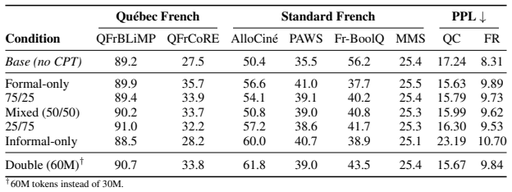
Table 3 : Continuous Register Sweep on CroissantLLM 1.35B: Results are Macro-F1, averaged over three seeds. Perplexity (PPL) is evaluated on held-out Québec French and standard French sets.
Original paper · CC BY 4.0 · Eeham Khan, Richard Khoury, Leila Kosseim · When Does Continual Pre-Training Help? A Controlled Study of Dialectal Adaptation for Québec French · Original paper figure · Extracted the figure area from page 5 of the original PDF.When a dialect gain can be trusted
Large language models usually handle the standard form of a language better than its regional varieties, and continual pre-training (CPT) is the common way to narrow that gap. CPT keeps training an existing model on dialectal text, aiming to improve regional competence while retaining what the model learned during pre-training. In these studies three things tend to change together: how strong the base model already is in the target variety, what mix of genres and registers the corpus has, and which evaluation tasks judge the result.
The study therefore asks whether the benefit depends on the base model's starting competence, whether register and genre matter more than the amount of text, and whether aggregate scores hide the task-level changes CPT produces. Prior work reports that CPT's efficacy depends on model scale and domain size, and that small or mismatched corpora can leave a stronger model unchanged or even degrade it.
Québec French is the case because paired benchmarks that target the same capabilities are available for it.
Corpus, models and benchmarks
The adaptation text is the mixed-source Québec French corpus built by Khan et al. (2026), which totals 86.7M tokens. Its formal register holds 52.5M tokens of public-domain literature, Québec Wikipedia and news, and its informal register holds 34.2M tokens of transcribed speech and colloquial text from forums and social media. Table 1 lists the nine sources with their genre, register and token count.
Nine models from three families are adapted: CroissantLLM at 1.35B, Llama-3.2/3.1 at 1B, 3B and 8B, and Qwen2.5 at 0.5B, 1.5B, 3B, 7B and 14B. Each adapted model is compared with its own unadapted baseline, and every run uses the same 30M-token budget. Adaptation uses LoRA while the base-model weights stay frozen, so the LoRA updates carry all of the change.
QFrBLiMP is a grammatical acceptability task of 1,761 sentence pairs, and QFrCoRE is a definition-matching task over 4,633 regional idiomatic multi-word expressions, where the model picks the meaning from ten candidates. The standard French controls are MultiBLiMP-Fr, with 255 sentence pairs, and MFrCoE, with 4,938 standard French expressions.
To watch for forgetting, four general standard French tasks are also scored: AlloCiné, a binary sentiment task over 20,000 movie reviews, PAWS-X, a paraphrase task on 2,000 French test samples, Fr-BoolQ, with 178 French test samples, and MMS, with 63,190 French test samples.
Scores are macro-F1 computed from length-normalized candidate log-likelihoods and averaged over three random seeds. Held-out perplexity is also computed for Québec French and for standard French.
Building budget-matched register variants
Five register variants run from formal-only (100/0) to informal-only (0/100), with 75/25, 50/50 and 25/75 mixtures between them. Within each register, sources are sampled in proportion to their share of the full corpus, so the internal source mix follows the original corpus.
A source can run short when its allocation is larger than its raw size, and CRIFUQ is the example given. Such a source is not repeated over several epochs. All its available tokens are used once, and the shortfall is filled with random sentences from other sources in the same register. This keeps the 30M budget strict and avoids overfitting the smallest domains.
Any change in the score is then tied to the missing genre's content rather than to a smaller training set.
Register effects across nine models
Under formal-only and informal-only CPT, grammatical acceptability barely moves for any of the nine models. QFrBLiMP changes by at most 2.0% and MultiBLiMP-Fr by at most 4.8% in Macro-F1. The authors read this as evidence that dialectal CPT leaves underlying syntax intact regardless of register.
Expression comprehension moves much more. Formal-only training gives higher QFrCoRE scores for almost all models, with an average advantage of 5.3 points over informal-only training. Informal-only training lowers QFrCoRE for eight of the nine models, by 4.0% on average, while raising the standard French MFrCoE by 5.0% in all nine.
QFrCoRE and MFrCoE share the same multiple-choice format, so their opposite movement points to a change in knowledge rather than a change in how the task is answered. The authors call this an evaluation trap: an informal-trained model checked only on standard French would look better, while its grasp of Québec expressions declines.
Register gradient and the volume check
CroissantLLM 1.35B is the testbed for the continuous sweep because it gained most from CPT in the register comparison. Under formal-only training its QFrCoRE Macro-F1 rises from 27.5 to 35.7.
Across five mixtures, QFrCoRE scores are 35.7 for formal-only, 33.9 for 75/25, 33.7 for mixed 50/50, 32.2 for 25/75 and 28.2 for informal-only. QFrCoRE falls as informal text replaces formal text, while QFrBLiMP has no consistent direction. The authors take this to show that the target variety's distinctive vocabulary is sparse in informal data.
The volume check uses a 60M-token mixed 50/50 condition. It reaches a QFrCoRE of 33.8, only 0.1 above the 30M-token mixed 50/50 condition at 33.7.
Which genre carries the regional expressions
Removing Québec Wikipedia, 31.2M tokens, leaves QFrCoRE at 33.8. Literary text therefore carries the regional expressions the benchmark asks for, while removing the encyclopedic source makes no difference to this score.
Grammatical acceptability stays in place across the ablations, with QFrBLiMP varying from 89.5 to 90.3. Removing BEQ also lowers Fr-BoolQ from 40.5 to 35.2 and raises standard French perplexity from 9.68 to 11.73. Removing the informal genres raises AlloCiné from 53.1 to 65.0, which the authors read as informal text interfering with sentiment ability.
The authors offer a hypothesis for the literary effect, which they have not tested. They suggest that BEQ, as public-domain Québec literature, has an older and lexically denser vocabulary, making it the likeliest source of the traditional expressions the benchmark covers.
Base model competence sets the expression gain
When adapted scores are plotted against unadapted scores, grammatical performance stays close to the diagonal, moving by at most 2.0% for any model. Expression scores behave differently: the gain depends on where the model starts. The authors read the 30M-token budget as lifting weaker models more than stronger ones.
The authors suggest the strongest models already hold much of the regional knowledge in the corpus, and that 30M tokens is too sparse to change their internal representations.
Standard French replay and its trade-offs
Replay puts 10%, 25% or 50% of the 30M budget on standard French text from a held-out corpus. It is run on the 50/50 Québec French mixture of CroissantLLM 1.35B. The authors use it to expose capability losses that averaged scores would hide.
Averaged over the four general standard French benchmarks, the score stays near 38.8 at every replay ratio, roughly 3 below the unadapted 41.9%. Read on this average alone, replay appears to restore nothing.
Fr-BoolQ recovers steadily as replay grows, from 40.8 to 50.1, a gain of 9.3%. AlloCiné falls by 7.7% over the same replay range. The authors attribute this to a trade-off: formal standard French restores logical inference but moves the model away from the colloquial language sentiment needs. PAWS-X and MMS stay flat across all replay ratios, and their stability is part of why the averaged score looks steady.
QFrCoRE stays at 33.7 under replay, so the dialectal gain survives it. Standard French perplexity falls from 9.62 to 8.47 as replay grows, which they read as broader language modelling gains. At the 25% ratio, a balanced French-English source gives Fr-BoolQ 48.0, against 48.1 for the French-only replay at the same ratio. They suggest that recovery of logical reasoning is not strictly tied to standard French exposure, since CroissantLLM is bilingual.
Why aggregate scores and perplexity mislead
The flat replay average hides opposing task shifts, so it cannot show what changed. The same masking appears during adaptation: the formal-only condition improves Québec dialect performance while Fr-BoolQ falls from 56.2 to 37.7, an 18.5% degradation.
Perplexity is often used as a stand-in when dialect benchmarks are missing. Without literary text, CroissantLLM reaches the lowest Québec French perplexity of any CroissantLLM condition, 10.46 down from 15.91, yet its QFrCoRE is the lowest at 28.3. The authors explain this by simplification: removing dense literary text makes the language modelling task easier, so perplexity improves while the dialect vocabulary is lost.
In this study, perplexity therefore appears to be an unreliable predictor of dialectal acquisition.
The authors connect this to critiques of NLP leaderboards, which argue that shortcut metrics can stand in for real capability. Their recommendation is disaggregated, per-task reporting for dialectal adaptation.
Limitations
The study covers Québec French only and relies on the COLE suite and its standard French counterparts, so the literary effect has to be checked on other dialects and languages. All models share one LoRA configuration, chosen to attribute differences to the base model and corpus and because of hardware constraints. The lack of gains for the strongest models therefore reflects this setting, not a bound on what CPT can achieve.
Full-parameter training, other LoRA ranks and learning rates, and budgets beyond 60M tokens were not evaluated. Only language understanding is evaluated, so whether CPT changes the dialect of generated text was not tested. Why literary text outperforms web data for dialectal adaptation was not investigated.
Paper info
- Authors
- Eeham Khan, Richard Khoury, Leila Kosseim
- Venue
- arXiv · Preprint
- First published
- 2026-11-18
- Added
- 2026-11-20
- Updated
- 2026-11-18
- Version
- v1
- arXiv
- 2611.24699
- Category
- cs.CL · cs.AI · cs.LG
- Original paper terms
- CC BY 4.0
- What we show
- Paper info, commentary and permitted figures from the original paper
AI commentary is a separate explanation from the original paper and may contain errors. The original paper and figures follow each source's terms of use and any rights noted separately.
Abstract
Continual pre-training (CPT) is widely used to adapt pretrained language models to dialectal and non-standard language varieties, yet it remains unclear when this additional training is necessary, what drives its benefits, and whether aggregate evaluation scores adequately capture its effects. In this paper, we present a controlled study of CPT for Québec French language understanding across nine LLMs spanning different families and scales. Using a budget-matched protocol of 30M tokens per experiment, our results show that the benefit of CPT depends strongly on the starting model's existing competence in the target variety. When CPT is beneficial, the improvements are driven more by corpus composition than by data volume, with literary text accounting for most of the gain. Paired Québec and standard French evaluations further show that CPT primarily improves expression comprehension rather than grammatical competence, and that corpus register determines which regional expressions are acquired. These gains also involve capability-specific trade-offs, including declines in reading comprehension that aggregate scores can conceal. Overall, these findings show that CPT for dialectal adaptation should not be treated as a uniformly beneficial default. Instead, adaptation strategies should begin with a careful assessment of the base model's existing competence, accompanied by source-level data analysis and task-level evaluation.
Quote from the paper
Eeham Khan, Richard Khoury, Leila Kosseim (2026). When Does Continual Pre-Training Help? A Controlled Study of Dialectal Adaptation for Québec French. arXiv:2611.24699v1. https://arxiv.org/abs/2611.24699v1
BibTeX
@misc{khan2026when,
  title = {{When Does Continual Pre-Training Help? A Controlled Study of Dialectal Adaptation for Québec French}},
  author = {Eeham Khan and Richard Khoury and Leila Kosseim},
  year = {2026},
  eprint = {2611.24699},
  archivePrefix = {arXiv},
  url = {https://arxiv.org/abs/2611.24699v1}
}