Paper commentary
RoboDx: Repair and Diagnosis of Faults in Robot Software
- Problem Not stated in the paper.
- Method Generates robot navigation repair tasks with known injected faults, grades repairs with hidden scenarios and a metamorphic check, and asks agents to name the cause from purchased probes.
- Results Claude Opus 5.5's verified two-fault repairs removed both faults in 17 of 49 cases, and it named both faults on 10 of 50 pairs without seeing the code.
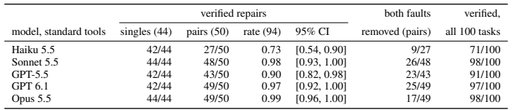
Table 3 : Repair on ROBODX-HARD-100 with standard tools, one attempt per task. The first three columns count verified repairs on the 44 singles and 50 pairs we analyse and give the rate over those 94 tasks. The interval is a 95% bootstrap interval that resamples groups of tasks built from the same faults. “Both faults removed” counts the verified pair repairs that remove both injected edits. The last column covers all 100 tasks. Three models have a verified rate near 1.00 while far fewer of their repairs remove both faults.
Original paper · CC BY 4.0 · Dan, Soham · RoboDx: Repair and Diagnosis of Faults in Robot Software · Original paper figure · Extracted the figure area from page 6 of the original PDF.Why a passing repair is not a complete one
A coding agent can satisfy every hidden check and still leave one of the injected faults in the code. Some safety-related code does nothing until another fault makes it matter, so a check on the robot's behaviour can miss it. Repair benchmarks built from repository issues grade a fix with unit tests and know only the reported bug, so a fault left behind by a repair cannot be counted.
ROBODX differs from such benchmarks in three ways: the fix is graded by how the simulated robot drives, every injected fault is known so leftovers can be counted, and a second track asks for the cause directly. A high verified repair rate can therefore make repair look finished even when faults remain.
On the 50 two-fault tasks, 17 of its 49 verified repairs remove both injected edits.
How faults are injected
Each operator belongs to one mechanism family, and the families are spatial, temporal, communication and control, with 143 operators in all.
A candidate becomes a task only if the correct renamed stack passes every hidden scenario and the faulty stack fails a behavioural requirement.
A worked task: a loud fault hiding a quiet one
The example task combines a heading gain set ten times too low with a deleted speed cap. A repair is verified only if it passes the unit tests, the 21 hidden scenarios and the metamorphic check.
The heading gain is the loud fault: lowering it from 2.0 to 0.2 makes the robot turn sluggishly and miss waypoints, and alone it fails six of the 21 hidden scenarios. The speed cap is the quiet fault. Without it, the robot holds its top forward speed through a turn and drifts wider from its route, but with the correct gain it turns fast enough that no hidden scenario fails.
Together the two faults fail 16 scenarios.
Opus restored the gain and left the cap out, and the verifier accepted the repair because the missing cap alone fails no hidden scenario.
How verification and diagnosis are scored
It combines the unit tests, the hidden scenarios evaluated against the requirements of Table 7, and a metamorphic check with three pairs per task.
It buys probes, each with a price, within a total budget of 12. For each hypothesis, the simulator computes the observation a probe would return, and that observation is the hypothesis's signature under the probe.
The EIG oracle is given every signature and chooses each probe by expected information gain. Random probing with exact inference buys probes at random and keeps only the hypotheses whose signatures match what it has observed. An answer is task-correct only if the set of hypotheses it names equals the set of hypotheses that cannot be told apart from the true one under every probe, and no partial credit is given.
What the verified repairs leave in the code
Opus has a verified repair on 98 of all 100 tasks.
On the 50 pairs, 17 of Opus's 49 verified repairs remove both edits, which gives the full-repair rate of 17 of 49. GPT 6.1 and Sonnet remove both in about half of their verified repairs, but many of their removals set a constant to another value.
Without the request for minimal, root-cause fixes, Opus removes both edits in 24 of 50 verified repairs, against 17 of 49 with the request.
Naming the cause without the code
In one diagnosis run on the running example, Opus spent its probes on a network-cut mission, a test-bench arc drive, a stream of velocity commands and a long straight, then named the low heading gain alone with confidence 0.5.
Across the 94 tasks, Opus names the cause on 32 of 44 single-fault tasks but names both faults on only 10 of 50 two-fault tasks. The most common wrong answer of Opus on pairs is one of the two faults alone, given on 16 pairs. Its other wrong answers include both faults with an extra hypothesis on 7 pairs and a hypothesis containing neither fault on 14 pairs.
Random probing with exact inference reaches 47 of 50 pairs, so the probes Opus bought often held enough information to single out both faults.
What agents lack: the simulator's signatures
With no probing and the same observations for every model, the four models name the cause on 27 to 38 of 94 tasks. On the 50 pairs they name the cause on 0 to 5 of them.
On the 50 pairs the same addition gives 48 to 50 correct answers. A plain string comparison against the table solves all 94 tasks.
The models' own predictions of the signatures give no detectable gain, since Opus is right on 40 tasks with them and on 38 without them. Two controls for Opus agree with this reading: giving every observation the probes could return, with no budget, moves its share of correct answers from 0.45 to 0.54, and a tool that returns the simulator's output on request makes Opus right on every task.
Real bug-fix pull requests
Under the strict reading, Opus is verified on 88 of 97 tasks, a rate of 0.91, and Haiku on 74 of 97, a rate of 0.76 with a 95% interval of [0.67, 0.84].
The other three models are not ordered.
Limitations
The results do not cover manipulation or perception code.
The repair prompt asks for minimal fixes, and the agents run in a custom loop without a shell. In a shell-agent check on 20 of the 50 pairs, Opus's repair was verified on all 20 and removed both faults on 8, while the custom loop removed both on 6 of 19 verified repairs.
The real set is a companion check, relies on model judges for its issue texts, and does not validate the generator.
Paper info
- Authors
- Dan, Soham
- Venue
- arXiv · Preprint
- First published
- 2026-11-18
- Added
- 2026-11-20
- Updated
- 2026-11-18
- Version
- v1
- arXiv
- 2611.23816
- Category
- cs.RO · cs.SE
- Original paper terms
- CC BY 4.0
- What we show
- Paper info, commentary and permitted figures from the original paper
AI commentary is a separate explanation from the original paper and may contain errors. The original paper and figures follow each source's terms of use and any rights noted separately.
Abstract
A patch to a robot's navigation software can pass every unit test and still drive the robot off its path. Checking how the repaired robot drives catches such patches. It does not show that the agent found everything that was wrong. We introduce RoboDx, a generator of repair tasks for simulated robot navigation software with known injected faults. A hidden verifier marks a repair as verified only if the robot then drives correctly in hidden scenarios, which the agent never sees. A second track hides the code and asks the agent to pick the cause from a list of hypotheses. A task with two faults can contain a quiet fault, a fault that makes no hidden scenario fail unless the other fault is also present. On our set of 100 tasks, RoboDx-Hard-100, almost every repair by Claude Opus 5.5 with standard coding tools is verified. We analyse 94 of the tasks, 44 with one fault and 50 with two. On the 50 two-fault tasks, only 17 of Opus's 49 verified repairs remove both injected edits. Most faults left behind are configuration constants whose correct value the task's documentation does not state. Opus names both faults on 10/50 of these tasks when it cannot see the code. We then give four current models the same measurements of each faulty robot, picked so that, in the simulator, only the true cause produces all of them. The models name the cause on at most 38 of 94 tasks. They are right on almost all when they also get the simulator's output for every hypothesis. Their own predictions of that output give no detectable gain. On 97 tasks from real bug-fix pull requests, Claude Haiku 5.5, the weakest model on the generated tasks, scores lowest, and the other three models are not ordered.
Quote from the paper
Dan, Soham (2026). RoboDx: Repair and Diagnosis of Faults in Robot Software. arXiv:2611.23816v1. https://arxiv.org/abs/2611.23816v1
BibTeX
@misc{soham2026robodx,
  title = {{RoboDx: Repair and Diagnosis of Faults in Robot Software}},
  author = {Dan, Soham},
  year = {2026},
  eprint = {2611.23816},
  archivePrefix = {arXiv},
  url = {https://arxiv.org/abs/2611.23816v1}
}