Paper commentary
Learning through Discernment: when a small language model learns from user feedback on the job, and when it decays
- Problem Learning overnight from a small model's own daily attempts needs a judge to choose the lessons. Without a true outcome, both the model's self-judgment and the user's reaction can be wrong, and a wrong lesson teaches the model to repeat the failure.
- Method Trains a frozen Qwen3 0.6B or 1.7B model with a LoRA adapter each night on lessons picked by one of five judges, including a separate frozen feedback sense built in three versions.
- Results Sense v3 kept four of its five lives near the oracle for two weeks.
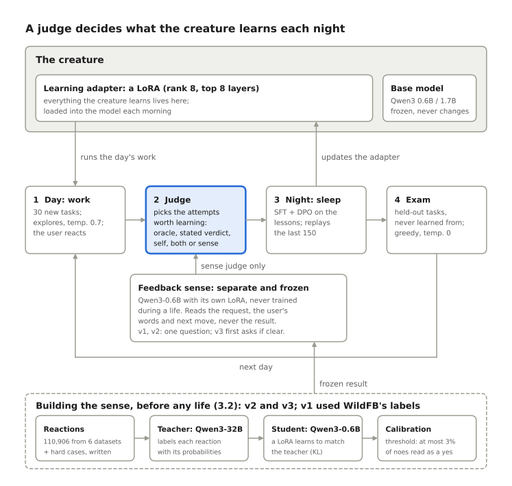
Figure 1 : The creature’s parts (top), its daily cycle (middle), the feedback sense (bottom) and how the sense was built, once, before any life (dashed); the judge, highlighted, is what the experiments vary
Original paper · CC BY 4.0 · Kongsilp, Sirisilp · Learning through Discernment: when a small language model learns from user feedback on the job, and when it decays · Original paper figure · Extracted the figure area from page 5 of the original PDF.Learning overnight without a true outcome
The study asks what happens when a small model on a device fine-tunes itself each night on its own daily attempts, with no checker to say whether each attempt succeeded. Two candidates can fill that role: the model's own judgment of its work, and the user's reaction to it. Both can fail. Models are weak at judging their own work, and users often stay courteous about failures, thanking the assistant even when the task was not done.
A wrong lesson does more than waste one attempt, because once the model trains on it, the model is pushed to repeat that failure.
How the creature learns each night
The system is called a creature. Its base model is a frozen Qwen3 model with 0.6B or 1.7B parameters, served with vLLM and thinking mode off, and its base weights never change.
A judge then decides which attempts become lessons. This judge is the one part the experiments vary.
Each night the adapter is trained with SFT and DPO on the lessons, and the training replays the most recent 150 lessons.
Each morning an exam runs fixed held-out tasks that the creature never learns from, decoded greedily at temperature 0. The exam is run on day 0 before any learning and then daily or at intervals, so each day's work starts from everything learned so far.
Five judges and the feedback sense
The oracle takes the benchmark's own score as the verdict: a reward of 0.5 or more on WebShop, or a full pass on tau2-bench. It stands in for training only on verified successes, and it is an upper bound that no deployed system has. The stated verdict applies a fixed rule with no model, so praise counts as a yes, silence or moving on counts as nothing, and any other reaction counts as a no.
Self-judging has the creature reflect on its own steps and purchase, without the user's words. The both judge adds the user's words to that reflection.
The sense answers 100, 80, 20, 0 or null. The scores 100 and 80 count as a yes, 20 and 0 as a no, and null means nothing is learned. An 80 counts as half a yes.
Its weakness was that it accepted warm thanks for a failed attempt and a lukewarm 'I guess that'll do' as approval, both with confidence above 0.9.
The second version was distilled from a teacher, Qwen3-32B, that labelled 110,906 moments from six public datasets under a written guide, plus hard cases the teacher wrote itself. The teacher's probabilities over the five answers were kept as targets. The student, a Qwen3-0.6B with a LoRA, learned to match the teacher's probabilities on 47,800 reactions by KL divergence, and its confidence threshold of 0.65 was chosen so that false accepts stayed at or under 3%.
Trained nine times, each time with one task type held out, the sense read 0.5% to 8.1% of the unseen type's noes as yeses. Writing (6.9%) and booking and ordering (8.1%) went well over the 3% target.
The teacher answered both questions for 63,248 reactions, and one LoRA learned both answers from 44,746 of them, weighting the score by how clear the teacher judged the reaction.
Benchmarks, users and protocol
The WebShop setting used here has 1,000 products, 6,910 shopping requests generated from their attributes, and 13 requests written by people, drawn from a catalogue of 1.18 million real products.
The customer is Gemini 3 Flash, and the published tau2-bench graders are used, so the scores are comparable to published ones but not identical.
The authors designed this user, so results that depend on its reactions carry that design.
The first 100 synthetic WebShop goals are held out from practice, and the exam uses 50 of them plus the 13 written by people. On WebShop an attempt with reward 0.5 or more is a lesson, and a failure is one below 0.5. Statistics treat each life as one sample, comparing groups with a Welch t-test and a Mann-Whitney U test, with Holm correction for the primary claims.
Judging itself: decline over days and a year
In Experiment 1-B, the both judge ran for a year with 5 seeds beside one oracle life. Both lives peaked near day 6 at 52, were back at 15 by day 14 and ended the year at 5, with three of the five at 0.
All four reached 46 to 53 on day 7 and fell to 26 to 38 by day 14, so none of the adapter designs stopped the decline. The authors read this as evidence that the judge's choice of lessons, not the adapter or the elapsed time, drives the decline.
Sense v1 and v2 with plain and realistic users
In Experiment 2 the sense v1 judge was compared with the oracle and the both judge over 14 days with 5 seeds, using the plain user. Sense v1 learned from only 0 to 7 lessons per life, against 247 to 274 for the oracle, and four of its five lives reached 34 to 59 by day 14. On day 14 it averaged 39.7 (standard deviation 21.3), against 16.1 for the both judge and 62.0 for the oracle.
With 5 seeds the t-test does not find either gap significant (p = 0.07 and 0.08), while a rank test puts the gap to the oracle at p = 0.01. The sense's own accuracy stayed fixed: it read 82.6% of 302 recorded reactions correctly on day 0 and 82.8% on day 14.
In Experiment 3 the user reacts as people do, and sense v2 judged the lives. Three of five sense v2 lives fell to 0 to 3 on day 1 and never recovered, while two reached 55 and 57 by day 14. One example is a shopper who asked for men's loafers in size 6.5 under $60 and bought nothing. The user thanked the assistant and left, and sense v2 scored that reaction 100 with confidence 0.92, so the attempt became a lesson.
On day 14 the sense v2 lives averaged 22.5 (standard deviation 30.8), against 62.0 for the oracle (Welch t-test p = 0.045, Mann-Whitney p = 0.01).
Changing the sleep schedule, so that each lesson counts once and the creature sleeps only after 5 lessons, reduced the collapses but did not remove them: two of five lives still ended at 0 to 3. The authors attribute the collapse to the judge rather than to the sleep schedule.
Sense v3 and the tau2-bench test
In Experiment 4 sense v3 learned from clear verdicts only, with each lesson counted once in sleep. Four of its five lives stayed near the oracle for two weeks.
Over a longer run, sense v3 lessons stayed clean but scarce, and the score faded to the level of self-judging by day 60. The authors read the late fade as a separate effect from the early one: lessons that are correct but too few to keep the skill in place.
One 1.7B life learned on day 2 from a customer who ended with thanks after the agent failed to cancel all upcoming flights, and sense v3 scored that reaction 100 with confidence 0.99.
What predicts where a WebShop life ends
Pooling 97 fourteen-day WebShop lives from Experiments 1 to 4 that learned at least once, the share of failed attempts among a life's lessons predicted its day-14 exam score closely (Spearman rho = -0.81, p < 0.001).
The number of lessons mattered less than expected: sense v1 lives learned from 0 to 7 lessons and still reached 34 to 59.
Limitations
Only the 0.6B and 1.7B Qwen3 models were studied, so whether a larger model would judge itself better, and decay less, was not tested. All users are simulated: the authors' own user on WebShop and Gemini as the customer on tau2-bench.
Paper info
- Authors
- Kongsilp, Sirisilp
- Venue
- arXiv · Preprint
- First published
- 2026-11-18
- Added
- 2026-11-20
- Updated
- 2026-11-18
- Version
- v1
- arXiv
- 2611.23716
- Category
- cs.LG · cs.AI · cs.CL
- Original paper terms
- CC BY 4.0
- What we show
- Paper info, commentary and permitted figures from the original paper
AI commentary is a separate explanation from the original paper and may contain errors. The original paper and figures follow each source's terms of use and any rights noted separately.
Abstract
Small language models on devices could keep improving by learning, overnight, from their own daily work. Without a true outcome, however, something must decide which attempts are worth learning from, and both the model's own judgment and the user's reaction can be wrong. We study a small model (Qwen3 0.6B and 1.7B) with a LoRA adapter, fine-tuned each night on the attempts a judge accepts, over 127 lives of up to a year on WebShop and $\tau^2$-bench. We compare the true outcome, the user's stated verdict and the model's own judgment with a separate, frozen "feedback sense" that reads the user's reaction, built in three versions. Judging itself, the model improved and then decayed, over a year and whatever its adapter. A sense that took polite give-ups for success collapsed 3 of 5 lives; one built for discernment, which first asks whether the user gave a clear verdict, kept 4 of 5 near the oracle for two weeks, then faded on clean but scarce lessons, to the level of self-judging by day 60. When the user cannot see the outcome ($\tau^2$-bench), the sense read reactions correctly, yet 80% of its lessons were failures the customer had thanked. Across 97 lives, the share of failed attempts among the lessons predicted the outcome (Spearman $\rho$ = -0.81). In our experiments, learning from users held up only where the judge kept failures out and the user could see the outcome; lopsided lessons may also narrow the model.
Quote from the paper
Kongsilp, Sirisilp (2026). Learning through Discernment: when a small language model learns from user feedback on the job, and when it decays. arXiv:2611.23716v1. https://arxiv.org/abs/2611.23716v1
BibTeX
@misc{sirisilp2026learning,
  title = {{Learning through Discernment: when a small language model learns from user feedback on the job, and when it decays}},
  author = {Kongsilp, Sirisilp},
  year = {2026},
  eprint = {2611.23716},
  archivePrefix = {arXiv},
  url = {https://arxiv.org/abs/2611.23716v1}
}