Paper commentary
Same Model, Different People: Numerical Execution Contracts and the Reproducibility of Fairness Audits
- Problem Not stated in the paper.
- Results Strict FP32 changed none of the 4B model's 204,204 decisions on three GPUs, while TF32 changed 41 decisions on the H100 and 39 on the RTX 4090, and no Tier 1 contract changed a verdict under the prespecified, unweighted tests.
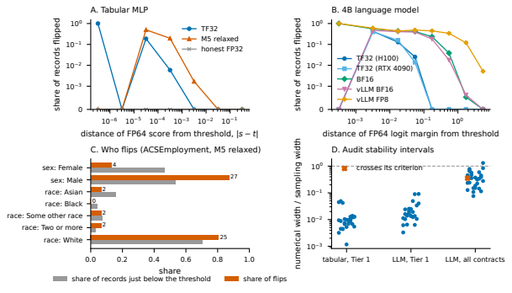
Fig. 1 . From arithmetic to audit verdict. (A) Share of the tabular MLP’s records whose decision flipped, by distance of the FP64 score from the threshold, under TF32, the M5’s relaxed default and the honest FP32 contracts. (B) The same for the 4B language model by distance of its logit margin from the threshold. (C) Under the one-signed relaxed default, each group’s share of the ACSEmployment MLP’s 31 flipped records (not its flip rate) against its share of the 71 records below the threshold, down to the deepest flip: 27 of 38 men and 4 of 33 women flipped. (D) Each audit statistic’s numerical spread over the contracts, the MI350X’s excluded, relative to its sampling interval; a cross marks an interval that crosses its criterion. Rates use reproducible flips; empty bins are not drawn.
Original paper · CC BY 4.0 · Zhang, Erzheng, Chu, Agnes · Same Model, Different People: Numerical Execution Contracts and the Reproducibility of Fairness Audits · Original paper figure · Extracted the figure area from page 11 of the original PDF.Why arithmetic belongs to an audit
A group statistic in a fairness audit is computed from thresholded decisions, so every decision's arithmetic becomes part of what the audit measures. Naming the model and framework does not settle this, because the framework version and the accelerator also determine how the function is evaluated, and a report that omits them leaves part of the audited function unstated.
Earlier work on arbitrariness in fairness has usually changed the model itself, by retraining on other hardware, pruning or quantizing it, or varying training randomness.
A second language model, Mistral Small 3.2 (24B), is scored separately against strict FP32.
How a contract flips a decision
A thresholded model gives the decision \(f_c(x)=1[s_c(x)\geq t]\), where \(s_c(x)\) is the score computed under execution contract \(c\) and the threshold \(t\) is fixed before scoring.
The score error is \(\delta_c(x)=s_c(x)-s(x)\), measured against a reference score \(s(x)\). A decision changes only when the score lies within the size of this error of the threshold, so a flip needs \(|s-t|\leq|\delta_c|\). A score that lands exactly on the threshold counts as positive, and the exact ties this rule decides are reported in an appendix.
Error of both signs pushes records across the threshold in both directions, while one-signed error moves records only onto the groups on one side. All 31 flips of the ACSEmployment MLP under the M5 relaxed default went in one direction.
The reference is FP64 for the tabular models and the 4B model, and strict FP32 for the 24B model, and the controls support FP64 as a reference at the operating points the study fixes in advance.
Tier 1 arithmetic against a strict control
The one exception to repeatability was vLLM BF16, which did not reproduce its scores bit for bit.
TF32 changed the 4B model's decisions on both NVIDIA GPU generations, 41 on the H100 and 39 on the RTX 4090, which is at most 0.035% of a dataset. The deployment configurations changed far more decisions, up to 4.123% of the Diabetes decisions under FP8 serving.
Every Tier 1 flip of the language model lay close to the threshold, since no TF32 flip had a logit margin above 0.0817. The FP8 deployment contract reached further, to a logit margin of 8.3577.
Of 120 verdicts of the pass-fail or four-fifths type, 11 sat within first-order reach of a Tier 1 flip, and none of them changed.
Which people flip
Their Jaccard index, the overlap of two sets divided by their union, was 0.38 pooled over the four tasks and ranged from 0.31 to 0.67 by task. Under a chance model that matches flips by task, side of the threshold and margin bin, the H100 and RTX 4090 expected 13.7 shared records rather than the observed 22, which gives a chance Jaccard index of 0.21.
The authors read this as individual-level arbitrariness with a single fitted model, in the sense used by Cooper et al. The tabular flips were more stable across hardware than the language-model flips.
A contract with one-signed error sets a direction for who flips: men held 27 of the ACSEmployment MLP's 31 one-way relaxed flips. The authors report this as a mechanism rather than a disparity.
Deployment configurations and verdict changes
In an exploratory post hoc split, deployment contracts changed 6 of the 17 pass-fail verdicts whose FP64 sampling interval contained 0.05, and none of the other 43. Their FP64 gaps lay between 0.0024 and 0.0214 from 0.05, so the contrast is descriptive, not a tested rule.
Of the five Tier 2 significance changes, two, both the 4B model's Diabetes changes by sex, survived pooled, Wald and patient-clustered variances. The three tabular significance changes by race recurred under at most two of the tests and under no clustered, adjusted test.
The 4B model ranks near chance on this task, so these counts show decision sensitivity rather than clinical harm.
The 24B employment audit under FP8
For the 24B model's ACSEmployment audit by sex on 20,000 records, strict FP32 gave a demographic-parity gap of 0.0567 and an equalized-odds gap of 0.0515.
FP8 serving selected 54.4% of records against 44.7% under strict FP32, with a base rate of 45.4%. When each contract selects strict FP32's 8,948 records by its own margin, FP8's demographic-parity gap is 0.0541, which fails, and its equalized-odds gap is 0.0481, which passes. vLLM BF16 gave 0.0581 and 0.0513 under the same matched selection, and both fail.
FP8 raised 84% of the margins, by a mean of 0.41 logits, and its rank correlation with strict FP32 was 0.969. Of its 2,156 flips, 2,044 selected a record that strict FP32 had not selected. The demographic-parity pass for FP8 rests on the operating point, and its equalized-odds pass does not hold as a robust result, so FP8 is not shown to be fairer.
An audit stability protocol and its cost
Before scoring, the auditor declares the set C of admissible contracts, which includes the deployment contract, a strict FP32 control and a reference. For a statistic M, the stability interval spans the smallest to the largest value over every run of every contract in C.
The protocol separates three claims of different cost: reproducing one deployment, portability across deployments, and sampling uncertainty. Of the 96 ACS reference verdicts, survey weights changed 4.
Strict FP32 cost 7.55 times the GPU time of BF16 on the same GPU, and the multiple also includes a change of attention kernel. The multiple on an RTX 4090 was 1.59, so the cost depends on the accelerator. For the 24B model, strict FP32 cost 6.33 times TF32's GPU time, and 22.5 times BF16's on one H100, at 115.68, 18.27 and 5.14 GPU-hours per million decisions.
Limitations
No clinical deployment data were used.
Paper info
- Authors
- Zhang, Erzheng, Chu, Agnes
- Venue
- arXiv · Preprint
- First published
- 2026-11-18
- Added
- 2026-11-20
- Updated
- 2026-11-18
- Version
- v1
- arXiv
- 2611.23657
- Category
- cs.CY · cs.LG
- Original paper terms
- CC BY 4.0
- What we show
- Paper info, commentary and permitted figures from the original paper
AI commentary is a separate explanation from the original paper and may contain errors. The original paper and figures follow each source's terms of use and any rights noted separately.
Abstract
Fairness audits treat a trained model as a fixed decision function, but the arithmetic that evaluates it is part of that function. This study holds the model, records, threshold and audit code fixed and varies the numerical execution contract in two tiers. Tier 1 changes only how products and sums are computed, with the serialized weights byte-identical, and is the causal test of arithmetic. Tier 2 runs reduced-precision deployment configurations (BF16 compute, FP8 and 8-bit weights), which can also round weights and change engines and kernels, so its effects belong to the configuration. It audits three tabular model families and two open-weight language models (4B and 24B parameters) on four public tasks, including hospital readmission, on CPUs and GPUs from NVIDIA, AMD and Apple. Tier 1 changed decisions near the threshold, and which ones depended on the GPU and its software stack, but no verdict under the prespecified, unweighted tests. Tier 2 configurations changed more decisions and some diagnostic verdicts, but no four-fifths verdict. Serving the 24B model with vLLM FP8 selected 54% of people rather than 45% and passed an employment-status audit by sex that its strict FP32 reference failed: its demographic-parity and equalized-odds gaps fell from 0.0567 and 0.0515 to 0.0417 and 0.0394, against a diagnostic tolerance of 0.05. At the reference's selection count FP8 failed demographic parity, and no reading gave its equalized-odds change a paired interval excluding zero. The declared audit depends on the configuration; FP8 is not shown to be fairer. At the frozen thresholds, every pass-fail verdict a configuration changed had a sampling interval containing its criterion. It proposes an audit stability protocol in which the auditor declares contracts, groups, weights and tests before scoring and records each verdict's range over them apart from its sampling uncertainty.
Quote from the paper
Zhang, Erzheng, Chu, Agnes (2026). Same Model, Different People: Numerical Execution Contracts and the Reproducibility of Fairness Audits. arXiv:2611.23657v1. https://arxiv.org/abs/2611.23657v1
BibTeX
@misc{erzheng2026same,
  title = {{Same Model, Different People: Numerical Execution Contracts and the Reproducibility of Fairness Audits}},
  author = {Zhang, Erzheng and Chu, Agnes},
  year = {2026},
  eprint = {2611.23657},
  archivePrefix = {arXiv},
  url = {https://arxiv.org/abs/2611.23657v1}
}