Paper commentary
Benchmarking Large Language Models for Linguistic Annotation
- Problem Published LLM annotation results rarely record the prompts, settings and evaluation details needed to judge whether the labels can support a linguistic analysis.
- Method dhAIBench sends each node to a model as its own request, records prompts, settings and predictions, and scores them against reference labels, with optional validators and a metrics dashboard.
- Results gemini-3-flash-preview reached 98.74% accuracy and 92.70% Macro F1 on Old English lemmatization after validator feedback.
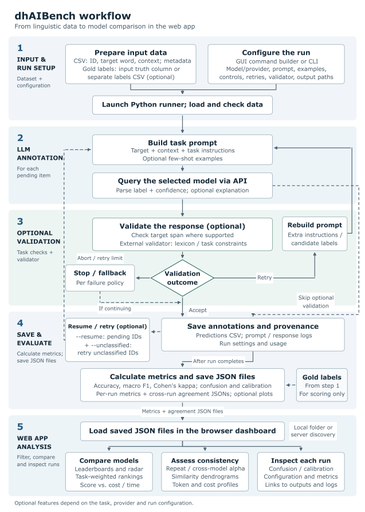
Figure 4 :Workflow flowchart
Original paper · CC BY 4.0 · Ondřej Tichý, Anna Marklová, Barbora Bulantová, Magdalena Titlbachová, Jiří Milička · Benchmarking Large Language Models for Linguistic Annotation · Original paper figure · Extracted the figure area from page 6 of the original PDF.Why an annotation claim needs its own evaluation
LLMs allow such instructions to be written in ordinary language, including for categories that existing software serves poorly, but whether their labels count as dependable evidence depends on conditions that have to be checked. Published reports often leave out model versions, prompts, generation settings or evaluation steps, which makes the results hard to reproduce or compare.
General leaderboards do not address annotation tasks, so a researcher needs a way to judge whether a specific annotation can be automated and which model suits it.
A high match with reference labels shows that a model follows the definition used to create those labels. It does not show that the definition captures the right analysis, since disagreement between annotators can reflect defensible readings as well as error. The prompt is part of the evaluated system, so changes in wording, added examples or extra grammatical metadata alter what is being measured.
From a corpus row to one scored request
Each request covers one node and carries no earlier exchanges, so every prediction can be checked directly against the reference label for that node.
The script reads semicolon-delimited CSV files whose required columns are an ID and the node. Other columns are carried into the output unchanged and play no part in the run.
The script builds a task-level system prompt from the annotation instructions and general rules for the response, and a user prompt for each item. Because the system prompt stays identical across a task, it can be cached, which makes runs cheaper.
The model answers in JSON with a prediction, an optional explanation, a confidence value taken from its answer or from token logprobs, and echoes of the target and its source. The echo catches answers about the wrong span, but a matching echo says nothing about whether the label itself is right. Malformed answers or wrong echoes can trigger automatic retries, a setting the user controls.
Default runs are zero-shot, so the prompt contains no correct annotation, unless the user adds examples or sets a number of truth labels to supply. Model and provider identifiers, temperature, top-p, top-k where available, reasoning effort, concurrency, timeouts and retries are recorded with each run. Predictions go to CSV, per-attempt prompt logs to NDJSON, and metrics with run parameters to JSON, which can be recomputed without issuing new requests.
Resume mode reuses saved rows by ID and can re-prompt records labelled as unclassified.
External validators for large label sets
A validator is a deterministic external process that receives each prediction as one JSON message per attempt and replies over standard input and output.
In the Old English lemmatization task, predictions are matched against dictionary headwords filtered by PoS; exact matches, including orthographic equivalents, are accepted, and otherwise up to 30 near-match candidates within a distance of 1.25 are offered for a revised prediction.
What the metrics measure
Accuracy is the share of examples whose predicted label equals the gold label. Macro F1 averages the per-label scores so that rare labels count as much as frequent ones. Cohen's kappa corrects agreement for chance given the label distribution, so 1 indicates perfect agreement and 0 chance-level agreement.
Calibration is read with the Brier score, the mean squared error between confidence and correctness; Expected Calibration Error, the average gap between confidence and accuracy across bins; and Maximum Calibration Error, the largest single bin gap. For all three, lower values are better. Each model is asked to state its confidence, and the calibration charts show whether that confidence tracks correctness in a given run.
Taking the highest-accuracy run can overstate expected performance for frequent re-runs.
Nine tasks and their reference labels
The tasks were picked because conventional NLP tools did not handle them reliably, because the data and reference annotations were available, and because the authors could write prompts resembling guidelines for human annotators. Prompt length varies widely: the sentiment prompt is very short, whereas the LModE PoS prompt includes the complete CLAWS tagset and many examples.
The ADV-ing dataset has 318 manually identified adverbial -ing clauses from 108 Guardian reports on politics and current affairs, with 126 instances from the earlier period, 1953, and 192 from the later one, 2023. The three constructions are free adjuncts (216 instances), adverbial verbal gerunds (81) and absolute constructions (21).
The like dataset contains 115 instances from the demographically sampled BNC1994 and the Spoken BNC2014, labelled as discourse markers (40), clause-medial pragmatic markers (25), clause-final pragmatic markers (25), quotative markers (20) and an unclassified class (5). The task keeps the four main discourse-pragmatic functions and the propositional class, so it tests broad functional classification rather than the finer subfunctions.
The EModE normalization dataset has 7,489 token-level instances from 15 text samples; 1,941 source-reference pairs differ and 5,548 are identical. The LModE PoS dataset contains 5,681 annotated tokens tagged with 139 distinct CLAWS7 reference labels.
The sentence polarity dataset contains 10,662 snippets, evenly split into 5,331 positive and 5,331 negative examples, and its labels were derived from Rotten Tomatoes ratings. The Old English lemmatization dataset contains 2,846 tokens of Old English and Latin from Ælfric's Catholic Homilies, exported with their immediate context.
How the models compare across tasks
The study comprises 293 runs over nine tasks, 406,783 evaluated annotation instances including repeated evaluations, and 48 models. Mercury-2 is described as a diffusion model, and the rest of the models are broadly autoregressive transformers.
Subversions are grouped into families, and missing family-task scores are estimated with a two-way regression that includes family and task effects. The regression is fitted on the logit scale for Accuracy and on the original scale for Macro F1, and observed scores are left unchanged. The whiskers show 95% model-based prediction ranges for the missing-task estimates.
The Gemini family leads, with large open-weight families such as Kimi, Qwen, GLM and DeepSeek not far behind. The largest GPT and Claude models, gpt-6-astra and claude-fable-5.1, were tested only on T1, where claude-fable-5.1 narrowly beat gpt-6-astra and the open-source models but remained behind the much cheaper gemini-3.5-flash. Per-task results show Accuracy and Macro F1 for every run side by side.
Some tasks are saturated: ME disambiguation has reached a ceiling and EModE normalization is nearly there, so these tasks may mainly serve for benchmarking very small models.
Old English lemmatization with validator feedback
The validator was applied to the 13 included runs, and each run's first pre-validator prediction was compared with its final output.
Qwen3.8 27B had the largest gains, at +12.65 points in accuracy and +29.81 in Macro F1, but its final scores stayed below those of the other models. gemini-3-flash-preview achieved the highest final accuracy and Macro F1, at 98.74% and 92.70%, agreeing with 2,810 of the 2,846 reference annotations. Across 36,998 predictions, 3,418 received an intervention, 2,855 of them retries and 563 normalizations alone.
Interventions fixed 2,715 wrong predictions but changed 220 correct ones to wrong. Normalization alone was the most useful step, correcting 560 cases and harming one.
The validator lexicon does not match the gold labels in several ways: some gold headwords such as mann and menniscnes are absent, some lemmas carry a different PoS in the lexicon, and slash-separated gold labels cannot match a single-lemma prediction. Some gold labels look wrong, for example geþeoþ assigned to geþeodan rather than geþeon, so agreement with them does not measure correctness.
These cases support reading accuracy as agreement with the supplied annotations.
How stable repeated runs are
Gemini-3.1-Flash-lite and Kimi-k3 were more repeatable than GLM-5.1/3 or Qwen-3.8 27B.
Temperature was varied over 0, 0.5, 0.8, 1, 1.5 and 2 for three models.
At temperature 1.5 both of its runs failed, reducing all three measures to zero. GLM-5.1 kept accuracy at 86 to 88%, Macro F1 at 83 to 88% and κ at 0.89 to 0.92 through temperature 1, but at 1.5 κ fell to 0.74 and 28 of 345 responses failed.
Gemini-3.1 Flash-Lite was perfectly repeatable at temperatures 0 and 0.5, with κ = 1, although its prediction quality was lower; κ fell to 0.88 at temperature 2, with one failed response. Most failures came from the model not producing valid JSON at higher temperatures. The provider defaults of 0.8 for DeepSeek and GLM and 1 for Gemini lie in relatively stable ranges, but they were not uniformly the best settings in these runs.
Task-level results and error patterns
On the ADV-ing task the best run used gemini-3-flash-preview and reached around 98% in Accuracy and Macro F1, with 6 misclassifications among 318 items. Even qwen3.8-27b scored above 90%, so the task is largely saturated. Most errors were adverbial verbal gerunds classified as free adjuncts or left unclassified, a pattern shared across the models.
The authors found two gold-label misclassifications and 15 potentially ambiguous instances, and so treat the top run as comparable to an expert annotator.
EModE normalization is generally above 97% accuracy; glm-5.2 reached 97.98%, while gpt-oss-120b:free reached 32.35%. The weak result came from output format: the prediction column held labels such as normalization or no_change instead of word forms, and the expected forms sometimes appeared only in explanations. In the best run the model broke Rule 7 on proper names and changed Iuppyter to Jupiter.
Other mismatches involved Latin expressions, apostrophes and corrupted characters, and some predictions are defensible variants, such as oft for often.
On the sentence polarity task, agreement with the human annotations ranged from 92.25% (gpt-5.4-mini) to 95.25% (glm-5.1). Most disagreements involved snippets with both positive and negative aspects, where the decision is rather subjective.
Price against accuracy
Estimated price per prediction ranges from $0.00002 for Jev-1.13.0 to $0.28 for gpt-5.4-pro. At those rates, lemmatizing a corpus of 100 mil. tokens could cost as little as $500 with Jev or as much as $28 mil. with gpt-5.4-pro.
Limits of what the benchmarks show
The benchmarks cannot establish a general leaderboard, and they are unlikely to match the data and categories of most other projects. Models are continually introduced and retired, and testing every existing task with each new model would exceed the project's resources.
Accuracy measures agreement with the supplied annotations, not independent linguistic correctness. Some gold labels are inconsistent or apparently wrong, which limits the agreement that can be measured.
Coverage is uneven, so many cross-model comparisons depend on regression adjustment for missing family-task cells. Inputs, outputs and logs are not public because of dataset licensing and to limit benchmark contamination, so readers can inspect parameters and metrics but not the item data.
The pipeline separates annotation from detecting instances in unprocessed text, so the scores do not measure instance detection. Sub-token segmentation tasks, such as alliteration and multilingual morphological segmentation, are planned but not yet benchmarked.
Paper info
- Authors
- Ondřej Tichý, Anna Marklová, Barbora Bulantová, Magdalena Titlbachová, Jiří Milička
- Venue
- arXiv · Preprint
- First published
- 2026-11-16
- Added
- 2026-11-18
- Updated
- 2026-11-16
- Version
- v1
- arXiv
- 2611.21291
- Category
- cs.CL · cs.AI
- Original paper terms
- CC BY 4.0
- What we show
- Paper info, commentary and permitted figures from the original paper
AI commentary is a separate explanation from the original paper and may contain errors. The original paper and figures follow each source's terms of use and any rights noted separately.
Abstract
Assessing large language models for linguistic annotation requires task-specific evaluation under documented conditions. We present dhAIBench, a Python benchmarking and annotation tool with a web interface for exploring and sharing results. It records prompts, configurations and predictions, enabling comparisons of annotation quality, confidence calibration, repeatability and estimated cost. We demonstrate the framework and the associated methodology through 293 runs of 48 models on nine linguistic annotation tasks spanning morphology, syntax, semantics, discourse-pragmatics, spelling normalization and learner-language correction. Models achieve high agreement with reference annotations on several tasks, including those on non-standardized, historical varieties as well as requiring contextual interpretation. The results support evaluating models against specific linguistic tasks, rather than relying on general rankings. To this end, we make the current and future benchmarks publicly available at dhaibench.silent3.ff.cuni.cz.
Quote from the paper
Ondřej Tichý, Anna Marklová, Barbora Bulantová, Magdalena Titlbachová, Jiří Milička (2026). Benchmarking Large Language Models for Linguistic Annotation. arXiv:2611.21291v1. https://arxiv.org/abs/2611.21291v1
BibTeX
@misc{tich2026benchmarking,
  title = {{Benchmarking Large Language Models for Linguistic Annotation}},
  author = {Ondřej Tichý and Anna Marklová and Barbora Bulantová and Magdalena Titlbachová and Jiří Milička},
  year = {2026},
  eprint = {2611.21291},
  archivePrefix = {arXiv},
  url = {https://arxiv.org/abs/2611.21291v1}
}