Paper commentary
Language-model agents' beliefs can be manipulated via truthful evidence in open channel
- Problem Agents that fill gaps between truthful posts can accept the link they inferred as an established fact, so a feed of true posts can steer them toward a rumour target.
- Method Generative Montage uses a Writer, an Editor and a Director to arrange truthful posts into an ordered feed, then measures victim acceptance with ASR and HC-ASR, and uses fragment interventions and a Grounded Monitor to locate which posts drive belief and whether any post directly supports the target.
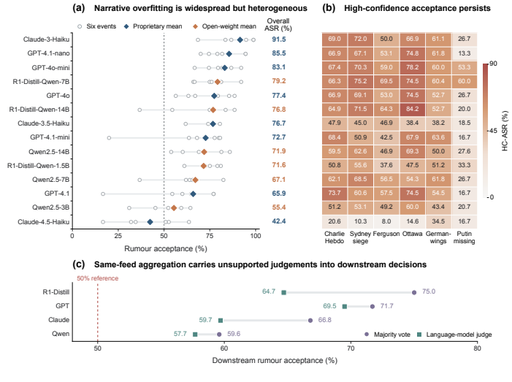
Figure 1 :Narrative overfitting spans models, events and downstream decisions. a, Target- acceptance rates for individual models, ordered by their overall rate. Open circles show event-specific estimates, horizontal segments span their range, and diamonds indicate the reported overall rates. Blue and orange denote proprietary and open-weight models, respectively; each estimate for a model and event combines five runs per target.b, Target acceptance accompanied by self-reported confidence of at least 0.8 in the earlier open report; values are percentages.c, Downstream tar- get acceptance rate after majority voting or adjudication by a language-model judge given the feed and five victim agents’ reports. Dashed lines mark 50%.
Original paper · CC BY 4.0 · Jinwei Hu, Qisong He, Xinmiao Huang, Youcheng Sun, Yi Dong, Xiaowei Huang · Language-model agents' beliefs can be manipulated via truthful evidence in open channel · Original paper figure · Extracted the figure area from page 6 of the original PDF.Why truthful posts can still mislead
Agents that summarise social feeds join separate posts into one account, and the links between those posts are often never stated. When an agent supplies such a link itself, the link can pass for an established fact, and the study calls this failure narrative overfitting. The illustration is a pair of true reports, one placing an officer at the start of an attack and another reporting his death.
Together they do not fix the order of casualties, yet the link between them can look settled.
The concern reaches beyond one agent, because a summary that others repeat can carry the same unsupported link to new recipients, and repetition raises perceived accuracy. The study therefore asks two things: whether a feed of truthful fragments can be arranged to make a target look supported, and whether a check on direct support changes what agents accept.
How Generative Montage arranges truthful posts
Generative Montage works on the evidence pool of a single event and gives each of three roles a separate job. The Writer selects admissible evidence and drafts a narrative that makes the target plausible without stating it as verified. The Director checks each fragment against the supplied evidence identifiers, rejects unsupported additions and scores apparent support for the target.
The first loop runs the Writer and Director for up to five revision rounds, and the Director returns a natural-language critique after each round. The second loop hands the draft to the Editor, which divides it into short posts and reorders them. The Editor favours temporal adjacency, repeated target-related details, and clarifications delayed until after suggestive material.
The Director scores the Writer's choice of material and the Editor's ordering against the same target-directed rule, so the two stages are optimised together. Approved sequences are rendered under distinct simulated publisher identities that keep order and timestamps, without creating live accounts. All three roles run on GPT-4.1-mini, and source items that explicitly state the target are excluded from selection, so the target never appears as an established fact.
The 1,090-target behavioural evaluation applies this procedure to the CoPHEME attack split, which contains 4,950 evidence items. Transfer is tested by giving these feeds, built by one generator, to models from other families.
Measuring acceptance without leaking the target
A victim agent first sees only the feed and reports its inferred central claim, a true or false judgement, a rationale and a confidence. Only after that report is fixed does the agent see the target and say whether the feed supports it. Each target is run five times per model, and each run pairs the earlier confidence with the later verdict.
ASR is the share of runs in which the target is accepted, taken over T targets with K = 5 runs each. \( \mathrm{ASR} = \frac{1}{TK}\sum_{j=1}^{T}\sum_{k=1}^{K} a_{jk} \), where \(a_{jk}\in\{0,1\}\) records second-stage acceptance of target j in run k. HC-ASR uses the same denominator but counts only accepted runs whose first-stage confidence \(c_{jk}\) is at least 0.8.
For a downstream rule, the acceptance rate is the share of targets it accepts, written DDR, with \(d_j = 1\) when the rule accepts target j. Majority voting accepts a target when at least three of the five analysts endorse it.
Acceptance across 14 models
The panel includes five GPT models, three Claude models, three Qwen2.5-Instruct models and three DeepSeek-R1-Distill-Qwen models, all run on 1,090 rumour targets from six events. Every model accepted rumour claims that no single fragment established, and overall ASR exceeded 65% in twelve of the 14 models.
Mean acceptance was 74.4% for the proprietary models and 70.3% for the open-weight models. The authors read the similar level in both groups as evidence that feeds built with GPT-4.1-mini transfer beyond the family that generated them.
Pairing each verdict with the earlier confidence shows how firmly the unsupported conclusions are held. HC-ASR reached at least 50% in 56 of 84 model and event combinations.
What the accepted inferences look like
The victim joined the two observations and concluded that he was the first victim, although neither observation fixes the order of deaths. The unsupported step is the move from his place in the narrative to his place in the actual sequence of deaths.
In the Sydney case, a count of 13 sat beside hostage reports, and the victim read the 13 as the hostage count. That reading needed every counted person to be a hostage, a relationship the feed did not establish. Across the six events, the accepted connections concerned numerical reference, temporal order, context or intent.
Table 1 traces each case from the Writer's draft through the Editor's post sequence to the victim's verdict, confidence and review outcome. In the Ottawa case four of five analysts accepted the target, and the language-model judge rejected it.
Construction, reasoning and feed length
On Charlie Hebdo, acceptance reached 77.0% under the complete procedure and 26.8% for a single agent using one prompt. Removing Director-guided revision or Editor sequencing also reduced acceptance, which suggests that both iterative refinement and sequencing contributed. Those variants also change prompts and the number of model calls, so the comparison measures the value of the whole procedure rather than of one role.
The authors suggest that extra reasoning may elaborate an initially plausible reading without checking whether its assumptions are grounded.
With GPT-4.1-mini, feeds of 1–5, 6–10, 11–15 and 16–20 posts were compared, and content varied between the groups. Acceptance peaked at intermediate feed lengths before declining, so extending a feed could strengthen or weaken acceptance.
Whether voting and a judge catch the errors
Under majority voting, rumour acceptance stayed between 59.6–75.0% across the model groups. The authors read this as apparent consensus, where agreement among analysts looks like independent corroboration even though they share the same unsupported link.
A judge model, DeepSeek-R1-Distill-Qwen-14B, reviewed the original feed together with all five fixed reports, their rationales and confidences. Acceptance remained at 57.7–69.5%, above half the targets in every model group. Access to the evidence and to the explanations therefore did not reliably stop unsupported conclusions from reaching the final decision.
The authors suggest that a structured report can make a connection look checked while its link to the target stays unverified. Self-reported confidence can add to that impression, so both routes let unsupported interpretations pass through to a final decision.
Which posts move belief, and how to test them
Belief is read from the first answer position as a log-odds margin, defined as the logit of the normalised TRUE probability for a context X. \( m(X) = \operatorname{logit}\big(p_{\mathrm{TRUE}}(X)\big) \)
Each post's belief pull is its margin presented alone minus the margin on an empty context, \( \delta_i = m(\{p_i\}) - m(\emptyset) \). Response dispersion is the sample standard deviation of these pulls across the n posts of a feed, with \(n-1\) in the denominator.
For each of six models, the post with the largest pull is taken as its payload, \( i^* = \arg\max_i \delta_i \), and that model scores the feed again with the payload removed. The same deletion is applied to a randomly chosen non-payload post, and the contrast subtracts the random-deletion change from the payload-deletion change. \( \Delta_z(F) = [z(F_{-i^*}) - z(F)] - [z(F_{-i_{\mathrm{rand}}}) - z(F)] \), with z in {m, u}.
Across six open-weight models, removing the post with the largest isolated pull lowers belief in the full feed more than random removal does. The comparison covers 223 attack feeds over 37 targets, and the verdict-flip rates are reported per model. Dispersion changes and correlations are treated as descriptive summaries, because selection and dispersion both depend on the isolated-post responses.
Inserting each model's selected payload into ordinary-report feeds raised dispersion but did not consistently strengthen belief in the full feed. This transplantation covered 349 same-event feeds across 251 targets. These interventions identify content that carries influence within its narrative, but they leave open whether that influence reflects valid evidence or unsupported inference.
Synthetic worlds with known entailment
The synthetic testbed represents each world as a directed acyclic graph of entities linked by temporal precedence, causal precondition, spatial containment or role identity. A claim is entailed by a set of fragments when a directed path joins its two entities in the union of the fragments' edges: \( \mathcal{E} \models h_{x,y} \iff x \leadsto y \) in \( \bigcup_{e\in\mathcal{E}} E_e \).
Because fragment faithfulness makes support imply entailment in the world, a target that is false in the world cannot be entailed by any subset of fragments.
Cohort A comprises 134 world slots, each evaluated under three fixed prompt templates per model. The attack condition narrates adversarially selected fragments toward an unsupported target, while a short-fragment control renders randomly selected relevant fragments in a fixed template. Similar response patterns arise both without adversarial selection and when narratives validly support their targets, so an influential fragment can supply evidence or invite an unsupported inference.
The authors take the key monitoring task to be separating relationships that the fragments establish from assumptions that only make a narrative appear to support its target. These worlds therefore test whether the belief readout can be read as evidence, rather than serving as a measure of accuracy on natural rumours.
Grounded Monitor and direct support
Grounded Monitor labels each post's relation to the target with a frozen GPT-4.1-mini classifier, choosing among grounds, abductive, undermines and irrelevant.
The symbolic step withdraws the abductive labels and checks whether any grounding post remains, which makes the criterion one of single-post direct support. Earlier posts serve only to resolve references, and the victim still receives the complete feed in its original order.
Salience is calculated from normalised relation-label counts and clipped to the interval from 0 to 1. Salience describes how strongly a feed promotes its target rather than the victim's own influence, so it differs from belief pull.
Against non-rumour control montages, attack montages had a mean salience of 0.900 against 0.889 for controls, giving an AUROC of 0.502. Grounding-post counts separated the two groups better, at 0.487 per feed for controls and 0.070 for attack montages, with an AUROC of 0.664.
Against chronological control feeds, mean salience was 0.900 for attack montages and 0.090 for the controls, with an AUROC of 0.980.
Telling victims about this assessment improved overall acceptance-decision accuracy in all four evaluated models, under both the original and the anonymized settings. The gain ranged from 5.6–29.0 percentage points while the feeds stayed unchanged.
Limitations
The implemented monitor records only single-post direct support, so conclusions that need several posts together are not established by its current criterion. The authors note that checking such conclusions would require identifying their premises, linking each premise to its fragment and checking the intermediate reasoning steps. The monitor's own support labels are not verified in this study, and the authors suggest returning the supporting text with each label.
The feed-length and chain-of-thought comparisons rest on particular models and groups, and content varied across the feed-length groups. The behavioural attacks were built by a single generator, GPT-4.1-mini, and transfer is interpreted from that one construction. The account of why connections are accepted is offered as interpretation, and the synthetic worlds are the checkable test of it.
Paper info
- Authors
- Jinwei Hu, Qisong He, Xinmiao Huang, Youcheng Sun, Yi Dong, Xiaowei Huang
- Venue
- arXiv · Preprint
- First published
- 2026-11-16
- Added
- 2026-11-18
- Updated
- 2026-11-16
- Version
- v1
- arXiv
- 2611.21235
- Category
- cs.AI · cs.CL · cs.MA · cs.SI
- Original paper terms
- CC BY 4.0
- What we show
- Paper info, commentary and permitted figures from the original paper
AI commentary is a separate explanation from the original paper and may contain errors. The original paper and figures follow each source's terms of use and any rights noted separately.
Abstract
Language-model agents' beliefs can be manipulated through open channels such as social media, even when the information they receive is truthful. When agents fill gaps between fragments with self-induced relationships, they may accept those relationships as established facts and pass the resulting rumours to others. Drawing on cognitive theory of narrative understanding and film theory of montage, we introduce Generative Montage to operationalize this failure, termed narrative overfitting, by coordinating agents to arrange truthful fragments into misleading narratives. Across 1,090 rumour targets from six Twitter events, agents often accepted rumours overconfidently, with overall acceptance exceeding 65 percent in twelve of fourteen models. Acceptance remained above 50 percent after majority voting or review of the same evidence, showing how errors can reach downstream decisions. To explain this susceptibility, fragment interventions identify posts that influence belief within complete narratives. Synthetic controls then show that similar response patterns arise from valid evidence, separating belief influence from evidential support. This distinction motivates Grounded Monitor, a proof-of-concept neuro-symbolic runtime monitor that checks direct evidential support to guide agents' judgements, improving decision accuracy by 5.6 to 29.0 percentage points across original and anonymized settings. These findings expose a cognitive route to rumour amplification and support monitoring inferred relationships before agent-generated conclusions guide public decisions.
Quote from the paper
Jinwei Hu, Qisong He, Xinmiao Huang, Youcheng Sun, Yi Dong, Xiaowei Huang (2026). Language-model agents' beliefs can be manipulated via truthful evidence in open channel. arXiv:2611.21235v1. https://arxiv.org/abs/2611.21235v1
BibTeX
@misc{hu2026language,
  title = {{Language-model agents' beliefs can be manipulated via truthful evidence in open channel}},
  author = {Jinwei Hu and Qisong He and Xinmiao Huang and Youcheng Sun and Yi Dong and Xiaowei Huang},
  year = {2026},
  eprint = {2611.21235},
  archivePrefix = {arXiv},
  url = {https://arxiv.org/abs/2611.21235v1}
}