Paper commentary
Breaking feature collapse in self-supervised time series encoders
- Problem General-purpose time series encoders stop gaining accuracy as they grow, and the paper ties this plateau to collapse of the encoder's output tokens.
- Method Not stated in the paper.
- Results As a frozen encoder with 7.1 M parameters it reached 70.12 % average balanced accuracy over UEA and UCR, and at 1.60B tokens its patch-token cosine similarity was 0.32 against 0.46 for OTIS under matched pre-training.
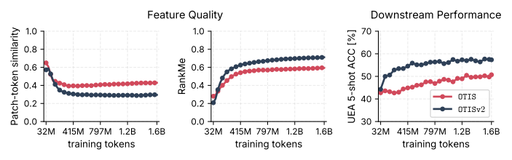
Figure 2 :Feature quality and its consequences for downstream performance.Pre-training of OTIS and OTISv2 with the same data, width, depth, optimiser, and schedule. Both use C= 6N D= 6.82×10 16 FLOPs at N= 7.1 M parameters, D= 1.60 B training tokens, and DC = 32M unique tokens.(Left)Patch-token cosine similarity ( ↓).(Centre)RankMe ( ↑) normalised by the encoder width d= 192.(Right)UEA 5-shot balanced accuracy on 23 datasets (↑). Token similarity drops in both encoders within the first 200 M tokens, then stays at 0.46 in OTIS but declines to 0.32 in OTISv2, whose5-shot lead grows to5to7pp by1.60B tokens.
Original paper · CC BY 4.0 · Özgün Turgut, Daniel Rueckert · Breaking feature collapse in self-supervised time series encoders · Original paper figure · Extracted the figure area from page 2 of the original PDF.Why larger time series encoders stall
General-purpose time series encoders are meant to serve as one backbone for many tasks and domains, yet the scaling trend seen in language and vision does not appear for them. OTIS-7.1M comes within 0.6 pp of MOMENT-308M on downstream performance across 143 datasets while being 43× smaller.
The analysis places the cause in the feature space rather than in parameter count. The output tokens of the encoder partly collapse: they resemble each other closely and occupy only part of the feature dimensions. Masked data modelling rewards accurate per-patch reconstruction but imposes no direct limit on the feature space, so the encoder can concentrate what it has learned into just a few token coordinates.
What changes in the OTIS encoder
OTISv2 keeps the OTIS pre-training recipe and the Transformer encoder-decoder layout of that model. The encoder has 7.1 M parameters in 12 blocks of width 192, with three heads and a 768-wide MLP, while the decoder has 1.7 M parameters, four blocks of width 160, and serves pre-training alone. Each variate is cut into non-overlapping patches of 24 time points, so a pre-training context of 1,008 time points gives 42 patches per variate.
Inside every block a SwiGLU MLP takes the place of the GELU MLP, and the attention and MLP output projections start at zero, so every block begins as an identity map.
Because that learnable variate embedding ties the tokeniser to domain labels, OTISv2 drops it and gives global information separate tokens. Four learnable register tokens are appended after patch embedding, next to the [CLS] token; they carry no grid position, are removed at the output, and leave only [CLS] and patch tokens for downstream use.
The motivation is that patch tokens in vision transformers can be repurposed for global computation at the cost of local detail, so registers let the patch tokens keep the local waveform structure.
Axial RoPE replaces both absolute position embeddings: each query and key is rotated by angles set by its position, so the attention logit depends only on the offset between two positions. Half of each head's dimensions rotate with the variate index and the other half with the time index; with a head dimension of 64, each half has 16 frequency pairs, and the [CLS] and register tokens are not rotated.
How the feature-space objectives are defined
Masking follows the OTIS dual scheme: post-fix masking is applied with probability 0.33 and random masking otherwise, with masking ratio 0.5 for post-fix and 0.7 for random masking. The reconstruction term is the mean squared error between each patch and its reconstruction, averaged over all patches, which gives the expression below. \[ L_{\mathrm{MSE}}=\frac{1}{N_p}\sum_{i=1}^{N_p}\lVert x_i-\mathrm{xb}_i\rVert_2^2 \] A normalised cross-correlation term penalises shape mismatch: each variate is standardised by its mean and standard deviation, the products of input and reconstruction are averaged, and the loss is one minus that value.
\[ L_{\mathrm{NCC}}=1-\mathrm{NCC}(X,\mathrm{Xb}) \]
Each sample yields two independently masked views: the student sees both, the decoder reconstructs only view u, and the teacher sees less-masked views whose visible patches include all of the student's. Separate projection heads for [CLS] and patch tokens each have 8,192 outputs. Teacher outputs are centred by an exponential moving average with momentum 0.9, and the teacher temperature is set below the student temperature of 0.1, which keeps the teacher from collapsing to a uniform distribution.
The [CLS] loss matches the sample-level distributions of the two views, while the patch loss pulls each visible student patch toward the teacher token at the same position. Because the patch loss uses teacher tokens computed from the same or more context, it gives dense supervision in feature space that masked reconstruction in input space cannot supply.
Self-distillation reduces redundancy within a sample but cannot prevent different inputs from mapping to a narrow cone of features, which is why a KoLeo term is added. For a group of 32 masked samples, the KoLeo regulariser takes the negative mean log of each sample's distance to its nearest neighbour in the group, computed on ℓ2-normalised [CLS] features.
\[ L_{\mathrm{KoLeo}}=-\frac{1}{n_g}\sum_{i=1}^{n_g}\log r_i,\qquad r_i=\min_{j\in\{1,\ldots,n_g\}\setminus\{i\}}\lVert z_i-z_j\rVert_2 \]
The total objective adds the NCC term with weight 0.1, the self-distillation terms with weight 0.1, and the KoLeo term with weight 0.025 to the reconstruction loss. These weights were set empirically, and all losses are averaged over the batch. Pre-training runs for 50 epochs on two NVIDIA A100 GPUs with AdamW, an effective batch size of 384, and a peak learning rate of 1.2×10⁻³ under a warmup-stable-decay schedule.
In the batch-size and learning-rate sweep, the 1.2×10⁻³ peak rate was the best of the settings tried at effective batch size 384.
Frozen encoders on UEA and UCR
Frozen encoders were scored with balanced accuracy on 23 UEA and 120 UCR datasets under 5-shot, k-NN and linear protocols. Nine public encoders from the UniTS, MOMENT and OTIS families are compared, but they were trained with different data, token budgets and compute, so the table is a benchmark rather than a controlled comparison.
OTISv2-7.1M reaches 70.12 % average balanced accuracy, the highest in the table, and OTIS-128M is 0.2 pp behind at 69.97 %, despite having 18× more parameters and 1.9× more training tokens. MOMENT-308M, the largest encoder, scores 1.83 pp below OTISv2-7.1M.
On the UCR linear probe, five wider encoders with width 384 to 1,024 score 0.1 to 1.0 pp higher, which the authors suggest reflects the benefit of width for a trained linear head.
Does feature-space supervision lower token similarity?
Figure 2 tracks patch-token cosine similarity, RankMe normalised by width 192, and UEA 5-shot accuracy against training tokens.
In both encoders token similarity drops within the first 200 M tokens. OTIS then stays at 0.46, while OTISv2 keeps declining to 0.32 at 1.60B tokens. The RankMe of OTISv2 rises faster and levels off higher, so the authors read the collapse in OTIS as setting in early and not being undone by further training.
Neither encoder develops the high-norm artefact tokens that large vision transformers show. For single ECG samples of the released encoders, patches in OTISv2 attend to distinct sets of patches, whereas OTIS attention maps look alike.
Does effective rank track accuracy?
Table 2 lists RankMe, patch-token similarity and UEA 5-shot accuracy for each setting, with means over three seeds.
Across the ten settings RankMe spans 51 to 65, and UEA 5-shot accuracy follows it with a Pearson correlation of r = +0.83.
Patch-token similarity does not track UEA 5-shot accuracy (r = −0.48). On the uni-variate UCR archive both measures track 5-shot accuracy, with r = +0.66 for RankMe and r = −0.85 for token similarity, although accuracy varies by only 1.8 pp across the settings.
The setting with the highest RankMe, batch size 96 at learning rate 6×10⁻⁴, also has the highest UEA 5-shot accuracy at 55.01 %. The authors note that RankMe needs no labels, so it can guide optimisation choices before any downstream evaluation.
Which change supplies the gain
Table 3 starts from the OTIS recipe and adds one component per row until it reaches OTISv2; all rows use the same FLOPs, 1.60B tokens and 7.1 M parameters, and report means over three pre-training seeds. The first three rows add architectural changes, the next four add training stabilisers, and the last three add the feature-space objectives.
Together with gradient clipping, the feature-space rows lower token similarity from 0.62 to 0.50 and raise RankMe from 60 to 75. They also raise average accuracy by 4.48 pp, which is more than the 3.93 pp total gain from OTIS to OTISv2.
Self-distillation lowers token similarity by 0.09, raises RankMe by 8, and adds 3.06 pp to UEA 5-shot and 3.15 pp to UEA k-NN accuracy. KoLeo acts only on the [CLS] token but still lowers patch-token cosine similarity, because [CLS] and patch tokens share encoder weights. Gradient clipping leaves the average accuracy essentially unchanged, at +0.08 pp.
Adding a domain token lowers the average accuracy by 1.29 pp, and registers in its place recover the same 1.29 pp at unchanged token similarity, reaching 63.69 %, the same average as OTIS. Axial RoPE raises token similarity by 0.07, the largest rise among the architectural rows, but it alone among them raises RankMe, by 6, and gives the largest UCR linear-probe gain, of 1.25 pp.
The authors conclude that a rise in token similarity need not mean a loss of rank.
Scaling under a fixed token budget
Tokens per parameter fall from 31 at 7.1 M to 1.9 at 116 M.
OTISv2 loses some rank, from 0.55 to 0.38, but keeps its similarity between 0.39 and 0.49.
The authors read the plateau as setting in at a larger size at this token budget rather than disappearing.
Limitations
The evaluation focuses on discriminative tasks, and the effect of OTISv2 on generative tasks has not been studied; zero-shot forecasting is covered only in an appendix. The pre-training corpus over-represents physiological signals, so generalisation to other time series domains needs further evaluation. The largest encoder in the scaling study has 116 M parameters trained on 221 M tokens, which is small compared with computer vision and natural language processing.
Paper info
- Authors
- Özgün Turgut, Daniel Rueckert
- Venue
- arXiv · Preprint
- First published
- 2026-11-16
- Added
- 2026-11-17
- Updated
- 2026-11-16
- Version
- v1
- arXiv
- 2611.20981
- Category
- cs.LG · cs.AI
- Original paper terms
- CC BY 4.0
- What we show
- Paper info, commentary and permitted figures from the original paper
AI commentary is a separate explanation from the original paper and may contain errors. The original paper and figures follow each source's terms of use and any rights noted separately.
Abstract
General-purpose time series encoders promise a single backbone that generalises across tasks and domains; however, they currently do not scale. We trace this down to a critical point of failure: under the predominant masked data modelling supervision, the encoder's output tokens partially collapse. This is the natural consequence of supervising encoders only in the input space, which leaves no constraint against redundant token dimensions in the feature space. We introduce OTISv2, which suppresses the collapse by complementing the reconstruction objective in input space with two objectives in the feature space: a self-distillation loss against an exponential-moving-average teacher, and a KoLeo regulariser. Under matched training, the resulting encoder reduces the cosine similarity and lifts the effective rank of its output tokens relative to its predecessor, and it scales monotonically from 7.1 M to 116 M parameters where its predecessor declines. It matches or surpasses existing general-purpose time series encoders across 143 uni- and multi-variate datasets. To foster further research, we release our code and pre-trained weights.
Quote from the paper
Özgün Turgut, Daniel Rueckert (2026). Breaking feature collapse in self-supervised time series encoders. arXiv:2611.20981v1. https://arxiv.org/abs/2611.20981v1
BibTeX
@misc{turgut2026breaking,
  title = {{Breaking feature collapse in self-supervised time series encoders}},
  author = {Özgün Turgut and Daniel Rueckert},
  year = {2026},
  eprint = {2611.20981},
  archivePrefix = {arXiv},
  url = {https://arxiv.org/abs/2611.20981v1}
}