논문 해설
Breaking feature collapse in self-supervised time series encoders
자기지도 시계열 인코더에서 특징 붕괴 깨기
- 연구 문제 범용 시계열 인코더는 파라미터를 늘려도 성능이 기대만큼 오르지 않습니다.
- 연구 방법 마스크드 재구성 목표에 EMA 교사 기반 자기 증류와 KoLeo 정규화를 더해 출력 토큰의 특징 붕괴를 억제합니다.
범용 시계열 인코더의 스케일링 정체
범용 시계열 인코더는 하나의 백본으로 여러 과제와 도메인을 다루는 것을 목표로 합니다. 그러나 이 논문은 현재의 범용 시계열 인코더가 파라미터를 늘려도 성능이 충분히 오르지 않는다고 지적합니다. OTIS-7.1M은 43배 큰 MOMENT-308M과 다운스트림 성능 차이가 0.6 pp에 그쳤고, OTIS는 43M에서 128M로 늘려도 0.8 pp만 얻었습니다. 저자들은 이 정체의 원인을 인코더 출력 토큰이 일부 차원에만 몰리는 특징 붕괴에서 찾습니다. 마스크드 데이터 모델링은 입력 공간에서 패치를 재구성하도록만 감독하므로, 특징 공간에서 중복된 토큰 차원을 막는 제약이 없습니다.
입력 공간과 특징 공간을 함께 감독하는 학습
OTISv2는 OTIS의 구조와 마스크드 재구성 목표를 유지하면서, 인코더 출력 토큰에 직접 작용하는 두 손실을 더합니다. 첫째는 EMA 교사의 출력 분포에 학생의 [CLS] 토큰과 패치 토큰 출력을 맞추는 자기 증류 손실입니다. 교사에는 중심화와 낮은 온도가 적용되어 한 차원이 출력을 지배하거나 분포가 균일하게 무너지는 것을 막습니다. 둘째는 같은 배치 그룹의 [CLS] 특징을 단위 초구면 위에 고르게 펼치는 KoLeo 정규화입니다. 자기 증류는 샘플 안의 중복을 줄이고, KoLeo는 샘플 사이의 중복을 줄입니다. 구조 측면에서는 변수 임베딩 대신 등록 토큰과 축 방향 RoPE를 써서 도메인 라벨 없이 임의의 변수 수와 길이를 처리하도록 바꾸었습니다.
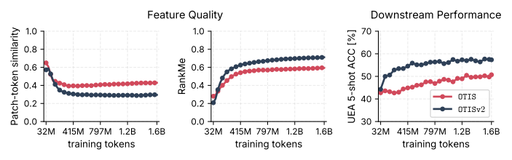
Figure 2 :Feature quality and its consequences for downstream performance.Pre-training of OTIS and OTISv2 with the same data, width, depth, optimiser, and schedule. Both use C= 6N D= 6.82×10 16 FLOPs at N= 7.1 M parameters, D= 1.60 B training tokens, and DC = 32M unique tokens.(Left)Patch-token cosine similarity ( ↓).(Centre)RankMe ( ↑) normalised by the encoder width d= 192.(Right)UEA 5-shot balanced accuracy on 23 datasets (↑). Token similarity drops in both encoders within the first 200 M tokens, then stays at 0.46 in OTIS but declines to 0.32 in OTISv2, whose5-shot lead grows to5to7pp by1.60B tokens.
원문 · CC BY 4.0 · Özgün Turgut, Daniel Rueckert · Breaking feature collapse in self-supervised time series encoders · 원문 그림 인용 · 원본 PDF 2쪽에서 그림 영역을 추출했습니다.토큰 랭크와 정확도의 관계
저자들은 학습 조건을 고정한 상태에서 배치 크기와 학습률만 바꾼 10개 설정을 비교했습니다. 이 실험에서 RankMe는 UEA 5-shot 정확도와 r=+0.83으로 상관했고, 패치 토큰 유사도는 r=−0.48로 정확도와 약하게 상관했습니다. 이 결과는 목적함수가 같아도 유효 랭크를 떨어뜨리는 최적화 조건이 다운스트림 성능을 제한할 수 있음을 보여 줍니다. 다만 상관 분석이므로 인과를 직접 증명한 실험으로 읽지는 않습니다.

Table 2 :Feature quality and downstream performance under a fixed objective. OTISv2-7.1M pre-trained at ten combinations of effective batch size Beff and peak learning rate η, ordered by RankMe. RankMe, patch-token cosine similarity (Sim), and UEA 5-shot accuracy (5-shot) are means over three seeds. RankMe correlates with5-shot (r= +0.83), but Sim does not (r=−0.48).
원문 · CC BY 4.0 · Özgün Turgut, Daniel Rueckert · Breaking feature collapse in self-supervised time series encoders · 원문 그림 인용 · 원본 PDF 7쪽에서 그림 영역을 추출했습니다.단계별 구성요소의 기여
OTIS에서 OTISv2로 한 구성요소씩 더한 누적 ablation에서, 특징 공간 목표를 추가한 행이 패치 토큰 유사도를 0.62에서 0.50으로 낮추고 RankMe를 60에서 75로 올렸습니다. 자기 증류는 UEA 5-shot과 k-NN 정확도를 각각 3.06 pp, 3.15 pp 올렸고 KoLeo는 추가로 두 정확도를 2.06 pp, 3.55 pp 올렸습니다. 반면 그래디언트 클리핑은 평균 정확도를 0.08 pp만 바꾸었습니다. 구조 변경 행은 평균 0.58 pp를, 안정화 기법 행은 1.13 pp를 잃었다고 보고되었습니다. 세 시드의 평균이며, 이 ablation은 같은 학습 예산의 7.1M 모델에서 얻은 결과입니다.
데이터 제약 아래의 크기 확장
4개 크기와 221M 토큰 예산에서 데이터 반복 횟수를 바꾼 실험에서, OTISv2의 UEA 5-shot 평균 정확도는 7.1M에서 116M까지 올랐습니다. 반면 OTIS는 같은 범위에서 떨어졌습니다. 저자들은 OTIS가 커질수록 토큰 유사도가 0.72에서 0.95로 올라가 붕괴된다고 해석합니다. 각 규모는 단일 시드로 학습되었으므로 약 0.6 pp 이내의 차이는 해석하지 않습니다. 또한 14.8M 이후의 이득은 작고 데이터 예산에 따라 부호가 바뀌어, 고原 plateau가 사라진 것이 아니라 더 큰 크기로 밀려난 것으로 보고합니다.
남은 한계
저자들이 밝힌 대로 실험은 판별 과제에 집중되어 있으며, 생성형 과제에 대한 효과는 아직 연구하지 않았습니다. pre-training 코퍼스는 생리 신호가 많아 다른 시계열 도메인으로의 일반화를 더 평가해야 합니다. 탐색한 최대 규모는 116M 파라미터와 221M 학습 토큰으로 컴퓨터 비전과 자연어 처리보다 작습니다. 또한 OTISv2는 OTIS보다 가산 잡음에 더 민감했고, 그 감도는 주로 [CLS] 임베딩에서 나타났습니다. 자기 증류가 쓰는 지수 이동 평균 교사 때문에 학습 메모리는 약 2.4배 늘어나지만 추론 비용은 바뀌지 않습니다.
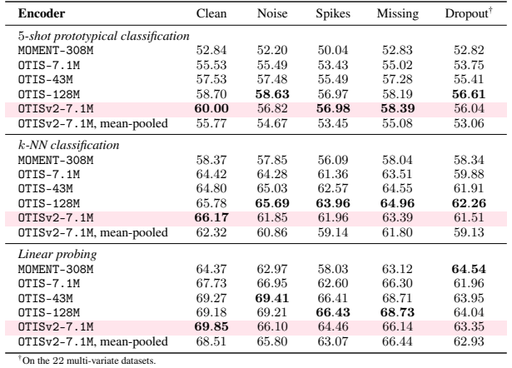
Table 11 : OTISv2 loses more accuracy under corruptions, mostly through its [CLS] embedding. Balanced accuracy (↑) on the 23 UEA datasets with clean training splits and corrupted test splits. Bold marks the best encoder per protocol and condition.UniTS and the two smaller MOMENT encoders, which lead in no setting, are omitted, and the clean accuracies reproduce Table 1 within0.1pp.
원문 · CC BY 4.0 · Özgün Turgut, Daniel Rueckert · Breaking feature collapse in self-supervised time series encoders · 원문 그림 인용 · 원본 PDF 25쪽에서 그림 영역을 추출했습니다.논문 정보
- 저자
- Özgün Turgut, Daniel Rueckert
- 학회·저널
- arXiv · 프리프린트
- 최초 공개일
- 2026년 11월 16일
- 등록일
- 2026년 11월 17일
- 수정일
- 2026년 11월 16일
- 버전
- v1
- arXiv
- 2611.20981
- 분류
- cs.LG · cs.AI
- 원문 이용 조건
- CC BY 4.0
- 제공 범위
- 논문 정보, 해설, 허용된 원문 그림
AI 해설은 논문 원문과 별개의 설명이며 오류가 있을 수 있습니다. 원문과 그림은 각 출처의 이용 조건과 따로 표시된 권리를 따릅니다.
초록
General-purpose time series encoders promise a single backbone that generalises across tasks and domains; however, they currently do not scale. We trace this down to a critical point of failure: under the predominant masked data modelling supervision, the encoder's output tokens partially collapse. This is the natural consequence of supervising encoders only in the input space, which leaves no constraint against redundant token dimensions in the feature space. We introduce OTISv2, which suppresses the collapse by complementing the reconstruction objective in input space with two objectives in the feature space: a self-distillation loss against an exponential-moving-average teacher, and a KoLeo regulariser. Under matched training, the resulting encoder reduces the cosine similarity and lifts the effective rank of its output tokens relative to its predecessor, and it scales monotonically from 7.1 M to 116 M parameters where its predecessor declines. It matches or surpasses existing general-purpose time series encoders across 143 uni- and multi-variate datasets. To foster further research, we release our code and pre-trained weights.
원문 인용
Özgün Turgut, Daniel Rueckert (2026). Breaking feature collapse in self-supervised time series encoders. arXiv:2611.20981v1. https://arxiv.org/abs/2611.20981v1
BibTeX
@misc{turgut2026breaking,
  title = {{Breaking feature collapse in self-supervised time series encoders}},
  author = {Özgün Turgut and Daniel Rueckert},
  year = {2026},
  eprint = {2611.20981},
  archivePrefix = {arXiv},
  url = {https://arxiv.org/abs/2611.20981v1}
}