論文解説
Breaking feature collapse in self-supervised time series encoders
自己教師あり時系列エンコーダにおける特徴崩壊の解消
- 課題 汎用の時系列エンコーダは、パラメータを増やしても性能が期待どおりには上がりません。
- 手法 マスクド再構成の目的に、EMA教師による自己蒸留とKoLeo正規化を加えて、出力トークンの特徴崩壊を抑えます。
汎用時系列エンコーダのスケーリングの頭打ち
汎用の時系列エンコーダは、1つのバックボーンで複数のタスクやドメインを扱うことを目指しています。しかし、この論文は、現在の汎用時系列エンコーダがパラメータを増やしても性能が十分に上がらないと指摘します。OTIS-7.1Mは43倍大きいMOMENT-308Mと下流タスクの性能差が0.6 ppにとどまり、OTISは43Mから128Mに増やしても0.8 ppしか得られませんでした。著者らは、この頭打ちの原因を、エンコーダの出力トークンが一部の次元に集中する特徴崩壊にあると見ています。マスクドデータモデリングは入力空間でパッチを再構成するよう学習させるだけなので、特徴空間で重複したトークン次元を抑える制約がありません。
入力空間と特徴空間を同時に監督する学習
OTISv2は、OTISの構造とマスクド再構成の目的を維持したまま、エンコーダの出力トークンに直接作用する2つの損失を加えます。1つ目は、EMA教師の出力分布に生徒の[CLS]トークンとパッチトークンの出力を合わせる自己蒸留損失です。教師には中心化と低い温度が適用され、1つの次元が出力を支配したり、分布が一様に崩れたりするのを防ぎます。2つ目は、同じバッチグループの[CLS]特徴を単位超球面上に均等に広げるKoLeo正規化です。自己蒸留はサンプル内の重複を減らし、KoLeoはサンプル間の重複を減らします。構造面では、変数埋め込みの代わりにレジスタトークンと軸方向RoPEを使い、ドメインラベルなしで任意の変数数と長さを扱えるように変更しました。
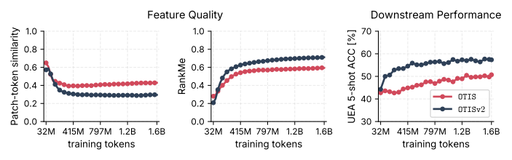
Figure 2 :Feature quality and its consequences for downstream performance.Pre-training of OTIS and OTISv2 with the same data, width, depth, optimiser, and schedule. Both use C= 6N D= 6.82×10 16 FLOPs at N= 7.1 M parameters, D= 1.60 B training tokens, and DC = 32M unique tokens.(Left)Patch-token cosine similarity ( ↓).(Centre)RankMe ( ↑) normalised by the encoder width d= 192.(Right)UEA 5-shot balanced accuracy on 23 datasets (↑). Token similarity drops in both encoders within the first 200 M tokens, then stays at 0.46 in OTIS but declines to 0.32 in OTISv2, whose5-shot lead grows to5to7pp by1.60B tokens.
出典 · CC BY 4.0 · Özgün Turgut, Daniel Rueckert · Breaking feature collapse in self-supervised time series encoders · 論文の図を引用 · 元のPDFの2ページ目から図の部分を抽出しています。トークンのランクと精度の関係
著者らは、学習条件を固定し、バッチサイズと学習率だけを変えた10個の設定を比較しました。この実験では、RankMeはUEA 5-shot精度と r=+0.83 で相関し、パッチトークン類似度は r=−0.48 で精度と弱く相関しました。この結果は、目的関数が同じでも、実効ランクを下げる最適化条件が下流性能を制限しうることを示しています。ただし相関分析なので、因果関係を直接証明した実験と捉えるべきではありません。

Table 2 :Feature quality and downstream performance under a fixed objective. OTISv2-7.1M pre-trained at ten combinations of effective batch size Beff and peak learning rate η, ordered by RankMe. RankMe, patch-token cosine similarity (Sim), and UEA 5-shot accuracy (5-shot) are means over three seeds. RankMe correlates with5-shot (r= +0.83), but Sim does not (r=−0.48).
出典 · CC BY 4.0 · Özgün Turgut, Daniel Rueckert · Breaking feature collapse in self-supervised time series encoders · 論文の図を引用 · 元のPDFの7ページ目から図の部分を抽出しています。段階ごとの構成要素の寄与
OTISからOTISv2まで構成要素を1つずつ加えていく累積アブレーション実験では、特徴空間の目的を加えた行でパッチトークン類似度が0.62から0.50に下がり、RankMeは60から75に上がりました。自己蒸留はUEA 5-shotとk-NN精度をそれぞれ3.06 pp、3.15 pp上げ、KoLeoはさらに両精度を2.06 pp、3.55 pp上げました。一方、勾配クリッピングは平均精度を0.08 pp変えただけでした。構造変更の行は平均0.58 ppを、安定化手法の行は1.13 ppを失ったと報告されています。3つのシードの平均であり、このアブレーションは同じ学習予算の7.1Mモデルで得られた結果です。
データ制約下でのサイズ拡張
4つのサイズと221Mトークンの予算で、データの反復回数を変えた実験では、OTISv2のUEA 5-shot平均精度は7.1Mから116Mまで上がりました。一方、OTISは同じ範囲で下がりました。著者らは、OTISは大きくなるほどトークン類似度が0.72から0.95に上がり、崩壊すると解釈しています。各規模は単一のシードで学習されたため、約0.6 pp以内の差は解釈しません。また、14.8M以降の利得は小さく、データ予算によって符号が変わるため、高原 plateau が消えたのではなく、より大きな規模へ移ったものと報告しています。
残された限界
著者らが述べているように、実験は識別タスクに集中しており、生成タスクへの効果はまだ調べていません。事前学習コーパスには生理信号が多く、他の時系列ドメインへの汎化はさらに評価する必要があります。探索した最大規模は116Mパラメータ、221M学習トークンで、コンピュータビジョンや自然言語処理より小さいです。また、OTISv2はOTISより加法ノイズに敏感で、その感度は主に[CLS]埋め込みに現れました。自己蒸留で使う指数移動平均教師のため、学習メモリは約2.4倍に増えますが、推論コストは変わりません。
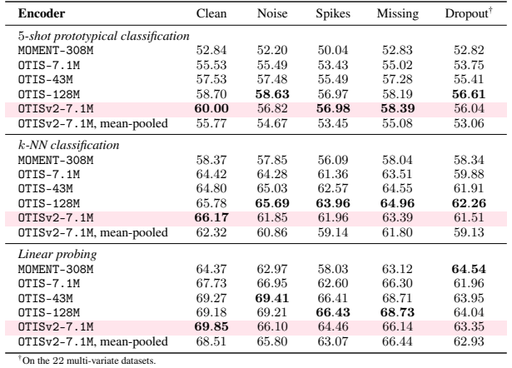
Table 11 : OTISv2 loses more accuracy under corruptions, mostly through its [CLS] embedding. Balanced accuracy (↑) on the 23 UEA datasets with clean training splits and corrupted test splits. Bold marks the best encoder per protocol and condition.UniTS and the two smaller MOMENT encoders, which lead in no setting, are omitted, and the clean accuracies reproduce Table 1 within0.1pp.
出典 · CC BY 4.0 · Özgün Turgut, Daniel Rueckert · Breaking feature collapse in self-supervised time series encoders · 論文の図を引用 · 元のPDFの25ページ目から図の部分を抽出しています。論文情報
- 著者
- Özgün Turgut, Daniel Rueckert
- 学会・ジャーナル
- arXiv · プレプリント
- 公開日
- 2026年11月16日
- 登録日
- 2026年11月17日
- 更新日
- 2026年11月16日
- バージョン
- v1
- arXiv
- 2611.20981
- カテゴリ
- cs.LG · cs.AI
- ライセンス
- CC BY 4.0
- 掲載内容
- 論文情報・解説・論文の図
この解説は、Refivuの韓国語解説をAIで翻訳したものです。不正確な翻訳や誤りが含まれる可能性があります。論文と図の利用条件は各出典に従います。
アブストラクト
General-purpose time series encoders promise a single backbone that generalises across tasks and domains; however, they currently do not scale. We trace this down to a critical point of failure: under the predominant masked data modelling supervision, the encoder's output tokens partially collapse. This is the natural consequence of supervising encoders only in the input space, which leaves no constraint against redundant token dimensions in the feature space. We introduce OTISv2, which suppresses the collapse by complementing the reconstruction objective in input space with two objectives in the feature space: a self-distillation loss against an exponential-moving-average teacher, and a KoLeo regulariser. Under matched training, the resulting encoder reduces the cosine similarity and lifts the effective rank of its output tokens relative to its predecessor, and it scales monotonically from 7.1 M to 116 M parameters where its predecessor declines. It matches or surpasses existing general-purpose time series encoders across 143 uni- and multi-variate datasets. To foster further research, we release our code and pre-trained weights.
この論文を引用
Özgün Turgut, Daniel Rueckert (2026). Breaking feature collapse in self-supervised time series encoders. arXiv:2611.20981v1. https://arxiv.org/abs/2611.20981v1
BibTeX
@misc{turgut2026breaking,
  title = {{Breaking feature collapse in self-supervised time series encoders}},
  author = {Özgün Turgut and Daniel Rueckert},
  year = {2026},
  eprint = {2611.20981},
  archivePrefix = {arXiv},
  url = {https://arxiv.org/abs/2611.20981v1}
}