論文解説
Adaptive-Elbow Graph Traversal for Schema Retrieval in Text-to-SQL
Text-to-SQLにおけるスキーマ検索のためのAdaptive-Elbowグラフ走査
- 課題 固定top-kの検索は、質問ごとに必要なテーブル数が違うため予算が合わず、埋め込みの類似度では結合に必要なブリッジテーブルを見落とします。
- 手法 質問ごとの類似度曲線のエルボーでシードテーブル数を決め、外部キーを双方向に1ホップたどってブリッジテーブルを加えます。
- 結果 BIRD mergedで1ホップの場合、再現率97%と適合率36.9%を記録しました。これは固定kのシードの適合率25.6%を上回る結果です。
テーブル選択の2つの失敗
LLMベースのtext-to-SQLでは、クエリを生成する前にスキーマ検索の段階を通す必要があります。テーブルが数百個あるデータベースでは、この段階が全体の精度の上限になります。必要なテーブルを落とすと正しいクエリは作れません。一方で多く入れすぎると、無関係なテーブルがノイズとなってモデルの出力を下げます。エージェント型の検索は正確ですが、大きなカタログ全体に適用するにはコストと遅延が大きいです。そこで、埋め込みのコサイン類似度で上位k個を選ぶ軽量な手法が代替として使われます。ただし、この手法には2つの弱点があります。1つ目は、すべての質問に同じkを適用するため、単純な質問には不要なテーブルが付き、複雑な質問では正解のテーブルが押し出されてしまうことです。
2つ目は、order_itemsのように結合に必要なブリッジテーブルは、名前や説明の意味的類似度では見つけにくいことです。この論文は、この2つの弱点をそれぞれ適応型エルボーと外部キーの走査で扱います。
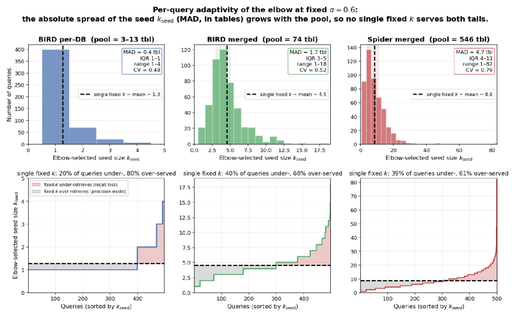
Figure 1 :Per-question variation of the elbow seed at a single aggressiveness 𝛼table=0.6.Top:distribution of the elbow seed 𝑘seed over 500 questions per corpus; the dashed line is the mean (the “fixed 𝑘”). The absolute spread (MAD, in tables) grows with the pool—0.4→1.7→4.7 tables—as does the relative spread (CV,0.48→0.52→0.79 ). Bottom:questions sorted by 𝑘seed; a single fixed 𝑘 (its mean) falls below the per-question seed for some queries (fewer tables, at risk to recall) and above it for the rest (more tables, at cost to precision), splitting them20%/80% (BIRD per-DB),40%/60%(BIRD merged), and39%/61%(Spider merged).
出典 · CC BY 4.0 · Fabio Picariello, Salvatore Cipolla, Susanna Bonura, Vito Morreale · Adaptive-Elbow Graph Traversal for Schema Retrieval in Text-to-SQL · 論文の図を引用 · 元のPDFの8ページ目から図の部分を抽出しています。質問ごとの検索予算を決める適応型エルボー
まず、各テーブルノードのスコアを、チャンクごとの最大コサイン類似度で計算します。そのスコアを降順に並べ、類似度の曲線を作ります。この曲線は、手前の急な頭の部分と、後ろのほぼ同じ値が続く尾の部分に分かれます。エルボーは、その切り替わりが起きる順位です。この手法では、曲線を移動平均で平滑化します。窓のサイズは、プールサイズの対数に合わせた基本の窓と、それより広い窓の2つを使います。各平滑化曲線について、両端点を結ぶ直線と各順位の点との間のchord distanceを計算し、この距離が最大になる最も早い順位をエルボーの候補とします。2つの窓で得た候補の中央値を最終インデックスとして使い、そこに攻撃性パラメータαを掛けて、1からn−1の範囲にクランプします。
αが1より大きいと切断点が深くなり、残る候補が増えます。1より小さいと頭の側に引き寄せられ、候補が減ります。この調整は、順位を類似度のしきい値τに変換する式につながります。αが1の場合、調整はなくなります。最上位の候補は下限の1があるため、必ず残ります。
外部キーの双方向走査によるブリッジテーブルの追加
エルボーで選んだシードテーブルから、REFERENCES辺を向きに関係なくたどり、1ホップごとに現在の集合に隣接するテーブルを追加します。クエリとの意味的類似度は低くても、結合に欠かせない連結テーブルを復元することが目的です。グラフはPostgreSQLから一度読み込んだあと、メモリ上で走査します。ホップ数を増やしても追加の効果は小さかったため、この論文ではエルボーと1ホップを組み合わせる構成を勧めています。
BIRDとSpiderで作った3つのプール
同じクエリ集合を使うため、この2つの設定の差は、プールサイズの効果を抑えて比べられます。Spiderは、学習用データベースを合わせて546テーブルのグラフにした最大のプールです。BIRD mergedからSpider mergedへの移行ではデータセットの構成も同時に変わるため、プールサイズだけによる因果的な比較とは読めません。各コーパスでは、seed 1234で抽出した500クエリを評価しました。正解テーブルは基準SQLからASTパーサで抽出し、失敗した場合は正規表現で代替しました。再現率は正解テーブル数で割った値、適合率は返されたテーブル数で割った値です。
固定kに対するエルボーの精度の差
BIRD mergedでt_hop=1の場合、ElbowHopは再現率97%と適合率36.9%を記録しました。同じホップ条件で固定kのシードは適合率25.6%にとどまり、再現率はほぼ同程度でした。Spider mergedでは1ホップの場合、適合率が7.0%から14.3%に上がりました。この差はプールが大きくなるほど広がりました。BIRD per-DBプールでは同じ優位性は見られませんでした。t_hopが1以下のとき、エルボーの小さな予算は再現率を一部譲って精度を得る方向に近く、t_hopが2以上では2つの予算の曲線がほぼ重なりました。著者らは、候補が少ない小さなプールでは、クエリごとの予算と固定予算の差が小さいため、優位性が現れにくいと解釈しています。
クエリごとのseedの平均絶対偏差は0.4、1.7、4.7テーブルで、プールが大きくなるほど大きくなりました。
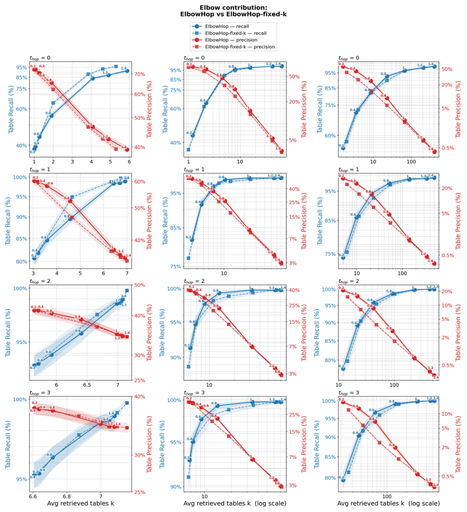
Figure 2 :ElbowHop (per-question elbow, solid) versus ElbowHop-fixed 𝑘 (fixed seed, dashed), each at its own budget, with blue = recall (left axis) and red = precision (right axis), one panel per 𝑡hop and±1 SEM bands. At matched recall the elbow holds substantially higher precision, and the gap grows with pool size. Markers along each curve are the swept 𝛼table values, labelled in every panel and increasing with 𝑘 from left to right (𝛼table=0.6, our default, is the third).
出典 · CC BY 4.0 · Fabio Picariello, Salvatore Cipolla, Susanna Bonura, Vito Morreale · Adaptive-Elbow Graph Traversal for Schema Retrieval in Text-to-SQL · 論文の図を引用 · 元のPDFの9ページ目から図の部分を抽出しています。DenseとHybrid RRFのベースラインとの比較
Denseは、ElbowHop-fixed kと同じ総テーブル数に合わせた、純粋なコサイン類似度の上位kです。Hybrid RRFは、密な順位とBM25の順位をk_rrf=60で融合する手法です。同じ予算ではElbowHopのほうが高い再現率を得ました。この差はプールが大きくなるほど広がりました。再現率99%で比べると、最も高い固定kのDenseとHybrid RRFは、ElbowHopより約1から6ポイント届きませんでした。BIRD mergedのHybrid RRFとの差は6.2ポイントで、最大でした。精度は3つの方法が1本の曲線上に並んでおり、同じ予算ではどちらがより正確かは言えません。
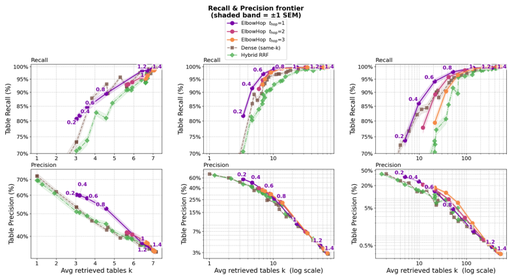
Figure 5 :Recall (top) and precision (bottom) frontiers versus average budget 𝑘 (log scale) for ElbowHop (solid, one per𝑡 hop), Dense (dashed, at the ElbowHop-fixed𝑘total budget), and Hybrid-RRF (dashed),±1SEM bands.
出典 · CC BY 4.0 · Fabio Picariello, Salvatore Cipolla, Susanna Bonura, Vito Morreale · Adaptive-Elbow Graph Traversal for Schema Retrieval in Text-to-SQL · 論文の図を引用 · 元のPDFの11ページ目から図の部分を抽出しています。ブリッジテーブルの回収効果
全体の再現率の差は、BIRD per-DBで+8ポイント、BIRD mergedで+2、Spider mergedで+3と小さめでした。この論文では、内容列がなく結合キーとしてだけ現れる連結テーブルを、ブリッジテーブルとして別に数えて分析しました。この分析では、t_hop=1でαが小さい範囲のとき、BIRDでは+15ポイント、Spiderでは+6から7ポイントの効果が見られ、予算が大きくなるとこの効果は0に減りました。予算が広がると、Denseが順位の拡散によって同じテーブルを回収するためです。
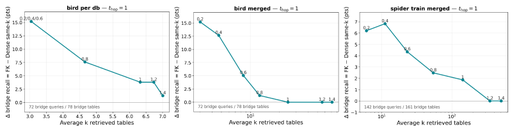
Figure 4 :Bridge-table recall gain of the FK traversal at iso-budget:Δ =recall(seed+FK)−recall(dense same-𝑘) , in points, restricted to content-column-free junction/linking gold tables, at 𝑡hop=1. Each marker is one swept 𝛼table, placed at its mean budget 𝑘. The gain peaks at tight budget (+15 points on BIRD, +6–7 on Spider) and decays as𝑘grows. Counts:72bridge queries /78bridge tables on BIRD,142/161on Spider.
出典 · CC BY 4.0 · Fabio Picariello, Salvatore Cipolla, Susanna Bonura, Vito Morreale · Adaptive-Elbow Graph Traversal for Schema Retrieval in Text-to-SQL · 論文の図を引用 · 元のPDFの10ページ目から図の部分を抽出しています。テーブル単位の評価の限界と平坦な分布
評価はテーブル単位の再現率と精度にとどまり、列の選択やSQLの実行精度は検証していません。したがって、テーブルの精度の向上が最終的なSQLの精度の向上につながるかどうかは、この実験では確認できていません。エルボーは明確な折れ目があって初めて機能するため、候補がごく少ない場合や、類似度が全体的に高いか低く平坦な場合は、ほとんどの候補を返す方向に低下することがあります。こうした平坦なケースを別途示して頻度を測定していないため、その頻度は示せません。chord distanceの最大点が一意であるとの保証もありません。同点は最も早い順位で決めていますが、複数の局所最大点から選ぶ基準は設定していません。
埋め込みモデルの比較も体系的なアブレーション実験ではなく、all-MiniLM-L6-v2は計算コストを理由に選びました。
論文情報
- 著者
- Fabio Picariello, Salvatore Cipolla, Susanna Bonura, Vito Morreale
- 学会・ジャーナル
- arXiv · プレプリント
- 公開日
- 2026年11月16日
- 登録日
- 2026年11月17日
- 更新日
- 2026年11月16日
- バージョン
- v1
- arXiv
- 2611.20979
- カテゴリ
- cs.DB · cs.IR
- ライセンス
- CC BY 4.0
- 掲載内容
- 論文情報・解説・論文の図
この解説は、Refivuの韓国語解説をAIで翻訳したものです。不正確な翻訳や誤りが含まれる可能性があります。論文と図の利用条件は各出典に従います。
アブストラクト
LLM-based natural-language interfaces to relational databases are gated by a schema-retrieval step: the generator can only be as good as the slice of schema it is shown. On a database with hundreds of tables, that slice must be selected and the selection is two-sided---omit a needed table and the query becomes unrecoverable, include too many and the irrelevant ones act as noise that degrades the model's output. When an agentic retriever that lets the model inspect the schema can be too costly or too slow, the fallback is an embedder that ranks tables by cosine similarity and keeps a top-k. This fallback has two weaknesses: a fixed budget is suboptimal question by question, and embedding similarity overlooks foreign-key-linked tables that are necessary for joins. We present Adaptive-Elbow Graph Traversal (AEGT, ElbowHop for short), a property-graph table retriever that addresses both: an adaptive elbow cutoff replaces the fixed budget with a per-question one under a single aggressiveness parameter, and bidirectional foreign-key traversal deterministically recovers the bridge tables embedding similarity misses. We evaluate the retriever on 3 corpora of increasing candidate-pool size (BIRD Mini-Dev queried per database, 3--13 tables; its eleven schemas merged, 74; and a merged Spider-train graph, 546) and isolate the two mechanisms under a per-question budget-matched protocol. Across these settings the adaptive elbow emerges as the dominant mechanism---at matched recall it roughly doubles precision over a fixed budget on the larger pools, the margin widening as the pool grows---while the foreign-key traversal pays off on the join-critical bridge tables dense retrieval cannot reach, in the single-hop tight-budget case. We characterize the method as a low-cost, recall-robust first stage for schema retrieval on which a downstream selection or generation step can build.
この論文を引用
Fabio Picariello, Salvatore Cipolla, Susanna Bonura, Vito Morreale (2026). Adaptive-Elbow Graph Traversal for Schema Retrieval in Text-to-SQL. arXiv:2611.20979v1. https://arxiv.org/abs/2611.20979v1
BibTeX
@misc{picariello2026adaptive,
  title = {{Adaptive-Elbow Graph Traversal for Schema Retrieval in Text-to-SQL}},
  author = {Fabio Picariello and Salvatore Cipolla and Susanna Bonura and Vito Morreale},
  year = {2026},
  eprint = {2611.20979},
  archivePrefix = {arXiv},
  url = {https://arxiv.org/abs/2611.20979v1}
}