論文解説
artist: A Python package for differentiable ray tracing and gradient-based optimization of solar tower power plant operation
artist:太陽光タワー発電所の運転を対象とした微分可能なレイトレーシングと勾配ベース最適化のPythonパッケージ
- 課題 既存のレイトレーサーは順方向のフラックス予測しかできないため、測定フラックスからプラントパラメータを復元したり、運転変数を勾配ベースで最適化したりするのが困難です。
- 手法 光学パイプラインをNURBS曲面、剛体運動学、soft binning、soft occlusionによって微分可能にし、KL損失を勾配ベースで最小化します。
太陽光タワー発電所の逆問題と微分可能なシミュレーション
太陽光タワー発電所では、数千基のヘリオスタットが中央の受信機に光を集めて熱を生成します。ヘリオスタットの表面変形や運動学的な整列誤差は受信機上のフラックス分布を歪めますが、この誤差を構成要素ごとに直接測定するのは困難です。既存のレイトレーサーは、与えられたプラントモデルでフラックスを予測する順方向シミュレーションしかできず、測定したフラックスから未知のパラメータを復元したり、運転変数を勾配ベースで直接最適化したりすることはできません。
この論文は、光学パイプライン全体を微分可能にし、順方向予測、逆モデリング、最適化を単一のフレームワークで行うオープンソースパッケージartistを提案します。扱う課題は、ヘリオスタットの表面と運動学の再構成、受信機のフラックス予測、aim point最適化の3つです。
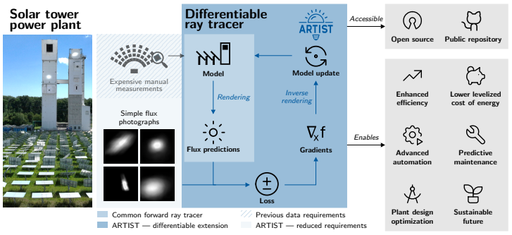
Figure 1 . Overview of ray tracing in solar tower power plant digital twins.Conventional ray tracers predict flux density distributions from a plant model (forward rendering).artistextends this workflow with differentiable inverse rendering, enabling recovery of unknown plant parameters from flux images acquired during normal operation, and direct gradient-based optimization of plant operation. Together, these capabilities reduce reliance on expensive manual measurements, enabling more autonomous and efficient solar tower operation through next-generation control strategies.
出典 · CC BY 4.0 · Marlene Busch, Marie Weiel, Kaleb Phipps, Daniel Maldonado Quinto, Max Pargmann, Robert Pitz-Paal, Markus Götz · artist: A Python package for differentiable ray tracing and gradient-based optimization of solar tower power plant operation · 論文の図を引用 · 元のPDFの2ページ目から図の部分を抽出しています。微分可能な光学パイプラインの構成
artistはヘリオスタットの表面をNURBSで表現します。各ファセットは制御点Bと重みwで定義され、制御点が再構成の過程で学習されるパラメータになります。運動学は、アクチュエータ軸の回転と並進をつなぐ剛体変換の連鎖としてモデル化し、軸の傾きの項を加えて、傾きパラメータを勾配で学習します。
光線の蓄積段階では、従来のハードbinningの代わりにsoft binningを使います。各光線のエネルギーを最も近い4つのピクセルに線形に配分するため、フラックス損失から受信機マップと表面法線を経て、上流の物理パラメータまで勾配が流れます。遮蔽は、LBVHで候補ヘリオスタットを探したのち、シグモイドで交差の有無を近似し、Beer-Lambert透過モデルで遮蔽信号を積算するsoft occlusionによって微分可能にします。
損失関数と制約を用いた統合最適化
画像ベースのタスクでは、測定フラックスと予測フラックスを正規化して確率分布とみなし、損失としてKL発散を用います。式はL_flux = D_KL(F_ref || F_pred) = Σ_p F_ref,p log(F_ref,p / F_pred,p)で、和は受信機のすべてのピクセルpについてとります。表面と運動学の再構成では、この損失をAdamで最小化して、NURBSの制御点と軸の傾きを更新します。
aim point最適化では、目標フラックス分布に対するKL発散に、フラックス保存、分散制限、受信機の最大フラックス制限といった制約を、augmented-Lagrangian法で加えます。タスクが変わっても順方向モデルと最適化の手順は同じで、目的関数だけが変わります。
ヘリオスタット表面の再構成結果
評価したすべてのヘリオスタットと、各ヘリオスタットのすべてのフラックス画像について平均しました。
誤差は72.7%、つまり3.6倍減少しました。著者らは、この値は表面変形の効果がヘリオスタットの位置や太陽の位置によって変わるため、保守的な推定であると解釈しています。
運動学の再構成と予測事例
運動学の再構成には2つの方法があります。整列ベースの再構成は、焦点位置で基準法線を求め、運動学モデルの予測法線と合わせます。フラックスベースの再構成は、予測フラックスと測定フラックスの焦点位置の間のユークリッド距離を損失とします。整列ベースは光線追跡を使わずに素早く初期校正を行い、初期誤差が大きくても適用できます。フラックスベースは、予測フラックスが受信機に安定して当たった後の微調整に使われます。
3つのヘリオスタットを対象にした図3の事例では、理想モデルはAP41が部分的に、BF65が完全に標的を外れていました。表面のみを再構成した場合は整列がそのままで、運動学のみを再構成した場合はCoMは合うものの表面の歪みが残りました。表面と運動学を同時に再構成した場合は、測定の基準に最も近く合いました。
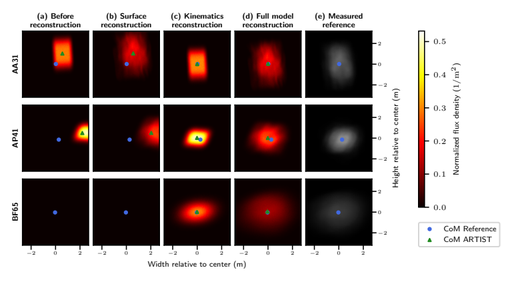
Figure 3 . Predicted and measured flux images for three heliostats: (a)idealized model,(b)reconstructed surface only,(c)reconstructed kinematics only,(d)full reconstructed model combining reconstructed surface and kinematics, and(e)measured reference flux image. The full reconstructed model shows the closest agreement with the measured flux density distribution. Within each row, the flux density distributions are normalized such that the integrated reflected power originating from the heliostat area equals one for the full reconstructed model. Flux density distributions that are partially off-target therefore contain only a fraction of the total flux and have an integral smaller than one. All images are shown on the same spatial scale, corresponding to the physical dimensions of the calibration target, with the image axes centered at the receiver center.
出典 · CC BY 4.0 · Marlene Busch, Marie Weiel, Kaleb Phipps, Daniel Maldonado Quinto, Max Pargmann, Robert Pitz-Paal, Markus Götz · artist: A Python package for differentiable ray tracing and gradient-based optimization of solar tower power plant operation · 論文の図を引用 · 元のPDFの9ページ目から図の部分を抽出しています。aim point最適化の例
aim point最適化の例では、再構成された100基のヘリオスタットを使いました。基準は、すべてのヘリオスタットが受信機の中心を狙う場合です。最適化では、各ヘリオスタットに個別のaim pointを割り当てて、目標フラックス分布に近づけました。最適化した場合も、入射総電力は約482 kWで保たれました。著者らの説明では、この例は目標分布に合わせて入射フラックスを再配分した結果です。
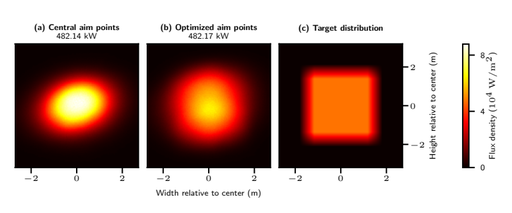
Figure 4 . Aim point optimization flux density distributions: (a)Flux density distribution with all heliostats aiming at the receiver center,(b)optimized distribution obtained by assigning individual aim points to each heliostat, and(c)the target distribution. The optimization redistributes the incident flux density to approximate the target distribution while preserving the total incident power. A total of 100 reconstructed heliostats were used for the optimization. All images are shown on the same spatial scale, corresponding to the physical dimensions of the target, with the image axes centered at the receiver center.
出典 · CC BY 4.0 · Marlene Busch, Marie Weiel, Kaleb Phipps, Daniel Maldonado Quinto, Max Pargmann, Robert Pitz-Paal, Markus Götz · artist: A Python package for differentiable ray tracing and gradient-based optimization of solar tower power plant operation · 論文の図を引用 · 元のPDFの10ページ目から図の部分を抽出しています。遮蔽の未実装と検証範囲の限界
現在の光学モデルには、光線が反射する前に隣のヘリオスタットに遮られる遮蔽は含まれていません。著者らは、遮蔽モデルは入射光線と反射光線に独立しているため、遮蔽の拡張の基盤になると説明しています。不確かさの定量化もまだ実装されていないため、高温環境での意思決定や、最適化されたモーター位置の安全な適用には限界があります。個々の構成要素は以前に検証されたアプローチに従っていますが、追加の運用データセットや実プラントの測定でさらに検証する必要があります。ヘリオスタットの配置や受信機設計のリバースエンジニアリングは、この研究の範囲外です。
論文情報
- 著者
- Marlene Busch, Marie Weiel, Kaleb Phipps, Daniel Maldonado Quinto, Max Pargmann, Robert Pitz-Paal, Markus Götz
- 学会・ジャーナル
- arXiv · プレプリント
- 公開日
- 2026年11月16日
- 登録日
- 2026年11月17日
- 更新日
- 2026年11月16日
- バージョン
- v1
- arXiv
- 2611.20851
- カテゴリ
- cs.LG
- ライセンス
- CC BY 4.0
- 掲載内容
- 論文情報・解説・論文の図
この解説は、Refivuの韓国語解説をAIで翻訳したものです。不正確な翻訳や誤りが含まれる可能性があります。論文と図の利用条件は各出典に従います。
アブストラクト
Solar tower power plants provide dispatchable, renewable energy by concentrating sunlight with thousands of mirrors, called heliostats, onto a central receiver. Efficient operation requires accurate modeling of the optical path from each heliostat to the receiver and compensation for manufacturing imperfections, kinematic misalignment, and material degradation that distort the flux distribution. Conventional ray tracers predict the flux from an assumed plant model but are limited to forward simulation. They cannot recover unknown plant parameters from measured flux nor directly optimize plant operation. We present artist, an open-source, FAIR4RS-compliant Python package implementing a fully differentiable digital twin of solar tower power plants. By making the optical pipeline, comprising heliostat surface representation, kinematics, blocking, and ray tracing, end to end differentiable, artist turns the digital twin from a passive forward model into an active physics-based tool for inverse modeling and data-driven optimization. The resulting gradient-based framework unifies tasks usually handled by separate solutions, such as reconstructing heliostat surfaces and kinematics from operational flux images without costly deflectometry, predicting irradiance at the receiver, and optimizing aim points to realize a desired receiver flux density distribution. Built on PyTorch, artist scales to real plants through GPU acceleration, a structure-of-arrays memory layout, and nested data parallelism. It interfaces with open data sources such as the PAINT database. We describe the software architecture, physical models, and optimization framework, and demonstrate the workflow on representative tasks. By integrating modeling, prediction, and optimization into a single open, interpretable package, artist provides a principled foundation for data-driven research toward autonomous solar tower operation.
この論文を引用
Marlene Busch, Marie Weiel, Kaleb Phipps, Daniel Maldonado Quinto, Max Pargmann, Robert Pitz-Paal, Markus Götz (2026). artist: A Python package for differentiable ray tracing and gradient-based optimization of solar tower power plant operation. arXiv:2611.20851v1. https://arxiv.org/abs/2611.20851v1
BibTeX
@misc{busch2026artist,
  title = {{artist: A Python package for differentiable ray tracing and gradient-based optimization of solar tower power plant operation}},
  author = {Marlene Busch and Marie Weiel and Kaleb Phipps and Daniel Maldonado Quinto and Max Pargmann and Robert Pitz-Paal and Markus Götz},
  year = {2026},
  eprint = {2611.20851},
  archivePrefix = {arXiv},
  url = {https://arxiv.org/abs/2611.20851v1}
}