論文解説
Generalization Testing of Grid Foundation Models for Power Flow and Optimal Power Flow
電力潮流と最適電力潮流のためのGrid Foundation Modelsの汎化テスト
- 課題 grid FMは、学習時に見ていない線路、負荷、格子では、DCベースラインを上回る精度を維持できません。
- 手法 アドミタンスの変更、負荷倍率、未学習の格子という3つの軸で、GENCO、LUMINA、GridSFMをzero-shotで評価します。
- 結果 線路の追加は削除より大きな誤差を生み、負荷倍率1.10ではGridSFMの∆Qが67%に達しました。
大規模格子モデルの汎化の問題
電力系統の定常状態の解析では、潮流計算(PF)と最適潮流計算(OPF)を何度も繰り返す必要があります。contingencyスクリーニング、負荷や再生可能エネルギーの不確実性のもとでの確率的なAC計算、候補トポロジーの比較は、いずれもこの繰り返しに依存しているためです。Newton–Raphsonや内点法は信頼できますが、ケース数が増えるほどコストが大きくなります。そこで学習ベースの代理モデルが注目され、複数の格子で事前学習したgrid foundation model(FM)が提案されました。FMの価値は、学習に含まれなかった線路、負荷、格子でも正確だという主張にかかっているため、この論文ではその汎化の限界を検証しています。
特にFMは不確実性を併せて出さず、答えを一つだけ返すため、失敗が静かに起きる点が問題として示されています。
3つの軸による検証の枠組み
この論文では、汎化を3つの軸に分けて検証しています。A1は学習済みネットワークのアドミタンス行列を変える軸で、線路を削除または追加し、線路長を延ばします。A2は同じ格子で、負荷を学習範囲を超えて引き上げる軸です。A3は、学習に含まれていない格子にモデルを適用する軸です。対象はGENCO、LUMINA、GridSFMで、参照値はPowerModelsを使い、NR(AC-PF)とIpopt(AC-OPF)で求めます。これをDC近似の結果を上回るべきベースラインとします。全体の流れは、入力の変形、zero-shot予測、参照値とベースラインとの比較の順です。
線路の追加と削除の違い
N-k試験では線路を1つ、または3つから5つ除去し、N+1試験では並列線や短い・長い新しい線路を追加します。事例の強度は、線路の潮流を定格で割ったseverityで定め、0.6と0.9の事例を残しました。zero-shotのGENCOは、変更したすべての格子でDC-PFより悪い結果でした。著者らは、線路の追加はN-k学習データの凸包の外側に位置するため、より難しくなると解釈しています。この解釈はDCベースの分析に基づく示唆的な説明であり、AC性能についての保証ではありません。
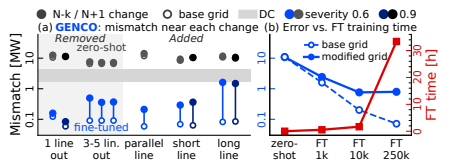
Fig. 2 . GENCO on 118-bus. (a) Mean real power mismatch over the buses within three hops of each removed or added line, base grid (hollow) and modified grid (filled). (b) The same mismatch averaged over line-addition cases, with fine-tuning (FT) training time (red) from the authors’ logs. Such changes occur in practice through maintenance, faults and network expansion, and the topology given to a model can also be wrong due to topology estimation errors [14]. A removal takes out a single line or three to five lines (N-k), and an addition adds a parallel line or a new line between two buses that are two lines apart (short new line) or seven or more lines apart (long new line). A short new line has the grid’s median line parameters, and a long new line has these values doubled. The severity of a change (adding or removing a line) is defined as the ratio of the power flow on that line to its rating, measured before and after the change. To test medium and severe changes of each type, we keep cases leading to severities of 0.6 and 0.9, such that the modified grid stays within its voltage limits and has an AC-OPF solution. Note that three to five lines out are built only at severity 0.6, and the parallel line takes about half the flow of the line it connects, so it never reaches severity 0.9. We test on the 118- and 2000- bus grids, which the models (except zero-shot GENCO) were trained on, drawing 1k and 500 new samples, respectively, with each FM’s own data generator. Considering locality of voltage and reactive power in trans- mission grids, we measure mismatch at buses within three hops of a removed or added line for GENCO, and at the three nearest generator buses for the GridSFM performance measure. Further, LUMINA’s dispatch error is measured over all generators, since the active-power changes are global. Fig. 2a shows that zero-shot GENCO is worse than DC-PF in every modified-grid case, which is consistent with reporting in [4]. In contrast, fine-tuned (FT) GENCO’s error rises up to 5.5×afterN-kand up to20×afterN+1, while staying below DC-PF in all cases. However, this improvement comes at the cost of solved samples and training time: Fig. 2b shows that the error on the base grid decreases steadily with both, but on the modified grid it saturates at 10k samples, and at 250k samples it remains more than 10 times that on the base grid. Next, we use GridSFM to predict generator set-points for the 2000-bus grid and solve an AC-PF from them via NR, following [5], without PV–PQ bus conversion at reactive limits. Therefore, we measure the generators’ reactive-limit violation∆Qas a percentage ofQ max −Q min. We observed that, on the base grid,∆Qis7×lower than with DC-OPF set- points, it stays below 10% after lines are removed, and rises from 23 to 482% after a short new line is added at severity 0.9 (Fig. 3a). Importantly, the generation-cost error reported in [5] stays at 1.1% and misses this reactive-limit failure. Further, for
出典 · CC BY 4.0 · Ayushi Jolotia, Parikshit Pareek · Generalization Testing of Grid Foundation Models for Power Flow and Optimal Power Flow · 論文の図を引用 · 元のPDFの2ページ目から図の部分を抽出しています。線路長を延ばした場合の試験
線路長の試験では、線路の抵抗、リアクタンス、充電サセプタンスをm倍して、線路が長くなった状況を作ります。R/X比は保たれますが、サセプタンス行列の条件数κは大きくなります。118-busではκが2.9kから8.6kへ、2000-busでは193kから545kへ上がります。GridSFMは線路パラメータを入力として受け取り、すべてのmでディスパッチ誤差はDC-OPF以下でしたが、m=8ではAC-PFの収束率が70%にとどまりました。
負荷倍率と負荷限界
A2の試験では、各サンプルの負荷を基準負荷のλ倍に増やし、負荷限界λ*に対する比率で示します。GENCOの118-busの負荷限界は基準負荷の2.45倍から3.43倍で、LUMINAとGridSFMの2000-busの限界は1.31倍です。118-busのbus 44の電圧が最も急に下がるため、連続潮流計算で得られた真のnose曲線と比較しました。ファインチューニングしたGENCOは、学習範囲内では参照値に追従しますが、その外では電圧低下がはるかに緩やかで、電圧誤差とmismatchはλ*付近で2〜3桁大きくなりました。GridSFMの∆Qはλ/λ*=1.10で67%に達し、その答えの40%ではPFが収束しませんでした。
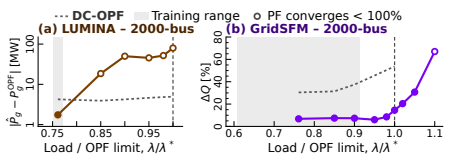
Fig. 8 . LUMINA and GridSFM on 2000-bus, againstλ/λ ⋆, each sample’s load as a fraction of its OPF limit. (a) LUMINA’s dispatch error. (b) GridSFM’s reactive violation∆Qover all generators.
出典 · CC BY 4.0 · Ayushi Jolotia, Parikshit Pareek · Generalization Testing of Grid Foundation Models for Power Flow and Optimal Power Flow · 論文の図を引用 · 元のPDFの4ページ目から図の部分を抽出しています。未学習のPGLib格子の結果
A3の試験は、各モデルの学習セットに含まれないPGLib格子にzero-shotで適用します。格子ごとに500サンプルのうち、参照値を計算できる302から500サンプルを残しました。格子のバス数、κ、R/X、loops per bus、slackからのdepthを学習範囲と比べ、near、edge、farに分類しました。LUMINAは学習格子ではDC-OPFよりディスパッチ誤差が5倍低かったものの、near格子では17倍悪く、PF収束率は22%でした。GridSFMのディスパッチ誤差はedge格子では学習格子並みにとどまりましたが、farである10192-busの格子ではDC-OPFの10倍になりました。
著者らは、5つの特性だけでは未学習格子への汎化は保証できないと考えています。この判断は複数の格子に対する観察から導いた解釈であり、特性による基準が十分であるという証明ではありません。
限界と指標の死角
GridSFMは発電コストの誤差が1.1%と報告されていますが、この指標では無効電力の限界違反が見えません。この論文ではPV–PQバス切り替えを適用しない状態で∆Qを測定し、2000-busに短い新しい線路を重大度0.9で追加すると、∆Qは23から482%に上がりました。また、zero-shotの実験結果は、示された格子とサンプル数に限られ、他の格子でも同じ結果になる保証はありません。結局、FMの答えには誤差の警告がないため、参照値を別に求めて確認する必要があり、その確認コストがFMの利点を減らします。
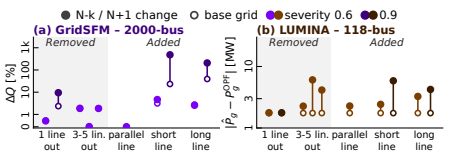
Fig. 3 . (a) GridSFM on 2000-bus: reactive violation∆Q, mean over the three generator buses nearest to the topology change, over 500 samples. (b) LUMINA on 118-bus: dispatch error, mean over all generators in each sample, median over 1k samples. Base grid (hollow), modified grid (filled).
出典 · CC BY 4.0 · Ayushi Jolotia, Parikshit Pareek · Generalization Testing of Grid Foundation Models for Power Flow and Optimal Power Flow · 論文の図を引用 · 元のPDFの3ページ目から図の部分を抽出しています。論文情報
- 著者
- Ayushi Jolotia, Parikshit Pareek
- 学会・ジャーナル
- arXiv · プレプリント
- 公開日
- 2026年11月14日
- 登録日
- 2026年11月17日
- 更新日
- 2026年11月14日
- バージョン
- v1
- arXiv
- 2611.19194
- カテゴリ
- eess.SY · cs.LG
- ライセンス
- CC BY 4.0
- 掲載内容
- 論文情報・解説・論文の図
この解説は、Refivuの韓国語解説をAIで翻訳したものです。不正確な翻訳や誤りが含まれる可能性があります。論文と図の利用条件は各出典に従います。
アブストラクト
There is growing interest in foundation models (FMs) for power grids, particularly for power flow and optimal power flow. Their usefulness depends on generalization accuracy, which existing works test on their own benchmarks. We propose a three-axis framework to test their generalization limits: changed admittance matrices of training grids, load levels, and unseen grids. We test GENCO, LUMINA and GridSFM against the DC baseline, alongside their reported limitations, and discuss theoretical reasons for their failures. Experiments reveal that adding a line degrades all FMs more than removing one, and longer lines eventually make LUMINA and fine-tuned GENCO worse than DC. All three degrade beyond their training load range, where the loading-voltage curve steepens. On unseen grids, LUMINA degrades sharply even inside its training range, and GridSFM fails on the grid farthest from it. Thus, beyond training conditions, FMs behave more like meta-models requiring test-time fine-tuning data and compute.
この論文を引用
Ayushi Jolotia, Parikshit Pareek (2026). Generalization Testing of Grid Foundation Models for Power Flow and Optimal Power Flow. arXiv:2611.19194v1. https://arxiv.org/abs/2611.19194v1
BibTeX
@misc{jolotia2026generalization,
  title = {{Generalization Testing of Grid Foundation Models for Power Flow and Optimal Power Flow}},
  author = {Ayushi Jolotia and Parikshit Pareek},
  year = {2026},
  eprint = {2611.19194},
  archivePrefix = {arXiv},
  url = {https://arxiv.org/abs/2611.19194v1}
}