논문 해설
Generalization Testing of Grid Foundation Models for Power Flow and Optimal Power Flow
전력 조류 및 최적 전력 조류를 위한 Grid Foundation Models의 일반화 테스트
- 연구 문제 grid FM은 학습 때 보지 못한 선로, 부하, 격자에서 DC 기준선을 넘는 정확도를 유지하지 못합니다.
- 연구 방법 Admittance 변경, 부하 배율, 미학습 격자의 세 축으로 GENCO, LUMINA, GridSFM을 zero-shot으로 평가합니다.
- 주요 결과 선로 추가가 제거보다 큰 오차를 만들었고, 부하 배율 1.10에서 GridSFM의 ∆Q가 67%에 이르렀습니다.
대규모 격자 모델의 일반화 문제
전력망의 정상 상태 분석에서는 조류계산(PF)과 최적조류계산(OPF)을 수없이 반복해야 합니다. contingency 스크리닝, 부하와 재생에너지 불확실성 아래의 확률적 AC 계산, 후보 토폴로지 비교가 모두 이 반복에 기대기 때문입니다. Newton–Raphson과 내점법은 신뢰할 수 있지만 사례 수가 늘수록 비용이 커집니다. 그래서 학습 기반 대리모델이 주목받았고, 여러 격자를 사전학습한 grid foundation model(FM)이 제안되었습니다. FM의 가치는 학습에 없던 선로, 부하, 격자에서도 정확하다는 주장에 달려 있으므로 이 논문은 그 일반화 한계를 시험합니다. 특히 FM은 불확실성을 함께 내지 않고 하나의 답만 내므로, 실패가 조용히 일어난다는 점이 문제로 제시됩니다.
세 축의 시험 틀
이 논문은 일반화를 세 축으로 나눠 시험합니다. A1은 학습한 네트워크의 admittance matrix를 바꾸는 축으로, 선로를 제거하거나 추가하고 선로 길이를 늘립니다. A2는 같은 격자에서 부하를 학습 범위 너머로 올리는 축입니다. A3은 학습에 없던 격자에 모델을 적용하는 축입니다. 시험 대상은 GENCO, LUMINA, GridSFM이며, 참값은 PowerModels로 NR(AC-PF)과 Ipopt(AC-OPF)를 써서 구하고, DC 근사 결과를 넘어서야 하는 기준선으로 둡니다. 전체 흐름은 입력 변형, zero-shot 예측, 참값과 기준선 비교 순서입니다.
선로 추가와 제거의 차이
N-k 시험은 선로 한 개 또는 세 개에서 다섯 개를 제거하고, N+1 시험은 병렬선이나 짧거나 긴 새 선로를 추가합니다. 사례의 강도는 선로 조류를 정격으로 나눈 severity로 정하며, 0.6과 0.9 사례를 남겼습니다. zero-shot GENCO는 수정된 모든 격자에서 DC-PF보다 나빴습니다. 저자들은 선로 추가가 N-k 학습 데이터의 볼록 껍질 밖에 놓이기 때문에 더 어렵다고 해석합니다. 이 해석은 DC 기반 분석에 근거한 지시적 설명이며 AC 성능에 대한 보장이 아닙니다.
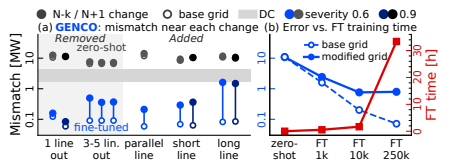
Fig. 2 . GENCO on 118-bus. (a) Mean real power mismatch over the buses within three hops of each removed or added line, base grid (hollow) and modified grid (filled). (b) The same mismatch averaged over line-addition cases, with fine-tuning (FT) training time (red) from the authors’ logs. Such changes occur in practice through maintenance, faults and network expansion, and the topology given to a model can also be wrong due to topology estimation errors [14]. A removal takes out a single line or three to five lines (N-k), and an addition adds a parallel line or a new line between two buses that are two lines apart (short new line) or seven or more lines apart (long new line). A short new line has the grid’s median line parameters, and a long new line has these values doubled. The severity of a change (adding or removing a line) is defined as the ratio of the power flow on that line to its rating, measured before and after the change. To test medium and severe changes of each type, we keep cases leading to severities of 0.6 and 0.9, such that the modified grid stays within its voltage limits and has an AC-OPF solution. Note that three to five lines out are built only at severity 0.6, and the parallel line takes about half the flow of the line it connects, so it never reaches severity 0.9. We test on the 118- and 2000- bus grids, which the models (except zero-shot GENCO) were trained on, drawing 1k and 500 new samples, respectively, with each FM’s own data generator. Considering locality of voltage and reactive power in trans- mission grids, we measure mismatch at buses within three hops of a removed or added line for GENCO, and at the three nearest generator buses for the GridSFM performance measure. Further, LUMINA’s dispatch error is measured over all generators, since the active-power changes are global. Fig. 2a shows that zero-shot GENCO is worse than DC-PF in every modified-grid case, which is consistent with reporting in [4]. In contrast, fine-tuned (FT) GENCO’s error rises up to 5.5×afterN-kand up to20×afterN+1, while staying below DC-PF in all cases. However, this improvement comes at the cost of solved samples and training time: Fig. 2b shows that the error on the base grid decreases steadily with both, but on the modified grid it saturates at 10k samples, and at 250k samples it remains more than 10 times that on the base grid. Next, we use GridSFM to predict generator set-points for the 2000-bus grid and solve an AC-PF from them via NR, following [5], without PV–PQ bus conversion at reactive limits. Therefore, we measure the generators’ reactive-limit violation∆Qas a percentage ofQ max −Q min. We observed that, on the base grid,∆Qis7×lower than with DC-OPF set- points, it stays below 10% after lines are removed, and rises from 23 to 482% after a short new line is added at severity 0.9 (Fig. 3a). Importantly, the generation-cost error reported in [5] stays at 1.1% and misses this reactive-limit failure. Further, for
원문 · CC BY 4.0 · Ayushi Jolotia, Parikshit Pareek · Generalization Testing of Grid Foundation Models for Power Flow and Optimal Power Flow · 원문 그림 인용 · 원본 PDF 2쪽에서 그림 영역을 추출했습니다.선로 길이 증가 시험
선로 길이 시험은 선로의 저항, 리액턴스, 충전 서셉턴스를 m배로 곱해 선로가 길어진 상황을 만듭니다. R/X 비율은 유지되지만 susceptance 행렬의 condition number κ가 커집니다. 118-bus에서는 κ가 2.9k에서 8.6k로, 2000-bus에서는 193k에서 545k로 올라갑니다. GridSFM은 선로 파라미터를 입력으로 받으며 디스패치 오차가 모든 m에서 DC-OPF 이하였지만, m=8에서 AC-PF 수렴 비율이 70%에 그쳤습니다.
부하 배율과 로딩 한계
A2 시험은 각 샘플의 부하를 기본 부하 대비 λ배로 늘리고, 로딩 한계 λ*에 대한 비율로 나타냅니다. GENCO의 118-bus 로딩 한계는 기본 부하의 2.45에서 3.43배이고, LUMINA와 GridSFM의 2000-bus 한계는 1.31배입니다. 118-bus의 bus 44 전압은 가장 가파르게 떨어지므로 연속 조류계산으로 얻은 참 nose 곡선과 비교했습니다. 미세조정 GENCO는 학습 범위 안에서는 참값을 따라가지만 그 밖에서는 전압 하락이 훨씬 완만했고, 전압 오차와 mismatch가 λ*에서 두세 자릿수 커졌습니다. GridSFM의 ∆Q는 λ/λ*=1.10에서 67%에 이르고 그 답의 40%에서 PF가 수렴하지 않았습니다.
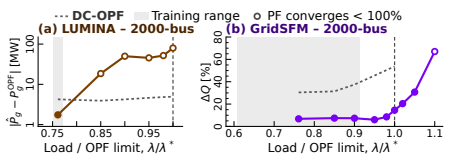
Fig. 8 . LUMINA and GridSFM on 2000-bus, againstλ/λ ⋆, each sample’s load as a fraction of its OPF limit. (a) LUMINA’s dispatch error. (b) GridSFM’s reactive violation∆Qover all generators.
원문 · CC BY 4.0 · Ayushi Jolotia, Parikshit Pareek · Generalization Testing of Grid Foundation Models for Power Flow and Optimal Power Flow · 원문 그림 인용 · 원본 PDF 4쪽에서 그림 영역을 추출했습니다.미학습 PGLib 격자의 결과
A3 시험은 각 모델의 학습 세트에 없는 PGLib 격자에 zero-shot으로 적용합니다. 격자별로 500개 샘플 중 참값을 계산할 수 있는 302에서 500개를 남겼고, 격자의 bus 수, κ, R/X, loops per bus, slack으로부터의 depth를 학습 범위와 비교해 near, edge, far로 분류했습니다. LUMINA는 학습 격자에서 DC-OPF보다 디스패치 오차가 5배 낮았지만 near 격자에서는 17배 나빴고 PF 수렴 비율은 22%였습니다. GridSFM의 디스패치 오차는 edge 격자에서 학습 격자 수준에 머물렀지만 far인 10192-bus 격자에서는 DC-OPF의 10배가 되었습니다.
저자들은 다섯 특성만으로는 미학습 격자의 일반화를 보장하지 못한다고 봅니다. 이 판단은 여러 격자에 대한 관찰에서 나온 해석이며 특성 기준이 충분하다는 증명은 아닙니다.
한계와 지표의 사각지대
GridSFM은 생성비용 오차가 1.1%로 보고되지만, 이 지표는 무효전력 한계 위반을 드러내지 못합니다. 본 연구는 PV–PQ 버스 전환을 적용하지 않은 상태에서 ∆Q를 측정했고, 2000-bus에서 짧은 새 선로를 심각도 0.9로 추가하면 ∆Q가 23에서 482%로 올랐습니다. 또한 zero-shot 실험 결과는 제시된 격자와 샘플 수에 한정되며, 다른 격자에서 같은 결과가 나온다는 보장은 없습니다. 결국 FM의 답에는 오차 경고가 없어 참값을 따로 구해 확인해야 하고, 이 확인 비용이 FM의 이점을 줄입니다.
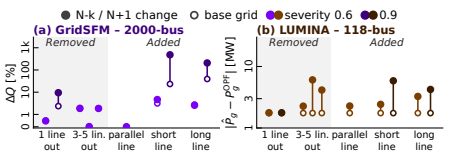
Fig. 3 . (a) GridSFM on 2000-bus: reactive violation∆Q, mean over the three generator buses nearest to the topology change, over 500 samples. (b) LUMINA on 118-bus: dispatch error, mean over all generators in each sample, median over 1k samples. Base grid (hollow), modified grid (filled).
원문 · CC BY 4.0 · Ayushi Jolotia, Parikshit Pareek · Generalization Testing of Grid Foundation Models for Power Flow and Optimal Power Flow · 원문 그림 인용 · 원본 PDF 3쪽에서 그림 영역을 추출했습니다.논문 정보
- 저자
- Ayushi Jolotia, Parikshit Pareek
- 학회·저널
- arXiv · 프리프린트
- 최초 공개일
- 2026년 11월 14일
- 등록일
- 2026년 11월 17일
- 수정일
- 2026년 11월 14일
- 버전
- v1
- arXiv
- 2611.19194
- 분류
- eess.SY · cs.LG
- 원문 이용 조건
- CC BY 4.0
- 제공 범위
- 논문 정보, 해설, 허용된 원문 그림
AI 해설은 논문 원문과 별개의 설명이며 오류가 있을 수 있습니다. 원문과 그림은 각 출처의 이용 조건과 따로 표시된 권리를 따릅니다.
초록
There is growing interest in foundation models (FMs) for power grids, particularly for power flow and optimal power flow. Their usefulness depends on generalization accuracy, which existing works test on their own benchmarks. We propose a three-axis framework to test their generalization limits: changed admittance matrices of training grids, load levels, and unseen grids. We test GENCO, LUMINA and GridSFM against the DC baseline, alongside their reported limitations, and discuss theoretical reasons for their failures. Experiments reveal that adding a line degrades all FMs more than removing one, and longer lines eventually make LUMINA and fine-tuned GENCO worse than DC. All three degrade beyond their training load range, where the loading-voltage curve steepens. On unseen grids, LUMINA degrades sharply even inside its training range, and GridSFM fails on the grid farthest from it. Thus, beyond training conditions, FMs behave more like meta-models requiring test-time fine-tuning data and compute.
원문 인용
Ayushi Jolotia, Parikshit Pareek (2026). Generalization Testing of Grid Foundation Models for Power Flow and Optimal Power Flow. arXiv:2611.19194v1. https://arxiv.org/abs/2611.19194v1
BibTeX
@misc{jolotia2026generalization,
  title = {{Generalization Testing of Grid Foundation Models for Power Flow and Optimal Power Flow}},
  author = {Ayushi Jolotia and Parikshit Pareek},
  year = {2026},
  eprint = {2611.19194},
  archivePrefix = {arXiv},
  url = {https://arxiv.org/abs/2611.19194v1}
}