논문 해설
Inner Product Regularization for Imitation Learning
모방 학습을 위한 내적 정규화
- 연구 문제 기존 상태별 정규화는 무시해야 할 섭동과 반응해야 할 섭동을 구분하지 못해 정책 민감도를 전반적으로 낮춥니다.
- 연구 방법 정책 Jacobian으로 상태 공간 내적을 만들고, 인접 상태를 군집화한 뒤 평균 내적의 하위 고유값 비율을 정규화 항으로 더합니다.
정책이 상태 섭동에 엇갈리게 반응하는 문제
모방 학습 정책은 학습 데이터에 없던 상태에서 작동해야 하며, 센서 잡음, 장면 변화, 누적 오차 때문에 상태가 조금씩 달라집니다. 기존 정규화 기법은 각 상태를 따로 놓고 그 상태에서 정책이 얼마나 민감한지를 줄입니다. 이렇게 하면 로봇이 무시해야 할 섭동과 반응해야 할 섭동을 구분하지 못하고, 과제에 중요한 방향의 민감도까지 함께 줄어듭니다.
이 논문은 같은 섭동에 대한 정책의 1차 반응이 인접한 상태들 사이에서 일관되어야 한다는 관점을 취합니다. 무시해야 할 섭동 방향이 인접 상태마다 같은 null space를 공유하도록 만드는 것이 목표입니다. 질문은 이 일관성을 정규화로 강제하면 불필요한 상태 차원과 학습·테스트 분포 이동에 대한 강건성이 높아지는지입니다.
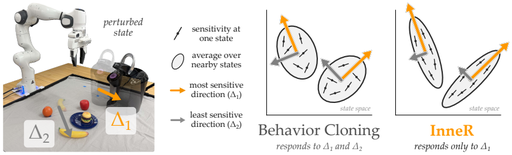
Figure 1 .(Left) Robot learning to close a coffee machine. At test time the robot encounters a new state. As compared to the states in its training dataset, this new state has some perturbations that are task-relevant (shifting the pose of the coffee machine,∆1) and some that are irrelevant (shifting the banana,∆ 2). (Right) Local state perturbations have a first-order effect on the policy outputs. At each state the policy is sensitive to some perturbation directions and ignores others; averaging over nearby states reveals the directions to which the policy is most and least sensitive. Under standard behavior cloning these responses are inconsistent across nearby states, and thus the policy reacts to both∆ 1 and∆ 2. We propose InneR, an inner product regularization approach that enforces similar responses to the same perturbation at nearby states: the policy still responds to∆ 1 but now ignores∆ 2.
원문 · CC BY 4.0 · Benjamin A. Christie, Tianyu Qiu, Amy H. Choi, David Fridovich-Keil, Dylan P. Losey · Inner Product Regularization for Imitation Learning · 원문 그림 인용 · 원본 PDF 2쪽에서 그림 영역을 추출했습니다.내적 정규화의 계산 과정
방법의 출발점은 행동 공간의 내적을 상태 공간으로 끌어오는 것입니다. 정책 Jacobian J(s)를 통해 상태 공간 내적 행렬 A(s)=J(s)^T M J(s)를 정의하며, 이 행렬의 null space에 놓인 상태 섭동은 1차 근사에서 행동을 바꾸지 않습니다. 상태 공간 내적은 M과 J에 의해 결정되므로 학습 중 정책이 바뀌면 함께 바뀝니다.
InneR는 배치 안의 상태들을 Jacobian 행 공간의 chordal Grassmann 거리로 군집화합니다. 각 군집의 평균 내적 행렬을 계산하고 그 고유값을 내림차순으로 정렬한 뒤, 하위 n−m개 고유값의 합을 전체 고유값 합으로 나눈 비율을 정규화 항으로 씁니다. 분모는 stop-gradient로 분리되어 있어, 고유값 전체를 키워서 비율을 줄이는 경로를 막습니다. 이 정규화는 기본 모방 학습 손실에 가중치 γ로 더해집니다. 확률적 정책에서는 A(s) 대신 Fisher information F(s)를 쓰고 m 대신 r을 사용합니다.
단일 적분기 시뮬레이션의 결과
단일 적분기 목표 도달 과제에서 상태 차원 n을 늘리며 최종 상태 오차를 비교했습니다. 무관한 노이즈 차원이 늘어날수록 BC의 오차는 증가했고, MLP의 static 설정에서 오차는 0.5에서 7.4로 커졌습니다. Frobenius와 Nuclear 기준선은 모든 n에서 BC보다 나빴습니다. InneR-C는 static에서는 InneR과 비슷했지만 dynamic에서는 무너졌습니다.
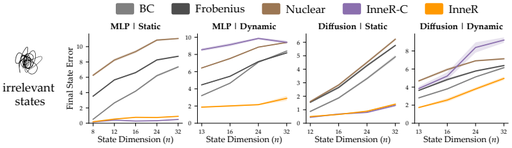
Figure 2 .Single-integrator simulation from Section 7.1. Plots show the error between the robot and the goal as state dimensionn increases (lower is better). The far left of each plot corresponds to the minimum state dimension for that setting, and each added state element is irrelevant noise that is sampled uniformly at random in both the demonstrations and the test states. Ideally the robot is robust to these variations in the irrelevant state dimensions, and so the final state error should be constant inn.InneRis the only method whose error stays nearly flat in every setting besides Diffusion–Dynamic, where it is consistently lower than the alternatives while maintaining a similar positive slope.InneR-Cmatches it instatic, where one global null space is correct, but fails indynamic. Shaded regions show standard error across10seeds.
원문 · CC BY 4.0 · Benjamin A. Christie, Tianyu Qiu, Amy H. Choi, David Fridovich-Keil, Dylan P. Losey · Inner Product Regularization for Imitation Learning · 원문 그림 인용 · 원본 PDF 10쪽에서 그림 영역을 추출했습니다.분포 이동 실험에서는 학습 데이터의 무관한 상태 차원이 목표와 상관되도록 만들었습니다. 이 결과는 단일 적분기 시뮬레이션과 지정한 설정에서 확인한 것입니다.
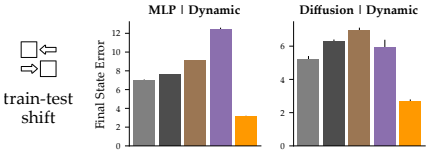
Figure 4 .Single-integrator simulation from Section 7.3 highlighting thedynamictask. At training time the irrelevant state dimensions are correlated with the active goal (ρ= 0.9), but at test time this correlation is removed, so a policy that reads the goal from the irrelevant entries fails (i.e., causal confusion (de Haan et al. 2019)).InneRis the only method that improves onBC.
원문 · CC BY 4.0 · Benjamin A. Christie, Tianyu Qiu, Amy H. Choi, David Fridovich-Keil, Dylan P. Losey · Inner Product Regularization for Imitation Learning · 원문 그림 인용 · 원본 PDF 10쪽에서 그림 영역을 추출했습니다.계산 비용과 적용 한계
InneR는 학습 시간을 늘립니다. 16차원 상태에서 MLP는 6.5배, diffusion 정책은 5배 증가했다고 보고되었습니다. 비용의 주요 원인은 배치 안 상태마다 추가 역전파를 거치는 Jacobian 계산, 정규화 손실에 대한 2차 미분, 그리고 배치 크기에 따른 특이값 분해와 고유값 분해입니다. 저자들은 이 비용이 상태 차원이 커질수록 늘어난다고 밝혔습니다.
또한 이 논문은 이미지 관측 정책이나 고차원 특징 표현에는 적용하지 않았습니다. 고차원 입력에서 고유값을 효율적으로 추정하는 방법은 향후 과제로 남겨 두었습니다.
논문 정보
- 저자
- Benjamin A. Christie, Tianyu Qiu, Amy H. Choi, David Fridovich-Keil, Dylan P. Losey
- 학회·저널
- arXiv · 프리프린트
- 최초 공개일
- 2026년 11월 12일
- 등록일
- 2026년 11월 14일
- 수정일
- 2026년 11월 12일
- 버전
- v1
- arXiv
- 2611.17159
- 분류
- cs.RO
- 원문 이용 조건
- CC BY 4.0
- 제공 범위
- 논문 정보, 해설, 허용된 원문 그림
AI 해설은 논문 원문과 별개의 설명이며 오류가 있을 수 있습니다. 원문과 그림은 각 출처의 이용 조건과 따로 표시된 권리를 따릅니다.
초록
Robots that learn from demonstrations should extrapolate their policy despite state perturbations such as sensor noise, scene variation, and compounding errors. One approach to this robustness is regularization. Prior regularizers consider each state on its own and limit how sensitive the policy is to any perturbation at that state. By contrast, we explore how the policy's output shifts when given the same perturbation at different states. Our insight is that, locally, the robot should respond to state perturbations in a consistent manner: e.g., if changing an irrelevant object position does not impact the policy at one state, that same change should not shift the policy output at a nearby state. Applying this insight, we develop inner product regularization (InneR). We show that the inner product on action space induces an inner product on state space through the policy Jacobian (the Fisher information for stochastic policies), and that the null space of this inner product governs which state perturbations have a first-order effect on the policy. By clustering states whose inner products are aligned, averaging the inner products within each cluster, and minimizing the smallest eigenvalues of that average, InneR shapes the learned policy so that nearby states share a common null space. InneR enforces consistent responses to perturbations without limiting policy expressiveness, and can be appended to existing imitation learning pipelines for deterministic or stochastic policies. In simulated experiments, InneR makes learned policies more robust to irrelevant state dimensions and shifts between training and test distributions, whereas norm penalties often perform worse than behavior cloning. On a real robot arm performing three manipulation tasks, InneR raises the average success rate of a diffusion policy from 18% to 57% without additional data.
원문 인용
Benjamin A. Christie, Tianyu Qiu, Amy H. Choi, David Fridovich-Keil, Dylan P. Losey (2026). Inner Product Regularization for Imitation Learning. arXiv:2611.17159v1. https://arxiv.org/abs/2611.17159v1
BibTeX
@misc{christie2026inner,
  title = {{Inner Product Regularization for Imitation Learning}},
  author = {Benjamin A. Christie and Tianyu Qiu and Amy H. Choi and David Fridovich-Keil and Dylan P. Losey},
  year = {2026},
  eprint = {2611.17159},
  archivePrefix = {arXiv},
  url = {https://arxiv.org/abs/2611.17159v1}
}