논문 해설
Ballad: Bandit-Based LLM Routing for Automated Heuristic Discovery
Ballad: 자동 휴리스틱 발견을 위한 밴딧 기반 LLM 라우팅
- 연구 문제 더 크고 비싼 LLM이 자동 휴리스틱 발견에서 항상 더 좋은 결과를 내지 않아, 어떤 모델을 매 단계 호출할지 온라인으로 고르는 문제가 생깁니다.
- 연구 방법 LLM 풀을 밴딧 팔로 보고 극값 점수, DAG 계보 크레딧, 윈도우 최근성 항, 고정 예산 탐색 보너스를 합산하여 매 라운드 호출 모델을 고릅니다.
LLM 크기만으로는 휴리스틱 품질을 보장하기 어렵습니다
자동 휴리스틱 발견(AHD)은 LLM이 코드로 표현된 휴리스틱을 반복적으로 변이하고 개선하는 방식입니다. 이 과정에서 한 번의 실행에 수천 번의 LLM 호출이 필요하므로 어떤 모델을 호출할지가 비용과 결과 모두에 크게 영향을 줍니다. 이 논문은 더 크고 비싼 모델이 항상 더 좋은 휴리스틱을 만든다는 가정을 여러 NP-hard 조합 최적화 문제에서 검증했습니다. 그 결과 큰 모델이 일관되게 우위에 있지 않았고, 일부 과제에서는 작은 무료 모델이 비싼 모델보다 나은 결과를 냈습니다.
그래서 고정된 모델 하나나 모든 모델을 매번 호출하는 앙상블 대신, 탐색 중 얻은 온라인 피드백으로 각 단계에서 호출할 모델을 골라야 합니다. 다만 이 선택은 기존 라우팅이나 밴딧 문제와 여러 점에서 다릅니다. 기존 라우팅은 오프라인 레이블을 전제로 하고, 밴딧은 팔이 독립이고 누적 보상을 최대화한다고 가정합니다. AHD에서는 최고 점수 휴리스틱 하나가 목표이고, 한 LLM의 출력이 다른 LLM의 문맥이 되며, 집단이 진화하면서 모델별 효용도 변합니다.
BALLAD의 팔별 점수 구성
BALLAD는 각 LLM을 밴딧의 팔로 보고, 매 라운드 팔마다 점수 Score_l(t)를 다시 계산합니다. 점수는 세 항의 합입니다. 첫째 항은 기본 극값 점수 base(ℓ) = (1−λ)·q̂_τ(ℓ) + λ·max O_ℓ입니다. 여기서 O_ℓ은 모델 ℓ이 만든 휴리스틱 점수의 버퍼이고, q̂_τ(ℓ)은 O_ℓ에서 B번 부트스트랩 재표본을 뽑아 각 재표본의 최댓값을 모은 분포의 τ 분위수입니다. λ는 안정적인 분위수 추정과 실제 관측 최댓값 사이의 혼합 비율입니다. 둘째 항은 계보 항으로, 최근 W 라운드 안에서 조상 휴리스틱을 따라 할인된 크레딧을 로그 사용 횟수로 나눈 윈도우 fertility 점수입니다.
셋째 항은 전체 예산 T를 쓰는 탐색 보너스 β√(log T / n_ℓ)입니다.
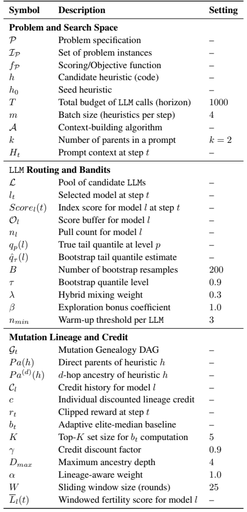
Table 3 : Notations and Hyperparameter Settings for BALLAD
원문 · CC BY 4.0 · Samidha Verma, Ankit Anand, Sayan Ranu · Ballad: Bandit-Based LLM Routing for Automated Heuristic Discovery · 원문 그림 인용 · 원본 PDF 13쪽에서 그림 영역을 추출했습니다.계보 크레딧은 새 휴리스틱의 보상 r_t = max(0, f_P(h_t) − b_t)가 0보다 클 때만 전파됩니다. 여기서 b_t는 상위 K개 엘리트 점수의 중앙값입니다. 크레딧은 거리 d에 대해 γ^d를 곱해 Dmax 깊이까지 조상 팔에 더해집니다. 이렇게 하면 한 모델이 직접 만든 휴리스틱뿐 아니라 그 출력이 다른 모델의 고득점 휴리스틱에 기여한 경우도 반영됩니다.
풀 구성과 개별 LLM 비교 결과
논문은 gemini-2.5-flash-lite, gemini-2.5-flash, gemma-3-12b-it, gemma-3-27b-it의 네 모델 풀에서 TSP, CVRP, Online BP, Offline BP, GED를 평가했습니다. 평가는 검증 세트에서 고른 프로그램을 테스트 세트에 적용하는 방식이며, 세 번 반복한 평균과 표준편차로 보고합니다. 표 1에서 gemini-2.5-flash는 가장 크고 비싼 모델이지만 어떤 과제에서도 최고 목적값이나 최고 순위를 얻지 못했습니다. 반면 gemma-3-12b-it는 가장 작은 모델임에도 CVRP에서 최고 성능을 보였습니다.
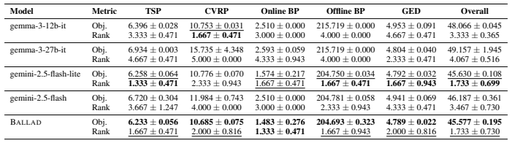
Table 1 : Test-set performance. We report the best program (selected on validation) evaluated on the test set. For each model, we show mean ± std (over 3 runs) forTask-Specific Objective (Obj.)( ↓) and Rank( ↓), where lower is better for both Obj, since we benchmark on minimization problems, and rank. Ranks are integer-valued; draws at full precision share the lowest rank, and the next rank is skipped.Overallis the mean of per-problem means; its std is the root-mean-square of per-problem stds.
원문 · CC BY 4.0 · Samidha Verma, Ankit Anand, Sayan Ranu · Ballad: Bandit-Based LLM Routing for Automated Heuristic Discovery · 원문 그림 인용 · 원본 PDF 7쪽에서 그림 영역을 추출했습니다.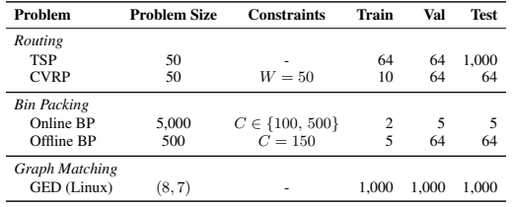
Table 4 :Benchmark dataset configurations.Problems are grouped by type.Problem Sizedenotes the average instance size: number of cities/nodes for routing problems, number of items for packing problems, and (|V|, |E|) for graph problems. Problem-specific constraints, such as vehicle capacity W (CVRP) and bin capacity C (BP), are listed in theConstraintscolumn. Instance counts are given per split.
원문 · CC BY 4.0 · Samidha Verma, Ankit Anand, Sayan Ranu · Ballad: Bandit-Based LLM Routing for Automated Heuristic Discovery · 원문 그림 인용 · 원본 PDF 18쪽에서 그림 영역을 추출했습니다.BALLAD는 전체 평균 목적값 45.577을 기록했고, 전체 평균 순위도 가장 좋았습니다. 다만 저자들은 CVRP에서 gemma-3-12b-it가 단독 최고임에도 BALLAD가 주로 gemini-2.5-flash-lite와 gemma-3-27b-it를 선택했다고 관찰하며, 이를 비최고 모델들의 상호작용과 계보 크레딧 때문으로 해석합니다.
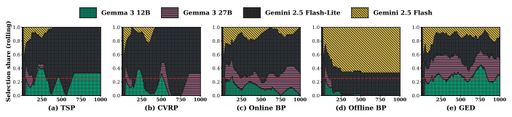
Figure 1 :LLM selection share across search steps (rolling window of 100 calls).Each panel shows, for a combinatorial optimization problem, the fraction of LLM calls routed to each model by BALLAD over the course of the evolutionary search. The dotted horizontal line marks the uniform-allocation baseline (1/K=25% here), corresponding to a policy with no preference over arms. Deviations from this baseline reflect the learned routing policy by BALLADfavors models with selection share above 1/K due to higher estimated utility.
원문 · CC BY 4.0 · Samidha Verma, Ankit Anand, Sayan Ranu · Ballad: Bandit-Based LLM Routing for Automated Heuristic Discovery · 원문 그림 인용 · 원본 PDF 8쪽에서 그림 영역을 추출했습니다.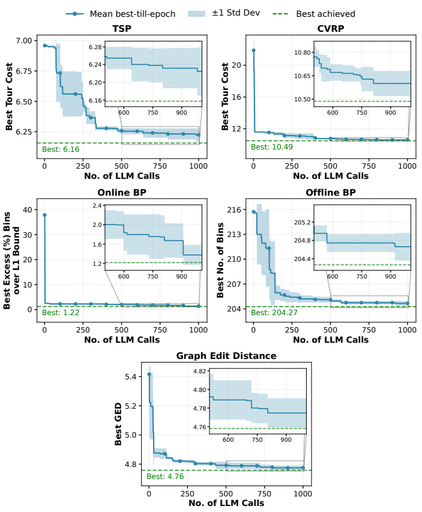
Figure 3 :Best test objective vs. number of LLM calls for BALLAD(lower is better).After each call, all programs generated so far are evaluated on the test set, and the best-performing program is retained. The blue line shows the mean across three runs, with the shaded region indicating ±1 standard deviation. The green dashed line marks the best objective achieved across all runs. Insets zoom in on the second half of the search to highlight smaller improvements. Since the best program is selected using test performance at each step, these curves provide an optimistic estimate of the results in Table 1, where selection is based on validation performance. The final mean is comparable to or better than the corresponding table value.
원문 · CC BY 4.0 · Samidha Verma, Ankit Anand, Sayan Ranu · Ballad: Bandit-Based LLM Routing for Automated Heuristic Discovery · 원문 그림 인용 · 원본 PDF 20쪽에서 그림 영역을 추출했습니다.API 비용 비교
비용은 학습 세트에서 계산한 실행당 API 비용을 Gemini 2.5 공개 단가로 환산한 값입니다. gemma-3 모델은 무료라 비용 그림에서 제외되었습니다. 논문은 BALLAD가 gemini-2.5-flash 대비 최대 5.30배, 평균 2.86배 저렴하다고 보고합니다. gemini-2.5-flash-lite와 비교하면 다섯 과제 중 세 곳에서 더 저렴했고 평균적으로는 1.19배 비쌌습니다. 이 평균 비용 차이를 두고 저자들은 BALLAD가 더 저렴한 모델을 더 많이 사용하는 탐색 결과로 봅니다.
그림 2에 나온 65.6% 절감은 gemini-2.5-flash 대비 평균 비용 감소로 보고된 값입니다. 결과는 Offline BP와 GED에서 예외가 있었고, 이 두 과제에서는 가장 강한 모델이 전체 구간에서 경쟁력을 유지해 할당이 더 많이 쏠렸습니다.
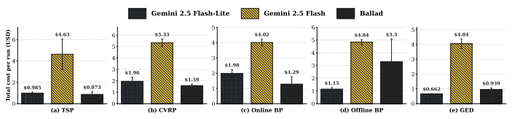
Figure 2 :LLM API cost per run.Total monetary cost (USD) of one evolutionary search run on each task, averaged over three independent runs (mean ± std as error bars). Costs are computed from per-call input/output token counts using public Gemini 2.5 list prices: Flash-Lite at $0.10/M input and $0.40/M output tokens, Flash at $0.30/M input and $2.50/M output tokens. gemma-3 models incur no monetary cost, hence not shown. Average cost reduction relative to gemini-2.5-flash using BALLADis 65.6%.
원문 · CC BY 4.0 · Samidha Verma, Ankit Anand, Sayan Ranu · Ballad: Bandit-Based LLM Routing for Automated Heuristic Discovery · 원문 그림 인용 · 원본 PDF 8쪽에서 그림 영역을 추출했습니다.계보 항과 탐색 보너스의 기여
Table 2의 ablation은 TSP, CVRP, Online BP 세 문제에서 수행되었습니다. 전체 목적값은 세 문제 평균입니다. BALLAD의 전체 목적값은 6.134로, 표준 UCB의 6.243, SW-UCB의 6.314, Thompson Sampling의 6.517보다 낮았습니다. 같은 표에서 계보 크레딧을 끈 BALLAD(α=0)는 전체 목적값 6.159를 기록해 계보 항을 포함한 BALLAD보다 나빴습니다. 이는 계보 항이 이 설정에서 기여했다는 관찰이며, 모든 과제에서 같은 방향이라는 뜻은 아닙니다.
탐색 보너스도 현재 라운드 대신 전체 예산 T를 쓸 때의 설정이 증가형 √log t 보너스보다 전체 결과가 좋았습니다. 비용 페널티 탐색은 저렴하지만 약한 모델로 쏠려 전체 목적값이 나빠졌다고 보고되었습니다.
확장 9개 모델 풀의 결과와 비용
저자들은 GPT-5, GPT-5 Mini, GPT-5 Nano, Claude Sonnet 5, Claude Haiku 4.5, Gemini 2.5 Flash, Gemini 2.5 Flash Lite, Gemma 3 27B, Gemma 3 12B로 이루어진 9개 모델 풀을 Offline BP와 GED에서만 실험했습니다. 프런티어 모델 비용 때문에 범위를 이 두 과제로 제한했습니다. 확장 풀은 두 과제 모두 목적값을 개선했고, 특히 GED는 표준편차 구간이 겹치지 않았습니다.
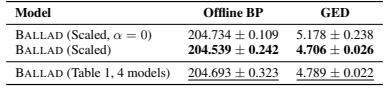
Table 5 :Scaling to Frontier Models:Objective values on Offline BP and GED for four- and nine-model pools, with and without lineage-aware exploitation.Scaleddenotes the nine-model pool. Boldand underline denote the best and runner-up values, respectively.
원문 · CC BY 4.0 · Samidha Verma, Ankit Anand, Sayan Ranu · Ballad: Bandit-Based LLM Routing for Automated Heuristic Discovery · 원문 그림 인용 · 원본 PDF 23쪽에서 그림 영역을 추출했습니다.비용 비교에서는 같은 토큰량을 모두 GPT-5 단가로 계산한 값과 비교했습니다. 이 비교는 GPT-5만 쓸 때 같은 토큰량이 나온다는 가정을 검증하지 않았습니다. 따라서 평균 46.35%, 최대 68.3% 절감은 이 가정 아래의 값입니다.

Table 6 :Cost Comparison:Average cost per run (USD) of BALLAD(Scaled) versus pricing the same token volume entirely at GPT-5’s rate. Relative savings are shown in parentheses.
원문 · CC BY 4.0 · Samidha Verma, Ankit Anand, Sayan Ranu · Ballad: Bandit-Based LLM Routing for Automated Heuristic Discovery · 원문 그림 인용 · 원본 PDF 23쪽에서 그림 영역을 추출했습니다.블랙박스 모델 가정의 한계
저자들은 현재 공식화가 각 LLM을 고정된 프롬프트 전략을 가진 블랙박스 생성기로 다룬다고 밝힙니다. 이 설정은 모델마다 다른 프롬프트, 변이 연산자, 계보 정보나 문맥 표현을 활용하는 차이를 반영하지 못합니다. 또한 BALLAD의 밴딧 규제 보장은 주장하지 않으며, 독립성과 정상성 가정이 AHD에서 성립하지 않는다는 점을 전제로 합니다.
논문 정보
- 저자
- Samidha Verma, Ankit Anand, Sayan Ranu
- 학회·저널
- arXiv · 프리프린트
- 최초 공개일
- 2026년 11월 12일
- 등록일
- 2026년 11월 14일
- 수정일
- 2026년 11월 12일
- 버전
- v1
- arXiv
- 2611.17241
- 분류
- cs.AI
- 원문 이용 조건
- CC BY 4.0
- 제공 범위
- 논문 정보, 해설, 허용된 원문 그림
AI 해설은 논문 원문과 별개의 설명이며 오류가 있을 수 있습니다. 원문과 그림은 각 출처의 이용 조건과 따로 표시된 권리를 따릅니다.
초록
Modern automated heuristic discovery (AHD) systems increasingly rival hand-crafted heuristics by leveraging Large Language Models (LLMs) to iteratively mutate and refine solutions. A natural assumption is that more powerful and more expensive models consistently yield better heuristics. We challenge this empirically: across multiple NP-hard combinatorial optimization problems, we find no consistent advantage for larger, costlier models. This raises a deeper question: given a pool of LLMs spanning frontier and freely hosted or open-weight models, how should one adaptively select which model to invoke at each step of the search? The challenge is non-trivial. The optimal LLM may shift over the course of a run, and because one LLM's output seeds the context for subsequent calls, each model's reward signal is non-stationary and entangled across the heuristic population, thus violating the independence assumptions of classical online decision-making settings. We address this through Ballad (Bandit-based LLM Routing for Automated Heuristic Discovery), an online bandit algorithm that learns to orchestrate a pool of LLMs into an ensemble that matches or exceeds what any soloist LLM achieves alone. This orchestration is powered by an LLM selection policy that favors rare, high-scoring heuristics over stable averages, a DAG-based credit propagation mechanism through the genealogy of the heuristic population, and discounting of stale observations to remain attuned to each model's current utility. Across five NP-hard combinatorial optimization problems and a pool of four models of varying capability and cost, Ballad not only matches the best individual LLM in hindsight but, in several cases, surpasses every individual model while reducing API cost by up to 65.6% relative to always using the strongest model.
원문 인용
Samidha Verma, Ankit Anand, Sayan Ranu (2026). Ballad: Bandit-Based LLM Routing for Automated Heuristic Discovery. arXiv:2611.17241v1. https://arxiv.org/abs/2611.17241v1
BibTeX
@misc{verma2026ballad,
  title = {{Ballad: Bandit-Based LLM Routing for Automated Heuristic Discovery}},
  author = {Samidha Verma and Ankit Anand and Sayan Ranu},
  year = {2026},
  eprint = {2611.17241},
  archivePrefix = {arXiv},
  url = {https://arxiv.org/abs/2611.17241v1}
}