논문 해설
Your Hypergradient is Skewed: Antithetic Neumann Estimation for Bilevel Optimization
당신의 hypergradient는 치우쳐 있다: 이분 최적화를 위한 Antithetic Neumann 추정
- 연구 문제 Neumann 급수 기반 하이퍼그래디언트 추정은 편향과 분산 외에 곱 구조에서 생기는 왜도 오차를 가집니다.
- 연구 방법 확률적 Hessian 표본을 기준 Hessian 주변에서 거울 대응시키고 두 곱을 평균하여 홀수 차수 섭동 항을 상쇄합니다.
- 주요 결과 Housing 로버스트 회귀에서 ANE 방법의 R2는 0.60을 기록했고, Fashion-MNIST 정제에서는 ANE-SGD가 정확도 89.6%를 기록했습니다.
Neumann 역근사의 세 번째 오차
하이퍼그래디언트를 계산하려면 내부 Hessian의 역행렬이 필요하고, 실제로는 절단된 Neumann 급수로 이를 근사합니다. 기존 분석은 이 추정치의 편향과 분산을 중심으로 다뤄 왔습니다. 이 논문은 Neumann 급수가 확률적 Hessian 인자들의 곱으로 이루어진다는 점에서 세 번째 오차원인 왜도가 생긴다고 주장합니다. 미니배치 평균은 독립 기여들의 평균이므로 왜도가 배치 크기에 따라 줄지만, 곱 구조의 Neumann 항은 그렇게 항별로 평균되지 않습니다. 따라서 이 논문은 편향과 분산 외에 홀수 차수 섭동 항이 만드는 비대칭 오차를 줄이는 것을 목표로 합니다.
거울 대칭 Neumann 추정기
ANE는 각 확률적 Hessian 표본을 기준 Hessian 주변의 거울 대응물과 짝지어 두 곱을 평균합니다. 거울 표본은 식 (6)처럼 기준 Hessian에서 편차의 반대 방향으로 만든 것이며, 순방향과 거울 곱의 평균인 식 (7)을 역Hessian-벡터 추정치로 사용합니다. 기준 Hessian이 정확하고 τ=1이면 Proposition 3.4에 따라 홀수 개의 섭동 인자를 포함한 항이 소거되고 짝수 차수 항만 남습니다. 저자들은 이 조건에서 ANE의 최선형 섭동이 제거된다는 점을 이론적 근거로 제시합니다. 기준 Hessian이 근사이면 잔여 홀수 차수 기여는 기준 오차에 선형으로 묶입니다. 이 대칭 구성은 대수적 상쇄이며, 전체 하이퍼그래디언트의 왜도가 0이라는 증명은 아닙니다.
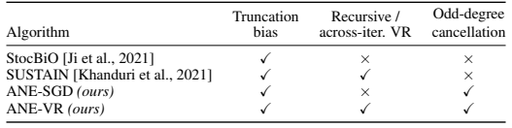
Table 1 :Neumann-based bilevel methods.All methods inherit truncation bias from the Neu- mann inverse approximation. SUSTAIN applies recursive variance reduction across outer iterations. ANE modifies the within-estimate Neumann product by antithetic mirroring, which cancels odd perturbation-degree terms under an exact reference. These mechanisms act at different stages and can be combined; ANE may also affect variance because it removes the linear perturbation term.
원문 · CC BY 4.0 · Jason Bohne, Pawel Polak, Gary Kazantsev, David Rosenberg · Your Hypergradient is Skewed: Antithetic Neumann Estimation for Bilevel Optimization · 원문 그림 인용 · 원본 PDF 2쪽에서 그림 영역을 추출했습니다.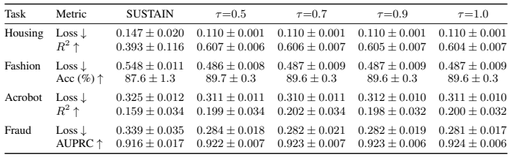
Table 5 :ANE-SGD sensitivity to mirror strengthτ(mean±SD over 20 seeds for every column). SUSTAIN is shown for reference.
원문 · CC BY 4.0 · Jason Bohne, Pawel Polak, Gary Kazantsev, David Rosenberg · Your Hypergradient is Skewed: Antithetic Neumann Estimation for Bilevel Optimization · 원문 그림 인용 · 원본 PDF 21쪽에서 그림 영역을 추출했습니다.스칼라 곱 모델과 이론적 근거
이론 검증은 확률적 Hessian이 한 고유방향에서 곱셈적으로 작용하는 스칼라 곱 모델에서 출발합니다. Theorem 3.1은 인자 노이즈의 세 번째 중심 모멘트가 홀수 차수 항에 비례함을 보이며, 표준화된 왜도는 대략 1/√m 비율로 줄지만 약한 수축 조건에서는 정규화되지 않은 세 번째 모멘트 항이 커질 수 있다고 설명합니다. Lemma A.2는 같은 곱 모델에서 절단된 전체 합의 세 번째 모멘트 하한을 제시하며, 이 하한은 약한 수축에서 절단 깊이와 조건수에 따라 커지는 방향을 보입니다. 이 결과들은 스칼라 모델과 지정된 가정에 대한 것이며 모든 하이퍼그래디언트 추정기에 일반화된 것은 아닙니다.
네 가지 쌍수준 과제의 결과
실험은 로버스트 회귀, 데이터 정제, 오프라인 강화학습, 불균형 분류의 네 과제에서 ANE-SGD와 ANE-VR을 StocBiO 및 SUSTAIN과 비교했습니다. Housing 로버스트 회귀에서 ANE 방법의 R2는 0.60을 기록했고 SUSTAIN은 0.39였습니다. Fashion-MNIST 데이터 정제에서는 ANE-SGD와 ANE-VR이 정확도 89.6%와 89.5%를 기록했고, 기준선은 87.5%와 87.6%였습니다. 본문 표의 손실 지표도 같은 방향의 개선을 보였으나 과제별 설정과 시드 조건을 함께 읽어야 합니다. 동일한 깊이·배치·시드 조건에서 얻은 비교이며 다른 모델과 데이터셋으로의 확장은 검증하지 않았습니다.
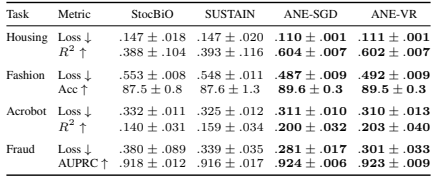
Table 3 :Final test metrics (mean±SD over 20 seeds per task).For Fraud, Loss is the class- balanced validation (outer) objective (Appendix C.3). Best per task inbold. In Acrobot, SUSTAIN beats StocBiO (R 2 = 0.16vs.0.14) but ANE-VR matches ANE-SGD, consistent with across- iteration VR adding little on top of ANE.
원문 · CC BY 4.0 · Jason Bohne, Pawel Polak, Gary Kazantsev, David Rosenberg · Your Hypergradient is Skewed: Antithetic Neumann Estimation for Bilevel Optimization · 원문 그림 인용 · 원본 PDF 10쪽에서 그림 영역을 추출했습니다.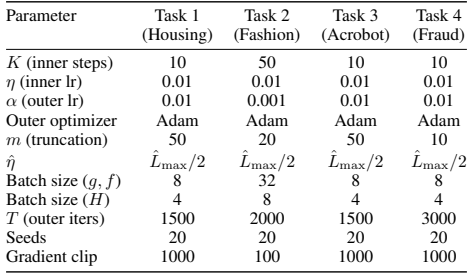
Table 4 : Full hyperparameter settings for each real task.
원문 · CC BY 4.0 · Jason Bohne, Pawel Polak, Gary Kazantsev, David Rosenberg · Your Hypergradient is Skewed: Antithetic Neumann Estimation for Bilevel Optimization · 원문 그림 인용 · 원본 PDF 20쪽에서 그림 영역을 추출했습니다.상쇄 이론의 적용 범위와 비용
저자들은 홀수 차수 상쇄가 완전한 하이퍼그래디언트 왜도 이론이 아니라고 밝힙니다. 근사 기준 Hessian에 대한 경계는 실제 과제가 가정하지 못하는 수축 조건을 전제로 하며, 따라서 실험에서 얻은 개선을 왜도 보정 하나로만 설명할 수 없습니다. 비용 측면에서 ANE는 거울 분기와 기준 Hessian 적용 때문에 표준 Neumann 하이퍼그래디언트 스텝보다 약 세 배의 비용이 드는 것으로 보고됩니다. 벽시계 시간을 맞춘 비교는 향후 과제로 남아 있습니다.
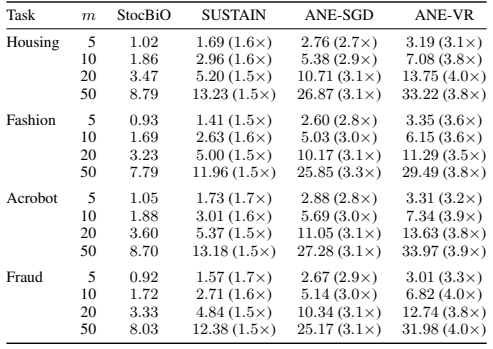
Table 11 : Hypergradient-step wall-clock time (ms per call; ratio to StocBiO in parentheses).
원문 · CC BY 4.0 · Jason Bohne, Pawel Polak, Gary Kazantsev, David Rosenberg · Your Hypergradient is Skewed: Antithetic Neumann Estimation for Bilevel Optimization · 원문 그림 인용 · 원본 PDF 24쪽에서 그림 영역을 추출했습니다.논문 정보
- 저자
- Jason Bohne, Pawel Polak, Gary Kazantsev, David Rosenberg
- 학회·저널
- arXiv · 프리프린트
- 최초 공개일
- 2026년 11월 11일
- 등록일
- 2026년 11월 13일
- 수정일
- 2026년 11월 11일
- 버전
- v1
- arXiv
- 2611.15895
- 분류
- cs.LG · math.OC
- 원문 이용 조건
- CC BY 4.0
- 제공 범위
- 논문 정보, 해설, 허용된 원문 그림
AI 해설은 논문 원문과 별개의 설명이며 오류가 있을 수 있습니다. 원문과 그림은 각 출처의 이용 조건과 따로 표시된 권리를 따릅니다.
초록
Bilevel optimization is a core tool in practical machine learning workflows, including hyperparameter tuning, data reweighting, robust learning, reinforcement learning, and imbalanced classification. Hypergradient computation requires the inverse of the inner Hessian, typically estimated via a truncated Neumann series. While existing analyses focus on bias and variance, we show that the product structure of the Neumann series introduces a third source of error: skewness. We identify that, unlike ordinary gradients, whose asymmetry is suppressed by mini-batch averaging, the Neumann estimator amplifies skewness across factors, with the third-moment error growing, under weak contraction, with truncation depth, inner condition number, and per-factor noise asymmetry. This arises in many practical settings such as corrupted labels, outliers, heterogeneous or class-imbalanced datasets. To address this, we introduce the Antithetic Neumann Estimator (ANE), which pairs each Hessian sample with a mirrored counterpart around a reference Hessian and averages the resulting inverse-Hessian estimates. With an exact reference, the antithetic product retains only even-order noise, eliminating all odd-order perturbation terms; with an approximate reference, the residual odd-order contribution is bounded linearly in the reference error. ANE requires only a modification of the Hessian vector step and combines with existing stochastic or variance-reduced bilevel methods. We instantiate ANE-SGD and ANE-VR, the latter adding recursive variance reduction. Across robust regression, data cleaning, offline reinforcement learning, and imbalanced classification, ANE-based methods improve on stochastic and variance-reduced baselines on every task (20 seeds each), lowering loss by 4 to 25% relative to the best baseline; the largest gains, on robust regression, are a 25% lower test loss and a 54% higher test r-squared.
원문 인용
Jason Bohne, Pawel Polak, Gary Kazantsev, David Rosenberg (2026). Your Hypergradient is Skewed: Antithetic Neumann Estimation for Bilevel Optimization. arXiv:2611.15895v1. https://arxiv.org/abs/2611.15895v1
BibTeX
@misc{bohne2026your,
  title = {{Your Hypergradient is Skewed: Antithetic Neumann Estimation for Bilevel Optimization}},
  author = {Jason Bohne and Pawel Polak and Gary Kazantsev and David Rosenberg},
  year = {2026},
  eprint = {2611.15895},
  archivePrefix = {arXiv},
  url = {https://arxiv.org/abs/2611.15895v1}
}