논문 해설
Training Calibrated Conditional Generative Models with a Sample-Only Coverage Loss
샘플만으로 계산하는 커버리지 손실을 이용한 보정된 조건부 생성 모델 학습
- 연구 문제 과신하는 조건부 생성 모델을 샘플만으로 coverage 보정하는 문제입니다.
- 연구 방법 참조점별 TARP 신용값의 Cramér–von Mises 불일치를 평균하는 손실을 샘플로 계산하여 학습에 더합니다.
- 주요 결과 SBI 벤치마크에서 밀도 기반 CalNPE와 비슷한 coverage를 보였고, 이미징 실험에서 선형 역산란 Mira 판정이 가장 좋았습니다.
과신하는 조건부 생성 모델의 문제
역문제에서 조건부 생성 모델은 측정값 y가 주어졌을 때 가능한 신호 θ의 사후 샘플을 만듭니다. 그런데 이런 모델은 자주 과신하여 사후분포의 불확실성을 너무 좁게 표현합니다. 과학 응용에서는 이 과신이 치명적이므로 보정된 불확실성이 필요합니다.
기존 정규화 방법은 서로 다른 약점을 가집니다. 밀도 기반 coverage 목적은 모델 밀도를 요구하고, 엄격 적합 점수 규칙인 Energy Score는 샘플만 필요하지만 coverage를 직접 강제하지 않습니다. 이 논문은 샘플만으로 coverage를 미분 가능하게 강제하는 손실을 만들려 합니다.
참조 규칙과 TARP-CvM 손실
TARP-CvM은 각 측정값 y에 참조점 ψ(y)를 대응시키는 참조 규칙을 씁니다. 참조점을 중심으로 참값 θ를 지나는 공을 만들고, 모델 샘플 중 그 공 안에 드는 비율을 신용값으로 계산합니다. 신용값이 모델이 옳다면 [0,1]에서 균등분포를 따라야 한다는 것이 핵심입니다.
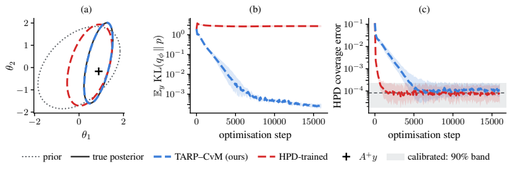
Figure 1 : Gaussian linear inverse problem,θ∈R 8. (a) 2-d slice of 68% level sets of the prior, the true posterior, and models trained with the HPD loss and with TARP-CvM alone. (b) Expected KL to the true posterior during training. (c) HPD coverage error during training: it cannot distinguish the two models, although their KL differs strongly. Setup and details in Section 5.1 and Appendix E.1.
원문 · CC BY 4.0 · Benjamin Remy, Raphael Rossellini, Chihway Chang, Rebecca Willett · Training Calibrated Conditional Generative Models with a Sample-Only Coverage Loss · 원문 그림 인용 · 원본 PDF 3쪽에서 그림 영역을 추출했습니다.손실은 규칙마다 신용값의 누적분포와 대각선의 차이를 제곱해 적분한 Cramér–von Mises 불일치를 구한 뒤 규칙 분포에 대해 기댓값을 취합니다. 이때 평균이 규칙 바깥에 있어서 한 규칙 안에서 과대 coverage와 과소 coverage가 상쇄되는 문제를 피합니다. 저자들은 측정 공간의 초평면으로 두 변위를 나누는 switch 규칙이 이 조건을 만족한다고 설명합니다.
학습에서는 지시함수 대신 시그모이드 근사를 쓰고, 정렬된 신용값에 대한 닫힌 형태의 CvM 통계량을 사용해 기울기를 계산합니다.
SBI 벤치마크에서의 coverage 비교
SBI 벤치마크에서는 NPE, 밀도 기반 CalNPE, TARP-CvM을 같은 학습 절차로 비교했습니다. 네 문제와 세 시뮬레이션 예산을 사용했고, TARP-CvM은 사후 샘플만으로 학습했습니다.
결과에서 세 방법은 대부분의 설정에서 통계적으로 구분되지 않았습니다. TARP-CvM은 CalNPE와 비슷한 coverage 오차를 보였지만, CalNPE는 밀도 평가를 사용하는 방법입니다. 저자들은 이 결과를 밀도를 평가하지 않고도 비슷한 보정을 얻었다는 의미로 해석합니다.
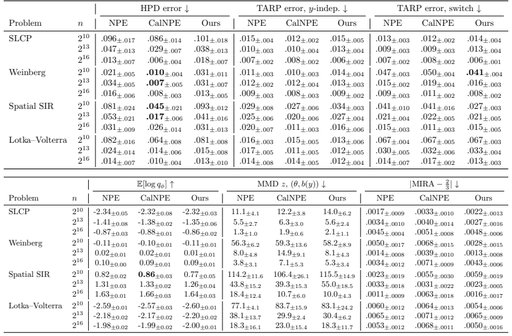
Table 1 : SBI benchmark results for NPE, CalNPE (λ= 100, Falkiewicz et al., 2023) and TARP-CvM (Ours, λ= 30,M= 16), all trained with the same protocol, for simulation budgetsn∈ {2 10,2 13,2 16}. Mean± standard deviation over five independently trained estimators per cell. Bold marks the best mean when it is significantly better than both other methods. HPD and TARP errors are theL 1 coverage errors under each credible-region map,E[logq ϕ] is the expected log posterior density of the true parameters, MMDzthe z-score of an MMD test on the pairs (θ, b(y)), and|Mira−2/3|the deviation of the Mira score from its calibrated value.
원문 · CC BY 4.0 · Benjamin Remy, Raphael Rossellini, Chihway Chang, Rebecca Willett · Training Calibrated Conditional Generative Models with a Sample-Only Coverage Loss · 원문 그림 인용 · 원본 PDF 28쪽에서 그림 영역을 추출했습니다.이미징 역문제에서의 보정 결과
Navier–Stokes, 선형 역산란, 압축센싱 MRI에서 DSM으로 사전학습한 모델을 ES, pCRPS, TARP-CvM으로 미세조정했습니다. 모든 pre-training 모델은 Mira 기준으로 과신했습니다.
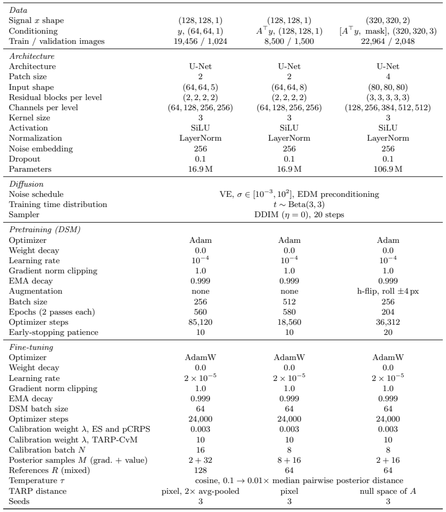
Table 2 : Architecture and training of the conditional diffusion posteriors. Fine-tuning starts from the converged networks from pretraining. All four fine-tuning objectives share every setting except the calibration weightλ.
원문 · CC BY 4.0 · Benjamin Remy, Raphael Rossellini, Chihway Chang, Rebecca Willett · Training Calibrated Conditional Generative Models with a Sample-Only Coverage Loss · 원문 그림 인용 · 원본 PDF 31쪽에서 그림 영역을 추출했습니다.Navier–Stokes와 선형 역산란에서 TARP-CvM은 가장 낮은 TARP coverage 오차를 기록했습니다. 선형 역산란에서는 TARP-CvM만 Mira 기준 보정 범위 안에 들었습니다. MRI에서는 Energy Score가 TARP 기반 오차가 가장 낮았지만 Mira로는 여전히 과신으로 판정되었고, TARP-CvM만 범위 안에 들었습니다.
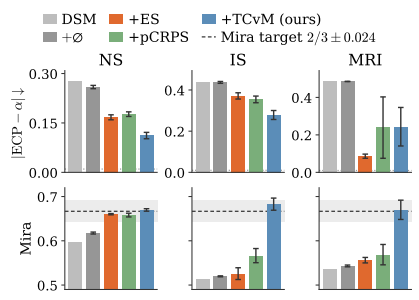
Figure 3 : Coverage before and after calibration.
원문 · CC BY 4.0 · Benjamin Remy, Raphael Rossellini, Chihway Chang, Rebecca Willett · Training Calibrated Conditional Generative Models with a Sample-Only Coverage Loss · 원문 그림 인용 · 원본 PDF 12쪽에서 그림 영역을 추출했습니다.Navier–Stokes는 비선형 순방향 연산자를 쓰므로 정리 1의 가정이 엄밀히 적용되지 않는다고 저자들이 명시합니다.
샘플링 깊이와 적용 조건
학습 중 역전파하는 샘플러의 단계 수는 T=20으로 고정했습니다. 추론 때 T를 100이나 500으로 늘리면 NS와 IS에서는 Mira가 null band 안에 머물렀지만, MRI에서는 Mira가 범위를 벗어났습니다. T=100과 500에서는 DSM만 학습한 모델보다도 낮아졌습니다.
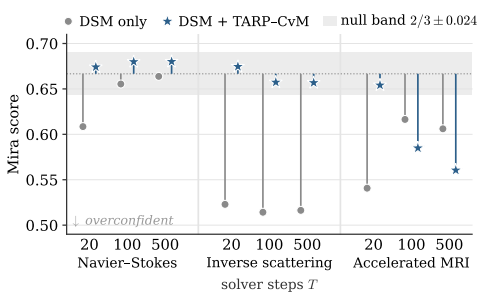
Figure 4 : Coverage under varying sampler depth. TARP-CvM was trained atT= 20.
원문 · CC BY 4.0 · Benjamin Remy, Raphael Rossellini, Chihway Chang, Rebecca Willett · Training Calibrated Conditional Generative Models with a Sample-Only Coverage Loss · 원문 그림 인용 · 원본 PDF 13쪽에서 그림 영역을 추출했습니다.저자들은 MRI에서 학습된 보정이 20단계 샘플러의 이산화 오차를 보상하는 것이라고 해석합니다. 따라서 보정은 학습 때 쓴 샘플링 깊이에 묶여 있으며, 학습 비용도 T에 비례해 늘어납니다.
논문 정보
- 저자
- Benjamin Remy, Raphael Rossellini, Chihway Chang, Rebecca Willett
- 학회·저널
- arXiv · 프리프린트
- 최초 공개일
- 2026년 11월 11일
- 등록일
- 2026년 11월 13일
- 수정일
- 2026년 11월 11일
- 버전
- v1
- arXiv
- 2611.15829
- 분류
- cs.LG · stat.ME · stat.ML
- 원문 이용 조건
- CC BY 4.0
- 제공 범위
- 논문 정보, 해설, 허용된 원문 그림
AI 해설은 논문 원문과 별개의 설명이며 오류가 있을 수 있습니다. 원문과 그림은 각 출처의 이용 조건과 따로 표시된 권리를 따릅니다.
초록
Conditional generative models have become the tool of choice for sampling posteriors in scientific inverse problems, where we seek to sample images or signals conditioned on a set of indirect and noisy measurements. Yet they are often overconfident, which is a critical failure in scientific applications where accurate uncertainty quantification is essential. Existing regularizers fall short in complementary ways: differentiable coverage objectives require the model's density and do not identify the posterior, while strictly proper scoring rules such as the energy score need only samples but do not directly enforce coverage. We close this gap by introducing a differentiable loss function based on the expected coverage probability, estimated from samples alone. It applies to any conditional generative model, with no need for tractable densities or architectural changes. We prove that it is a strict divergence, vanishing if and only if the model equals the true posterior. On simulation-based inference benchmarks, it matches a density-based coverage loss without evaluating the density. On high-dimensional imaging inverse problems, it yields better-calibrated posteriors than scoring-rule regularizers, with little change in the reconstruction quality of point estimates.
원문 인용
Benjamin Remy, Raphael Rossellini, Chihway Chang, Rebecca Willett (2026). Training Calibrated Conditional Generative Models with a Sample-Only Coverage Loss. arXiv:2611.15829v1. https://arxiv.org/abs/2611.15829v1
BibTeX
@misc{remy2026training,
  title = {{Training Calibrated Conditional Generative Models with a Sample-Only Coverage Loss}},
  author = {Benjamin Remy and Raphael Rossellini and Chihway Chang and Rebecca Willett},
  year = {2026},
  eprint = {2611.15829},
  archivePrefix = {arXiv},
  url = {https://arxiv.org/abs/2611.15829v1}
}