Paper commentary
artist: A Python package for differentiable ray tracing and gradient-based optimization of solar tower power plant operation
- Problem Conventional solar tower ray tracers predict receiver flux only in the forward direction, so they cannot recover heliostat parameters from measured flux or optimize aim points by gradients.
- Method artist expresses the NURBS surfaces, rigid-body kinematics, soft-binning accumulation and LBVH soft occlusion as differentiable PyTorch operations, then fits the registered parameters with Adam against a KL-based loss.
- Results Averaged over the evaluated heliostats, the normalized absolute flux error fell from 0.55 for the nominal surface to 0.15 for the reconstructed NURBS surface, a 72.7 % reduction.
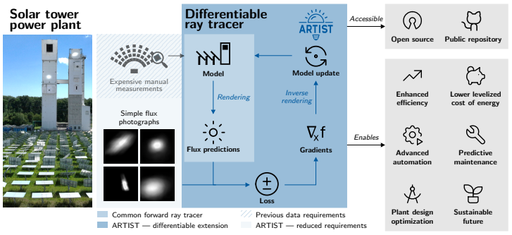
Figure 1 . Overview of ray tracing in solar tower power plant digital twins.Conventional ray tracers predict flux density distributions from a plant model (forward rendering).artistextends this workflow with differentiable inverse rendering, enabling recovery of unknown plant parameters from flux images acquired during normal operation, and direct gradient-based optimization of plant operation. Together, these capabilities reduce reliance on expensive manual measurements, enabling more autonomous and efficient solar tower operation through next-generation control strategies.
Original paper · CC BY 4.0 · Marlene Busch, Marie Weiel, Kaleb Phipps, Daniel Maldonado Quinto, Max Pargmann, Robert Pitz-Paal, Markus Götz · artist: A Python package for differentiable ray tracing and gradient-based optimization of solar tower power plant operation · Original paper figure · Extracted the figure area from page 2 of the original PDF.Why forward ray tracers fall short
Heliostat surface deformations and kinematic misalignments shift the flux that reaches the receiver, and those shifts are hard to measure one heliostat at a time. Established solar tower ray tracers predict the receiver flux from a plant model they are given, which makes them forward-only tools. Recovering unknown plant parameters from measured flux, or choosing aim points by gradient descent, needs gradients that these tools cannot supply because they are not differentiable.
Without a way to infer these deviations, plants keep conservative safety margins, which caps operating temperatures.
Making the optical chain differentiable
artist keeps the usual forward pipeline of surfaces, kinematics, ray tracing, blocking and receiver accumulation, but writes every step as differentiable tensor operations on top of PyTorch. Because the whole chain is one computational graph, a scalar loss on the predicted flux yields gradients for every physical parameter that feeds into it.
Only parameters that are explicitly registered as optimizable are updated; the other plant data come from the scenario file as inputs. The same forward model therefore serves prediction, reconstruction and optimization, and the authors present this as the reason the framework stays physically consistent.
Surface and kinematic parameters
Each heliostat facet is modeled as a NURBS surface, which gives a smooth but flexible shape that remains differentiable. The surface is a ratio of weighted B-spline basis functions applied to control points, so the control points and weights determine the geometry. \[ S(u,v)=\frac{\sum_{i=0}^{n}\sum_{j=0}^{m} N_{i,p}(u)\,M_{j,q}(v)\,w_{i,j}\,B_{i,j}}{\sum_{i=0}^{n}\sum_{j=0}^{m} N_{i,p}(u)\,M_{j,q}(v)\,w_{i,j}} \]
The control points B_{i,j} are the parameters that surface reconstruction adjusts, starting from a flat ideal surface. Surface normals are taken analytically from the partial derivatives of the surface at sampled (u, v) coordinates, so the normals stay differentiable with respect to the control points.
Motor positions are mapped to heliostat pose by a chain of rigid-body translations and rotations. For the kinematics, the model adds rotation terms for heliostat-specific actuator-axis tilts, because angular misalignments dominate the optical error. Since the kinematic chain is built from differentiable tensor operations, gradients reach these tilt parameters, which are fitted from measured calibration images.
Differentiable accumulation and blocking
Hard binning assigns each reflected ray's full energy to its nearest receiver pixel, so the flux changes in discrete jumps and its gradient is zero almost everywhere. artist replaces this with soft binning, based on bilinear splatting, which distributes each ray's energy linearly over its four nearest pixels according to the sub-pixel landing position.
Because the accumulated flux varies continuously with landing position, gradients from a flux loss reach the surface normals and the upstream parameters.
Blocking is handled with a Linear Bounding Volume Hierarchy, in which each heliostat is one rectangular primitive. The primitives are sorted by Morton codes derived from their centroids and assembled into a binary radix tree, with axis-aligned bounding boxes at the internal nodes. During tracing, ray-AABB tests narrow the set of candidate blockers before the occlusion is computed for them.
These soft contributions are combined with a Beer-Lambert transmittance model, so a binary blocked-or-visible decision becomes a differentiable occlusion signal.
One objective for several tasks
For image-based tasks, the measured and predicted receiver flux are normalized and treated as discrete probability distributions. Their mismatch is measured by the Kullback-Leibler divergence, summed over all receiver pixels p. \[ L_{\text{flux}} = D_{\mathrm{KL}}(F_{\text{ref}} \,\|\, F_{\text{pred}}) = \sum_{p} F_{\text{ref},p}\log\frac{F_{\text{ref},p}}{F_{\text{pred},p}} \]
Adam minimizes this loss when unknown parameters are recovered or controllable parameters are optimized. Extra regularizers, such as smoothness priors for surfaces or energy constraints, can be added to the same objective. Operational limits such as spillage and maximum receiver flux are enforced through an augmented-Lagrangian formulation, with normalized optimization variables.
Changing only the objective switches the same digital twin between reconstruction and optimization tasks, while the forward model and the solver stay the same.
Surface reconstruction error
The comparison metric is the normalized absolute flux error, which sums the absolute differences between predicted and reference flux and divides by the summed reference flux. \[ E_{L1}=\frac{\sum_{p}\left|F_{\text{pred},p}-F_{\text{ref},p}\right|}{\sum_{p}F_{\text{ref},p}} \] Both flux images are normalized before comparison, so the metric reflects only spatial differences and not the absolute flux magnitude.
Averaged over all evaluated heliostats and all their flux images, the error is 0.55 for the nominal ideal surface and 0.15 for the reconstructed NURBS surface. That corresponds to a reduction of 72.7 %, or a factor of 3.6. The authors regard this figure as a conservative estimate, since the effect of surface deformations depends on heliostat position and solar position.
Two kinematic calibration routes
The alignment-driven route turns focal spot positions into reference heliostat normals using the incident ray direction, the heliostat position and the law of reflection. The kinematic model predicts the normal from the recorded actuator positions, and the optimizer reduces the difference between the two normals.
The flux-driven route instead runs the differentiable ray tracer at each step and compares focal spots extracted from predicted and measured flux images by their Euclidean distance. Gradients pass through the ray tracer, the NURBS surface model and the kinematic chain before they update the tilt parameters.
Its reference normal is only approximate, because the focal spot centroid is not the exact aim point, so it serves as a fast initial calibration. Flux-driven reconstruction refines the parameters once the predicted flux reliably hits the receiver, and both routes start from the plant's measured configuration.
Flux prediction across model stages
Three heliostats, AA31, AP41 and BF65, are simulated under four models and compared with a measured reference flux image. The idealized model has perfect geometry and kinematics, so its distributions are undistorted and misaligned with the reference. In that model, AP41 partly misses the target and BF65 misses it completely.
Adding only the reconstructed surface corrects the mirror deformation but leaves the alignment unchanged. Adding only the reconstructed kinematics corrects the center of mass of the predicted distribution while the mirror stays idealized. The full reconstructed model, which combines both, matches the reference in center of mass and in flux distortion, and it is the closest of the four.
Each row is normalized so that the full reconstructed model integrates to one, so off-target distributions integrate to less than one. The text gives this comparison only through the figure, with no error score for these three heliostats.
Aim point optimization on 100 heliostats
Aim points determine how much energy reaches the receiver and how evenly it is spread, which bears on thermal stress. Previous studies that used reconstructed heliostat models in plant operation reported energy yield increases of up to 20 %.
artist optimizes the motor positions of all heliostats jointly over continuous aim points, rather than choosing among discrete candidate points or optimizing each heliostat alone. The objective combines the KL divergence between desired and predicted flux with augmented-Lagrangian constraints for flux conservation, spillage and local heat peaks.
The example uses 100 reconstructed heliostats, and the baseline has all of them aiming at the receiver center. The baseline carries 482.14 kW of total incident power, and the optimized aim points carry 482.17 kW. The optimized distribution approximates the target shape while the incident power stays essentially the same, and the text reports no shape-matching score for this case.
Software structure and scale
A scenario file in HDF5 stores heliostats, target areas, light sources and prototypes in groups, and a parser builds scenarios from the open PAINT database. Core components such as surfaces, kinematics, actuators, receivers and the light source are abstract classes, so users extend them by inheritance and assemble plants by composition.
Heliostat data are stored as a structure-of-arrays, so each parameter type is contiguous across heliostats, which suits GPU memory access. Heliostats with a shared configuration are batched, and groups can be distributed across compute nodes with PyTorch's distributed data parallel backend. CPU and GPU execution are supported on Windows and Linux, within the backends PyTorch supports.
Limitations
The current optical model does not include shading, in which neighboring heliostats block incoming rays before reflection. The soft occlusion model does not depend on whether a ray is incoming or reflected, which the authors see as a basis for differentiable shading.
artist does not provide uncertainty quantification, which the authors consider important for decisions in high-temperature operation. Further validation on additional operational datasets and live plant measurements is still required.
The statement that artist needs fewer training data than black-box approaches is made in the discussion and is not backed by a reported comparison experiment. Inverse plant design, such as optimizing field layouts and receiver geometries, is outside the scope of this work.
Paper info
- Authors
- Marlene Busch, Marie Weiel, Kaleb Phipps, Daniel Maldonado Quinto, Max Pargmann, Robert Pitz-Paal, Markus Götz
- Venue
- arXiv · Preprint
- First published
- 2026-11-16
- Added
- 2026-11-17
- Updated
- 2026-11-16
- Version
- v1
- arXiv
- 2611.20851
- Category
- cs.LG
- Original paper terms
- CC BY 4.0
- What we show
- Paper info, commentary and permitted figures from the original paper
AI commentary is a separate explanation from the original paper and may contain errors. The original paper and figures follow each source's terms of use and any rights noted separately.
Abstract
Solar tower power plants provide dispatchable, renewable energy by concentrating sunlight with thousands of mirrors, called heliostats, onto a central receiver. Efficient operation requires accurate modeling of the optical path from each heliostat to the receiver and compensation for manufacturing imperfections, kinematic misalignment, and material degradation that distort the flux distribution. Conventional ray tracers predict the flux from an assumed plant model but are limited to forward simulation. They cannot recover unknown plant parameters from measured flux nor directly optimize plant operation. We present artist, an open-source, FAIR4RS-compliant Python package implementing a fully differentiable digital twin of solar tower power plants. By making the optical pipeline, comprising heliostat surface representation, kinematics, blocking, and ray tracing, end to end differentiable, artist turns the digital twin from a passive forward model into an active physics-based tool for inverse modeling and data-driven optimization. The resulting gradient-based framework unifies tasks usually handled by separate solutions, such as reconstructing heliostat surfaces and kinematics from operational flux images without costly deflectometry, predicting irradiance at the receiver, and optimizing aim points to realize a desired receiver flux density distribution. Built on PyTorch, artist scales to real plants through GPU acceleration, a structure-of-arrays memory layout, and nested data parallelism. It interfaces with open data sources such as the PAINT database. We describe the software architecture, physical models, and optimization framework, and demonstrate the workflow on representative tasks. By integrating modeling, prediction, and optimization into a single open, interpretable package, artist provides a principled foundation for data-driven research toward autonomous solar tower operation.
Quote from the paper
Marlene Busch, Marie Weiel, Kaleb Phipps, Daniel Maldonado Quinto, Max Pargmann, Robert Pitz-Paal, Markus Götz (2026). artist: A Python package for differentiable ray tracing and gradient-based optimization of solar tower power plant operation. arXiv:2611.20851v1. https://arxiv.org/abs/2611.20851v1
BibTeX
@misc{busch2026artist,
  title = {{artist: A Python package for differentiable ray tracing and gradient-based optimization of solar tower power plant operation}},
  author = {Marlene Busch and Marie Weiel and Kaleb Phipps and Daniel Maldonado Quinto and Max Pargmann and Robert Pitz-Paal and Markus Götz},
  year = {2026},
  eprint = {2611.20851},
  archivePrefix = {arXiv},
  url = {https://arxiv.org/abs/2611.20851v1}
}