Paper commentary
MOBO-CAPS: Multi-Objective Bayesian Optimization with Cardinality-Aware Pareto Selection
- Problem Standard MOBO spends its evaluation budget on approximating the whole Pareto front, and any reduction to M solutions happens afterwards, so the evaluations are not targeted at the final M-point set.
- Method Formalizes a sequential search for exactly M solutions with maximal hypervolume, and proposes REHVI, a replacement-aware variant of EHVI, and CHO-UCB, which optimizes a collective UCB-based hypervolume over an M-point set.
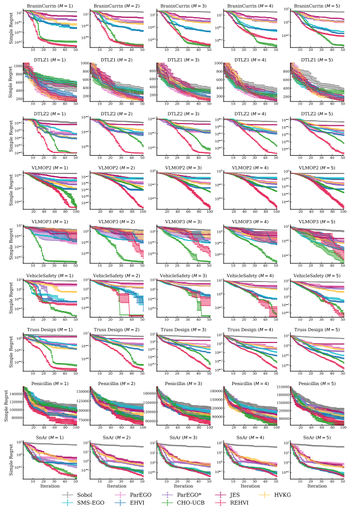
Figure 5 : The cardinality-aware methods, REHVI and CHO-UCB, achieve the strongest overall performance across settings.
Original paper · CC BY 4.0 · Wang, Hanyang, Branke, Juergen, Poloczek, Matthias · MOBO-CAPS: Multi-Objective Bayesian Optimization with Cardinality-Aware Pareto Selection · Original paper figure · Extracted the figure area from page 18 of the original PDF.Why fix the set size at M
Standard multi-objective Bayesian optimization tries to recover the whole Pareto front, and a second step then picks a subset for the decision-maker. That two-step pipeline treats the final cardinality as an afterthought, so the evaluations spent on regions that the subset will never include are not steered toward the final M-point set.
Because the search itself is sequential and the budget is limited, the set must be assembled from new evaluations rather than picked from an already observed pool, which distinguishes it from the Hypervolume Subset Selection Problem.
As M grows, returning many Pareto-optimal points begins to resemble approximating the full front, so the cardinality constraint matters most when only a few final solutions are needed.
How REHVI and CHO-UCB score candidates
REHVI starts from EHVI and adds a replacement step, so that the candidate added to the current M-point set is always paired with one removal. For each candidate, the method draws Monte Carlo samples from the GP posterior, adds the candidate to the current set, removes the point whose deletion keeps the largest hypervolume, and averages the resulting gain over the samples.
CHO-UCB works on the GP posterior mean and standard deviation of each objective. For a candidate x it forms an optimistic estimate of the form \( \mu(x) + \sqrt{\beta_t}\,\sigma(x) \), where \( \beta_t \) sets the exploration weight. In the theoretical version used for the regret analysis, the exploration parameter is fixed to B, and the upper bound is written as \( \mathrm{UCB}_t(x) := \mu_{t-1}(x) + B\sigma_{t-1}(x) \).
The batched method then chooses the whole M-point multiset that maximizes the hypervolume of these optimistic values, so the set is optimized jointly rather than one point at a time.
The cost of the two methods differs in structure. Applying the qEHVI complexity to REHVI with one candidate and a fixed M-point set gives \( O(KNM^2) \), where N is the number of Monte Carlo samples. CHO-UCB uses N = 1 and batch size q = M, which gives \( O(K(2M-1)) \) in the bi-objective analysis, so it avoids Monte Carlo sampling altogether.
Regret bound for batched CHO-UCB
The analysis is restricted to the noise-free setting, where each objective f_i lies in the RKHS of a known kernel k_i with norm at most B, and k_i(x,x) is at most 1. Under these conditions the objective values, the posterior means and the UCB and LCB values all lie in the interval from -2B to 2B, which keeps the hypervolume Lipschitz argument bounded.
The instantaneous regret at iteration t is bounded by a Lipschitz constant times the sum over objectives of the largest posterior standard deviation in the batch, with \( L_{HV} = MK(2B-\min_j z_{\mathrm{ref},j})^{K-1} \). The proof obtains this by sandwiching the true objective between the LCB and UCB values, so the hypervolume gap is at most the gap between the UCB and LCB hypervolumes of the same batch.
Summing the per-iteration bound over the batched history and using the cumulative posterior standard deviation bounds \( C_i(T,d,\theta_i) \) gives a simple regret that decreases with T through the factor 1/T. The resulting statement is \[ r^{\text{simple}}_T \le \frac{2BMK(2B-\min_j z_{\mathrm{ref},j})^{K-1}}{T}\sum_{i=1}^{K} C_i(T,d,\theta_i) \].
The authors describe this as a sublinear bound, and whether it actually vanishes depends on how the cumulative terms \( C_i(T,d,\theta_i) \) grow with T, which the proof takes from earlier RKHS results.
Benchmark ranks and pairwise evidence
The comparison uses nine test problems, with each experiment repeated 20 times and reported as mean plus or minus one standard error. Cardinalities from M = 1 to M = 5 are included, and the main text shows M = 3 for all nine problems, while the remaining cardinalities appear in the appendix. Performance is scored by simple regret, the gap between the approximate true maximum hypervolume and the best hypervolume the algorithm has found so far.
Sobol has the highest average rank at 8.93 (0.07), and the baselines ParEGO, ParEGO*, SMS-EGO, HV-KG and JES fall between these values.
REHVI ranks first in 30 of the 45 settings. The 45 settings reuse the same test problems across cardinalities and are therefore not independent, so the authors note that the reported significance may be somewhat inflated.
DTLZ2 results across input dimensions 3D, 6D and 10D and across 2, 3 and 4 objectives show a broadly consistent ranking of algorithms.
Larger cardinalities and sampling behaviour
On DTLZ2 with target cardinalities M = 10 and M = 15, the relative advantage of REHVI and CHO-UCB over the baseline acquisition functions decreases as M increases.
On BraninCurrin with M = 4, EHVI spreads its evaluations along the Pareto front, while CHO-UCB and REHVI concentrate near the best sets of size M. REHVI is the most exploitative of the three, which the authors connect to its replacement step favouring points that add to the current set.
Acquisition optimization time
Wall-clock times were measured on an Intel Core i7-1355U CPU, averaged per iteration across problems, and exclude surrogate model training time. For the cardinalities used in the experiments, CHO-UCB is faster to optimize than REHVI.
Among the cardinality-aware methods, REHVI has the longest wall-clock time and CHO-UCB the shortest, because CHO-UCB needs no Monte Carlo simulation. The authors note that the main computational burden lies in updating the CAPS-set, which is an NP-hard subset selection, so the acquisition optimization itself is comparatively cheap.
Limits of the evidence
The main experiments cover cardinalities up to M = 5, objective counts up to K = 3 and input dimensions up to d = 10.
The true maximum hypervolume is approximated by multi-start L-BFGS, which may sometimes give suboptimal targets and compress the absolute regret values; the authors judge that the relative ordering of algorithms still holds.
Paper info
- Authors
- Wang, Hanyang, Branke, Juergen, Poloczek, Matthias
- Venue
- arXiv · Preprint
- First published
- 2026-11-15
- Added
- 2026-11-17
- Updated
- 2026-11-15
- Version
- v1
- arXiv
- 2611.19999
- Category
- cs.LG
- Original paper terms
- CC BY 4.0
- What we show
- Paper info, commentary and permitted figures from the original paper
AI commentary is a separate explanation from the original paper and may contain errors. The original paper and figures follow each source's terms of use and any rights noted separately.
Abstract
Multi-objective Bayesian optimization (MOBO) traditionally aims to approximate the entire Pareto front, but, due to resource constraints, real-world deployment is often limited to testing a small, representative subset of solutions. Hence current methods first approximate the full front before selecting solutions, potentially wasting costly evaluations. We formalize this problem as Multi-objective Bayesian Optimization with Cardinality-aware Pareto Selection (MOBO-CAPS), where the goal is to identify a set of exactly M solutions with high hypervolume. We propose two practical cardinality-aware acquisition strategies: REHVI, a replacement-aware approximation to expected hypervolume improvement, and CHO-UCB, which constructs an optimistic M-point set by optimizing a collective UCB-based hypervolume objective. We prove a sublinear simple regret bound for the batched version of CHO-UCB, and empirically show that cardinality-aware acquisition design improves over standard MOBO followed by post-hoc subset selection across nine benchmarks.
Quote from the paper
Wang, Hanyang, Branke, Juergen, Poloczek, Matthias (2026). MOBO-CAPS: Multi-Objective Bayesian Optimization with Cardinality-Aware Pareto Selection. arXiv:2611.19999v1. https://arxiv.org/abs/2611.19999v1
BibTeX
@misc{hanyang2026mobo,
  title = {{MOBO-CAPS: Multi-Objective Bayesian Optimization with Cardinality-Aware Pareto Selection}},
  author = {Wang, Hanyang and Branke, Juergen and Poloczek, Matthias},
  year = {2026},
  eprint = {2611.19999},
  archivePrefix = {arXiv},
  url = {https://arxiv.org/abs/2611.19999v1}
}