Paper commentary
Towards wearable-scale, transition-aware sleep staging for clinical populations
- Problem Sleep staging models trained mostly on healthy sleepers often generalize poorly to clinical patients, whose sleep is more fragmented and whose expert labels are scarce.
- Method Distils a SleepGPT teacher, adapted with labels from 25% of training patients, into a 31k-parameter causal CNN-GRU. Each epoch's distillation term is weighted by the teacher's preceding-stage confidence and a cohort-specific transition prior.
- Results Raised per-patient macro F1 over cross-entropy trained on the same 25% labels by +3.2 to +7.6 points, with the largest gains in N1.
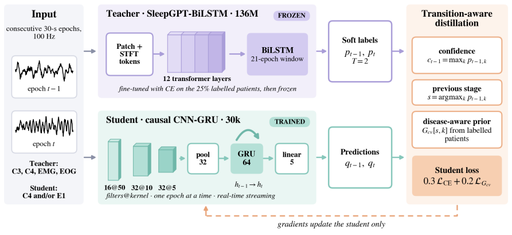
Fig. 1 . Overview of the proposed G𝑐𝑣-TAD framework. The teacher is adapted using 25% labelled patients and frozen during distillation. Its predictions guide a causal student through a transition-aware loss weighted by preceding-stage confidence and a cohort-specific prior. Only the student is intended for deployment.
Original paper · CC BY 4.0 · Suvadeep Maiti, Keya Sinha, Raju S. Bapi · Towards wearable-scale, transition-aware sleep staging for clinical populations · Original paper figure · Extracted the figure area from page 2 of the original PDF.Why staging degrades in clinical sleep
Automatic staging matters because scoring polysomnography by hand takes too much effort for long-term monitoring. Wearables that record one or two EEG or EOG channels could make sleep assessment continuous outside the laboratory, but most staging models were built on healthy or community cohorts and often transfer poorly to patients. A concrete example is a drop in performance when a model trained on healthy sleepers is applied to patients with ischemic stroke.
Clinical sleep also differs in structure: awakenings are more frequent, N1 takes a larger share and stage transitions vary more from patient to patient. Expert-labelled recordings are scarce, so a model cannot easily be adapted to each new patient population. Conventional knowledge distillation treats each epoch independently and does not model stage transitions, which is the gap this work targets.
The study asks whether a causal student running on one or two channels can recover much of a fully labelled teacher's performance when only 25% of training patients are labelled. It also asks whether weighting distillation by cohort-specific transition statistics improves on cross-entropy trained on the same labels, particularly for N1.
Adapting the SleepGPT teacher with few labels
The teacher is SleepGPT, a 136M-parameter transformer pretrained on 86k h of PSG, with a 3-layer BiLSTM of 100 hidden units on top. It takes four PSG channels (C3, C4, EMG and EOG) over a 21-epoch context and outputs one of five sleep stages. For each cohort it is fine-tuned twice, once on 25% and once on 100% of the labelled training patients.
The 100% version is the supervised reference, and the 25% version supplies the supervision for the student.
Fine-tuning minimizes cross-entropy with AdamW at a learning rate of 10−4 and a layer decay of 0.75, for at most 25 epochs, and keeps the checkpoint with the best inner-validation macro F1.
A causal CNN-GRU student for streaming staging
It has 30,421 parameters with a single channel and 31,221 parameters with EEG+EOG input.
Streaming works because the GRU hidden state carries over from one 30-s epoch to the next, so each epoch is scored as it arrives and no later epoch is needed.
How the transition-aware loss weights distillation
Figure 1 shows the arrangement: the frozen teacher passes its predictions through the transition-aware loss, which is weighted by the preceding-stage confidence and a cohort-specific prior, and only the student is deployed. The student's objective combines cross-entropy on scorer labels for labelled patients, with teacher pseudo-labels for unlabelled patients, and the G𝑐𝑣-TAD term.
For each epoch t from 2 onward, the teacher's preceding prediction gives a stage s_{t−1} and a confidence c_{t−1}, which scale the distillation term of the current epoch. Inside each epoch the terms are summed over the five stages k, with the prior row G𝑐𝑣[s_{t−1},k] selecting how much each candidate next stage counts. Each term is measured with d(p,q) = p log(p/q) − p + q, a non-negative generalized KL term between the teacher probability p_{t,k} and the student probability q_{t,k}.
The sum over the transitions t is written as follows, with a normalizing prefactor in front of it that this sentence leaves out. \[ L_{G_{cv}} \propto \sum_{t=2}^{L} c_{t-1} \sum_{k=1}^{5} G_{cv}[s_{t-1},k]\, d(p_{t,k},q_{t,k}) \]
The prior is built from the mean of the per-patient row-normalized transition matrices, written M̄, and from a between-patient variability term CV = σ/(M̄+ε), where σ is the element-wise standard deviation. The prior is G𝑐𝑣 = (1 − M̄)/(1 + λCV), with λ set to 0.5. Entries are large where the mean transition is rare and shrink as between-patient variability grows, so less probable next-stage transitions get more weight and transitions that vary strongly across patients get less.
The prior reduces emphasis on common self-transitions, so the loss concentrates distillation on less frequent stage changes.
Datasets and evaluation protocol
iSLEEPS contains overnight PSG recordings from 100 ischemic stroke patients. NAPS covers patients with isolated REM sleep behaviour disorder, recorded at several clinical sites and scored centrally under AASM guidelines, and 133 of its 138 recordings are kept because they contain the required central EEG, chin EMG and EOG channels. ISRUC-S1 contains patients with various sleep disorders, and 99 recordings with scorer-1 annotations are used after excluding recording 40 for its different montage.
Checkpoints are selected by validation macro F1, test patients stay held out, and accuracy, macro F1, Cohen's κ and per-stage F1 are reported. The gains in the label-efficiency comparison are means of paired per-patient macro F1 differences.
Label efficiency across three cohorts
On iSLEEPS, the EEG+EOG student reaches 0.67 macro F1 with cross-entropy on all labels and 0.62 with cross-entropy on 25% of labels, while the transition loss on the same 25% labels reaches 0.68. On ISRUC-S1, the same EEG+EOG setting moves from 0.73 under 25% cross-entropy to 0.77 under G𝑐𝑣-TAD, with 0.78 under full-label cross-entropy.
These gains are averages of paired per-patient differences, so they do not equal the differences between the fold means printed in Table 1.
The fully supervised cross-entropy students reach 0.305, 0.315 and 0.511 on N1 in the same three cohorts, so the transition loss matches or exceeds them on that stage.
Within each cohort, the EEG+EOG student is the strongest of the three input settings.
Position against published results
Table 2 places the study's results beside published numbers on iSLEEPS and ISRUC-S1, but the published protocols differ in folds and recordings from the present evaluation, so the comparison is indicative rather than controlled.
On iSLEEPS the teacher reaches 0.71 macro F1, the highest value in that cohort's rows, and the two-channel G𝑐𝑣-TAD student with 25% labels reaches 0.68. The student's 0.68 equals the highest published macro F1 listed for iSLEEPS, which is SE-ResNet-BiLSTM with one channel, for which the table notes that the patient-wise split is not stated.
Where the transition loss puts its weight
The teacher's soft predictions stay confident during consolidated N2, N3 and REM sleep but become less certain around transitions, particularly N1.
The weight of each epoch is w_t = c_{t−1} Σ_k G𝑐𝑣[s,k] p_{t,k}, relative to the night's mean, so the weight depends on the preceding confidence and on how the teacher's next-stage probabilities are shaped by the prior. N1 epochs make up 10, 10 and 13% of the data in the same cohorts and receive 12, 13 and 21% of the weight.
Across fold-1 training nights, G𝑐𝑣-TAD is correct on 56, 48 and 60% of disagreements, against 27, 29 and 29% for cross-entropy. The gains are not limited to transitions: the example night also shows improvement during stable N3 sleep. These analyses use training recordings whose scorer labels were hidden during learning and were examined retrospectively.
Cost on wearable-scale hardware
The authors argue that these weights fit within the SRAM of wearable microcontrollers.
Limitations
Distillation depends on the teacher: on the example night the teacher reaches only 64% accuracy, and the authors take this as a sign that distillation remains sensitive to teacher reliability. Speed was measured on an Intel Xeon W-2265 CPU, not on a wearable microcontroller, and the wearable electrode configurations and on-device performance were left for future work.
The evaluation covers three PSG cohorts, and generalization to additional clinical populations was not tested. The ISRUC-S1 analysis uses scorer-1 annotations on 99 recordings only. The published comparisons use different folds and recordings, so they indicate position rather than a controlled ranking.
Paper info
- Authors
- Suvadeep Maiti, Keya Sinha, Raju S. Bapi
- Venue
- arXiv · Preprint
- First published
- 2026-11-16
- Added
- 2026-11-17
- Updated
- 2026-11-16
- Version
- v1
- arXiv
- 2611.21040
- Category
- cs.HC · cs.AI
- Original paper terms
- CC BY 4.0
- What we show
- Paper info, commentary and permitted figures from the original paper
AI commentary is a separate explanation from the original paper and may contain errors. The original paper and figures follow each source's terms of use and any rights noted separately.
Abstract
Automatic sleep staging models are predominantly developed on healthy sleepers and generalize poorly to clinical populations with fragmented sleep. Across three cohorts (patients with stroke, isolated REM sleep behaviour disorder, and other sleep disorders), we observe 2-3x more awakenings per hour, nearly twice as much N1, and less REM sleep than in healthy sleepers. We propose a label-efficient teacher-student framework for wearable-scale sleep staging. SleepGPT (136M parameters), adapted using labels from 25% of training patients, supervises a causal CNN-GRU (31k parameters; 122 KB) that stages EEG, EOG, or both in real time. We introduce Gcv-TAD, a new black-box transition-aware distillation loss. It emphasizes uncommon stage transitions while discounting those that vary across patients, using a prior estimated from labelled patients. In patient-wise 10-fold cross-validation, Gcv-TAD improves per-patient macro F1 over supervised training on the same labels by +3.2 to +7.6 points on average. Gains are largest on N1, and performance approaches full-label training.
Quote from the paper
Suvadeep Maiti, Keya Sinha, Raju S. Bapi (2026). Towards wearable-scale, transition-aware sleep staging for clinical populations. arXiv:2611.21040v1. https://arxiv.org/abs/2611.21040v1
BibTeX
@misc{maiti2026towards,
  title = {{Towards wearable-scale, transition-aware sleep staging for clinical populations}},
  author = {Suvadeep Maiti and Keya Sinha and Raju S. Bapi},
  year = {2026},
  eprint = {2611.21040},
  archivePrefix = {arXiv},
  url = {https://arxiv.org/abs/2611.21040v1}
}