Paper commentary
Open-fMIND: A Large-Scale Open-Access fMRI Corpus for Pretraining Brain Foundation Models
- Problem Open fMRI data is free to use but scattered across small, inconsistently organized OpenNeuro datasets, while the large standardized resources are gated.
- Method Retrieves 322 OpenNeuro fMRI datasets, preprocesses each run with fMRIPrep, and parcellates it under 52 atlases in two versions, quasiraw and preproc.
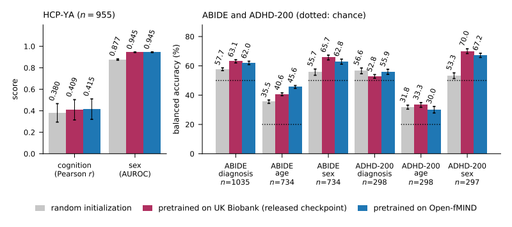
Figure 4 :A model pretrained on Open-fMIND reaches accuracy close to that of a model pretrained on UK Biobank.Frozen Brain-Semantoks encoders with a linear or kernel readout on HCP-YA, ABIDE and ADHD-200. Bars are means and error bars standard deviations over cross-validation folds (200 for HCP cognition) or repetitions (20 for HCP sex, 10 for ABIDE and ADHD-200). Accuracies are balanced accuracies, age is predicted as one of 5 classes of equal size, and dotted lines mark chance (50% for two classes, 20% for five).
Original paper · CC BY 4.0 · Carlo Alberto Barbano, Giovanni Marraffini, Demian Wassermann · Open-fMIND: A Large-Scale Open-Access fMRI Corpus for Pretraining Brain Foundation Models · Original paper figure · Extracted the figure area from page 10 of the original PDF.Why open fMRI data is hard to pool
Self-supervised pretraining has worked well for language and vision, and it is now being carried over to functional brain imaging. In this setting the scarce ingredient is data rather than model design.
The largest standardized fMRI resources, HCP, UK Biobank and ABCD, are well curated, but access is governed by data use agreements. Their data also cluster around a few acquisition protocols, mostly resting state plus one fixed task battery, which narrows what a model can learn from them.
OpenNeuro is open and hosts thousands of datasets in BIDS format, but each dataset is small, organized in its own way, and either left unprocessed or processed differently from the others.
What the release covers and why it is built this way
Most OpenNeuro fMRI studies are small, with a median of 25 subjects, so the value of the release comes from pooling them. Figure 1 places the released datasets against the full set of 1,066 OpenNeuro MRI datasets, and shows that the pooled release is larger in subjects and data than any single dataset.
To the authors' knowledge, the release is the largest fMRI corpus that is open, preprocessed and model-ready at the same time. Table 1 sets it against HCP, UK Biobank, ABCD and IBC: HCP lists 1,206 subjects under gated access, UK Biobank more than 40,000, ABCD 11,868, and IBC 13 subjects with 67 tasks.
Keeping all of them lets a study treat the parcellation as a view or augmentation and measure how sensitive its results are to the parcellation choice. The release has no phenotypic targets, diagnostic labels or behavioural scores, because OpenNeuro metadata follows no enforced standard and harmonizing it across studies is still an open question.
Retrieving and screening OpenNeuro datasets
Of the 387 datasets processed for this release, 27 were removed at inspection, 24 for lacking BOLD runs, 2 for being derivative datasets and 1 for an explicit exclusion. One further dataset failed to download, which leaves 359 datasets, a number that is larger than the 322 released datasets.
The analysed text does not spell out the step that takes the 359 retrieved datasets down to the 322 released ones, beyond the table label excluding failures.
fMRIPrep, parcellation and the quasiraw timeseries
fMRIPrep corrects head motion, aligns each functional run to the subject's anatomical image and resamples the data to the MNI152NLin2009cAsym template at 2 mm isotropic resolution in one interpolation step.
Each subject runs as a separate cluster job in a pinned fMRIPrep 25.2.3 Singularity container with fixed arguments, so the preprocessing can be repeated.
Schaefer and Yan account for 26 of the 52 variants, and they come in several resolutions and network assignments, so the effect of resolution inside one family can also be studied. Hard parcellations are applied with a labels masker and soft ones with a maps masker, so probabilistic atlases keep their overlapping weights instead of being reduced to one parcel per voxel.
The quasiraw output is one matrix per run and atlas, with time points along one axis and ROIs along the other.
The preproc denoising step and connectivity
The preproc version regresses out 26 fMRIPrep confounds, which are the 24-parameter expanded motion model together with white matter and cerebrospinal fluid signals. Volumes whose framewise displacement is above 0.5 mm are censored before filtering, and the remaining signal is linearly detrended and bandpass filtered between 0.01 and 0.1 Hz with a Butterworth filter.
Each ROI timeseries is then standardized to unit variance, and the global signal is not regressed.
The same step can be applied to quasiraw with other settings, such as global signal regression or another framewise displacement threshold.
Connectivity is the Pearson correlation matrix of the ROI timeseries for each run and atlas, computed with Nilearn's ConnectivityMeasure, and in preproc it uses only the volumes kept after scrubbing.
Release contents and file layout
The quasiraw version holds all 45,731 runs, while preproc holds 45,019 runs from 11,320 subjects and 320 datasets. Counting run and atlas pairs gives 2.38 million 4D volumes in quasiraw and 2.34 million in preproc, each with its connectivity matrix.
The files follow BIDS derivative naming, with one NIfTI timeseries and one JSON sidecar for each run and atlas, and the timeseries and connectivity matrix are stored in float32 so standard neuroimaging tools can read them. The sidecar records the atlas labels, repetition time, confound model, bandpass cutoffs, framewise displacement threshold, volumes scrubbed and provenance, so each timeseries can be traced back to its source scan.
Derivatives keep the license of their source dataset, and the licence table shows CC0-1.0 for 251 datasets, PDDL-1.0 for 34, CC-BY-SA-4.0 for 3, CC-BY-4.0 for 2, CC-BY-NC-4.0 for 1, one other licence, and 30 datasets with no stated licence.
Motion and scrubbing across released runs
The motion analysis reads the released preproc connectivity matrices in place, at Schaefer-400, so it tests the files users actually download.
The threshold is deliberately permissive, because the authors want downstream users to choose their own balance between quality and quantity of data.
How runs organize in connectivity space
The embedding uses only BIDS metadata, the task entity and the framewise displacement from the QC table, and it covers 44,241 preprocessed runs from 288 datasets, leaving out datasets with fewer than 5 subjects.
Twelve dense clusters, with between 549 and 3,147 runs each, hold 36% of the runs, and the other 64% sit in the connected bulk between them. Rest runs make up 19% of the runs and concentrate in a band through the embedding, while task runs make up 81%.
The cluster with the highest median framewise displacement contains 3,147 runs from 231 datasets, with a median mean framewise displacement of 0.165 mm against 0.124 mm over all runs. The authors read this as higher motion concentrated in one region but shared across many datasets, consistent with a residual motion signature.
A runs-of-one-dataset explanation therefore does not fit, because a dataset's runs spread over several regions. Cluster 5 holds only task runs, with no rest runs, 23 datasets and 34 task names.
Pretraining comparison with UK Biobank
The abstract reports that pretraining on Open-fMIND reaches downstream performance comparable to that obtained with UK Biobank. The analysed text gives no models, downstream tasks, metrics or training budgets for this comparison, so the claim can be read only at the level the abstract states.
Paper info
- Authors
- Carlo Alberto Barbano, Giovanni Marraffini, Demian Wassermann
- Venue
- arXiv · Preprint
- First published
- 2026-11-16
- Added
- 2026-11-18
- Updated
- 2026-11-16
- Version
- v1
- arXiv
- 2611.21215
- Category
- cs.LG · q-bio.NC
- Original paper terms
- CC BY 4.0
- What we show
- Paper info, commentary and permitted figures from the original paper
AI commentary is a separate explanation from the original paper and may contain errors. The original paper and figures follow each source's terms of use and any rights noted separately.
Abstract
Self-supervised pretraining has transformed language and vision, but its application to functional MRI (fMRI) is constrained by data access. The largest standardized fMRI resources are governed by data use agreements and dominated by a small number of acquisition protocols, while the thousands of openly licensed datasets on OpenNeuro are individually small, heterogeneously organized, and unprocessed. We present the first release of Open-fMIND, a uniformly preprocessed, openly accessible corpus of parcellated fMRI timeseries from 322 OpenNeuro studies, comprising 11,379 subjects and 45,731 functional runs. Each run is preprocessed with fMRIPrep and parcellated under 52 atlases spanning 14 families, yielding a massive 2.4 million timeseries. Timeseries are released either denoised with our default pipeline (preproc) or as the fMRIPrep output with its confound files (quasiraw), with functional connectivity matrices, per-run provenance and motion metadata. Open-fMIND is intended as a pretraining resource for self-supervised brain representation learning. Pretraining on it yields downstream performance comparable to that obtained with UK Biobank.
Quote from the paper
Carlo Alberto Barbano, Giovanni Marraffini, Demian Wassermann (2026). Open-fMIND: A Large-Scale Open-Access fMRI Corpus for Pretraining Brain Foundation Models. arXiv:2611.21215v1. https://arxiv.org/abs/2611.21215v1
BibTeX
@misc{barbano2026open,
  title = {{Open-fMIND: A Large-Scale Open-Access fMRI Corpus for Pretraining Brain Foundation Models}},
  author = {Carlo Alberto Barbano and Giovanni Marraffini and Demian Wassermann},
  year = {2026},
  eprint = {2611.21215},
  archivePrefix = {arXiv},
  url = {https://arxiv.org/abs/2611.21215v1}
}