Paper commentary
ReactBench-AD: Do Driving VLAs and World-Action Models React to Imminent Hazards in Their Path?
- Problem Driving VLAs and WAMs are mostly scored on nominal scenes, so their reactions to objects that block the ego path are rarely measured.
- Method Inserts a rendered crossing pedestrian, standing pedestrian or stationary car into real NAVSIM and PhysicalAI-Autonomous-Vehicles scenes, then compares each model's plans for the original and edited inputs.
- Results Alpamayo 1.5 reached +35.69 percentage points in P for a standing pedestrian at 2.0 s on ReactPAI. Fine-tuning ReCogDrive's action head on ReactTrain raised ∆P to +41.4 on ReactNAV, while navtest PDMS moved from 86.2 to 86.0.
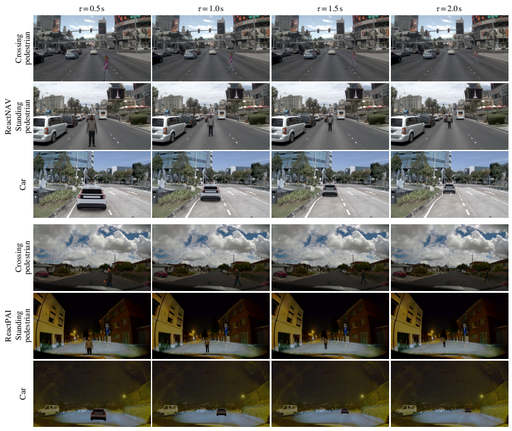
Figure 7 . Randomly selected ReactNA V (top) and ReactPAI (bottom) samples for each inserted object and look-ahead timeτ, shown in the edited front-camera image at the current framet. Each row shows a single scene, whose four look-ahead variants share the same asset.
Original paper · CC BY 4.0 · Theodoridis, Nikos, Mohandas, Reenu, Sharma, Sushil, Hogan, Ciarán, Sistu, Ganesh, Scanlan, Anthony, Brophy, Tim, Eising, Ciarán · ReactBench-AD: Do Driving VLAs and World-Action Models React to Imminent Hazards in Their Path? · Original paper figure · Extracted the figure area from page 14 of the original PDF.Why hazard reactions are hard to measure
Most driving benchmarks that VLAs and WAMs are scored on consist mainly of nominal scenes, where unexpected events rarely occur. Their behaviour when an obstacle is about to enter the vehicle's path therefore stays largely untested. Even the strong benchmark results reported for these models do not say how they behave when the vehicle must brake or steer to avoid something ahead.
A useful test needs two things. The inputs should be real and should match the configuration each model was trained on, and each hazardous scene needs an otherwise identical counterpart without the object, so that the object's effect on the predicted trajectory can be isolated. Collision rate alone cannot tell a model that ignores a hazard apart from one that reacts too weakly or too late, so the metrics need to describe the reaction itself.
Four VLAs (Alpamayo 1.5, Alpamayo 2, AutoVLA and ReCogDrive) and two WAMs (DriveWAM and SimWAM) are evaluated on it.
How the counterfactual pairs are built
Each object is rendered from 3D assets in Blender and composited into the original scene at the ego vehicle's front-bumper position on its logged trajectory, at one of the look-ahead times 0.5, 1.0, 1.5 or 2.0 s. A standing object is placed at the same target at every history timestep. A crossing pedestrian walks toward the ego path at 1.4 m/s and reaches the target at the look-ahead time.
The object is drawn with a contact shadow into up to four camera views and all four history timesteps, and parts hidden by existing geometry are removed. Only object and shadow pixels change, so the edited scene is an exact counterfactual of the original. A COCO detector, D-FINE-X, finds the inserted object in 99.3% of edited front-camera images, which is the check that the objects are recognizable.
For ReactNAV, navtest samples with an ego speed below 5 km/h are removed, and only samples in which all three objects can be placed at every history timestep are kept. This leaves 3,228 samples.
Both predicted plans are scored in the edited scene, so the difference isolates the model's reaction to the object. The edit effect is written as \\( \\Delta M = M(y^E; S^E) - M(y^O; S^E) \\), where \\( y^O \\) is the plan from the original scene and \\( y^E \\) the plan from the edited scene. The primary score on ReactNAV is \\( P = NC \\times DAC \\), combining the no-collision rate with drivable area compliance.
On ReactPAI, where no map data exists for DAC, \\( P = NC \\).
Contact speed is averaged only over samples where both plans lead to an at-fault collision, so it captures reactions that reduce impact without avoiding contact. The trajectory invariance rate counts samples whose ADE between the original-scene and edited-scene plans falls below a threshold. A high rate means the model essentially ignores the object.
Collisions are checked on plans interpolated piecewise-linearly to 100 Hz, since the predicted waypoints are sparse, and the at-fault criteria are stricter than those of NAVSIM.
How much the models react
For most models the edit effect on P stays small when the object is present. The exceptions are the two Alpamayo models, which gain substantially at longer look-ahead times on both subsets. Even Alpamayo 1.5 in its best case, a standing pedestrian at 2.0 s on ReactPAI, still leaves unsafe trajectories as the most likely outcome, in 62.01% of cases.
Excluding samples where even braking at 8 m/s² cannot prevent a collision barely changes ∆P.
For AutoVLA, ReCogDrive, DriveWAM and SimWAM, gains above one percentage point appear only for stationary cars, with DriveWAM as the sole exception, which also rises for a standing pedestrian at 2.0 s. When collisions are not avoided, these four models cut contact speed by less than 2 km/h in every case, while Alpamayo 1.5 and Alpamayo 2 cut it by up to 7.25 and 4.22 km/h.
The trajectory invariance rate shows how often the models essentially ignore the inserted object across the four ADE thresholds of 0.05, 0.1, 0.2 and 0.5 m.
Whether reasoning explains the failures
Only the two Alpamayo models reason in natural language before planning, so the CoT analysis covers them alone. AutoVLA always falls back to a fast mode with one generic reasoning output, so it is left out. The analysis runs on ReactPAI, which the authors consider closer to the Alpamayo training distribution.
Swapping the CoTs at 2.0 s shows that directly observing the inserted object matters more than receiving a CoT that tells the model to yield, while the CoT from the edited scene gives safer plans than the CoT from the original scene once the object is visible. Even an explicit instruction to stop leaves both models colliding in most samples.
What training stages change
ReCogDrive and SimWAM each publish a checkpoint per training stage. ReCogDrive adds an initial supervised fine-tuning stage for its VLM, and both models then pass through imitation learning and reinforcement learning, where the reward is PDMS. The RL stage uses GRPO variants adapted to diffusion for ReCogDrive and to flow matching for SimWAM.
Table 2 reports the edit effect on ReactNAV at 2.0 s for samples with an initial ego speed below 20 km/h, n = 1762, next to each checkpoint's navtest PDMS. The authors conclude that further optimizing nominal driving, on data where safety-critical cases are rare, can reduce a model's ability to handle them.
Teaching ReCogDrive to brake
Hazardous edited scenes have no logged trajectories that react to the object, so adding them to the RL mix is a natural first idea. GRPO, however, reinforces only the behaviour the policy already samples, and a group whose candidates share one reward yields no gradient. On 300 hazardous navtrain scenes with group size 32, only 26.3% of groups give a non-zero gradient, and only 1.3% reinforce a trajectory safe under the benchmark definition.
The authors therefore switch to supervised fine-tuning on artificial targets.
Benign variants with the same objects placed off the ego path are added as 11,742 further samples, so that a visual artifact is not a cue to brake. The total is 23,484 samples.
The artificial targets come from a cubic spline fitted to the logged waypoints. A stopping point is placed a margin \\( d_m \\) before the object, with \\( d_m = 1 \\) m, and the constant deceleration is \\( a = \\min\\{v_0^2/(2\\Delta s), a_{max}\\} \\), where \\( \\Delta s \\) is the arc length to that point. The waypoints are sampled at \\( s(t) = v_0 t - \\tfrac{1}{2} a t^2 \\), and the vehicle stays in place once it stops.
The cap is \\( a_{max} = 8 \\) m/s², and only samples where even this deceleration cannot avoid the collision are kept, all at 0.5 s.
Only the action head is updated, the VLM stays frozen, and training runs for three epochs, which is 276 gradient steps. Each epoch also draws 11,742 original navtrain samples anew, so the hazardous, benign and original groups each make up one third.
On the original ReactNAV scenes, IL + RT plans shorten the distance by at least 20% in only 0.9% of samples, and it never brakes harder than 4.5 m/s².
The generalization tests use 291 navtest samples with standing animals, an object category absent from ReactTrain, and 308 real-scene samples in which only the ego status is edited to create a collision with a nearly stationary vehicle 5 to 15 m ahead. On standing animals the edit effect is +28.1 for IL + RT, against +41.4 on ReactNAV, and IL barely reacts.
On real scenes, P rises from 6.8 to 54.2 and mean contact speed drops from 21.4 to 14.3 km/h.
Limits of the open-loop setup
Evaluation is open-loop, so delayed reactions that span several planning cycles are not assessed. The fine-tuning recipe is simple, and the authors note room for better uses of ReactTrain that might avoid the small nominal drop. The generalization tests cover only standing animals and real scenes with a stationary vehicle.
Paper info
- Authors
- Theodoridis, Nikos, Mohandas, Reenu, Sharma, Sushil, Hogan, Ciarán, Sistu, Ganesh, Scanlan, Anthony, Brophy, Tim, Eising, Ciarán
- Venue
- arXiv · Preprint
- First published
- 2026-11-15
- Added
- 2026-11-20
- Updated
- 2026-11-15
- Version
- v1
- arXiv
- 2611.20011
- Category
- cs.CV · cs.AI · cs.RO
- Original paper terms
- CC BY 4.0
- What we show
- Paper info, commentary and permitted figures from the original paper
AI commentary is a separate explanation from the original paper and may contain errors. The original paper and figures follow each source's terms of use and any rights noted separately.
Abstract
Vision-Language-Action models (VLAs) and World-Action Models (WAMs) have emerged in autonomous driving with the promise of strong generalization to long-tail scenarios. Although these models achieve state-of-the-art results on autonomous driving benchmarks, most existing benchmarks are dominated by nominal scenarios and therefore cannot test this promise. To test one such long-tail capability that is critical for safety, we introduce ReactBench-AD, a benchmark that measures how driving models react to objects that appear in the ego vehicle's path. Built on real NAVSIM and PhysicalAI-Autonomous-Vehicles scenes, ReactBench-AD composites a crossing pedestrian, a standing pedestrian, or a stationary car consistently across all camera views and history frames. Each edited scene thus forms an exact, pixel-level counterfactual pair with its original, which allows us to isolate the causal effect of the inserted object on the predicted trajectory. Evaluating four VLAs and two WAMs, we find that they react weakly, often barely at all. Finally, we test how easily one of the evaluated VLAs, ReCogDrive, can be taught to brake hard for imminent hazards: a short fine-tuning stage on edited scenes substantially improves its reactions, with the learned behavior generalizing to unseen objects and fully real scenes, at minimal cost to nominal driving. These results call into question the out-of-the-box long-tail capabilities of these models, but suggest that they can be a strong foundation for acquiring them with little additional training, highlighting the value of real or synthetic data that demonstrates the long-tail behaviors nominal datasets rarely contain. Code and data will be made publicly available.
Quote from the paper
Theodoridis, Nikos, Mohandas, Reenu, Sharma, Sushil, Hogan, Ciarán, Sistu, Ganesh, Scanlan, Anthony, Brophy, Tim, Eising, Ciarán (2026). ReactBench-AD: Do Driving VLAs and World-Action Models React to Imminent Hazards in Their Path?. arXiv:2611.20011v1. https://arxiv.org/abs/2611.20011v1
BibTeX
@misc{nikos2026reactbench,
  title = {{ReactBench-AD: Do Driving VLAs and World-Action Models React to Imminent Hazards in Their Path?}},
  author = {Theodoridis, Nikos and Mohandas, Reenu and Sharma, Sushil and Hogan, Ciarán and Sistu, Ganesh and Scanlan, Anthony and Brophy, Tim and Eising, Ciarán},
  year = {2026},
  eprint = {2611.20011},
  archivePrefix = {arXiv},
  url = {https://arxiv.org/abs/2611.20011v1}
}