Paper commentary
Calibrated Decision Rewards: Training Language Models with a Judge That Knows How Sure It Is
- Problem Learned rewards for open-ended reasoning are often overconfident and hard to trust, and a 0/1 answer checker gives no gradient when every sampled answer fails.
- Method A decision model reads a typed question about a response in one forward pass, averages the probabilities over option orders, and maps them through a two-parameter Platt fit fitted once on 1,024 labelled responses. The calibrated probability serves as the GRPO reward.
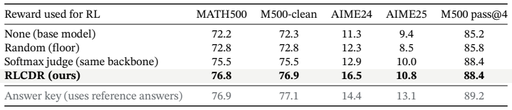
Table 4 .Ground-truthevaluationafter100GRPOsteps(pass@1,%;MATH500pass@4inthelastcolumn). Onlytherewarddiffersbetweenrows.Bold: bestrewardthatdoesnotusereferenceanswers.
Original paper · CC BY 4.0 · Rudransh Agnihotri, Manasvi Kapoor · Calibrated Decision Rewards: Training Language Models with a Judge That Knows How Sure It Is · Original paper figure · Extracted the figure area from page 9 of the original PDF.Why learned rewards fall short for reasoning RL
Reinforcement learning from verifiable rewards works well where an exact checker can compare a final answer with a reference, as in math answers or unit tests in code. Many other tasks, such as proofs, partial credit and open-ended answers, have no such checker, so practitioners fall back on learned rewards. Those rewards inherit problems of their own: scalar reward models give scores that only make sense within one prompt, and LLM judges read through a softmax are badly overconfident, sensitive to option order and easy to fool.
Calibration has mostly been checked offline on fixed benchmarks. Whether a reward stays calibrated on the samples a policy produces during RL, when that matters most, has not been measured. Hard problems add a separate gap: when every sampled answer is wrong, a 0/1 answer checker returns zero for all of them and GRPO receives no gradient.
A decision model that answers typed questions in one pass
It outputs a categorical distribution over the options, and it generates no text. The readout was trained for general decision making rather than on reward-model data.
Two typed questions are used. The outcome question asks whether the final answer is correct, with the options correct and incorrect, and yields the probability p_ok(x).
Multiple-choice readouts depend on the order of the options, so each question is asked in both the forward and the reversed order, and the probability given to each option is averaged across the two orders. The averaged probability then goes through a Platt fit, r = σ(a·logit(p_ok) + b). The two parameters are fitted once by maximum likelihood on 1,024 labelled policy responses to MATH problems, collected from other models, and they are frozen during RL, so the reward never sees the answer key.
The policy is optimized with GRPO, using the Dr. GRPO loss: a group-mean baseline, no division by the group standard deviation and no length normalization. Each sample's advantage is therefore r_i minus the group mean of r, so the calibrated scale of the reward enters the gradient directly.
Turning the critic distribution into a progress score
From the critic distribution q, the progress of a response with n steps is the expected fraction of steps that come before the first error. An answer judged error-free by the critic, q(none), counts as full progress. Formally, prog(x) = q(none) + Σ_{k=1}^{n} q(step_k)·(k−1)/n, so an early first error gives a small progress value and a late first error gives a large one.
The step reward keeps the decision model's own outcome probability as its base and adds progress on the remaining part: r_step(x) = r_out(x) + (1 − r_out(x))·λ·prog(x), with λ = 0.5. Because a confidently correct answer scores close to 1, a wrong answer is graded by how far it got before the error. The hybrid reward instead gives 1 to a correct final answer under the answer key and λ·prog(x) otherwise, so it tests step credit alone.
A controlled RL comparison of five rewards
Five rewards are compared, and only the reward differs between runs. RLCDR is the calibrated decision reward. The softmax judge uses the same backbone, prompt, debiasing and calibration procedure but reads the next-token softmax over the option letters, so it isolates the readout. The answer key, a math-verify check against the reference answer, is the ceiling.
Random reward, drawn as Bernoulli(0.5), is the floor, and the base model receives no training. The answer-key check is logged in every run but carries zero weight except in the answer-key run, which lets the faithfulness of each reward be measured on the policy's own samples.
Does the calibrated reward improve the policy?
Against the softmax judge, RLCDR is ahead by +1.30 points, with a 95% interval of [−0.50, +3.10] and p = 0.16. The authors treat that as within evaluation noise for one seed, so they make no policy-level claim between the two judges.
The random-reward run stays inside the noise on every slice, with +2.6 on levels 4 and 5 (p = 0.08) and −1.5 on levels 1 to 3, so the difficulty pattern does not come from RL alone.
Because the answer key shows the same length change, the authors read the behaviour as learning rather than exploitation of the reward.
Does the reward stay calibrated as the policy changes?
Both rewards were calibrated once on PPE answers written by Gemma-2-9B, Llama-3-8B, GPT-4o-mini and Claude-3-Haiku, and then frozen. The on-policy numbers are measured on the answers Qwen3-1.7B produces during training, which neither reward saw during calibration.
The average reward never exceeds the policy's true accuracy, and response length grows without any rise in reward, so the gap shows no sign of reward hacking.
The ranking advantage applies to a minority of updates, because 57% of all training groups had either all 8 answers right or all 8 wrong, and in those groups both rewards give little usable signal.
Hard problems where the answer key is silent
To check localization without human labels, the authors use roll-outs in the style of Math-Shepherd. For 800 failed answers, the base policy re-solves the problem four times from just before the flagged step and four times from just after it. If the flagged step is the real error, success should drop once it is included.
Locating the first error against a process reward model
The margin is largest on the hardest subsets, +7.7 on Olympiad and +9.2 on Omni-MATH, and the decision model beats the process reward model by +5 F1 on average and in 20 of 20 splits.
The authors' reproduction of Qwen2.5-Math-PRM-7B scores 73.0 on average, against the published 73.5. The decision model asks whether step k is correct over the prefix, which is the question a process reward model answers during RL. The decision model was never trained on step labels. The authors note that its step probabilities also rank better, with AUROC 0.972 against 0.954, and after calibration its Brier is 0.041 against 0.051.
Decision readout against softmax and scalar reward models
On PPE the decision readout reaches AUROC 0.809, against 0.709 for the softmax readout and 0.708 for the scalar reward model, with the largest margins on MATH (0.877) and IFEval (0.829).
With 100 calibration labels averaged over 20 held-out splits, the Brier scores are 0.184 for the decision readout, 0.222 for softmax and 0.217 for the scalar reward model on PPE, and 0.297, 0.373 and 0.352 on JudgeBench. On RM-Bench the scalar reward model wins all 20 splits, with Brier 0.079 against 0.160 for the decision readout, and on RewardBench2 it also wins 20 of 20 splits with Brier 0.153 against 0.214.
These are preference-pair benchmarks that match the scalar model's training format.
The decision readout wins where the question is whether an answer is correct, and the preference-trained scalar reward model wins on preference-pair benchmarks, as Figure 11 reports.
To test whether the advantage comes from a better-tuned head, the authors retrained heads on the hidden states of both models with the same labels. A new head on the base Qwen3.8-27B features still stays well behind the decision-model features on PPE, JudgeBench and RM-Bench.
What the reward costs per training step
The decision reward needs one forward pass per question and option order and generates no text. In E6, scoring 256 answers with two option orders took 146 seconds of a 340-second training step, on a separate GPU.
Paper info
- Authors
- Rudransh Agnihotri, Manasvi Kapoor
- Venue
- arXiv · Preprint
- First published
- 2026-11-18
- Added
- 2026-11-20
- Updated
- 2026-11-18
- Version
- v1
- arXiv
- 2611.25135
- Category
- cs.AI · cs.CL
- Original paper terms
- CC BY 4.0
- What we show
- Paper info, commentary and permitted figures from the original paper
AI commentary is a separate explanation from the original paper and may contain errors. The original paper and figures follow each source's terms of use and any rights noted separately.
Abstract
Reinforcement learning (RL) can only teach a language model what its reward can recognize. Answer checkers are exact but need a reference answer; learned reward models and LLM judges work everywhere, but their scores are not probabilities. We study RLCDR (Reinforcement Learning from Calibrated Decision Rewards). An LLM converted into a decision model answers a typed question about a response ("is the final answer correct?", "which step is the first error?") with a probability distribution, read in one forward pass, debiased over option orders and calibrated with about a hundred labels. Training Qwen3-1.7B with GRPO on MATH, this reference-free reward raises MATH500 accuracy from 72.2% to 76.8% (+4.65 points, p < 1e-4), matching training on the answer key (76.9%), while a random reward gains only +0.65. The gain grows with difficulty, from 44.8% to 51.7% on the hardest level. On the policy's own changing samples the reward stays calibrated: its expected calibration error is half that of a softmax judge on the same 27B backbone (0.074 vs. 0.141), and it shows no sign of reward hacking. Without step training, the same model finds the first wrong step better than a dedicated 7B process reward model (ProcessBench F1 0.772 vs. 0.722, 20/20 splits). We also map where the approach stops being enough: trained only on problems the base model mostly fails, the reference-free reward still improves the policy (+1.9 MATH500 points, p = 0.03) but trails the answer key, because its probabilities become overconfident on that distribution. We state six hypotheses in advance and test each with a control designed to falsify it.
Quote from the paper
Rudransh Agnihotri, Manasvi Kapoor (2026). Calibrated Decision Rewards: Training Language Models with a Judge That Knows How Sure It Is. arXiv:2611.25135v1. https://arxiv.org/abs/2611.25135v1
BibTeX
@misc{agnihotri2026calibrated,
  title = {{Calibrated Decision Rewards: Training Language Models with a Judge That Knows How Sure It Is}},
  author = {Rudransh Agnihotri and Manasvi Kapoor},
  year = {2026},
  eprint = {2611.25135},
  archivePrefix = {arXiv},
  url = {https://arxiv.org/abs/2611.25135v1}
}