Paper commentary
Chain-of-Thought Hidden States Reveal Task-Solving Directions for Direct Answers
- Problem CoT lengthens generation a great deal and on some tasks lowers accuracy below direct answering, so the question is whether the direct prompt's own state already holds a shorter route to the answer.
- Method Each CoT state is patched into the direct prompt to label it recovering or failed, a linear probe is trained on those labels, and the direct prompt's last hidden state is rotated once towards a per-question direction built from the two class means.
- Results Rotating the direct prompt state towards the contrastive direction at λ = 0.5 raised mean accuracy on LLaMA 3.1 8B from 46% to 85%, against 69% for CoT, with 19 generated tokens per question against 197.
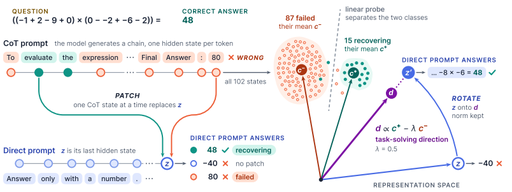
Figure 1 : Overview of our analysis on one Multistep Arithmetic question. Each CoT state is patched in place of the last state z of the direct prompt and labelledrecoveringif the model then answers correctly andfailedotherwise. The failed states and recovering states occupy different parts of the representation space, so that a linear probe predicts this label from a single state. The means of the question’s recovering and failed states, c+ and c−, give the task-solving direction d∝c + −0.5c −. Before generation, we rotate z onto the direction of d, keeping its norm; the direct prompt then writes four short lines and answers48instead of−40, even though the CoT itself answers80.
Original paper · CC BY 4.0 · Mehrafarin, Houman, Konstas, Ioannis · Chain-of-Thought Hidden States Reveal Task-Solving Directions for Direct Answers · Original paper figure · Extracted the figure area from page 2 of the original PDF.Why the direct prompt needs another route
Chain-of-Thought prompting asks a model to write intermediate steps before its answer, and the gain is concentrated on mathematical and symbolic questions. The cost is length: across the 25 tasks the chain averages 197 generated tokens per question for LLaMA 3.1 8B and 245 for Qwen 2.5 7B. On some tasks the chain also pulls accuracy below the level of a direct answer.
Earlier work found that states inside a wrong chain can still carry the information for the right answer, and that patching such a state into a direct run can make that run answer correctly. That analysis covered only arithmetic reasoning, stopped at detecting this information, and did not test whether the states share structure or use the outcome to narrow the gap.
This study keeps the patch outcome as a label, asks whether recovering and failed states can be told apart, and then tries to close the gap by moving the direct prompt's state.
Labelling CoT states by patching
Each question is run through two prompts that differ only in the system instruction: a source prompt that asks for step-by-step reasoning, and a target prompt that asks for the answer alone. From the source run the hidden state of every generated CoT token is cached at a late layer, and from the target run the state at the final prompt position is kept.
The cached state replaces the target state at the same layer, the model keeps decoding greedily, and so any change in the answer must come from the patched state.
A patched state is labelled recovering when the extracted answer matches the gold answer and failed otherwise, and this is done for every question, including those whose chain ended in a wrong answer. The late band covers layers 27, 29 and 31 for LLaMA 3.1 8B and 23, 25 and 27 for Qwen 2.5 7B, chosen because patching cost grows with the number of cached states.
Recovering states are a minority: on average 17% of CoT states recover the answer for LLaMA 3.1 8B and 28% for Qwen 2.5 7B.
Whether a linear probe separates the two classes
Because the classes are unbalanced, the probes are scored with AUROC.
Averaged over 25 tasks, the out-of-fold AUROC is 0.84 for LLaMA 3.1 8B at layer 29 and 0.80 for Qwen 2.5 7B at layer 25. Probe AUROC is not significantly correlated with the model's CoT accuracy, its direct accuracy or the CoT gain, with |ρ| ≤ 0.31.
Probes trained on one task were evaluated on every CoT state of every other task, and 587 of the 600 pairs scored above chance for both models. Transfer is stronger inside a reasoning type, with mean AUROC 0.71 against 0.65 for LLaMA 3.1 8B and 0.67 against 0.62 for Qwen 2.5 7B.
Building a direction for each question
For each question the recovering states and the failed states of its CoT are averaged separately at the same layer, giving a recovering mean and a failed mean. Averaging keeps what the states of a set share and cancels token-specific content, and the failed mean is a matched control because it comes from the same chain and differs only in its labels.
The contrastive direction is \(d_q(\lambda) = \lVert c_q^{+}\rVert\, \frac{c_q^{+} - \lambda c_q^{-}}{\lVert c_q^{+} - \lambda c_q^{-}\rVert}\), where λ ≥ 0 sets how strongly the failed mean is subtracted. The norm of the recovering mean is restored after normalisation, so λ changes only the direction; at λ = 0 the direction is the recovering mean, and at λ = 1 it is the difference-in-means direction that weights both means equally.
The two means of a question sit close together, about 27° apart for LLaMA 3.1 8B with cosine 0.89, so a direction close to one is close to the other, and subtracting part of the failed mean moves the target away from failures.
Rotating the direct prompt state once
The last hidden state of the direct prompt is rotated once, before any token is generated, towards a target direction using spherical linear interpolation. At t = 1 the state points along the target while its original norm is kept, so only its direction changes, and the model then generates as usual.
Each question is rotated towards its recovering mean, its failed mean, the contrastive direction for λ of 0.25, 0.5 and 0.75, and the task-level direction at λ of 0.5. Accuracy and generated tokens for each target are then compared with the direct prompt and with the CoT chain the directions were built from.
Accuracy after rotation
Table 2 reports macro-averaged accuracy over the 25 tasks, with a question lacking a direction counted as incorrect, at layer 29 of LLaMA 3.1 8B and layer 25 of Qwen 2.5 7B. Rotating towards the recovering mean raised accuracy from 46 to 80 on LLaMA 3.1 8B and from 52 to 82 on Qwen 2.5 7B, using 17 and 18 generated tokens per question.
Rotating towards the failed mean instead dropped accuracy to 9 on LLaMA 3.1 8B and 16 on Qwen 2.5 7B, far below the direct prompt. Accuracy rises with λ up to 0.5 and falls at 0.75, where Table 2 gives 83 and 84, because a larger λ moves the target away from failures but also away from the recovering mean. Among questions that both the direct and CoT prompts answer wrongly, the λ = 0.5 direction recovers the correct answer for 64% of questions on LLaMA 3.1 8B and 70% on Qwen 2.5 7B.
At λ = 0.5 the gain over the direct prompt is 39 points for LLaMA 3.1 8B and 34 for Qwen 2.5 7B, and over CoT it is 16 and 10 points.
Where generation stays short
Three of the tasks where Qwen stays below CoT are Penguins in a Table, Web of Lies and GSM8K, where CoT already reaches 90 to 97 on Qwen. The other three tasks where Qwen falls behind are Multistep Arithmetic and Tracking Shuffled Objects with five and seven objects, and the authors suggest this may be because Qwen's chains contain few recovering states on them.
On Movie Recommendation, Ruin Names and Causal Judgement for Qwen, where CoT does not improve over the direct prompt, rotation raises accuracy by 22 to 36 points. The authors explain this by the chain adding no computation for these tasks, so its steps may confuse the model and pull it away from its first answer. GSM8K and Multistep Arithmetic generate 39 and 55 tokens for LLaMA 3.1 8B, against 179 and 140 under CoT, and 52 and 66 for Qwen 2.5 7B, against 248 and 260.
Boolean Expressions and Snarks need only 3 and 5 tokens for LLaMA 3.1 8B, and 2 and 9 for Qwen 2.5 7B.
Whether one direction serves a whole task
The authors conclude that the task-solving direction is specific to each question rather than shared across a task.
Limitations
Three BIG-Bench Hard tasks were excluded because answer extraction after patching was unreliable, and one because the models often produced no chain. Interventions use three late layers and only the last position of the direct prompt.
Paper info
- Authors
- Mehrafarin, Houman, Konstas, Ioannis
- Venue
- arXiv · Preprint
- First published
- 2026-11-18
- Added
- 2026-11-20
- Updated
- 2026-11-18
- Version
- v1
- arXiv
- 2611.24598
- Category
- cs.CL · cs.AI
- Original paper terms
- CC BY 4.0
- What we show
- Paper info, commentary and permitted figures from the original paper
AI commentary is a separate explanation from the original paper and may contain errors. The original paper and figures follow each source's terms of use and any rights noted separately.
Abstract
Chain-of-Thought (CoT) prompting improves the performance of Large Language Models by eliciting intermediate reasoning steps. However, CoT is far from perfect: on some tasks, models perform worse than with direct-answer prompting, and on others they generate a few hundred tokens to reach the correct answer. We start by labelling each CoT hidden state as recovering if patching it into the direct prompt yields the correct answer, and failed otherwise. A linear probe shows that the model encodes these two classes differently. We then show that the representation space of the direct prompt holds a direction for each question that leads the model, in a short generation, to the correct answer more often than CoT does. Specifically, we rotate the direct prompt's last hidden state once, before generation, towards a direction built for each question from its own recovering and failed states. Across 25 tasks, these directions raise the direct prompt's mean accuracy from $46\%$ to $85\%$ on LLaMA 3.1 8B (CoT: $69\%$) and from $52\%$ to $86\%$ on Qwen 2.5 7B (CoT: $77\%$), with a tenth of CoT's tokens. CoT is thus not the shortest route to this accuracy, and these directions can be used in future work to train models to align their states with them.
Quote from the paper
Mehrafarin, Houman, Konstas, Ioannis (2026). Chain-of-Thought Hidden States Reveal Task-Solving Directions for Direct Answers. arXiv:2611.24598v1. https://arxiv.org/abs/2611.24598v1
BibTeX
@misc{houman2026chain,
  title = {{Chain-of-Thought Hidden States Reveal Task-Solving Directions for Direct Answers}},
  author = {Mehrafarin, Houman and Konstas, Ioannis},
  year = {2026},
  eprint = {2611.24598},
  archivePrefix = {arXiv},
  url = {https://arxiv.org/abs/2611.24598v1}
}