Paper commentary
How Reliable Is Visual Token Selection? Rethinking Pruning in Multimodal LLMs
- Problem Visual token pruning cuts MLLM cost, but the signals that choose which tokens to keep have rarely been checked for whether they hold up under small input changes or against each other.
- Method CoRePruner first picks m1 tokens by maximizing a determinant over a relevance-weighted similarity kernel, then adds m2 tokens ranked by attention scaled by a stability factor computed from K perturbed inputs.
- Results On LLaV A-1.5-7B with 32 retained tokens, CoRePruner reached 95.0% performance retention, against 93.9% for EADP, the strongest baseline in that table.
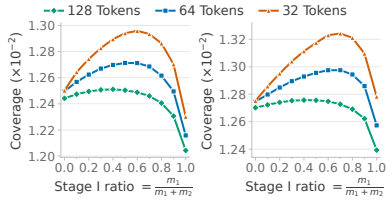
Figure 7 : Feature-space coverage of retained tokens, measured by the RMS-std of their features, across Stage I ratios on GQA (Left) and TextVQA (Right) with LLaV A-1.5-7B. Coverage peaks at intermediate ratios, supporting complementary token selection.
Original paper · CC BY 4.0 · Chaehee Song, Seokil Ham, KiHyun Seol, Jihyun Lee, Yubin Choi, Changick Kim · How Reliable Is Visual Token Selection? Rethinking Pruning in Multimodal LLMs · Original paper figure · Extracted the figure area from page 6 of the original PDF.Why pruning signals need a reliability check
Visual token pruning lowers the cost of MLLMs by dropping visual tokens, yet the signals that decide which tokens to drop have seldom been tested for whether they hold up. Models that handle high-resolution images or video can produce hundreds or thousands of visual tokens per input, and many of them carry little information that the answer needs.
The study asks two questions about attention and feature diversity, the two signals most pruning methods rely on: how stable the attention is when the input is changed without changing its meaning, and how much the token sets chosen by the two criteria overlap. The first failure is local instability, where attention magnitude for a single criterion moves under perturbations.
The second is global inconsistency, where attention and diversity choose different tokens even though their accuracy is similar.
The authors read both failures as a reason to stop treating pruning as ranking individual tokens and to build the retained set as a whole, with each criterion given a distinct role.
How attention moves under perturbation
The perturbations are padding color changes, Gaussian noise and resolution scaling. Under them the attention distribution and the token ranking both change, and the change is uneven across the image. Tokens on visually meaningful regions such as players, balls and banners keep high attention, while less informative regions fluctuate and can briefly receive high attention.
Stability is measured as the coefficient of variation of a token's attention scores across K perturbed inputs. For token i with scores a_i^k, the uncertainty is the standard deviation over the mean, with a small constant added to the denominator. A larger u_i means the attention on that token is less stable across the perturbed inputs.
On GQA, removing high-uncertainty tokens keeps more accuracy than removing low-uncertainty tokens, and the gap widens when the budget is tighter. The authors conclude that attention magnitude alone cannot separate tokens with similar attention, and that stability does separate them. They call this failure local instability.
Attention and diversity pick different tokens
The comparison pits instruction-aware diversity against CLS-token attention. The two criteria are isolated from their full pipelines, so the comparison reflects the selection signals alone. Table 1 shows broadly comparable accuracy for both criteria across tasks. On GQA at 128 retained tokens, attention scores 58.5 and diversity scores 59.8.
Their token sets have an intersection-over-union of 0.30 to 0.39 at 128 tokens, which falls to 0.18 to 0.26 at 64 tokens.
Figure 4 shows the same split at the level of image regions. Diversity keeps distributed regions that follow the instruction, while attention concentrates on visually salient objects. Low overlap alone does not show that either criterion is unreliable or that the two are complementary, so the authors check disagreement question by question.
The authors call this cross-criterion disagreement global inconsistency. It differs from local instability because it concerns how two criteria relate, not how one criterion behaves under perturbation.
Instruction-aware diversity stage
Stage I exists because the study's second finding implies that useful evidence is spread over more than one token subset, so the first stage aims at coverage rather than a final ranking. It uses instruction-aware determinantal point process selection, which balances relevance to the instruction against diversity among the chosen tokens.
Each visual token embedding z_i and the instruction embedding q yield a raw relevance r_i = sim(z_i, q). This is min-max normalized to a tilde-r_i between 0 and 1.
The relevance-weighted kernel multiplies a pairwise token similarity by the relevance of both tokens: tilde-L_ij = tilde-r_i times kappa(z_i, z_j) times tilde-r_j, where kappa measures similarity between tokens. \[ S = \arg\max_{T \subset Z,\ |T| = m_1} \det(\tilde{L}_T) \] Here tilde-L_T is the principal submatrix indexed by T. Maximizing the determinant penalizes redundant choices, and the relevance factors push the choice toward instruction-aligned tokens.
Stability-weighted attention anchors
Stage II works on the tokens outside the Stage I set S. Each remaining token z_i has an attention score a_i on the original input, and the uncertainty u_i is computed over K semantics-preserving perturbations with Equation 1.
The stability factor is rho_i = 1 / (1 + u_i) and the adjusted score is hat-a_i = rho_i times a_i. Because u_i is nonnegative, rho_i lies in (0, 1], so a token keeps more of its attention score when that score is stable. \[ \rho_i = \frac{1}{1 + u_i}, \qquad \hat{a}_i = \rho_i \, a_i \]
The m2 highest adjusted scores outside S form the anchor set A, using a top-K selection over the tokens in Z minus S. The final set is S* = S union A, with |S*| = m1 + m2. Stage II therefore takes the attention signal from the first criterion and the stability information from the perturbation analysis, and passes both to a selection that does not overlap with Stage I.
Accuracy under strict token budgets
At 32 retained tokens, CoRePruner reaches 95.0% performance retention, above 93.9% for EADP and 93.1% for CDPruner. Against the strongest baseline at each budget, the margin is +0.7 points at 128 tokens and +1.7 and +1.1 points at 64 and 32 tokens, so the margin is generally larger when the budget is tighter.
On Qwen2.5-VL-7B at 128 retained tokens out of 1296, CoRePruner reaches an average performance retention of 95.2%, while CDPruner reaches 90.3% and EADP 89.2%. The Qwen2.5-VL-7B setting is the one used to test transfer across visual-token generation mechanisms, and the authors report that margins widen as the budget tightens.
What each stage and the stability weight contribute
The ablation compares Stage I only, Stage II only, and a variant without reliability that replaces the Stage II score with raw attention, all on LLaV A-1.5-7B at 64 and 32 retained tokens. Table 6 reports the four columns in the order Stage I only, Stage II only, w/o Reliability and full CoRePruner.
At 32 retained tokens, removing the reliability weighting lowers GQA from 57.1 to 56.8 and MMVet from 29.3 to 27.4. Across the listed metrics at both budgets, the w/o Reliability variant scores below the full method, while Stage II only scores lowest on GQA at 32 tokens, at 52.3. Stage I only ties the full method on GQA at 32 tokens, at 57.1, so the stage-wise result does not favor the full method on every metric.
The authors read these results as support for keeping both instruction-aligned coverage and stable attention evidence, since the combined set does best overall. The effect of removing reliability is the drop in the full method's scores, not a gain from the removal.
Token allocation, perturbation count and coverage
The authors attribute the drop at larger Stage II shares to reduced instruction-aware contextual coverage.
The right panel of Figure 6 varies the number of perturbed images K on MMVet. Performance generally improves up to K=4 and fluctuates beyond that, so the study uses K=4 in all experiments.
Figure 7 measures feature-space coverage by the RMS-std of the retained tokens' features while the Stage I ratio m1 over m1 plus m2 varies, on GQA and TextVQA with LLaV A-1.5-7B.
Latency, FLOPs and extra vision-encoder cost
CoRePruner's prefill time is 35.7 ms, against 35.4 ms for VisPruner and CDPruner, and its decode time is 20.0 ms, the same as both. All three have a KV cache of 185.3 MB. Its GPU memory is 16.6 GB, compared with 15.2 GB for VisPruner and 14.4 GB for CDPruner.
Including vision encoding and token selection, CoRePruner reduces end-to-end latency by 27.9%, from 322.8 ms to 232.8 ms, and FLOPs by 64.2%, from 42.64T to 15.26T, relative to the unpruned model. That total includes four perturbed vision-encoder passes at 2.56T FLOPs each, which VisPruner and CDPruner do not need. Those two methods run at 109.0 ms and 111.3 ms with 5.02T FLOPs.
Limitations
The perturbations are designed to keep task-relevant semantics, and the authors note that this may not hold for fine-grained recognition or text-centric tasks. The uncertainty measure normalizes by the mean, so it may be sensitive to tokens with small mean attention.
Paper info
- Authors
- Chaehee Song, Seokil Ham, KiHyun Seol, Jihyun Lee, Yubin Choi, Changick Kim
- Venue
- arXiv · Preprint
- First published
- 2026-11-16
- Added
- 2026-11-17
- Updated
- 2026-11-16
- Version
- v1
- arXiv
- 2611.20505
- Category
- cs.CV
- Original paper terms
- CC BY 4.0
- What we show
- Paper info, commentary and permitted figures from the original paper
AI commentary is a separate explanation from the original paper and may contain errors. The original paper and figures follow each source's terms of use and any rights noted separately.
Abstract
Visual token pruning improves the efficiency of multimodal large language models (MLLMs) by removing redundant visual tokens, yet the reliability of existing selection signals has not been systematically examined. We analyze token selection under semantics-preserving perturbations and across representative pruning criteria, revealing two limitations. First, attention-based importance shifts non-uniformly under perturbations, so magnitude alone cannot distinguish stable evidence from unstable saliency (local instability). Second, attention- and diversity-based methods select substantially different subsets despite comparable performance, showing that useful evidence is not confined to a unique subset (global inconsistency). These findings motivate reliable token-set construction. We instantiate this perspective in CoRePruner, a training-free framework combining instruction-aware diversity with reliability-aware attention. Across image benchmarks, multiple MLLM architectures, and token budgets, CoRePruner improves performance, especially under aggressive pruning, and remains competitive on video benchmarks. Our results establish reliability as a central consideration in visual token selection.
Quote from the paper
Chaehee Song, Seokil Ham, KiHyun Seol, Jihyun Lee, Yubin Choi, Changick Kim (2026). How Reliable Is Visual Token Selection? Rethinking Pruning in Multimodal LLMs. arXiv:2611.20505v1. https://arxiv.org/abs/2611.20505v1
BibTeX
@misc{song2026reliable,
  title = {{How Reliable Is Visual Token Selection? Rethinking Pruning in Multimodal LLMs}},
  author = {Chaehee Song and Seokil Ham and KiHyun Seol and Jihyun Lee and Yubin Choi and Changick Kim},
  year = {2026},
  eprint = {2611.20505},
  archivePrefix = {arXiv},
  url = {https://arxiv.org/abs/2611.20505v1}
}