Paper commentary
LEDGE: Separating Critic and Editor Failures in Text-to-Image Self-Correction
- Problem End-to-end scores cannot tell whether a failed text-to-image self-correction loop broke at the critic's diagnosis or at the editor's execution.
- Method LEDGE holds the generated images and the editor fixed, compiles oracle instructions from GenEval verdicts, and uses those labels to LoRA-tune a structured critic built on Qwen3-VL-8B.
- Results With the VAREdit editor on SD1.5, oracle instructions reach 64.3% GenEval macro, against 50.9% for the baseline critic, and the oracle-supervised critic reaches 59.4%.
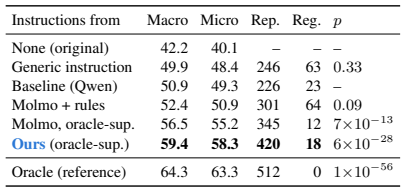
Table 1 . GenEval on SD1.5 images with the same V AREdit editor and the same 2,212 images. Rep./Reg.: repairs and regressions against the original images;p: exact McNemar test against the baseline critic on the same images. Best non-oracle results in bold.
Original paper · CC BY 4.0 · Vyom Agarwal, Mokshda Gangrade, Samet Ayhan, Giacinto Paolo Saggese · LEDGE: Separating Critic and Editor Failures in Text-to-Image Self-Correction · Original paper figure · Extracted the figure area from page 4 of the original PDF.Why end-to-end scores blur two failure sources
A self-correction loop has two stages that can each go wrong: the critic decides what to change and writes an instruction, and the editor tries to carry that instruction out. When only the final score is reported, a weak result cannot say which stage caused it, so a better critic can look useless behind a weak editor, and the reverse.
LEDGE keeps the generated images and the editor fixed, so the instruction is the only quantity that differs between runs. GenEval already lists each prompt's requirements and reports which one a failed image violates, which gives an answer key for the diagnosis step. Scoring runs against that answer key yields two quantities: the instruction gap, the score lost because the critic's instructions fall short of the oracle's, and the editor gap, the share of failures that stay unrepaired even under correct instructions.
The oracle reads the evaluator's verdict, so it cannot run at test time. It serves as a diagnostic reference, and the same labels also supervise a critic.
How failure reasons become edit instructions
A reason that says a count is too low does not say how many objects to insert or which total the image should reach, so the compiler fills those arguments from the prompt's requirements.
A missing object becomes an add edit that states how many to insert, the total to keep, and the side of its relation partner on which it goes; when both members of a relation are missing, they are added together. Before an excess is treated as real, overlapping detections with IoU above 0.5 are checked; if duplicates explain it, the image goes to REVIEW, which applied to 3 of the 3,802 failures.
Edits follow a fixed order of additions, removals, recolors and moves, and they are rendered with the same templates the critic uses. Because the rendering is shared, the oracle and the structured critic differ only in the diagnoses they produce. The oracle instruction is one valid edit among several, since moving the reference object could also fix a relation.
It is therefore a reference for this instruction format, not an upper bound on every possible instruction.
Structured output and training on oracle labels
The baseline critic returns one actionable error from four types, or KEEP or REVIEW, but 367 of 1,339 training failures need two edits, so a single-error format cannot cover them. The structured format returns a keep or edit decision with a list of add, remove, recolor and move records, each carrying its object, count, color and relation fields.
Fixed templates render the instructions from those records, and applying the same rendering to oracle edits reproduces their instructions for all 3,799 failures that receive edit lists.
Training labels come from a pilot set of GenEval-style prompts over 20 COCO classes, with 765 training prompts and 188 development prompts. Test prompts are kept apart: no training or development prompt shares a test prompt's specification, and checkpoints are chosen on development prompts only. GenEval templates repeat, so separate specifications do not rule out shared templates; the study therefore also evaluates objects that never appear in training.
The official benchmark was used once, with the selected checkpoint.
Instruction gap and editor gap on SD1.5
With VAREdit as the editor on the same 2,212 SD1.5 images, the original set scores 42.2% GenEval macro, the baseline critic reaches 50.9%, and oracle instructions reach 64.3%. Oracle instructions repair 512 of 1,324 failures, and the baseline critic repairs 226, capturing 39% of the gain the oracle gives over the original images. That leaves an instruction gap of 13.4 points.
A generic instruction, which asks the editor to satisfy the prompt and to leave correct images unchanged, repairs more failures than the baseline critic, 246 against 226. It also breaks 63 correct images where the baseline breaks 23, and in the paired comparison the two do not differ significantly, with 177 against 197 images and p = 0.33.
Even with oracle instructions, 812 of 1,324 SD1.5 failures stay unrepaired, which is 61.3% and defines the editor gap. Counting is the hardest task, with 38 of 201 failures repaired, while position reaches 29% and color attribution 32%.
Where the baseline critic misdiagnoses and what training changes
On the original SD1.5 images, the baseline critic keeps 88.9% of 888 correct images, but it edits 52.7% of 1,324 failures and sends 34.9% to review. It names the right error type and object for 39.4% of failures, while 12.4% stay unrepaired because the critic keeps the image.
The structured format alone brings no clear gain: the zero-shot structured critic edits 22.0% of correct images, and its any-match accuracy of 43.6% is close to the baseline's 42.3%, which is a looser type-level match.
A prompt-only rule that picks each task's most common edit reaches 49.1% exact diagnosis on test failures, but it edits every correct image, and it was tuned on the test failures, so it serves as an upper bound for prompt-only critics. Over all 2,212 images, that rule is right on 29.4%, against 79.9% for the oracle-supervised critic.
By task, exact diagnosis rises from 40% to 84% on position, from 13% to 58% on color attribution and from 36% to 78% on two objects, although training contains only 19 two-object prompts. Colors barely changes, from 49% to 51%, and the critic keeps 39 of its 99 failures there.
End-to-end repairs with the oracle-supervised critic
With the same editor, the oracle-supervised critic reaches 59.4% macro and 58.3% micro, with 420 repairs and 18 regressions. It recovers 63% of the instruction gap, which is 8.5 of 13.4 points, and 82% of the oracle's repairs.
Trained on the same oracle labels with QLoRA, Molmo reaches 56.5% with 345 repairs and 12 regressions, which is 4.1 points above its zero-shot version. The oracle-supervised Molmo recovers 65% of the oracle's gain, against 78% for the oracle-supervised critic built on Qwen3-VL-8B, so oracle supervision helps critics from both model families.
Transfer to SD3.5-Large, unseen objects, a second editor and other judges
Its share of the instruction gap falls to 27%, or 1.9 of 7.1 points, compared with 63% on SD1.5.
Among the 1,428 official images whose objects never appear in training prompts, the oracle-supervised critic reaches 59.1%, against 50.3% for the baseline and 64.4% for the oracle. On those images it closes 63% of the instruction gap, the same share as on all images.
With FLUX.1 Kontext as the second editor, oracle instructions reach 64.9% and the baseline critic 51.6%. The oracle-supervised critic reaches 61.5%, closes 74% of that gap, and yields 450 repairs with 5 regressions, against 231 repairs and 15 regressions for the baseline. The editor gap is also nearly unchanged, with 60.6% of failures unrepaired under oracle instructions, against 61.3% with VAREdit.
Re-scored with the T2I-CompBench judges, which played no part in training or selection, the SD1.5 mean rises from 47.45 to 61.17, against 53.89 for the baseline critic. Under these judges the critic recovers 97% of the oracle's gain, against 78% under GenEval, and the oracle's lead over the critic shrinks from 4.89 to 0.37 points. The authors read the shrinking lead as a sign that part of the oracle's advantage comes from fixes specific to GenEval's detector.
What the human check and scope leave open
One annotator, blind to the method, checked sampled repairs, and 72 of 100 SD1.5 repairs, split evenly between the oracle and the critic, were confirmed, with a 95% Wilson interval of 62-80%. In a second sample of 40 repairs per method, 80% of the baseline's repairs, 60% of the critic's and 70% of the oracle's were confirmed, a difference the authors report at p = 0.09.
Scaling repairs by these confirmation rates gives estimated net corrections of 158 for the baseline, 234 for the critic and 358 for the oracle, and the critic's gain is 3.4 micro points against GenEval's 9.0.
Labels, the oracle, checkpoint selection and the main evaluation all rely on GenEval's detector, and the oracle inherits the evaluator's errors. The T2I-CompBench judges offer an independent check, but the human check covers only a small sample of repairs.
The critic was trained with a single seed, and correction adds an 8B critic and an 8B editor, so the study makes no matched-compute claim against larger generators. The editor gap is also large on SD3.5, where 435 of 644 failed images remain unrepaired under oracle instructions. The authors list training editors for counting and position as future work, since those tasks show the largest editor gap.
Paper info
- Authors
- Vyom Agarwal, Mokshda Gangrade, Samet Ayhan, Giacinto Paolo Saggese
- Venue
- arXiv · Preprint
- First published
- 2026-11-16
- Added
- 2026-11-17
- Updated
- 2026-11-16
- Version
- v1
- arXiv
- 2611.20446
- Category
- cs.CV
- Original paper terms
- CC BY 4.0
- What we show
- Paper info, commentary and permitted figures from the original paper
AI commentary is a separate explanation from the original paper and may contain errors. The original paper and figures follow each source's terms of use and any rights noted separately.
Abstract
Text-to-image (T2I) self-correction combines a vision-language model (VLM) critic that diagnoses errors and proposes instructions with an image editor that executes them. End-to-end evaluation obscures whether failures arise from incorrect diagnoses or an editor unable to execute valid instructions. We introduce LEDGE (Learning Error Diagnosis in Generation and Editing), a framework that separates these bottlenecks. LEDGE compiles oracle edit instructions from GenEval while holding the generated images and the editor fixed, isolating the editor's correction capability from the critic's diagnostic accuracy. On Stable Diffusion 3.5 Large, oracle instructions raise GenEval from 72.0% to 81.2%, versus 74.1% for the baseline VLM critic. Yet 435 of 644 failed images remain unrepaired, exposing a substantial editor gap. We also use oracle labels from disjoint training prompts to supervise the critic. Oracle supervision raises exact diagnosis from 33.3% (the same VLM with our structured output, untrained) to 70.8%. With the same editor, the resulting critic improves GenEval from 42.2% (uncorrected) to 59.4% on Stable Diffusion 1.5, against 50.9% for the baseline critic, and from 72.0% to 76.0% on Stable Diffusion 3.5 Large, despite training only on Stable Diffusion 1.5. Improvements transfer to unseen object classes, a second editor, and independent T2I-CompBench judges and prompts. A small human evaluation confirms the ranking in estimated net corrections but suggests a smaller gain than detector-based evaluation. LEDGE thus distinguishes two limits of self-correction: knowing what to fix and being able to fix it.
Quote from the paper
Vyom Agarwal, Mokshda Gangrade, Samet Ayhan, Giacinto Paolo Saggese (2026). LEDGE: Separating Critic and Editor Failures in Text-to-Image Self-Correction. arXiv:2611.20446v1. https://arxiv.org/abs/2611.20446v1
BibTeX
@misc{agarwal2026ledge,
  title = {{LEDGE: Separating Critic and Editor Failures in Text-to-Image Self-Correction}},
  author = {Vyom Agarwal and Mokshda Gangrade and Samet Ayhan and Giacinto Paolo Saggese},
  year = {2026},
  eprint = {2611.20446},
  archivePrefix = {arXiv},
  url = {https://arxiv.org/abs/2611.20446v1}
}