Paper commentary
Region-VAD: Video Anomaly Localization and Detection via Region Selection
- Problem Video anomaly detectors trained from video-level labels usually pool whole frames, so their location is derived afterwards and is rarely verified.
- Method Region-VAD selects one rectangle per segment from the frame-to-frame change of frozen C-RADIOv4 tokens, without training. It then pools and scores only the tokens inside that rectangle, using attention probes and the UR-DMU head trained from video-level labels.
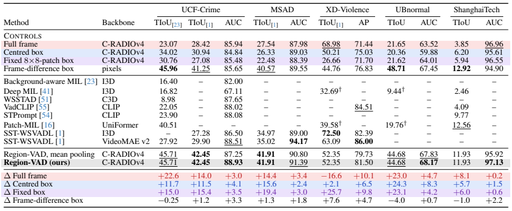
Table 2 . State-of-the-art comparison on five benchmarks. Localization and detection of the methods with a spatial output and of four controls. Three box controls test whether a box scores by its placement or by its size, and the frame-difference box applies the rule of Sec. 3.2 to pixel differences. For detection, the same head scores the mean of each control’s tokens (Sec. 4.1). TIoU[23]: boxes of [23] on every 16th frame; TIoU[1]: dense boxes of [1]; UBnormal and ShanghaiTech: official masks; † : unreleased keyframe boxes of [16], not comparable with ours. Numbers of published methods are those reported in [16], [1] and the respective papers. Bold and underline mark the best and second-best per column, including the controls, and ties share the mark. Last four rows: gain of Region-VAD over the four controls.
Original paper · CC BY 4.0 · D'Amicantonio, Giacomo · Region-VAD: Video Anomaly Localization and Detection via Region Selection · Original paper figure · Extracted the figure area from page 5 of the original PDF.Why whole-frame scores leave the location unchecked
Weakly supervised video anomaly detection learns from one label per video, yet it still has to say which frames contain the event. Most methods compress each clip into a single vector, rank the clips by that vector, and recover a location afterwards by mapping the clip score back onto the frame.
An operator needs to know where an event happens, and a location also lets a reader check whether the detector responds to the event or to the scene around it. That check is weakened when the score comes from the whole frame, because a detector can reach competitive accuracy from scene context alone while attending to the background.
On XD-Violence even a constant full-frame box scores competitively, so a localization number can reflect box size rather than where the model looked.
Token change in frozen features as a location cue
Region-VAD reverses the usual order: it chooses a region without training and only then detects from that region. The cue is the change of a token between consecutive segments, since a token that changes at a patch signals that something has moved or appeared there.
To observe the change, Region-VAD uses C-RADIOv4, which gives each frame four projections: the backbone features and the features of DINOv3, SAM 3 and SigLIP 2-aligned heads.
The projections differ in granularity: the backbone and DINOv3 group the frame into a few smooth regions, whereas SAM 3 and SigLIP 2 vary almost token by token.
Selecting one rectangle per segment without training
Each video is cut into segments of 16 frames, and the middle frame of each segment is resized to 320 × 240 pixels without cropping. The encoder returns one 1152-dimensional token per 16 × 16 patch, which gives a grid of 20 × 15 = 300 patches. The DINOv3, SAM 3 and SigLIP 2 heads map the same backbone tokens into spaces of 4096, 1024 and 1536 dimensions.
For each patch and projection, change is one minus the cosine between the token in the current segment and the token at the same patch in the previous segment. The cosine is used because it ignores scale, and the norm of a token differs by patch and by projection. Each change map is then standardized over the whole grid, which removes the uniform part of the change that the entire frame shares, such as camera motion or illumination.
A per-patch minimum across the four standardized maps keeps a patch only when all four projections place it above the frame average. With a single projection the minimum is the map itself, so the rule is unchanged for one encoder.
The consensus is then averaged over three segments with weights of one quarter for the previous segment, one half for the current segment and one quarter for the next, so that a change persisting over consecutive segments counts more than a one-off flicker.
The rectangle is the axis-aligned box of patches whose centred sum of the smoothed field is largest, where the centring subtracts the grid mean from each patch value before summing. The rule has no threshold and no size prior, so the box size follows from the field itself, and a rectangle is chosen in every segment, normal or anomalous.
Pooling and scoring inside the rectangle
The detector sees only the tokens inside the rectangle, yet the frozen encoder has already mixed in context from the wider image through its attention layers. Two attention probes then do the pooling: the first combines the four projections of each patch, and the second combines the patches of the rectangle, each probe using 8 heads followed by a residual MLP.
The resulting feature of each segment goes into UR-DMU, whose architecture, losses and loss weights are kept, and the head returns one anomaly score per segment.
Controls and annotation sets
Each frame's score is the overlap, measured as IoU, between the predicted box and the annotated box, and TIoU is that value averaged across the annotated anomalous test frames. Because TIoU rewards both placement and size, every localization result comes with three controls. The centred box has the same size as the rectangle but sits at the frame centre, so a gain over it is attributed to placement.
The full-frame box has a TIoU equal to the fraction of the frame covered by the annotated boxes, and the fixed 8 × 8 patch box at the frame centre does not depend on any method.
Localization is scored on the boxes of [23] on every 16th UCF-Crime frame, on the dense per-frame boxes of [1] for UCF-Crime, MSAD and XD-Violence, and on the official masks of UBnormal and ShanghaiTech.
Localization against published localizers and controls
On the boxes of [23], Region-VAD reaches 45.71 TIoU on UCF-Crime, which is 5.20 above the 40.51 of Patch-MIL. On the dense boxes of [1], it reaches 42.45 TIoU on UCF-Crime and 41.91 on MSAD, which the authors report as 12.55 and 6.89 above the trained SST-WSVADL localizer. On UBnormal the paper's rectangle is reported on the official masks at 44.68 TIoU.
The three box controls score far lower on UCF-Crime, MSAD and UBnormal: the centred box reaches 30.94 TIoU on UCF-Crime under [1], and the fixed box reaches 27.08. The authors read this as the gain coming from where the rectangle is placed rather than from its size.
Per anomaly class on UCF-Crime, the rectangle beats all three box controls in every class except Burglary, where the annotated boxes cover 42% of the frame. The frame-difference box is ahead of the rectangle in seven classes and behind it in six.
On the annotated anomalous test frames, the rectangle misses the annotated box entirely on 1.1 to 7.8% of frames.
On XD-Violence, where the annotated boxes are large and central, the full-frame box beats the rectangle and every published localizer but one. On ShanghaiTech the rectangle is 0.6 points below Patch-MIL, and the annotated events are much smaller than the rectangle, which has no size prior.
Detection from the rectangle against the full frame
On UCF-Crime the AUC rises from 85.94 to 88.93, on MSAD from 87.98 to 91.39, and on UBnormal from 63.52 to 68.17. On XD-Violence frame-level AP rises from 71.44 to 81.50, and on ShanghaiTech AUC rises from 96.96 to 97.13, a gain the authors place within the spread over seeds.
The fixed box and the frame-difference box are also below the rectangle on all datasets with the learned pooling. The authors take this as evidence that the tokens inside the rectangle carry the information needed for detection, and that placement matters for detection as it does for localization.
Some published detectors score higher than Region-VAD on individual benchmarks, for example VadCLIP and both SST-WSVADL models on XD-Violence, and SST-WSVADL with VideoMAE v2 on MSAD. These methods differ from Region-VAD in backbone and head, so the authors measure the effect of reading the full frame with the controls rather than with these published numbers.
Under UR-DMU, mean pooling inside the rectangle improves on the full-frame mean for every projection, by up to 2.5 AUC. Attention over the four projections of Region-VAD reaches 88.93 frame AUC, 1.7 above the mean of the same rectangle and 1.0 above SigLIP 2, the best single projection under attention.
Which parts of the region rule matter, and does the rule transfer
Smoothing adds 1.5 and 2.3 TIoU on the two annotation sets.
On UCF-Crime the consensus matches DINOv3 alone in accuracy, so its benefit is that it avoids choosing one projection, a choice that would need box annotations. The consensus stays behind frame differencing on the boxes of [23], on UBnormal and on ShanghaiTech.
With each of the other encoders run on its own change map, the rule gives 42.61 and 41.15 TIoU for V-JEPA 2.1, 45.53 and 42.01 for SAM 2, and 42.15 and 40.23 for RADIO v2.5. V-JEPA 2.1, SAM 2 and RADIO v2.5 localize above Patch-MIL and SST-WSVADL on both annotation sets, while VideoMAE v2 and InternVideo2 do so on the dense boxes.
Limits of the evidence
Region-VAD does not lead on XD-Violence, where the full-frame box is stronger, or on ShanghaiTech, where it trails Patch-MIL by 0.6 points. On fixed cameras the frame-difference box is ahead of the rectangle on UBnormal and ShanghaiTech, and on the sparse frames of [23].
The detection gain on ShanghaiTech lies within the spread over seeds, and the reported means come from three training seeds. The margin over SigLIP 2 under attention pooling is 1.0 AUC, which is less than the seed spread.
The comparison with published detectors mixes backbones and heads, so only the controls isolate the effect of reading the full frame.
The other encoders in the transfer study run on a single change map, so the consensus of four projections is evaluated only with C-RADIOv4.
Paper info
- Authors
- D'Amicantonio, Giacomo
- Venue
- arXiv · Preprint
- First published
- 2026-11-16
- Added
- 2026-11-17
- Updated
- 2026-11-16
- Version
- v1
- arXiv
- 2611.21132
- Category
- cs.CV
- Original paper terms
- CC BY 4.0
- What we show
- Paper info, commentary and permitted figures from the original paper
AI commentary is a separate explanation from the original paper and may contain errors. The original paper and figures follow each source's terms of use and any rights noted separately.
Abstract
Anomalies are local events, yet weakly supervised video anomaly detection scores them globally. Most methods pool an entire frame into a single vector, rank frames by that vector, and derive a location afterwards as a saliency map of the score. Full-frame pooling mixes the anomaly with its background, so a detector can reach competitive benchmark scores from scene context without being able to show where in the scene the anomaly occurs. We introduce Region-VAD, which first selects a region and then detects the anomaly from that region alone. Region-VAD selects an explicit rectangle over the tokens of a frozen foundation model and scores anomalousness only from the tokens inside the box, through attention pooling followed by a standard temporal head. The rectangle is not learned, it is the box in which the frozen tokens change most between consecutive segments, in all four feature projections of the encoder, and it is found by exhaustive search over the rectangles of the token grid. Only the pooling and the temporal head are trained, from video-level labels without boxes, masks or frame-level annotations, and no trained component reads a token outside the selected region. Experiments on five datasets, with one localizer configuration shared by all datasets and backbones, show that Region-VAD achieves state-of-the-art anomaly localization on UCF-Crime and MSAD at competitive detection performance.
Quote from the paper
D'Amicantonio, Giacomo (2026). Region-VAD: Video Anomaly Localization and Detection via Region Selection. arXiv:2611.21132v1. https://arxiv.org/abs/2611.21132v1
BibTeX
@misc{giacomo2026region,
  title = {{Region-VAD: Video Anomaly Localization and Detection via Region Selection}},
  author = {D'Amicantonio, Giacomo},
  year = {2026},
  eprint = {2611.21132},
  archivePrefix = {arXiv},
  url = {https://arxiv.org/abs/2611.21132v1}
}