논문 해설
Region-VAD: Video Anomaly Localization and Detection via Region Selection
Region-VAD: 영역 선택을 통한 비디오 이상 위치 파악 및 탐지
- 연구 문제 기존 약지도 이상 탐지는 프레임 전체를 압축해 점수를 내므로 이상의 위치를 검증하기 어렵습니다.
- 연구 방법 토큰 변화 지도에서 학습 없이 직사각형을 고르고, 그 안의 토큰만 attention으로 풀링해 이상을 탐지합니다.
- 주요 결과 UCF-Crime의 [23] 박스 기준 TIoU 45.71을 기록해 Patch-MIL의 40.51을 넘었습니다.
이상 위치를 알기 어려운 이유
약지도 비디오 이상 탐지에서는 비디오 단위 라벨만 주어지므로, 대부분의 방법은 프레임 전체를 하나의 벡터로 압축해 세그먼트를 순위화합니다. 위치는 그 뒤에 점수의 saliency 지도로 얻습니다. 이렇게 하면 장면 맥락만으로도 벤치마크 점수를 얻을 수 있어, 이상이 장면의 어디에서 일어나는지 보여 주지 못하는 문제가 생깁니다.
이 논문은 위치를 먼저 고르고 그 영역의 토큰만으로 이상을 탐지하는 localize-then-detect 구조를 제안합니다. 저자들은 기존 지역화기가 학습된 구성요소와 외부 의존성을 함께 두어 지역화 결과를 학습 조건과 분리하기 어렵다고 지적합니다.
토큰 변화로 영역을 고르는 방법
Region-VAD는 C-RADIOv4 인코더를 고정하고, 각 세그먼트의 중간 프레임을 20×15 토큰 격자로 바꿉니다. 영역 선택에는 학습 파라미터가 없습니다. 같은 패치 위치에서 현재 토큰과 이전 세그먼트 토큰의 코사인 거리를 구하고, 이를 패치 격자에서 표준화합니다. 식으로는 c(p)=1−cos(x_t,p, x_{t−1,p})이고, 표준화는 z(c)=(c−µ)/σ이며 µ와 σ는 격자의 패치 전체에서 계산합니다.
네 projection의 표준화된 변화 지도에서 패치마다 최솟값을 취해 합의 지도 m_t(p)=min_k z(c^k_t)(p)를 만듭니다. 이 최솟값은 네 projection이 모두 평균보다 크게 변한 패치만 남깁니다. 이후 m_t를 이웃 세그먼트와 가중 평균해 m̃_t를 얻고, m̃_t에서 평균 m̄_t를 뺀 값의 중심합이 최대인 직사각형을 R_t로 고릅니다. 중심합은 평균보다 크게 변한 패치는 점수를 올리고 그렇지 않은 패치는 낮춥니다. 탐색은 25,200개 직사각형을 summed-area table로 모두 평가하는 방식입니다.
선택된 R_t 안의 토큰은 두 개의 attention probe로 풀링됩니다. 첫 probe는 패치마다 네 projection을 묶고, 두 번째 probe는 R_t의 패치들을 묶어 세그먼트 특징 f_t를 만듭니다. 이 두 probe와 헤드는 학습되며, 세그먼트 특징은 UR-DMU 시간 헤드에 입력되어 이상 점수 s_t를 냅니다. 학습 손실은 비디오 라벨 y에 대한 MIL 항과 UR-DMU의 보조 항으로 구성됩니다. 저자들은 R_t가 고정 토큰에서 한 번 계산되어 학습에 고정된 패치 집합으로 들어가므로 R_t로는 기울기가 전달되지 않는다고 밝힙니다.
지역화 비교와 대조 박스
UCF-Crime에서 Region-VAD는 [23] 박스 기준 TIoU 45.71을 기록했고, 같은 표에서 Patch-MIL은 40.51이었습니다. 저자들은 이 차이를 Patch-MIL 대비 5.20 TIoU 향상으로 보고합니다. 조밀한 [1] 주석 기준에서는 SST-WSVADL보다 UCF-Crime에서 12.55, MSAD에서 6.89 TIoU 높았습니다.
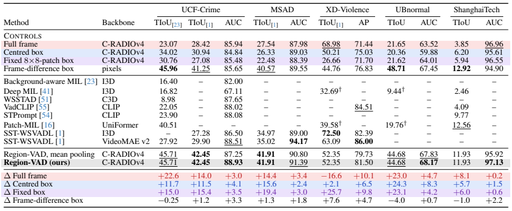
Table 2 . State-of-the-art comparison on five benchmarks. Localization and detection of the methods with a spatial output and of four controls. Three box controls test whether a box scores by its placement or by its size, and the frame-difference box applies the rule of Sec. 3.2 to pixel differences. For detection, the same head scores the mean of each control’s tokens (Sec. 4.1). TIoU[23]: boxes of [23] on every 16th frame; TIoU[1]: dense boxes of [1]; UBnormal and ShanghaiTech: official masks; † : unreleased keyframe boxes of [16], not comparable with ours. Numbers of published methods are those reported in [16], [1] and the respective papers. Bold and underline mark the best and second-best per column, including the controls, and ties share the mark. Last four rows: gain of Region-VAD over the four controls.
원문 · CC BY 4.0 · D'Amicantonio, Giacomo · Region-VAD: Video Anomaly Localization and Detection via Region Selection · 원문 그림 인용 · 원본 PDF 5쪽에서 그림 영역을 추출했습니다.이 이득이 박스의 위치 때문인지 크기 때문인지 구분하려고 저자들은 같은 크기의 중앙 박스, 전체 프레임 박스, 고정 8×8 패치 박스, 프레임 차분 박스를 대조군으로 두었습니다. UCF-Crime, MSAD, UBnormal에서는 같은 크기의 중앙 박스와 고정 박스가 훨씬 낮아, 이득이 R_t의 배치에서 온다고 해석합니다. 프레임 차분 박스는 픽셀 차분에 같은 규칙을 적용한 대조군이며, 저자들은 이것이 UCF-Crime의 일부 설정과 고정 카메라 데이터셋에서 토큰 변화보다 강하다고 보고합니다.
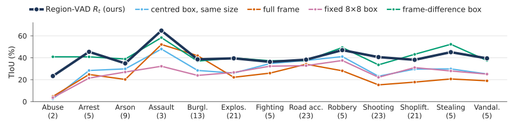
Figure 4 .Per-class localization on UCF-Crime.TIoU ofR t and of the four controls of Table 2 for each anomaly class (number of annotated test videos in parentheses) on the dense boxes of [1]; Section B of the appendix repeats it on the boxes of [23].R t exceeds the three box controls in every class but Burglary, whose annotations cover 42% of the frame, and the frame-difference box is ahead ofR t in seven classes and behind in six.
원문 · CC BY 4.0 · D'Amicantonio, Giacomo · Region-VAD: Video Anomaly Localization and Detection via Region Selection · 원문 그림 인용 · 원본 PDF 6쪽에서 그림 영역을 추출했습니다.XD-Violence에서는 장면이 크고 카메라가 사건을 따라가므로 전체 프레임 박스가 Region-VAD보다 높았습니다. ShanghaiTech에서는 주석 사건이 R_t보다 훨씬 작아 Patch-MIL에 0.6 TIoU 뒤졌습니다. 이 한계는 R_t에 크기 사전 정보가 없다는 설계에서 비롯됩니다.
영역 안 토큰의 탐지 성능
탐지는 같은 인코더와 헤드를 쓰되 입력만 바꾼 full-frame 대조와 비교해 평가했습니다. 다섯 벤치마크 모두에서 영역 안 토큰을 읽는 경우가 전체 프레임 특징보다 AUC가 높았습니다. 저자들은 이 결과가 영역 안 토큰에 탐지 근거가 담겨 있다는 두 번째 가설을 지지한다고 해석합니다. 다만 ShanghaiTech에서는 이득이 시드 편차 안에 있었습니다.
같은 크기의 중앙 박스도 여러 데이터셋에서 영역보다 낮았으므로 탐지 이득도 박스 위치에서 온다고 해석합니다. 수치는 세 시드의 평균으로 보고되었고, 표 S1에 표준편차가 있습니다.
풀링과 합의 규칙의 기여
부분 결과로 보면, 같은 영역에서 평균 풀링에서 attention 풀링으로 바꾸면 Region-VAD의 네 projection AUC가 1.7 올라갑니다. 저자들은 이 이득이 최고의 단일 projection인 SigLIP 2보다 1.0 높지만 시드 편차보다는 작다고 설명합니다. 토큰 변화 지도는 단일 맵보다 합의를 사용하고, 시간 평활화는 TIoU를 1.5와 2.3 높였습니다. 합의 지도는 UCF-Crime에서 단일 DINOv3 지도와 같은 TIoU를 보였으므로, 저자들은 이것이 선택 기준이 아니라 여러 지도를 결합하는 근거라고 봅니다.
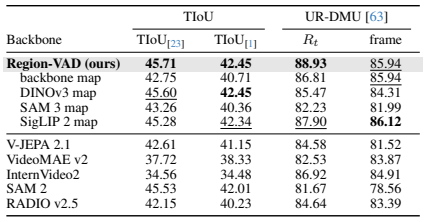
Table 5 .Backbone ablation on UCF-Crime.TIoU of the region selected by the rule of Sec. 3.2 from each token set, and frame AUC of UR-DMU with attention pooling insideR t (Rt) or the mean of the full-frame tokens (frame), which for Region-V AD is the full-frame control of Table 2 on the backbone tokens. Indented rows select the region from one map of C-RADIOv4 alone, as in Table 3, and their detection pools that map’s tokens inside theR t of Region-V AD, as in Table 4. The other encoders run the whole pipeline on their single change map. Bold/underline: best/second- best per column; ties share the mark.
원문 · CC BY 4.0 · D'Amicantonio, Giacomo · Region-VAD: Video Anomaly Localization and Detection via Region Selection · 원문 그림 인용 · 원본 PDF 8쪽에서 그림 영역을 추출했습니다.남은 문제
이 방법은 이벤트가 고정 토큰의 변화가 가장 큰 위치에 있다는 가정에 의존합니다. 교통처럼 지배적인 정상 움직임이 있으면 직사각형이 다른 곳으로 밀릴 수 있습니다. 정지해 있거나 느린 이상은 토큰을 거의 바꾸지 않으며, 한 직사각형은 떨어진 두 사건을 함께 감싸지 못합니다. 세그먼트당 중간 프레임 하나만 쓰므로 짧은 이벤트를 놓칠 수 있고, 세그먼트 안의 움직임은 나타내지 않습니다. 이상 학습 비디오에서 잘못 놓인 직사각형은 풀링에 잡음이 되는 것으로 저자들이 밝혔습니다.
논문 정보
- 저자
- D'Amicantonio, Giacomo
- 학회·저널
- arXiv · 프리프린트
- 최초 공개일
- 2026년 11월 16일
- 등록일
- 2026년 11월 17일
- 수정일
- 2026년 11월 16일
- 버전
- v1
- arXiv
- 2611.21132
- 분류
- cs.CV
- 원문 이용 조건
- CC BY 4.0
- 제공 범위
- 논문 정보, 해설, 허용된 원문 그림
AI 해설은 논문 원문과 별개의 설명이며 오류가 있을 수 있습니다. 원문과 그림은 각 출처의 이용 조건과 따로 표시된 권리를 따릅니다.
초록
Anomalies are local events, yet weakly supervised video anomaly detection scores them globally. Most methods pool an entire frame into a single vector, rank frames by that vector, and derive a location afterwards as a saliency map of the score. Full-frame pooling mixes the anomaly with its background, so a detector can reach competitive benchmark scores from scene context without being able to show where in the scene the anomaly occurs. We introduce Region-VAD, which first selects a region and then detects the anomaly from that region alone. Region-VAD selects an explicit rectangle over the tokens of a frozen foundation model and scores anomalousness only from the tokens inside the box, through attention pooling followed by a standard temporal head. The rectangle is not learned, it is the box in which the frozen tokens change most between consecutive segments, in all four feature projections of the encoder, and it is found by exhaustive search over the rectangles of the token grid. Only the pooling and the temporal head are trained, from video-level labels without boxes, masks or frame-level annotations, and no trained component reads a token outside the selected region. Experiments on five datasets, with one localizer configuration shared by all datasets and backbones, show that Region-VAD achieves state-of-the-art anomaly localization on UCF-Crime and MSAD at competitive detection performance.
원문 인용
D'Amicantonio, Giacomo (2026). Region-VAD: Video Anomaly Localization and Detection via Region Selection. arXiv:2611.21132v1. https://arxiv.org/abs/2611.21132v1
BibTeX
@misc{giacomo2026region,
  title = {{Region-VAD: Video Anomaly Localization and Detection via Region Selection}},
  author = {D'Amicantonio, Giacomo},
  year = {2026},
  eprint = {2611.21132},
  archivePrefix = {arXiv},
  url = {https://arxiv.org/abs/2611.21132v1}
}