논문 해설
How to Explain your Unexplainable Video Anomaly Detector
당신의 설명 불가능한 비디오 이상 탐지기를 어떻게 설명할까
- 연구 문제 기존 설명 방법은 점수가 어디를 보는지는 알려 주지만 어떤 의미에 의존하는지는 충분히 밝히지 못합니다.
- 연구 방법 동결된 VAD 모델의 입력 특징을 의미 그래프로 조건화된 확산으로 재생성하고, 마스크별 점수 변화를 측정합니다.
- 주요 결과 UCF-Crime CLIP에서 아웃컴 체인 제거는 여섯 탐지기 모두 4.23에서 6.78 AUC 포인트의 하락을 보였고, 같은 수의 무작위 삭제보다 큰 차이를 보였습니다.
약지도 VAD의 설명 가능성 문제
약지도 비디오 이상 탐지(WSVAD) 모델은 비디오 수준 라벨만으로 학습하며, 다중 인스턴스 학습(MIL)으로 가장 이상한 구간에 높은 점수를 줍니다. 그러나 이 모델은 고차원 특징 공간에서 점수를 내기 때문에 어떤 의미에 의존하는지 설명하기 어렵습니다. 기존 Grad-CAM 같은 사후 귀속 방법은 공간적 상관을 보여 줄 뿐 점수가 내용에 얼마나 의존하는지는 말해 주지 않습니다. 또한 VLM이 생성하는 설명은 이상 점수를 계산하는 분기와 분리되어 있어, 설명이 점수의 근거가 아닌 사후 합리화가 될 수 있습니다. 이 논문은 이 충실성 격차를 다루며, 동결된 탐지기의 특징 공간에서 반사실 개입으로 점수 의존성을 측정하려 합니다.
ETU의 두 단계 감사 파이프라인
ETU는 동결된 VAD 모델을 감사하는 분류기 불가지론적 프레임워크입니다. 첫 단계인 GEM은 I3D나 CLIP 특징을 루트(Ar), 액션(Aa), 아웃컴(Ao)으로 이루어진 방향 의존 그래프로 매핑하고, 이를 512차원 잠재 임베딩 zgraph로 압축합니다. 노드는 유형별 32개 프로토타입 코드북에서 Gumbel-Softmax로 선택되며, 교사 VLM의 라벨과 헝가리안 매칭을 통해 재구성 손실로 정렬됩니다. 엣지는 루트에서 액션, 액션에서 아웃컴으로 계층적으로 예측되며, 이때 OHEM으로 양성과 어려운 음성을 고릅니다.
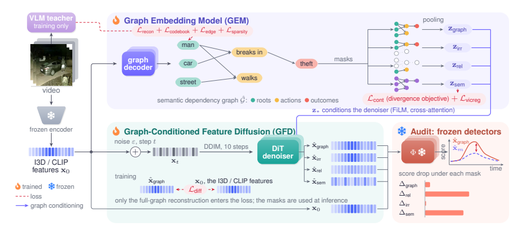
Figure 2 .Explain The Unexplainable (ETU) hands one set of masked reconstructions per video unchanged to every frozen detector. The Graph Embedding Model (GEM) maps continuous video features to a semantic dependency graph and a latent embedding zgraph; deterministic masks yield the counterfactual embeddings zrel,z irr,z sem, on which the Graph-Conditioned Feature Diffusion (GFD) denoises the video features. GFD is trained only to reconstruct the encoder features under the complete graph; the masked embeddings are used at inference. The change in a frozen detector’s score between the full-graph and a masked reconstruction is the audit’s reading of its dependence on the masked semantics. Node labels are illustrative.
원문 · CC BY 4.0 · D'Amicantonio, Giacomom, Bondarev, Egor · How to Explain your Unexplainable Video Anomaly Detector · 원문 그림 인용 · 원본 PDF 4쪽에서 그림 영역을 추출했습니다.두 번째 단계인 GFD는 DiT 기반 4블록 잡음 제거기를 사용하며, zgraph를 FiLM과 교차 어텐션으로 주입합니다. GFD는 전체 그래프 조건에서 재구성하는 손실만으로 학습되고, 관계(zrel), 무관(zirr), 의미 치환(zsem) 마스크 임베딩은 추론 시에만 사용됩니다. 감사 측정값은 전체 그래프 재구성과 마스크 재구성에 대해 동결된 탐지기의 벤치마크 점수 차이 Δm(x0)=Φ(x̂graph)−Φ(x̂m)입니다. 이 값은 프레임 단위 AUC(UCF-Crime)나 AP(XD-Violence)의 차이이며 점수의 단조 재스케일링에 불변입니다.
발산 목적이 개입을 targeted로 만드는 방식
GEM의 잠재 공간은 대조 손실 LGEMcont로 형성됩니다. zirr은 zgraph에 가깝게 당기고, zsem과 zrel은 코사인 유사도를 0 이하로 밀어내는 힌지 항으로 제약됩니다. 저자들은 이 목적을 제거한 divergence-free ETU와 발산 목적을 생성기에 추가한 divergence-trained generator를 비교했습니다. 제거 실험에서 관계 마스크의 효과와 같은 수의 무작위 삭제 효과가 구분되지 않았고, 생성기에 발산 목적을 넣으면 탐지기 변화가 제거된 의미보다 재구성 변위를 따르는 것으로 나타났습니다. 따라서 저자들은 GEM의 발산 목적이 마스크를 targeted 개입으로 만드는 설계 선택이라고 해석합니다.
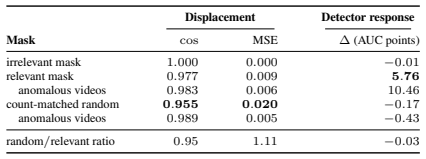
Table 4 .Displacement and detector response under the relevant mask and the count-matched random deletion.Median cosine and MSE of each masked reconstruction to the full-graph one, next to the frame-AUC drop of Eq. 8 averaged over the six detectors. The last row is the median of the per-video ratios random/relevant of 1−cos and of MSE, which differs from the ratio of the medians above, and the ratio of the mean deltas. Bold marks the larger displacement and response over all videos.
원문 · CC BY 4.0 · D'Amicantonio, Giacomom, Bondarev, Egor · How to Explain your Unexplainable Video Anomaly Detector · 원문 그림 인용 · 원본 PDF 7쪽에서 그림 영역을 추출했습니다.동결 탐지기 감사 결과
UCF-Crime CLIP 특징에서 전체 그래프 재생성은 탐지기에 작은 변화만 주었고, Δgraph는 −0.10에서 0.30 AUC 포인트 범위였습니다. 같은 조건에서 장면 의미 치환은 대부분의 탐지기에서 가장 큰 하락을 보였습니다. 관계 마스크로 아웃컴 체인을 제거하면 여섯 탐지기 모두 4.23에서 6.78 AUC 포인트가 떨어졌습니다. 배경 노드를 제거하는 irrelevant 마스크는 재생성 비용을 넘는 변화를 거의 보이지 않았습니다.
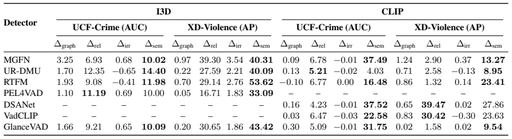
Table 1 .Regenerating under the complete graph costs the detectors very little, while substituting the scene semantics or removing the outcome chain costs every one of them. ∆graph is the drop from the clean features to the full-graph reconstruction; ∆rel, ∆irr and ∆sem are the reconstruction-referenced deltas of Eq. 8, in frame-AUC points on UCF-Crime and AP points on XD-Violence, positive for a drop; the largest masked delta of each detector on each track is in bold.
원문 · CC BY 4.0 · D'Amicantonio, Giacomom, Bondarev, Egor · How to Explain your Unexplainable Video Anomaly Detector · 원문 그림 인용 · 원본 PDF 6쪽에서 그림 영역을 추출했습니다.관계 마스크와 같은 수의 무작위 노드 삭제를 비교했을 때, ETU에서는 여섯 탐지기 모두 차이가 양수였고 95% 신뢰구간이 0을 제외했습니다. 다만 이 결과는 UCF-Crime CLIP 설정과 다섯 탐지기 표 조건에 한정된 결과입니다. 저자들은 XD-Violence에서도 장면 의미 치환이나 아웃컴 제거가 배경 제거보다 더 큰 비용을 준다고 보고합니다.

Table 3 .The count-matched random deletion under the three regimes.For each test video, a random draw of as many nodes as the relevant mask removes; the cost of the relevant mask, the cost of the random draw and their difference with its 95% confidence interval, in frame-AUC points at t=300 on the UCF-Crime/CLIP test videos. The divergence objective is used in GEM only by ETU, in both GEM and GFD by the divergence-trained generator (against its own full-graph reconstruction), and nowhere by the divergence-free ETU. The differences of ETU, positive on all six detectors with intervals that exclude zero, are in bold.
원문 · CC BY 4.0 · D'Amicantonio, Giacomom, Bondarev, Egor · How to Explain your Unexplainable Video Anomaly Detector · 원문 그림 인용 · 원본 PDF 7쪽에서 그림 영역을 추출했습니다.교사 VLM 의존성
저자들은 그래프가 교사 VLM에 얼마나 의존하는지 Qwen3-VL, InternVideo3, Gemma-4의 세 교사로 UCF-Crime 비디오를 파싱해 비교했습니다. 같은 비디오에서 두 교사의 원자 일치는 같은 클래스의 다른 비디오보다 73.4에서 81.4 퍼센트의 비디오에서 높았습니다. 따라서 저자들은 복구된 위상 구조를 장면의 구조가 아니라 조건화 구조로 보아야 한다고 봅니다.
적용 조건과 남은 문제
ETU의 결과는 GEM이 교사 그래프를 재현한다는 가정과 UCF-Crime, XD-Violence 두 데이터셋의 설정에 의존합니다. 발산 목적을 GEM이나 생성기에서 빼거나 넣으면 탐지기 응답의 해석이 달라지므로, 목적 설계가 결과를 좌우합니다. Holmes-VAU 같은 VLM 설명기는 반사실 프롬프트에서 점수가 거의 변하지 않아 표 1의 감사 대상에서 제외되었습니다. 또한 단일 노드 마스크는 탐지기에 따라 결과가 다르고, 시각화된 개별 비디오의 AP 변화는 전체 테스트 세트의 Δ를 대신하지 않습니다.
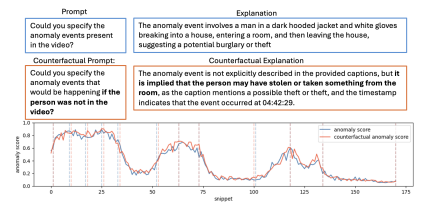
Figure 1 .A VLM explainer’s caption changes under a counter- factual prompt but its score does not.Counterfactual prompting of Holmes-V AU [67] on the “robbery” video provided in the official repository. The anomaly scores obtained with the two prompts are nearly identical, so the score does not follow the explanation the model gives, while the counterfactual explanation mentions the very person the prompt instructed to ignore.
원문 · CC BY 4.0 · D'Amicantonio, Giacomom, Bondarev, Egor · How to Explain your Unexplainable Video Anomaly Detector · 원문 그림 인용 · 원본 PDF 2쪽에서 그림 영역을 추출했습니다.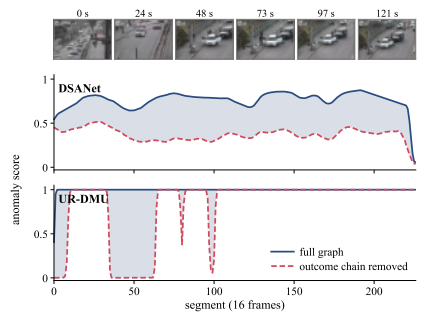
Figure 3 .The same intervention moves two detectors very differ- ently(Arrest024, UCF-Crime). Raw anomaly scores of DSANet and UR-DMU under the full graph and with the outcome chain removed (the rootsWhite pickup truckandPolice officers, their collision and arrest actions, and the resulting stop and restraint outcomes). The score of DSANet drops on every segment, whereas UR-DMU is saturated when unmasked and responds all-or-nothing.
원문 · CC BY 4.0 · D'Amicantonio, Giacomom, Bondarev, Egor · How to Explain your Unexplainable Video Anomaly Detector · 원문 그림 인용 · 원본 PDF 8쪽에서 그림 영역을 추출했습니다.논문 정보
- 저자
- D'Amicantonio, Giacomom, Bondarev, Egor
- 학회·저널
- arXiv · 프리프린트
- 최초 공개일
- 2026년 11월 16일
- 등록일
- 2026년 11월 17일
- 수정일
- 2026년 11월 16일
- 버전
- v1
- arXiv
- 2611.21131
- 분류
- cs.CV
- 원문 이용 조건
- CC BY 4.0
- 제공 범위
- 논문 정보, 해설, 허용된 원문 그림
AI 해설은 논문 원문과 별개의 설명이며 오류가 있을 수 있습니다. 원문과 그림은 각 출처의 이용 조건과 따로 표시된 권리를 따릅니다.
초록
Weakly-supervised Video Anomaly Detection (VAD) models assign anomaly scores from high-dimensional features, and their predictions remain unexplained. Saliency maps show where a model looks but not what it relies on, and the descriptions produced by Vision-Language Models (VLMs) are generated by branches that the anomaly score never reads. To address this faithfulness gap, we propose \textbf{Explain The Unexplainable (ETU)}, a classifier-agnostic framework that audits frozen VAD models through counterfactual interventions in their feature space. ETU maps video features to a discrete dependency graph of agents, actions and outcomes ($A_r \to A_a \to A_o$), regenerates the features by graph-conditioned diffusion with selected nodes of the graph masked, and measures the change in the score of a frozen detector; one set of interventions is applied unchanged to every detector. The generator is trained only to reconstruct the input features, so it cannot learn the contrast it is asked to measure, and we validate the audit with experiments that test every alternative explanation of its results, from the cost of regeneration to random deletions of matched size. On UCF-Crime features obtained from a CLIP encoder, we show that substituting the scene semantics results in the largest drop for most detectors, and that removing the outcome chain of the graph ($\Delta_{rel}$) changes the anomaly score of all six audited detectors far more than removing the same number of random nodes, even though the random deletion perturbs the features about as much. We show that this targeted behavior comes from the divergence objective of the graph embedding. Without it, the two interventions become indistinguishable, and with a divergence objective in the generator as well, the score change of the detector follows the displacement of the reconstruction rather than the semantics that were removed.
원문 인용
D'Amicantonio, Giacomom, Bondarev, Egor (2026). How to Explain your Unexplainable Video Anomaly Detector. arXiv:2611.21131v1. https://arxiv.org/abs/2611.21131v1
BibTeX
@misc{giacomom2026explain,
  title = {{How to Explain your Unexplainable Video Anomaly Detector}},
  author = {D'Amicantonio, Giacomom and Bondarev, Egor},
  year = {2026},
  eprint = {2611.21131},
  archivePrefix = {arXiv},
  url = {https://arxiv.org/abs/2611.21131v1}
}