논문 해설
ReconPotBench: Evaluating LLM Honeypots in Multi-Round Linux Reconnaissance
ReconPotBench: 다중 라운드 Linux 정찰에서의 LLM 허니팟 평가
- 연구 문제 기존 LLM 허니팟 평가는 개별 명령 출력만 보아 여러 라운드에 걸친 호스트 상태의 일관성을 확인하지 못합니다.
- 연구 방법 1,032개의 3라운드 Linux 정찰 상호작용과 실제 호스트 참조 출력을 구성하고, authenticity·consistency·utility를 LLM 평가자로 함께 채점합니다.
- 주요 결과 Cowrie는 일관성 0.45로 가장 높았고, 평가된 모든 LLM 구성은 Cowrie보다 높은 hacker utility를 기록했습니다.
기존 허니팟 평가의 공백
LLM 기반 허니팟은 셸 명령에 그럴듯한 출력을 만들 수 있는지를 보여 주었지만, 기존 평가는 대부분 명령 하나의 출력을 따로 봅니다. 실제 정찰에서 공격자는 앞선 출력에서 얻은 IP 주소, 포트, 프로세스 같은 엔티티를 다음 명령에서 다시 확인합니다. 따라서 개별 출력이 실제처럼 보여도 여러 라운드에 걸쳐 호스트 상태가 유지되지 않으면 허니팟은 쉽게 드러납니다. 이 논문은 이런 상호의존적 다회차 Linux 정찰 상호작용을 평가하는 벤치마크가 부족하다는 문제에서 출발합니다.
ReconPotBench의 구성
ReconPotBench는 1,032개의 3라운드 Linux 정찰 상호작용으로 구성됩니다. 각 사례는 Network→Software→Hardware 계층을 따르며, 첫 라운드 명령은 카테고리별로 수동 설계하고 2라운드와 3라운드 명령은 GPT-5.4로 생성한 뒤 사람이 검토했습니다. 참조 출력은 실제 Linux 호스트에서 명령을 실행해 얻었고, 평가 대상 시스템에는 생성 단계에서 제공되지 않습니다. 평가 대상은 1라운드에서 현재 명령만 받고, 2·3라운드에서는 앞선 명령과 생성 출력을 함께 받습니다.
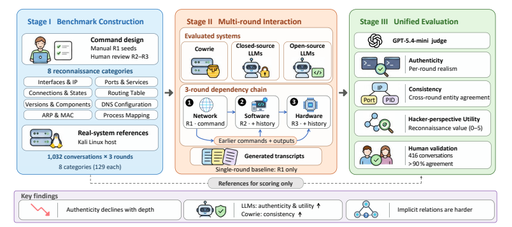
Figure 2 : Overview of ReconPotBench. The benchmark targets multi-round Linux reconnaissance interactions, in which later commands depend on earlier context, and enables unified evaluation of systems along three dimensions: round-level authenticity, cross-round consistency, and hacker-perspective utility.
원문 · CC BY 4.0 · Qianli Wang, Junchao Wu, Binkai Ou, Lidia S. Chao, Derek F. Wong · ReconPotBench: Evaluating LLM Honeypots in Multi-Round Linux Reconnaissance · 원문 그림 인용 · 원본 PDF 4쪽에서 그림 영역을 추출했습니다.authenticity·consistency·utility 채점
세 지표는 모두 GPT-5.4-mini를 평가자로 쓰는 LLM-as-a-judge 방식으로 계산합니다. authenticity는 각 라운드의 생성 출력이 참조 출력과 명령 의미, 정보 유형, 출력 형식에서 일치하는지를 1 또는 0으로 판정하고, 세 라운드의 평균을 취합니다. consistency는 3라운드 시퀀스 단위로 엔티티와 그 관계가 라운드 사이에 바뀌지 않았는지를 1, 0 또는 NA로 판정하며, NA 시퀀스는 분모에서 제외됩니다. utility는 시퀀스마다 0부터 5까지의 정수를 직접 부여하고, 데이터셋 전체에서는 점수별 비율 p_s로 가중한 평균 U로 집계합니다.
사람 검증 표본
자동 평가자의 신뢰도를 확인하려고 사람이 416개 다회차 상호작용을 검토했습니다. 표본은 Claude Sonnet-4.6 결과에서 8개 카테고리마다 52개씩 추출했고, 두 명의 대학원생이 독립적으로 판정했습니다. 그 결과 사람과 GPT-5.4-mini의 일치율은 authenticity 90.87%, consistency 97.36%, utility 91.35%였습니다. 이 검증은 샘플링된 Claude Sonnet-4.6 출력에 대한 일치를 보여 주며, 모든 모델 출력에 대한 평가 정확도를 증명하지는 않습니다.
Cowrie와 LLM 허니팟의 비교
Cowrie는 일관성 점수 0.45로 평가된 시스템 가운데 가장 높았지만, 나머지 LLM 구성은 0.07에서 0.21 사이에 있었습니다. 반면 hacker utility는 Cowrie가 0.66이었고, 평가된 모든 LLM 구성은 이보다 높았습니다. 열린 소스 모델 평균은 1.99, 닫힌 소스 모델 평균은 2.96이었습니다. authenticity는 모델에 따라 달랐습니다. 모든 닫힌 소스 모델은 Cowrie의 평균 0.17을 넘었지만, 열린 소스 결과는 Qwen2.5-7B 0.21, Llama3.1-8B 0.13, Hunyuan-7B 0.03으로 섞여 있었습니다. 따라서 이 결과는 모든 열린 소스 모델이 Cowrie보다 authenticity에서 낫다는 결론을 지지하지 않습니다.
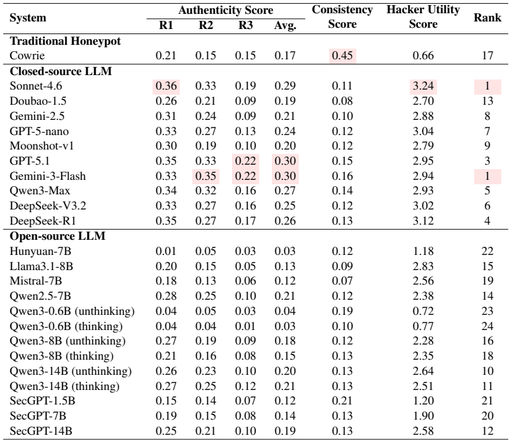
Table 2 : Comprehensive evaluation results for Cowrie and LLM honeypots in multi-round Linux reconnaissance. Authenticity is reported for each round, with “Avg.” denoting the mean across three rounds. Consistency is the fraction of conversations scored as fully consistent. Hacker utility is the weighted average of conversation-level scores from 0 to 5. Rank is computed by first converting hacker utility from the 0 to 5 scale to the 0 to 1 scale by dividing it by 5, and then averaging the converted hacker utility score with authenticity average and consistency. Higher values indicate better performance; all metric values are rounded to two decimals.
원문 · CC BY 4.0 · Qianli Wang, Junchao Wu, Binkai Ou, Lidia S. Chao, Derek F. Wong · ReconPotBench: Evaluating LLM Honeypots in Multi-Round Linux Reconnaissance · 원문 그림 인용 · 원본 PDF 8쪽에서 그림 영역을 추출했습니다.Claude Sonnet-4.6의 카테고리별 결과
Claude Sonnet-4.6의 카테고리별 결과에서 일관성은 Connection-to-Process Mapping이 0.30으로 가장 높았고, Port Connection States 0.20, Open Ports & Listening Services 0.18이 뒤를 이었습니다. 반면 Network Interfaces & IP는 0.04, Routing Table은 0.03, DNS Configuration은 0.02, ARP Cache & MAC Addresses는 0.01이었습니다. 비슷한 authenticity 평균이라도 일관성은 크게 달랐습니다. 예를 들어 Connection-to-Process Mapping, Open Ports & Listening Services, Service Versions & Components는 평균 authenticity가 모두 0.36이었지만 일관성은 0.30, 0.18, 0.08이었습니다.
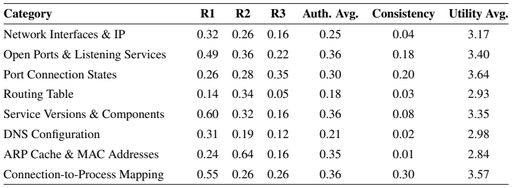
Table 3 : Category-level evaluation scores for Claude Sonnet-4.6. The 1,032 interactions are ordered as eight blocks of 129 interactions following Table 5. R1 to R3 report round-wise authenticity scores, “Auth. Avg.” reports the average authenticity across the three rounds, “Consistency” reports the fraction of conversations with consistency score 1, and “Utility Avg.” reports the weighted average hacker-utility score. All reported values are rounded to two decimal places.
원문 · CC BY 4.0 · Qianli Wang, Junchao Wu, Binkai Ou, Lidia S. Chao, Derek F. Wong · ReconPotBench: Evaluating LLM Honeypots in Multi-Round Linux Reconnaissance · 원문 그림 인용 · 원본 PDF 9쪽에서 그림 영역을 추출했습니다.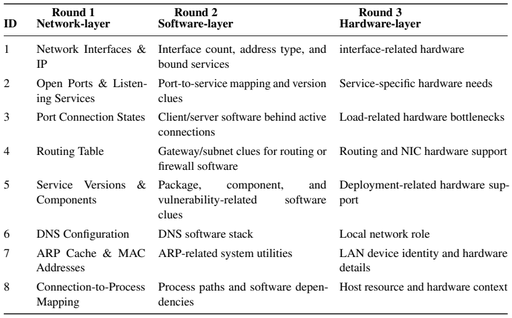
Table 5 : Eight reconnaissance categories and their three-round dependency chain.
원문 · CC BY 4.0 · Qianli Wang, Junchao Wu, Binkai Ou, Lidia S. Chao, Derek F. Wong · ReconPotBench: Evaluating LLM Honeypots in Multi-Round Linux Reconnaissance · 원문 그림 인용 · 원본 PDF 16쪽에서 그림 영역을 추출했습니다.범위와 남은 질문
이 벤치마크는 Linux 터미널 환경에서 단일 목표의 정찰 체인만 다룹니다. 교차 목표 정찰, 다른 운영체제와 셸 환경은 이번 연구에서 다루지 않았습니다. 또 모든 LLM은 같은 시스템 프롬프트에서 평가되었으므로, 결과는 이 공유된 설정에서의 성능을 보여 줄 뿐 다른 프롬프트나 상태 관리 구조에서의 최고 성능을 확정하지 않습니다. 이 논문은 호스트 상태를 명시적으로 저장하고 갱신하는 기준 구조를 함께 비교하지 않았습니다.
논문 정보
- 저자
- Qianli Wang, Junchao Wu, Binkai Ou, Lidia S. Chao, Derek F. Wong
- 학회·저널
- arXiv · 프리프린트
- 최초 공개일
- 2026년 11월 16일
- 등록일
- 2026년 11월 17일
- 수정일
- 2026년 11월 16일
- 버전
- v1
- arXiv
- 2611.20528
- 분류
- cs.CR · cs.CL
- 원문 이용 조건
- CC BY 4.0
- 제공 범위
- 논문 정보, 해설, 허용된 원문 그림
AI 해설은 논문 원문과 별개의 설명이며 오류가 있을 수 있습니다. 원문과 그림은 각 출처의 이용 조건과 따로 표시된 권리를 따릅니다.
초록
Large language models (LLMs) are increasingly used to build interactive honeypots, yet existing evaluations mainly assess isolated command outputs and cannot determine whether a system remains believable when later commands depend on earlier results. We present ReconPotBench, a multi-round benchmark for Linux reconnaissance honeypots. It contains 1{,}032 three-round reconnaissance interactions across eight reconnaissance categories, with reference outputs collected from a real Linux environment. Under a unified testing protocol, we compare Cowrie, open-source LLMs, and closed-source LLMs along three dimensions: round-level authenticity, cross-round contextual consistency, and hacker-oriented reconnaissance value. Results show that multi-round evaluation exposes failures hidden by single-round testing, as authenticity declines with interaction depth and both open-source and closed-source LLMs struggle to maintain coherent state across rounds. LLM-based honeypots nevertheless outperform Cowrie in authenticity and reconnaissance value, while Cowrie remains more consistent because of its rigid templated behavior. Category-level analysis further shows that tasks requiring systems to preserve network relationships across rounds are harder than tasks centered on explicit entities such as ports. ReconPotBench enables reproducible evaluation of LLM honeypots across authenticity, entity consistency, and hacker-perspective utility in dependent multi-round interactions. The dataset is available at: https://github.com/qianli-wang/ReconPotBench
원문 인용
Qianli Wang, Junchao Wu, Binkai Ou, Lidia S. Chao, Derek F. Wong (2026). ReconPotBench: Evaluating LLM Honeypots in Multi-Round Linux Reconnaissance. arXiv:2611.20528v1. https://arxiv.org/abs/2611.20528v1
BibTeX
@misc{wang2026reconpotbench,
  title = {{ReconPotBench: Evaluating LLM Honeypots in Multi-Round Linux Reconnaissance}},
  author = {Qianli Wang and Junchao Wu and Binkai Ou and Lidia S. Chao and Derek F. Wong},
  year = {2026},
  eprint = {2611.20528},
  archivePrefix = {arXiv},
  url = {https://arxiv.org/abs/2611.20528v1}
}