Paper commentary
Contrastive Activation-Guided Zeroth-Order Preference Optimisation for Memory-Efficient LLM Alignment
- Problem DPO still needs backpropagation, so its activation memory grows with sequence length, while isotropic zeroth-order updates for the DPO objective are noisy.
- Method Builds a per-layer low-rank subspace from the activation difference between chosen and rejected responses, samples zeroth-order perturbations only inside it, and keeps momentum in the coefficients of that basis.
- Results Against SFT, CA-ZODPO wins 34.6% and loses 28.6% under the Qwen2.5-32B-Instruct judge on 500 held-out prompts. At sequence length 2048 and batch size 4, its peak GPU memory is 11.08 GB against 26.94 GB for FO-DPO.
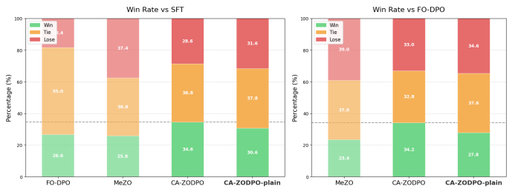
Figure 1 : Pairwise win/tie/loss rates judged by Qwen2.5-32B-Instruct. Left: comparisons against SFT. Right: comparisons against FO-DPO. CA-ZODPO achieves the best win-rate profile among zeroth-order methods and remains close to FO-DPO.
Original paper · CC BY 4.0 · Weiyun Huang, Alessio Galatolo · Contrastive Activation-Guided Zeroth-Order Preference Optimisation for Memory-Efficient LLM Alignment · Original paper figure · Extracted the figure area from page 4 of the original PDF.Memory cost of backpropagation in DPO
Zeroth-order optimisation avoids backpropagation by estimating update directions from forward evaluations only, and MeZO brings full-parameter fine-tuning memory close to the level of inference.
AGZO builds lower-dimensional perturbation subspaces from forward activations, but its application has been confined to classification tasks. Earlier zeroth-order preference work either depends on a reward model or targets general reinforcement learning rather than LLM alignment.
Using the preference pair to shape the search
CA-ZODPO gives the preference pair a second job beyond defining the loss. The same chosen and rejected responses also determine where the zeroth-order search looks. For each linear layer, the method compares the activations produced by the chosen response with those produced by the rejected one, and it extracts a low-rank basis from that contrast.
Perturbations are then sampled only inside that basis rather than across the full parameter space. The idea builds on AGZO's observation that a linear layer's gradient row space lies within the span of its input activations. CA-ZODPO refines this by working with the difference between the two responses. Parameters outside the linear layers keep the standard isotropic perturbation.
Building the contrastive basis per layer
The contrastive matrix keeps the difference between the mean chosen and mean rejected activations over the \(m\) token positions as one component, and places the token-wise differences alongside it. \[ H^{(l)}_{\Delta}=\mathrm{concat}\left(\mathrm{Mean}(H^{(l)}_{ch})-\mathrm{Mean}(H^{(l)}_{rej}),\;H^{(l)}_{ch}-H^{(l)}_{rej}\right) \] Power iteration approximates the leading rank-\(r_l\) subspace of this matrix in a few steps, producing an orthonormal basis \(A_l\) of size \(d_{in}\) by \(r_l\).
A Gaussian matrix \(R_l\) of size \(d_{out}\) by \(r_l\) is sampled, and the layer perturbation is \(R_l A_l^{\top}\) divided by \(\sqrt{r_l}\). \[ \Delta_l=\frac{R_l A_l^{\top}}{\sqrt{r_l}} \] The division by \(\sqrt{r_l}\) keeps the perturbation scale comparable across ranks. Once the basis exists, the activation matrices behind it are released before the perturbed loss evaluations run.
Updating weights with low-rank momentum
The DPO loss is the negative expectation of a log-sigmoid, scaled by \(\beta\), of the difference between two log ratios of the policy to the reference model, one for the preferred response and one for the rejected response. \[ \mathcal{L}_{\mathrm{DPO}}(\theta) = -\mathbb{E}\left[\log\sigma\left(\beta\log\frac{\pi_\theta(y_w\mid x)}{\pi_{\mathrm{ref}}(y_w\mid x)}-\beta\log\frac{\pi_\theta(y_l\mid x)}{\pi_{\mathrm{ref}}(y_l\mid x)}\right)\right] \] Instead of backpropagating through this loss, the method evaluates it at \(\theta+\epsilon\Delta\) and at \(\theta-\epsilon\Delta\), and forms the central estimate.
\[ g=\frac{\mathcal{L}_{\mathrm{DPO}}(\theta+\epsilon\Delta)-\mathcal{L}_{\mathrm{DPO}}(\theta-\epsilon\Delta)}{2\epsilon} \] The momentum buffer accumulates the scalar estimate \(g_t\) times the random coefficients \(R_t\) with weight \(1-\mu\). Because the basis can change between updates, the previous buffer is first re-expressed in the new basis by multiplying with \(A_{t-1}^{\top}A_t\).
The update reconstructs the weight change through the current basis. \[ N_t=\mu\,\tilde N_{t-1}+(1-\mu)\,g_t R_t,\qquad W_{t+1}=W_t-\eta_t\,\frac{N_t A_t^{\top}}{\sqrt{r}} \]
Experimental setup and judging protocol
Qwen2.5-1.5B is the base model. It is first supervised fine-tuned on chosen responses to give the SFT policy, which also serves as the fixed reference model. Anthropic HH-RLHF is the preference dataset. Four variants are compared: FO-DPO, MeZO applied to the DPO objective, CA-ZODPO, and CA-ZODPO-plain. Alignment is scored on 500 held-out prompts by Qwen2.5-32B-Instruct.
Each pair is judged in both presentation orders, and inconsistent decisions count as ties. Memory experiments run on a single 48 GB NVIDIA A40.
Alignment against SFT and FO-DPO
CA-ZODPO wins 34.6% and loses 28.6% against SFT under the same judge, a positive margin.
Against FO-DPO, MeZO shows a clear negative margin. CA-ZODPO wins 34.2% and loses 33.0%, which is close to balanced. Figure 1 shows the win, tie and loss rates for both comparisons, with SFT on the left and FO-DPO on the right. The authors read this as restricting perturbations to the contrastive activation subspace improving on isotropic perturbations and narrowing the gap to FO-DPO.
Whether the chosen–rejected difference matters
CA-ZODPO-plain builds its basis from the concatenated chosen and rejected activations, without taking their difference, and then applies the same extraction and perturbation procedure. Against SFT it wins 30.6% and loses 31.6%, while the full CA-ZODPO wins 34.6% and loses 28.6%. CA-ZODPO-plain still performs better than MeZO in both panels of Figure 1, so an activation subspace helps on its own.
Peak memory across sequence length
Figure 2 reports peak GPU memory on Qwen2.5-1.5B. The zeroth-order methods avoid the activation cache that grows with sequence length in FO-DPO. At batch size 4 and sequence length 2048, CA-ZODPO peaks at 11.08 GB, against 26.94 GB for FO-DPO. The abstract puts the peak memory reduction at about 59% at sequence length 2048.
Batch size under a fixed memory budget
CA-ZODPO uses 17.77 GB at batch size 16 and 29.35 GB at batch size 32 under the same sequence length.
The memory numbers show the headroom; the link to estimator noise is the authors' interpretation and is not measured in the batch-size experiment.
Limitations
Lower memory does not mean faster training, because CA-ZODPO uses three forward passes per update. The alignment rates are pairwise judgements, with inconsistent orderings counted as ties, so they describe standing against the chosen comparison model.
Paper info
- Authors
- Weiyun Huang, Alessio Galatolo
- Venue
- arXiv · Preprint
- First published
- 2026-11-16
- Added
- 2026-11-17
- Updated
- 2026-11-16
- Version
- v1
- arXiv
- 2611.20635
- Category
- cs.LG
- Original paper terms
- CC BY 4.0
- What we show
- Paper info, commentary and permitted figures from the original paper
AI commentary is a separate explanation from the original paper and may contain errors. The original paper and figures follow each source's terms of use and any rights noted separately.
Abstract
Direct Preference Optimisation (DPO) simplifies reinforcement learning from human feedback, but still relies on traditional backpropagation and its associated activation-memory cost. Zeroth-order (ZO) optimisation avoids backpropagation, yet isotropic perturbations can produce noisy updates for preference objectives defined by differences between chosen and rejected responses. We introduce Contrastive Activation-guided Zeroth-Order Direct Preference Optimisation (CA-ZODPO), which constructs a low-rank search subspace from the activation discrepancy between the chosen and rejected responses in each preference pair. Perturbations are restricted to this subspace, while momentum is maintained in low-rank coordinates to preserve the memory advantages of ZO training. On Qwen2.5-1.5B with Anthropic HH-RLHF, CA-ZODPO outperforms common ZO baselines and remains competitive with first-order DPO in pairwise preference evaluation. It also reduces peak GPU memory by about 59\% at a sequence length of 2048 while retaining the sequence-length scaling behaviour of zeroth-order training.
Quote from the paper
Weiyun Huang, Alessio Galatolo (2026). Contrastive Activation-Guided Zeroth-Order Preference Optimisation for Memory-Efficient LLM Alignment. arXiv:2611.20635v1. https://arxiv.org/abs/2611.20635v1
BibTeX
@misc{huang2026contrastive,
  title = {{Contrastive Activation-Guided Zeroth-Order Preference Optimisation for Memory-Efficient LLM Alignment}},
  author = {Weiyun Huang and Alessio Galatolo},
  year = {2026},
  eprint = {2611.20635},
  archivePrefix = {arXiv},
  url = {https://arxiv.org/abs/2611.20635v1}
}