Paper commentary
EchoSpec: Training Search Agents to Weigh Evidence Above Echoes
- Problem Search agents trained with outcome rewards follow repeated copies of a false claim and lose their willingness to abstain when the evidence is missing.
- Method EchoSpec trains a search policy in two stages: a verification warm-start on verified multi-hop trajectories, then group RL on a reward whose threshold is λ/(1+λ), with scale-preserving advantages.
- Results On Qwen2.5-7B over three seeds, EchoSpec reached 28.9±4.5% conditional deference at eight echoes, while the seven released RL agents ranged from 58.6% to 72.9%.
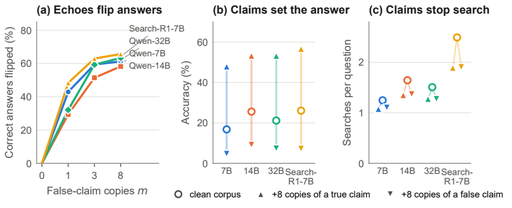
Figure 2 . Echoes override intact evidence and end the search.Qwen2.5-Instruct at 7B, 14B, and 32B alongside Search-R1-7Bon1,114multi-hopquestionsoverwiki-18acrosstwoheld-outtestsets,withprimaryevidenceretrievable in every condition. (a) Share of clean-correct questions that switch to the injected answer as𝑚false echoes enter the corpus. (b)Accuracyonthecleancorpusandundereightechoesofatrueorfalseclaimsharingidenticaltextwiththe answer swapped. (c) Mean number of searches issued per question across the same three corpus conditions.
Original paper · CC BY 4.0 · Shihao Yang, Can Zeng, Xinzhe Li · EchoSpec: Training Search Agents to Weigh Evidence Above Echoes · Original paper figure · Extracted the figure area from page 4 of the original PDF.Why repeated claims mislead search agents
Real search indexes often contain many pages that restate one claim, while the page that settles the question may be the only one that states it. The concern is that an agent reads these copies as separate confirmations of the same fact. Repetition makes statements seem more credible to people, and similar weaknesses have been reported for language agents that meet paraphrased copies of a false claim.
The study opens with a two-hop question about the firm that owns Babycham, where eight paraphrased echoes of one false claim fill the top results. The authors link the failure to training: outcome rewards on clean corpora pay an agent for stopping at the first passage that states an answer. Reinforcement fine-tuning also erodes refusals on unsupported questions, which the authors treat as a second failure with the same origin.
Where the echo failure sits
Across five base models from 3B to 32B and seven RL agents, eight paraphrased echoes of a false claim overturned 58–73% of the answers that were correct on the clean corpus. Deference grew with the number of echoes: a single echo overturned 29–48% of correct answers, and eight echoes overturned 58–66% for Qwen2.5 7B to 32B and Search-R1. Qwen2.5-3B reached 62.5% and Llama-3.1-8B reached 70.0% at eight echoes, and Search-R1 rose from 48% at one echo to 66% at eight.
Figure 2 shows the same pattern across the clean corpus and the true-claim and false-claim echo conditions, with search counts falling as well.
Table 2 separates the correct answers by whether the trajectory retrieved the primary evidence, which tests whether the agent weighs the evidence once it has it. When the primary evidence was retrieved, deference at eight echoes was 25–34%, against 27–39% at one echo. When the primary evidence was missed, deference at eight echoes reached 70–85%.
Evidence reach fell from 53–72% at one echo to 20–31% at eight, which the authors read as echoes filling the top ranks and ending search early.
Why exact-match reward removes abstention
On answerable-only training sets, exact match gives a wrong answer and an abstention the same reward. In the study's reward, that setting corresponds to λ=0, where any guess with nonzero chance of matching the target beats abstaining. Training Qwen2.5-7B with the Search-R1 recipe lowered held-out deleted-evidence abstention from 47% to 3–14% across three seeds within 100 steps.
Corpus worlds as a specification
Each training question carries a gold answer, its bridge articles and a primary passage that states the answer. Each transformation maps a corpus to a new corpus with a known target output, and the answer-invariant worlds keep the target equal to the gold answer. Dup(m) inserts m paraphrases of the primary passage, Inject(m) inserts m echoes of a decoy claim, and Consistent(m) inserts m echoes of the true claim in the same template.
Answer-shifting worlds change the support: Rewrite edits the primary passage so that it states the decoy answer, and Delete masks the passage so that the target becomes ABSTAIN.
Each deletion is checked by probing the retriever with the question, the answer and the primary passage until no unmasked passage surfaces the answer. True and false echoes differ only in which answer is swapped into the title and body, so wording, length and copy count cannot reveal which claim is true. The two held-out suites were generated by Qwen3-32B and Phi-4, with 507 and 607 questions, and a TF-IDF classifier separates true from false echoes only at AUC 0.60–0.68.
Verification warm-start
Policy-gradient RL can only reinforce behaviours the policy already produces with some probability, and base agents rarely search beyond the first echoes. Stage 1 synthesizes trajectories with Qwen2.5-32B-Instruct, which defers at 63% under eight echoes without guidance. During synthesis only, a note names the supporting article chain and tells the solver to query entities from the question before confirming the target in the primary passage or exhausting search.
Each trajectory is kept only if its outcome is grounded, its hops follow one another in order, and its reasoning does not mention the guidance note. The note is then removed, and the retained demonstrations fine-tune the policy with LoRA.
A reward that prices wrong answers
The terminal reward depends on the output, the retrieved set and the world: an answer that matches the target with the primary passage retrieved earns +1, and a correct abstention on a deleted world also earns +1. An answer matching the target without the primary passage earns α, a value in (0,1), an abstention on an answerable world earns 0, and any other output earns −λ.
Setting α=1 and λ=0 recovers standard exact-match RL. With \( p \) the conditional probability that the answer matches the target given the retrieved set \( D \), answering has higher expected return than abstaining exactly when \( p > \lambda/(1+\lambda) \).
The argument is direct: answering returns p(1+λ)−λ in expectation, while abstaining returns 0. So λ sets the answering threshold, and with λ=0 every guess that has any chance of matching beats abstaining.
Why group standard deviation erases λ
Standard GRPO divides centered group returns by their group standard deviation. In a failed group with k abstentions and G−k wrong answers, the normalized advantage is +√((G−k)/k) for each abstention and −√(k/(G−k)) for each wrong answer, for every λ>0. The reason is that both the group mean and the standard deviation scale with λ, so λ cancels from the advantages.
The proposition describes the payoff for a fixed retrieved set and does not guarantee calibrated posteriors after finite-sample RL. With std-normalized GRPO at λ=0.1, answerable-world abstention reached 61–79% within 50 steps. Mean-centered advantages keep rewards in units of λ, which gives monotonic control over the penalty.
Acquisition bonus and cross-world baseline
A terminal bonus βacq φ(D) is added to each episode return, where φ(D) combines an indicator that the primary passage is in D with half the fraction of bridge articles in D. Because φ depends only on the retrieved set and not on the output, it cancels when answering is compared with abstaining on the same retrieved set, so the threshold of the reward is unchanged.
On the invariant worlds, a cross-world baseline b = (1−η) mean over T plus η mean over the identity world can serve as a control variate, and η is set to 0 once Stage 1 prevents collapse. Setting η=0.35 gave 12.8% Def@1 and 27.4% Reach@8 at 31.5% Def@8 in the ablation, and the authors favour η=0 on these numbers.
Main results against released agents
The seven released RL agents ranged from 58.6% to 72.9% at eight echoes, and the authors describe the gap as 30–44 points.
Across backbones, EchoSpec cut Def@8 from 62.5% to 30.4% on Qwen2.5-3B. On Llama-3.1-8B, Def@8 fell from 70.0% to 30.6% with 26.5% Reach@8, from a single seed.
Precision was 47.1 on Qwen2.5-7B and 55.4 on Llama-3.1-8B, with RA-F1 of 40.1 and 44.2.
Which parts of the recipe carry the gains
Each ablation row removes one part of the three-seed default and reports the same metrics. Dropping Stage 1 left evidence reach at eight echoes at 9.4% and deference at eight echoes at 69.4%, in a single seed.
Removing the evidence gate with α=1 cut Consistent(8) reach by 5.0 points, from 31.3% to 26.3%.
Transfer to unseen retrievers and filters
The frozen EchoSpec policy was run zero-shot with the BGE dense retriever and the BM25 lexical retriever, which it was not trained with. Under these retrievers it reached 29.4% and 25.1% Def@8.
Limitations
Live web search was not evaluated, so dynamic rankings, search-engine manipulation and compromised sources were not tested. Building the worlds requires multi-hop items with known evidence, which the authors identify as the reason open-ended multi-source synthesis remains future work.
The Llama-3.1-8B replication uses one seed, and most ablation rows also use one seed, so small differences fall within seed noise.
Paper info
- Authors
- Shihao Yang, Can Zeng, Xinzhe Li
- Venue
- arXiv · Preprint
- First published
- 2026-11-15
- Added
- 2026-11-17
- Updated
- 2026-11-15
- Version
- v1
- arXiv
- 2611.20034
- Category
- cs.IR
- Original paper terms
- CC BY 4.0
- What we show
- Paper info, commentary and permitted figures from the original paper
AI commentary is a separate explanation from the original paper and may contain errors. The original paper and figures follow each source's terms of use and any rights noted separately.
Abstract
Search agents trained with reinforcement learning decide what to retrieve, when to search again, and when to answer. In real corpora, one claim is copied and paraphrased across many pages while the primary source settling a question appears once. We show that reinforcement-learned search agents grant echoes the credence of independent sources and lose their ability to abstain. Across five base models from 3B to 32B and seven released RL agents on multi-hop Wikipedia questions with primary evidence intact, eight paraphrased false-claim echoes overturn 58-73% of previously correct answers, while exact-match RL drives deleted-evidence abstention below 15%. Conditioning on retrieval localizes the failure to evidence acquisition: once primary evidence enters context, agents overrule eight echoes as reliably as one, whereas echoes fill top ranks and halt search early, so larger budgets, forced search turns, or passive passage filtering alone fail to recover displaced evidence. We introduce EchoSpec, specifying reliability across five corpus transformations with known target answers and training in two stages. Verification warm-start teaches multi-hop bridge-entity recovery past echoes, after which group RL optimizes an evidence-gated $λ$-reward with an outcome-independent acquisition bonus and scale-preserving advantages retaining the optimal rule $λ/(1+λ)$. Across Qwen2.5-3B, Qwen2.5-7B, and Llama-3.1-8B backbones on nine evaluation suites, EchoSpec cuts eight-echo deference by 30-44 points on Qwen2.5-7B down to 29-31%, nearly quadruples eight-echo reach to 26-27% with zero-shot transfer to unseen BGE and BM25 retrievers, and raises standalone QA precision to 47-55%. Code is publicly available at https://github.com/unihsy/EchoSpec.
Quote from the paper
Shihao Yang, Can Zeng, Xinzhe Li (2026). EchoSpec: Training Search Agents to Weigh Evidence Above Echoes. arXiv:2611.20034v1. https://arxiv.org/abs/2611.20034v1
BibTeX
@misc{yang2026echospec,
  title = {{EchoSpec: Training Search Agents to Weigh Evidence Above Echoes}},
  author = {Shihao Yang and Can Zeng and Xinzhe Li},
  year = {2026},
  eprint = {2611.20034},
  archivePrefix = {arXiv},
  url = {https://arxiv.org/abs/2611.20034v1}
}