Paper commentary
CLEAR: Legible and Steerable Recommendation via Grounded Natural-Language Interests
- Problem Recommenders keep their learned preferences in latent form, so people cannot inspect them, and item-level reactions do not show what durable preference was inferred or whether a correction lasted.
- Method The same normalized interest identity then drives retrieval, ranking, attribution and exposure control.
- Results Direct review rated about 88.5% of 7,261 displayed interests from 393 users as accurate. In the five-arm ablation, removing interest-conditioned candidate sourcing cost 13.7 pp of same-day delivery in the tested removal order.
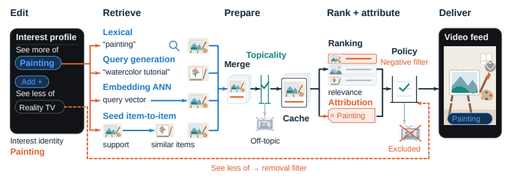
Figure 2 Grounding gives one editable interest four retrieval addresses and a stable serving identity.The display label becomes a lexical query, profile-conditioned rewrites expand that query, inferred interests retain behavioral support for trigger-to-item retrieval, the interest projection becomes an embedding query, and the user–interest identity can condition generative retrieval and cached supply. Candidates merge, pass a hard topicality gate, and enter ranking. Attribution preserves the same interest identity for delivery control; explicit negative state remains in the policy path.
Original paper · CC BY 4.0 · Extracted the figure area from page 5 of the original PDF.Why interests need to be readable and editable
Recommenders keep much of what they learn about a person in latent form. Item-level reactions can shift later predictions, yet they say nothing about which durable preference was inferred or whether a correction survived later updates.
The design asks for two linked properties in one control surface. Legibility means a person can read the inferred state in plain language and judge whether it fits them. Steerability means an accepted edit becomes lasting preference state that serving consumes, and that deliberate changes to serving measurably alter later delivery. Keeping the two apart matters because seeing an inferred interest does not show that the recommender acts on it.
One interest identity for reading and writing
CLEAR runs a read path and a write path through the same identity.
Each served record binds one normalized identity to its source, any supporting evidence, a query projection, shared annotations and preference state. Accepted user preferences persist across inference refreshes.
Profile construction runs asynchronously over a bounded slice of recent activity. Topical coverage guides which history is selected, and related events are grouped before the language model sees them.
New candidates merge into the prior inferred profile, while explicit additions and suppressions stay outside that merge. This keeps later inference from quietly reversing a correction the user made. Membership, support events and explicit preference state remain specific to each user.
Grounding inferred interests in the user's history
An inferred phrase is only useful if it can be tied back to what the user actually did. CLEAR projects the phrase into the recommender's co-engagement space and runs a reverse lookup over that user's own history. A content-understanding channel and a media channel trained on co-engagement each retrieve candidate events, and their deduplicated union is the support set.
The support set does three jobs on the profile side. Its size filters out candidates with too little evidence, and its overlap flags near-duplicate phrases that the same events support. Event actions and recency supply an ordering signal. Grounding therefore checks behavioral support, while whether the person endorses the description is tested separately by direct review.
A user declaration follows a different path. A fresh addition can come before any matching history, so it does not have to meet the support requirement that inferred candidates face. Responses to it later enter ordinary history and can support later inference, which keeps a cold-start declaration from being read as evidence about past behavior.
The grounded interest serves the recommendation cascade as an address in four ways. The stable user-interest identity keys cached supply, attribution and exposure accounting.
Behavioral retrieval requires a candidate to satisfy two conditions together. It must lie near the user's support events, and it must match the interest under content-understanding features. Either signal alone would admit a globally on-topic item outside the user's behavioral neighborhood, or a nearby item that is off topic. The lexical and embedding paths supply a new declaration first, and the support-set path refines that supply once behavioral evidence exists.
From an edit to ranked, attributed delivery
Four interest-conditioned retrieval mechanisms emit tagged candidates: lexical, trigger-to-item, embedding and generative retrieval. The candidates merge with the ordinary pool before ranking, so the supply changes which items can compete rather than only reordering a fixed set.
Ranking helps a new interest in two ways. Early- and late-stage ranking apply temporary terms conditioned on the declaration, so new candidates can compete before enough behavior has accumulated.
Retrieval applies that score as a hard topicality gate, while ranking uses it softly. The same scorer attributes ordinary candidates, so source identity, which says where a candidate came from, is kept separate from topical attribution, which says which interest it matches.
Naively boosting every topical match can flood one topic, so the controller separates topical relevance from how much exposure a user-interest pair has already received. Attribution runs before the controller, so exposure includes both ordinary and dedicated-source matches. Fireball keeps a decayed real-time counter of realized per-interest exposure (RPE), and high exposure damps further promotion.
The controller never writes model parameters.
Delivered items and user responses flow into ordinary learning, which may later improve organic supply. The authors describe the cycle as import, teach, harvest and re-teach: a fresh declaration first imports topical candidates, user responses supply behavioral signal, and organic candidates attributed to the same interest eventually reduce reliance on imports.
How accurate the displayed interests are
Direct review asked users to rate the displayed interests. Across 7,261 displayed interests from 393 users, about 88.5% were rated accurate. This measures the shipped display, so it reflects readability and fit to the user rather than the generator alone.
Rejections were sorted by reason to separate exposure from endorsement.
The offline generator benchmark gives the Specialized 3B generator, Gemini 2.5 Pro and the prior production generator the same history format, the same user-validated reference and the same semantic judge. F1@10, P@10 and R@10 score the first ten emitted interests, while F1@all scores the complete generated profile. Generation is scored before behavioral grounding and display selection.
The Specialized 3B generator reached 0.3967 mean-user F1@10, above 0.3633 for Gemini 2.5 Pro and 0.1911 for the prior production generator. On P@10 it reached 0.8067, against 0.7982 for Gemini 2.5 Pro. Gemini 2.5 Pro had the higher whole-profile F1@all, at 0.7051 against 0.5493 for the Specialized 3B generator. The specialized model's advantage in these results lies in the top-ten metrics, which match the objective it was trained for.
Grounding threshold and event-level support
The minimum support threshold is the main control over grounding strictness.
Figure 3 plots judged support precision against history-event coverage.
Support precision is the fraction of event-interest matches judged relevant, and coverage is the fraction of a user's history matched to at least one interest.
Vital and Reasonable both count as supported in this evaluation. On 137 human-labelled event-interest pairs, the grounding-judge variants agreed with human labels at 93 to 98%, with Cohen's κ of 0.86 to 0.95.
Production steerability and reception
Across these measures, same-day responsiveness reached 79.6%.
Topicality is judged by an independent multimodal judge that watches the video content rather than captions or metadata. It reached 87.2% on-topic across impressions sampled twice weekly, approximately 10,500 impressions drawn from about 8,000 video-interest pairs per run.
Among viewers holding at least one declared interest, attributed recommendations were liked at 11.55%, against 9.90% for other recommendations, a difference of 1.65 percentage points.
The authors read the same-surface and cross-surface comparisons as descriptive cohort-level differences, with mixed overall reception.
Which serving layers carry a positive edit
The stack ablation removes serving layers cumulatively from the production configuration, one arm at a time. The tested order is added-interest ranking boosts, then forced top-slot insertion, then negative filtering and suppression, then interest-conditioned candidate sourcing. Each consecutive difference gives the marginal delivery loss at that step, and the outer arm compares all layers removed with the production control.
The endpoint is same-day attributed matching delivery.
Enabling the full stack added 33.5 percentage points over that baseline. In the tested order, the marginal losses were 13.7 pp for interest-conditioned candidate sourcing, 11.1 pp for forced top-slot insertion and 8.7 pp for added-interest ranking boosts.
These per-layer losses describe one nested removal order and are not an order-free attribution. The authors report that no single layer dominates the effect, and all three delivery layers contribute materially in the tested order.
Suppression, replenishment and volume control
Similarity-aware demotion extends the production filter to ordinary recommendations. Compared with the filter alone, it reduced same-day reappearance of suppressed interests by 11.8%, and lower reappearance is the better outcome.
Replenishment compared dynamic topic selection with the prior age-limited sourcing policy.
Volume regulation compared real-time per-interest accounting with recalibrated volume dampening against prior daily accounting in a six-day user-randomized study. The recorded flooding-days metric fell by 15.4%, with an interval of 13.4% to 17.4%, and lower is better for this metric.
Deployment cost and incremental updates
CLEAR components have run in production for more than one year, across four surfaces on two platforms, Instagram and Facebook. History compression reduced prompt tokens by 39.5%. History budgeting reduced estimated accelerator need by 38.9%, and shared annotation removed approximately 98% of logical annotation requests.
The incremental-inference capacity estimate needs 35% fewer accelerators than the preceding history-budget configuration.
A separate historical maximum-history input benchmark puts Gemini 2.5 Pro at about 216 times the normalized model-inference cost of its 3B reference. The updated annotation pipeline raised throughput per accelerator by 145.5%.
Limitations
The per-layer ablation losses hold only for the tested nested removal order. The control arm uses a slightly narrower endpoint than the same-day responsiveness in Table 1, so the ablation values approximate that measure rather than reproduce it.
The calibration set for the topicality judge oversamples edge cases and is therefore not representative of production.
Stricter grounding lowers reference recall, which reached 28.7% at the three-event threshold. On whole-profile F1@all the Specialized 3B generator trails Gemini 2.5 Pro, at 0.5493 against 0.7051. The cohort reception comparisons are descriptive, and the authors label their pattern mixed.
Direct review is a descriptive user judgment over displayed interests. The topicality judge was validated on a human-labelled golden set of 137 item-interest pairs, and its agreement figures come from that set.
Paper info
- Authors
- Qi Guo, Reza Mirghaderi, Iordanis Fostiropoulos, David Fan, Yuchen Liu, Shiliang Tang, Lukasz Korycki, Golnaz Ghasemiesfeh, Xinzhu Bei, Sasha Vorontsov, Hanchao Yu, Brendan Quinlivan, Khoi Pham, Jigar Gada, Hao Yu, Felix Li, Hang Gao, Boyu Fang, Yang Gao, Yale Thomas, Xiaomeng Jin, Avishek Dutta, Hong Hong, Janet Xia, Ethan Zhu, Ellie Pan, Xiang Shen, Jawwad Zakaria, Jinfeng Lin, Jonathan Rush, Ruixue Lian, Noah Kennedy, Brian Vanover, Jas Pyneni, Daniel Thiyagu, Apoorv Saxena, Sanyogeeta Lawande, Huayu Ding, Hima Cherukuru, Yang Liu, Chen Kovacs, Qunshu Zhang, Lizhu Zhang, Benyu Zhang, Kate Chen, Ashish Singal, Danny Kanoff, Zhiyu Liu, Jiayi Liu, Jianyu Wang, Fei Liu, Xiangjun Fan, Abhishek Kumar, Hong Yan
- Venue
- arXiv · Preprint
- First published
- 2026-11-14
- Added
- 2026-11-17
- Updated
- 2026-11-14
- Version
- v1
- arXiv
- 2611.19110
- Category
- cs.AI · cs.IR
- Original paper terms
- CC BY 4.0
- What we show
- Paper info, commentary and permitted figures from the original paper
AI commentary is a separate explanation from the original paper and may contain errors. The original paper and figures follow each source's terms of use and any rights noted separately.
Abstract
Modern recommenders keep learned preferences in representations people cannot inspect or change. We present CLEAR (Controllable and Legible End-to-end Architecture for Recommendation), an end-to-end system deployed at Meta and built around an editable natural-language interest layer. CLEAR makes a ranked subset of inferred interests readable and stores accepted additions and suppressions as authoritative preference state. Behavioral grounding maps each inferred interest back to supporting events in the user's own history. The resulting interest object is also a serving address: its label and profile-conditioned rewrites drive lexical retrieval, its supporting events seed behavioral retrieval, its projection queries an embedding index, and its stable identity supports ranking, attribution, and exposure control. A fresh user declaration may precede behavioral support, so it enters through the same serving identity and initially draws candidates from topical retrieval. Ranking makes those candidates competitive, while a delivery controller observes attributable exposure and replenishes underexposed interests. Direct user review found that users rated about 88.5% of displayed interests accurate. In an offline benchmark using a shared evaluation protocol, the Specialized 3B generator reached 0.3967 mean-user F1@10, compared with 0.3633 for Gemini 2.5 Pro and 0.1911 for the prior generator. For a newly declared interest, a user-randomized cumulative ablation measured same-day delivery losses of 8.7 percentage points for added-interest ranking terms, 11.1 for reserved top-slot insertion, and 13.7 for interest-conditioned candidate sourcing, conditional on the tested removal sequence. CLEAR components have operated in production for over one year; the system spans four surfaces on Instagram and Facebook, with an interest layer people can inspect, correct, and use to direct recommendations.
Quote from the paper
Qi Guo, Reza Mirghaderi, Iordanis Fostiropoulos, David Fan, Yuchen Liu, Shiliang Tang, Lukasz Korycki, Golnaz Ghasemiesfeh, Xinzhu Bei, Sasha Vorontsov, Hanchao Yu, Brendan Quinlivan, Khoi Pham, Jigar Gada, Hao Yu, Felix Li, Hang Gao, Boyu Fang, Yang Gao, Yale Thomas et al. (2026). CLEAR: Legible and Steerable Recommendation via Grounded Natural-Language Interests. arXiv:2611.19110v1. https://arxiv.org/abs/2611.19110v1
BibTeX
@misc{guo2026clear,
  title = {{CLEAR: Legible and Steerable Recommendation via Grounded Natural-Language Interests}},
  author = {Qi Guo and Reza Mirghaderi and Iordanis Fostiropoulos and David Fan and Yuchen Liu and Shiliang Tang and Lukasz Korycki and Golnaz Ghasemiesfeh and Xinzhu Bei and Sasha Vorontsov and Hanchao Yu and Brendan Quinlivan and Khoi Pham and Jigar Gada and Hao Yu and Felix Li and Hang Gao and Boyu Fang and Yang Gao and Yale Thomas and Xiaomeng Jin and Avishek Dutta and Hong Hong and Janet Xia and Ethan Zhu and Ellie Pan and Xiang Shen and Jawwad Zakaria and Jinfeng Lin and Jonathan Rush and Ruixue Lian and Noah Kennedy and Brian Vanover and Jas Pyneni and Daniel Thiyagu and Apoorv Saxena and Sanyogeeta Lawande and Huayu Ding and Hima Cherukuru and Yang Liu and Chen Kovacs and Qunshu Zhang and Lizhu Zhang and Benyu Zhang and Kate Chen and Ashish Singal and Danny Kanoff and Zhiyu Liu and Jiayi Liu and Jianyu Wang and Fei Liu and Xiangjun Fan and Abhishek Kumar and Hong Yan},
  year = {2026},
  eprint = {2611.19110},
  archivePrefix = {arXiv},
  url = {https://arxiv.org/abs/2611.19110v1}
}