Paper commentary
StreamEmbed: Real-Time Indexing from Pixels for Screenshot Retrieval
- Problem Re-encoding every screenshot with a vision-language embedding model takes 2.33 s on an M2 Pro GPU, which makes continuous pixel-based indexing of a screen history costly.
- Method STREAMEMBED skips blocks that repeat a neighbor, recomputes only changed blocks with cached keys and values, and uses a LoRA consistency adapter, merged into the weights, to keep pruned embeddings close to full-screenshot embeddings.
- Results STREAMEMBED on Qwen3-VL-2B encodes up to 3.7 times faster than the full-screenshot index on an M2 Pro GPU, and stays within 1.3 R@10 of that index across the three SME histories.
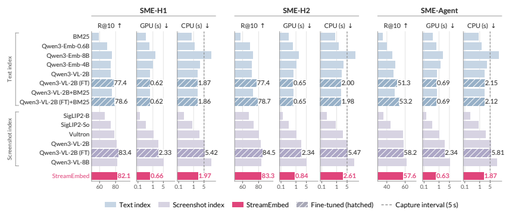
Figure 4 . Main results.STREAMEMBEDapproaches the accuracy of a screenshot index at close to the latency of a text index. Recall@10 and mean indexing latency per screenshot on the GPU and CPU of an M2 Pro (§6.1), latency on a log scale. Text indexes use Apple Vision OCR on the GPU and RapidOCR on the CPU, since Apple Vision OCR runs on the Neural Engine. OCR latency is almost equal to the BM25 latency, since BM25 adds under 0.1 ms.
Original paper · CC BY 4.0 · Dayoon Ko, Yichuan Wang, Soyeong Jeong, Joseph E. Gonzalez, Gunhee Kim, Sewon Min · StreamEmbed: Real-Time Indexing from Pixels for Screenshot Retrieval · Original paper figure · Extracted the figure area from page 7 of the original PDF.Why per-screenshot encoding is the bottleneck
A screen history is useful as searchable memory only if each screenshot is indexed while the user is still working, because a corpus built offline does not fit a stream that keeps growing. Indexing must also stay on the device, since the captured content is private and the laptop is used for other work during the same period.
OCR text is cheap to produce, but it loses what only the pixels carry, such as layout and which option is selected. Encoding the screenshot itself keeps that visual information, yet the screenshot index takes 2.33 s per screenshot on an M2 Pro GPU, against 0.31 s to encode the OCR text in the text index.
Encoding dominates the cost: the screenshot index takes 7.5 times as long as encoding the OCR text, and 3.6 times the total latency of the text index with OCR included. A screenshot index repeats this full cost for every new screenshot, because it encodes each one from scratch.
Where the redundancy in screen streams comes from
Within one screenshot, backgrounds, margins and blank panels cover large areas, so neighboring blocks often match.
For natural video the same share is 6-19%, so an encoder that treats every screenshot as new spends most of its work on tokens that did not need fresh computation. This points to two separate savings: skipping blocks that repeat a neighbor, and reusing the work done for blocks unchanged since the previous screenshot.
Dropping repeated blocks before the vision encoder
Because pruning runs ahead of the vision encoder, a dropped block enters neither the vision encoder nor the language model.
Each block is compared with its left neighbor and its upper neighbor, using the largest absolute difference over the RGB channels. A block is dropped when it repeats either neighbor within τ, which is 8 of 255 levels, and kept otherwise, so the kept set is \(P_t = \{ i : \|b_{t,i} - b_{t,\ell(i)}\|_\infty > \tau \text{ and } \|b_{t,i} - b_{t,u(i)}\|_\infty > \tau \}\).
Kept blocks keep their original position embeddings, so each token still records where its block sits on screen.
Grid keep adds one block from each uniform region in every 3×3 tile, so the kept set becomes \(K_t = P_t \cup G_t\). Each block is judged against its neighbors in the original screenshot, so the decisions are independent and can run in parallel, whereas the raster-order scheme of Wang et al. (2026a) makes each decision depend on earlier ones.
Recomputing only changed blocks across screenshots
Reuse is exact only when every token that a reused token attends to is also unchanged; otherwise it becomes an approximation, and a periodic refresh limits the error. A block is recomputed when it has no cache entry or when \(\|b_{t,i} - \hat b_i\|_\infty > \delta\), giving \(C_t = \{ i \in K_t : \hat b_i \text{ does not exist or } \|b_{t,i} - \hat b_i\|_\infty > \delta \}\) with \(\delta = \tau\).
Comparing against the cached version keeps every reused block within δ of that version, even when a block drifts slowly over many screenshots.
In every ViT layer, queries, keys and values are recomputed for the blocks in \(C_t\) and their cache is updated, while the other kept blocks take keys and values from the cache.
In the language model, the changed visual tokens and the fixed suffix are recomputed in every layer, and the suffix is always recomputed because its last token gives the embedding.
A refresh re-encodes all kept blocks when \(|C_t| > \rho |K_t|\) or \(t - t_r \geq R\), with \(\rho = 0.9\) and \(R = 10\). The first condition fires on a new screen, where recomputing only a few blocks saves little, and the second caps how far reused keys and values can drift.
A consistency adapter for pruned and reused inputs
The embedding model is first fine-tuned with LoRA on the training split of SCREENMEMEVAL, and that model embeds questions. This adapter is trained by distillation: the fine-tuned model acts as the teacher on full screenshots, and the adapter is the student on pruned inputs.
The loss has three terms: one minus the cosine similarity between the student embedding of the pruned screenshot and the teacher embedding of the full screenshot, a KL term between the teacher and student softmax distributions over a question's candidate screenshots, and a Margin-MSE term on a relevant screenshot and a hard negative. The formula is \[ \mathcal{L} = 1 - \cos\big(E_S(\tilde s), E_T(s)\big) + \mathrm{KL}\big(p_T \,\|\, p_S\big) + \mathcal{L}_{\text{margin}} \] where \(p_T\) and \(p_S\) are the teacher and student distributions.
The three terms match the teacher's embedding, its ranking over candidates, and its score gap on hard pairs, following multi-objective distillation.
Once merged into the screenshot encoder's weights, the adapter adds no computation, and the latency numbers reported later already reflect this.
Building SCREENMEMEVAL
Existing resources each lack one required part: a screenshot history, questions about the past, or relevance labels with public data.
SCREENMEMEVAL has three histories: SME-H1 with 117 days and 88 hours of screen time, SME-H2 with 57 days and 18 hours, and SME-Agent with 43 days and 78 hours. The two human histories come from a public dataset of computer-use recordings on Windows, and Table 2 gives recording, screenshot, and question counts for each history. SME-Agent records GPT-6.1 Sol performing the 184 tasks of myPCBench on Ubuntu; an LLM splits these tasks into 787 sub-tasks, and each sub-task becomes one recording on a 43-day calendar.
Single-recording questions ask where, when, what, how or which value, and are phrased in the first person. A generator writes them from per-recording annotations without seeing screenshots or OCR text, and a judge removes any question whose answer differs across similar recordings. Multi-recording questions count events, compare two values, order two events, or compare two durations, and their answers are computed from single-recording annotations or verified answers.
Relevance is labeled per task recording, and retrieval is scored with \[ \mathrm{Recall@}k(q) = \frac{1}{n}\left|\{ m : S^{+}_m(q) \cap T_k(q) \neq \emptyset \}\right| \] so that the score is the share of a question's n relevant recordings that have at least one screenshot in the top k.
Training uses 1,000 questions about the earliest recordings of SME-H1, and checkpoints and settings are chosen on 315 questions about the next 79 recordings. The benchmark has 10,426 test questions, with 1,315 questions for training and validation in addition.
Comparison conditions
A text index runs Apple Vision OCR for GPU timing and RapidOCR for CPU timing, then ranks the text with BM25 or embeds it with the Qwen3-Emb models or Qwen3-VL-2B. Reciprocal rank fusion combines the Qwen3-VL-2B ranking with the BM25 ranking. A screenshot index embeds the full image with SigLIP2-B, SigLIP2-So400m, VultronRetriever-Flash, or Qwen3-VL-2B or -8B, and Qwen3-VL-2B is used both as base and as LoRA fine-tuned.
The released Qwen3-VL baselines use a Conv3d patch embedding, while STREAMEMBED uses an equivalent linear patch embedding.
It is measured over the first 50 consecutive screenshots of 30, 30 and 20 recordings from SME-H1, SME-H2 and SME-Agent, or over all screenshots when there are fewer.
Accuracy against latency on the three histories
Against the screenshot index on Qwen3-VL-2B, STREAMEMBED runs 2.8 to 3.7 times faster on the GPU and stays within 1.3 R@10 of it across the three histories. The fine-tuned Qwen3-VL-2B screenshot index scores 83.4, 84.5 and 58.2 R@10 on SME-H1, SME-H2 and SME-Agent, while STREAMEMBED scores 82.1, 83.3 and 57.6, which are 1.3, 1.2 and 0.6 points lower.
On the GPU the screenshot index takes 2.33 to 2.34 s per screenshot, while STREAMEMBED takes 0.66 s, 0.84 s and 0.63 s on SME-H1, SME-H2 and SME-Agent.
Only Qwen3-VL-8B is clearly more accurate, on SME-Agent, and it takes about eight times the latency.
On the GPU, STREAMEMBED takes 0.66 s on SME-H1 against 0.62 s for the text index, and 0.63 s on SME-Agent against 0.69 s, but on SME-H2 it takes 0.84 s against 0.65 s. The 0.84 s on SME-H2 still fits within a 1 s capture interval, which the screenshot index at 2.34 s does not.
On the CPU, STREAMEMBED takes 1.87 to 2.61 s, close to the text index at 1.86 to 2.12 s, while the fine-tuned screenshot index takes 5.42 to 5.81 s, longer than a 5 s capture interval.
Lower resolution and smaller encoders
The gain is largest at low latency, where the baseline has to fall back to a small input.
At 0.19 s on SME-H1, Qwen3-VL-2B with STREAMEMBED at 480×270 reaches 75.3 R@10, against 65.0 R@10 for the full screenshot at 320×180. Near 0.7 s the gap narrows, yet STREAMEMBED on Qwen3-VL-2B still scores 2.7 R@10 above Qwen3-VL-8B at 480×270 while running faster. Lower resolution and smaller encoders also apply to STREAMEMBED, so most points on its frontier pair STREAMEMBED with a lower resolution.
Keeping a multi-year index in laptop memory
Flat is exact search, IVF and HNSW are approximate indexes, and PQ and 1-bit codes stay in RAM while their top 1,000 candidates are re-ranked with fp16 embeddings on disk.
The index cost that matters is therefore encoding, which is the cost STREAMEMBED reduces.
Contribution of each component
On SME-H1, the fine-tuned Qwen3-VL-2B screenshot index runs at 2.33 s on the GPU and 5.42 s on the CPU with 83.4 R@10. Switching to the linear patch embedding lowers GPU latency to 1.65 s and leaves R@10 at 83.4, and adding spatial pruning brings GPU latency to 1.00 s with 82.8 R@10. Temporal reuse then reaches 0.66 s and 81.8 R@10 on SME-H1, and the consistency adapter raises R@10 to 82.1 at the same latency.
Removing grid keep from spatial pruning gives 0.84 s and 55.2 R@10 on SME-Agent, against 1.00 s and 57.1 R@10 with grid keep. The pattern across the three histories is that each pruning or reuse step lowers accuracy slightly while cutting latency, and the adapter recovers accuracy at no latency cost.
Spatial pruning and temporal reuse each speed up encoding by about 1.5 times at a cost of about 1 R@10 point, and together they give 2.0 to 2.6 times, as the authors summarize. Overall the encoder runs 2.8 to 3.7 times faster than the released model, and the pruning and change detection overhead is about 0.01 s per screenshot.
Pruning every redundant block costs far more accuracy on SME-Agent than on the human histories, which suggests that dropping every redundant block shifts the embedding. Grid keep recovers most of that loss for about 0.15 s per screenshot, and the consistency adapter recovers more at no latency cost.
Applying STREAMEMBED to other encoders
Table 5 applies STREAMEMBED with the same thresholds to four encoders besides Qwen3-VL-2B, each fine-tuned with LoRA on SME-H1 and compared with its own full-screenshot version. On SME-H1, SigLIP2-So drops from 77.5 to 76.3 R@10 while its GPU latency falls from 0.34 s to 0.19 s, and Vultron moves from 78.9 to 77.8 R@10 with GPU latency from 1.05 s to 0.71 s.
Qwen3-VL-8B moves from 84.0 to 83.0 R@10 on SME-H1, with GPU latency from 5.15 s to 1.59 s.
The speedup depends on the computation that reuse can skip: on the GPU it is 2.5 to 3.7 times for the Qwen3-VL encoders, where temporal reuse also covers the language model.
Limitations
All latency numbers come from one Apple M2 Pro, each averaged over up to 50 consecutive screenshots of the sampled recordings.
Reuse is an approximation in both networks, and the refresh rule only bounds how far reused keys and values drift. The years-of-screenshots memory figures come from a simulation that adds Gaussian noise to real embeddings, not from a year-long recorded history.
The released Qwen3-VL-2B baseline uses a Conv3d patch embedding, while STREAMEMBED uses a linear patch embedding that the paper calls equivalent, so comparisons depend on that replacement. Learning what to recompute from the stream itself is left to future work.
Where this sits among related work
Streaming VLMs keep arriving frames in context to answer questions at any time, so their main concern is what to keep, whereas this index stores one embedding per screenshot for later queries.
Work on growing indexes rarely treats per-item encoding as the bottleneck, and it usually encodes less or defers encoding through cheaper models, fewer frames, early exit, smaller encoders or lower resolution. Systems that build screen histories on the device either process only some screenshots or represent screenshots as text, while this index keeps every screenshot as a pixel embedding.
Paper info
- Authors
- Dayoon Ko, Yichuan Wang, Soyeong Jeong, Joseph E. Gonzalez, Gunhee Kim, Sewon Min
- Venue
- arXiv · Preprint
- First published
- 2026-11-13
- Added
- 2026-11-16
- Updated
- 2026-11-13
- Version
- v1
- arXiv
- 2611.18516
- Category
- cs.CV · cs.IR · cs.LG
- Original paper terms
- CC BY 4.0
- What we show
- Paper info, commentary and permitted figures from the original paper
AI commentary is a separate explanation from the original paper and may contain errors. The original paper and figures follow each source's terms of use and any rights noted separately.
Abstract
Screen history can serve as searchable visual memory for people and agents, but unlike an offline corpus, it must be encoded and indexed as each screenshot arrives. OCR-based indexing is fast but loses visual information; visual encoding takes over two seconds. Yet screens change incrementally: most pixels repeat within and across screenshots. This raises a question: do visual encoders need to recompute their representations from scratch for every new screenshot? We present StreamEmbed, a system for incremental visual embedding that exploits this redundancy. Guided solely by pixel differences, it combines spatial token pruning, which skips blocks that repeat a neighbor, with temporal KV reuse, which reuses cached keys and values for blocks unchanged across screenshots. A small learned adapter compensates for pruning and reuse to preserve fidelity to full-screenshot embeddings. On ScreenMemEval, our benchmark of 10,426 questions over 184 hours of screen histories from two humans and a computer-use agent, StreamEmbed sets a new accuracy-latency Pareto frontier on an M2 Pro GPU: it encodes up to 3.7x faster than full-screenshot encoding without sacrificing accuracy and improves accuracy over OCR-based indexing by up to 6.3 Recall@10 points at matched latency. A memory-efficient vector index stores a simulated year of screenshots in 0.13 GB of RAM. Together, these results make real-time indexing of screen history in its native visual form practical, laying a foundation for fully local visual assistants.
Quote from the paper
Dayoon Ko, Yichuan Wang, Soyeong Jeong, Joseph E. Gonzalez, Gunhee Kim, Sewon Min (2026). StreamEmbed: Real-Time Indexing from Pixels for Screenshot Retrieval. arXiv:2611.18516v1. https://arxiv.org/abs/2611.18516v1
BibTeX
@misc{ko2026streamembed,
  title = {{StreamEmbed: Real-Time Indexing from Pixels for Screenshot Retrieval}},
  author = {Dayoon Ko and Yichuan Wang and Soyeong Jeong and Joseph E. Gonzalez and Gunhee Kim and Sewon Min},
  year = {2026},
  eprint = {2611.18516},
  archivePrefix = {arXiv},
  url = {https://arxiv.org/abs/2611.18516v1}
}