Paper commentary
MMFlash: Faster Speculative Decoding for Vision-Language Models
- Problem DFlash-style block drafters for vision-language models lose draft acceptance on tokens whose next-token prediction depends on the image, and training on multimodal data does not close that gap.
- Method Reweights the DFlash block cross-entropy by each token's visual dependence, scaled by the target's entropy and by the drafter's own miss probability, and adds a fixed sparse attention pattern for long video contexts.
- Results Reached an average greedy speedup of 3.00× on seven image benchmarks with Qwen3.5-4B, against 2.72× for DFlash trained on the same data.
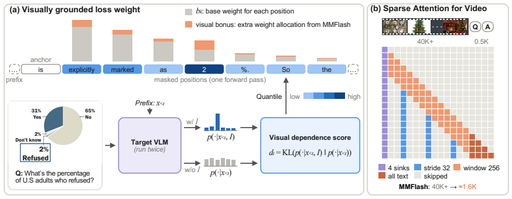
Figure 2 . Overview of MMFlash. (a) The target VLM is run twice on the same prefixx <t, with and without the imageI, and the visual dependence scored t is the KL divergence between the two next-token distributions. Each masked position of a block keeps its base weight bk and gains a visual bonus that depends ondt. (b) The MMFlash drafter adopts a simple sparse attention pattern for video inputs, shrinking a context of more than 40K tokens to about 1.6K.
Original paper · CC BY 4.0 · Sicheng Feng, Zigeng Chen, Song Wang, Gongfan Fang, Xinchao Wang · MMFlash: Faster Speculative Decoding for Vision-Language Models · Original paper figure · Extracted the figure area from page 2 of the original PDF.Where DFlash loses acceptance on image-dependent tokens
Speculative decoding lets a small drafter propose tokens that the target model checks in parallel, and a drafted token survives only when it matches the target's own choice. DFlash fills a whole draft block in one forward pass: the first slot holds an anchor token taken from the preceding verification step, and the remaining slots hold mask tokens.
Its training is a cross-entropy fit to the target's chosen tokens, \(\mathcal{L}_{\mathrm{DFlash}}=\sum_{k=1}^{B-1}w_k(-\log q_k)\), where the weight \(w_k=\exp(-(k-1)/\gamma)\) decays along the block, so later positions count for less.
To see how this behaves on image-dependent tokens, the authors score each token by its visual dependence, defined as the KL divergence between two next-token distributions of the target: one with the image and one without, on the same text prefix. \[ d = \mathrm{KL}\big(p(\cdot \mid \text{prefix}, I)\,\|\,p(\cdot \mid \text{prefix})\big) \] The score is read from the target rather than from the drafter or its attention maps, because the drafter only has to reproduce the target's distribution, so the image matters exactly to the extent that it changes that distribution.
The empirical study uses Qwen3.5-4B with two DFlash drafters: the officially released one, trained on text-only data, and one the authors trained on roughly 900K multimodal samples from LLaVA-OV-1.5-Instruct-Data. Each drafted token is assigned to one of four quartiles by its visual dependence, from Q1 for the least dependent to Q4 for the most.
Averaged across benchmarks and drafters, acceptance falls from 46% in Q1 to 22% in Q4, a 2.1× gap. Truncation points concentrate in the most visually dependent quartile: Q4 holds 44% of them against 7% in Q1, and Q3 and Q4 together hold 72-80%. The block-level view gives the same ordering: when drafted blocks are grouped by the quartile of their first predicted token, block acceptance drops from 33% in Q1 to 14% in Q4, a 2.4× gap.
From this the authors conclude that the acceptance loss concentrates on visually dependent tokens and that multimodal training alone does not close it. These quartile results come from Qwen3.5-4B on three benchmarks, each with 200 random samples and up to 128 anchor positions per sample.
Reweighting the block loss by visual dependence
MMFlash instead uses the visual dependence score, which is computed offline from the target with the image and the prefix fixed and stored with the training data, so it adds no training cost.
Figure 2 summarizes the design: the target runs twice on the same prefix, with and without the image, and each masked position of a block keeps a base weight and gains a visual bonus that depends on its visual dependence. \[ \tilde g_t = F_D(d_t) = \frac{1}{|D|}\sum_{t'\in D}\mathbf{1}[d_{t'}\le d_t] \] Here D is the set of all scored tokens, so the mapped value is the empirical quantile of the token's score.
A high score alone does not justify extra effort. If the target's with-image distribution is flat, the target chooses among near-tied candidates, and the drafter cannot predict that choice from its features. The quantile is therefore scaled by the exponential of the negative entropy of the with-image distribution, \[ g_t = \tilde g_t \exp(-H_t) \], where \(H_t\) is the entropy of \(p(\cdot \mid x_{<t}, I)\).
Here \(q_k\) is the probability the drafter assigns to the target's token at position k, and sg(·) is the stop-gradient operator.
The term \(b_k\) estimates the chance that positions 1 to k all survive verification, since the gradient at position k only matters when every earlier position is accepted. It is computed from the drafter's own confidence as \[ b_k = \prod_{i=1}^{k} \bar q_i, \qquad \bar q_i = (1-\lambda)\,\mathrm{sg}(q_i) + \lambda \]
The factor \(1-\mathrm{sg}(q_k)\) is the drafter's current probability of missing the target token at position k. Unless stated otherwise, the defaults are λ = 0.5 and α = 1.
Sparse attention for video contexts
The image benchmarks average 477 tokens of input, while the video benchmarks average 41,218 tokens, and a diffusion drafter attends to the full target context at every drafting step. The authors asked whether a small drafter needs that full context, and they analyzed the attention of the trained MMFlash drafter on video inputs.
Across 60 questions, the 256 most recent positions hold 0.8% of the context but receive 50.1% of the draft attention. Attention on visual tokens is diffuse with no single frame standing out, while most of the attention goes to the question and the generated answer.
A plain window of the 512 most recent positions lowers acceptance length on image benchmarks but raises it on video benchmarks. The authors take the video gain to show that a plain window can drop visual evidence a question needs, so the pattern keeps some distant tokens instead of discarding them.
The same pattern is used in training and inference so that the drafter sees the same context in both, and panel (b) of Figure 2 shows a context of more than 40K tokens reduced to about 1.6K.
Training data, targets and baselines
Regeneration uses greedy decoding with temperature 0.0, top-p 0.95, top-k 20 and a maximum of 4,096 generated tokens.
Prompts that restrict the answer to a word, phrase or option letter were rewritten to elicit reasoning; for Qwen3.5-4B, 37.0% of the prompts were changed, and the median response for the rewritten ones rose from 3 to 130 tokens. Without the rewrite, 12.5% of the regenerated responses contained at most 8 tokens.
The authors use Qwen3.5-4B and Qwen3.5-9B as targets and follow the official DFlash setting for training: block size 16, 512 anchors, batch size 2 and 6 epochs.
The baselines are MTP, the built-in multi-token prediction module at several draft-step counts; EAGLE-3, trained on the same data; DFlash-z, the official drafter; and DFlash, retrained by the authors on the same data. DFlash-z has six layers, reads hidden states from eight target layers and was trained on text-only data, while the retrained DFlash has five layers reading five target layers, and the DFlash-z training recipe was not released.
Inference runs in SGLang on one NVIDIA H200 with concurrency fixed at 1, top-p 0.95 and top-k 20, at temperatures 0 and 1, with thinking mode disabled and at most 4,096 generated tokens. Image evaluation covers seven benchmarks, ChartQA, CharXiv, MMStar, MMBench, DynaMath, MathVista and MathVerse, run zero-shot on 200 random samples per benchmark.
Speedups on seven image benchmarks
With Qwen3.5-4B under greedy decoding, MMFlash averages an acceptance length of 5.70 and a 3.00× speedup, against 5.12 and 2.72× for DFlash trained on the same data. The text puts the greedy gain over DFlash at 10.3-10.9%.
At temperature 1, MMFlash averages 2.54× on Qwen3.5-4B and 2.70× on Qwen3.5-9B. The text gives a separate 6.7-10.9% range over DFlash that covers both temperatures, so it is not the same figure as the greedy gain.
The abstract states margins of up to 195.4% over EAGLE-3 and up to 17.1% over DFlash across the multimodal benchmarks. The DFlash comparison is the cleanest, since the authors trained that baseline on the same data as MMFlash, whereas DFlash-z follows a different recipe and layer count.
Speedups on three video benchmarks
On Qwen3.5-4B at temperature 0, DFlash reaches 2.11× on LongVideoBench with an acceptance length of 3.14, and the MMFlash row without sparse attention reaches 2.23× with 3.23. The average context lengths are about 41.6 K, 42.3 K and 39.8 K tokens for LongVideoBench, MVBench and Video-MME.
Without any training, sparse attention raises average acceptance length by 11.1% and average speedup by 4.7%. Fine-tuning for 3 epochs on 2K samples from LLaVA-Video-178K raises these gains to 20.0% and 13.7%. The resulting average speedups are 2.33-2.71×, which the text reports as 11.2-23.2% above DFlash.
On Qwen3.5-9B, the fine-tuned drafter reaches 3.07× on LongVideoBench, against 2.71× for DFlash on the same benchmark. On Qwen3.5-4B, EAGLE-3 with a draft tree size of 4 reaches 1.63× on LongVideoBench and MTP with 15 steps reaches 1.31×.
Gemma4-E4B-it and Qwen3.8-27B
The authors train EAGLE-3 and MMFlash on data regenerated by each target, and they compare both with MTP at temperature 0. On Gemma4-E4B-it, MMFlash reaches 2.87×, 2.10× and 3.02× on ChartQA, MMStar and DynaMath, with acceptance lengths of 6.39, 4.83 and 7.15. EAGLE-3 reaches 2.27×, 1.50× and 1.90× on the same three benchmarks, so MMFlash is higher on each.
On Qwen3.8-27B, MMFlash reaches 4.18×, 3.54× and 4.71× on the same three benchmarks, against at most 3.07× for the best MTP row. The Qwen3.8-27B rows in the table contain MTP and MMFlash only, with no EAGLE-3 or DFlash row.
Block size, drafter depth and hidden states
Testing block size 8 against 16 on Qwen3.5-4B gives average speedups of 2.84× and 3.00×, and on Qwen3.5-9B 2.89× and 3.05×. Going from 16 to 8 lowers average speedup by 5.3% and average acceptance length by 18.7%, and the speedup still stays above the baselines in the main table. The authors link the acceptance drop to a cap: 28.8% and 27.6% of draft blocks reach the maximum acceptance length of 8 on ChartQA and CharXiv.
With 3, 5 and 8 drafter layers on CharXiv, acceptance length is 5.56, 6.17 and 6.39, and speedup is 3.25×, 3.46× and 3.42×. Average speedup rises by 6.7-8.1% from 3 to 5 layers and changes by less than 1% from 5 to 8 layers, which is why the default is 5 layers. At temperature 1 the acceptance length again grows with depth, but speedup is not monotone: on CharXiv and DynaMath the 8-layer drafter is below the 5-layer one.
Using 8 instead of 5 tapped target hidden states leaves CharXiv nearly unchanged, with acceptance length 6.17 and 6.18 and speedup 3.46× and 3.47×. On MMBench the acceptance length rises from 5.68 to 6.01 with the same drafter depth. Tapping 8 states instead of 5 increases online training time by 19.9%, so the default is 5 taps.
Serving at higher concurrency
The text reports a peak speedup of 3.58× on Qwen3.5-9B and notes that the speedup narrows as decoding becomes compute-bound.
Table 8 repeats the study on vLLM with the FlashAttention backend and the built-in DFlash speculator, with speedups of 1.17-3.72× across both targets. On Qwen3.5-4B the vLLM speedups are generally lower than on SGLang, because vLLM raises the baseline more than it raises MMFlash.
Limitations and open directions
The video part relies on a simple sparse pattern and light fine-tuning rather than a drafter built for video, and the authors say long-video drafting remains harder than image drafting. Omni-modal models that also take audio and generate streaming speech are not covered, and extending visual dependence to audio or joint audio-visual cues is left as future work.
Image measurements use 200 random samples per benchmark, zero-shot, with the same subset for all methods. The Gemma4-E4B-it and Qwen3.8-27B study covers three benchmarks, and its Qwen3.8-27B rows include MTP only. Video results are reported at temperature 0 only.
The ablations vary the test-time block size, the drafter depth and the number of tapped hidden states; none removes the visual terms or varies λ and α from their defaults of 0.5 and 1. The DFlash-z training recipe is not public, and 37.0% of the Qwen3.5-4B training prompts were rewritten to lengthen answers, which changes the training distribution.
Paper info
- Authors
- Sicheng Feng, Zigeng Chen, Song Wang, Gongfan Fang, Xinchao Wang
- Venue
- arXiv · Preprint
- First published
- 2026-11-13
- Added
- 2026-11-16
- Updated
- 2026-11-13
- Version
- v1
- arXiv
- 2611.18482
- Category
- cs.CV
- Original paper terms
- CC BY 4.0
- What we show
- Paper info, commentary and permitted figures from the original paper
AI commentary is a separate explanation from the original paper and may contain errors. The original paper and figures follow each source's terms of use and any rights noted separately.
Abstract
Speculative decoding accelerates generation by letting a lightweight drafter propose tokens for parallel verification by a target model. Diffusion drafters such as DFlash propose an entire token block in a single forward pass, but mainly focus on text-only tasks, leaving multimodal drafting underexplored. To study this setting, we first introduce a metric of token-level visual dependence based on the KL divergence between next-token distributions with and without visual input. We find that acceptance rates decrease from 46% in the lowest visual-dependence quartile to 22% in the highest, with this disparity persisting after multimodal training. Motivated by this observation, we propose MMFlash, a simple and effective framework that adaptively upweights visually dependent tokens that the drafter predicts poorly. For long video inputs, MMFlash further employs sparse attention to reduce redundant attention computation and improve drafting quality. Across various multimodal benchmarks, MMFlash achieves lossless decoding speedups of up to $3.58\times$, outperforming EAGLE-3 and DFlash by up to 195.4% and 17.1%, respectively.
Quote from the paper
Sicheng Feng, Zigeng Chen, Song Wang, Gongfan Fang, Xinchao Wang (2026). MMFlash: Faster Speculative Decoding for Vision-Language Models. arXiv:2611.18482v1. https://arxiv.org/abs/2611.18482v1
BibTeX
@misc{feng2026mmflash,
  title = {{MMFlash: Faster Speculative Decoding for Vision-Language Models}},
  author = {Sicheng Feng and Zigeng Chen and Song Wang and Gongfan Fang and Xinchao Wang},
  year = {2026},
  eprint = {2611.18482},
  archivePrefix = {arXiv},
  url = {https://arxiv.org/abs/2611.18482v1}
}