Paper commentary
Consistent Video-to-Video Translation via Explicit Correspondences
- Problem Fixed-window autoregressive video translation forgets objects once they leave the context window, while keeping the full history makes memory and runtime grow with sequence length.
- Method Matches latent patches of the input video to store past generated output patches, writes only novel input-output pairs, and feeds the retrieved outputs to the denoiser through correspondence cross-attention.
- Results Adding the mechanism to Rolling Forcing with VACE 1.3B lowers LPIPS on VACE-Bench from 0.427 to 0.240 and raises CLIP-Sim from 0.905 to 0.955.
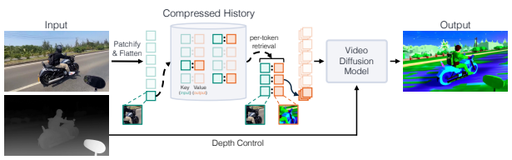
Fig.2 : Correspondence-based video translation.The memory is populated with input-output correspondence pairs from previous generations. To support the consis- tent translation of the next block of frames, we first retrieve from memory the output patcheswhosecorrespondinginputismostsimilartothecurrent.Theseoutputpatches, together with the normal input signal, is the input to our video diffusion model. Based on the new induced input-output pairs, we write to memory only those that are suffi- ciently different from existing.
Original paper · CC BY 4.0 · Gaurav Parmar, Zhengqi Li, Richard Zhang, Jun-Yan Zhu, Srinivasa Narasimhan, Eli Shechtman, Yotam Nitzan · Consistent Video-to-Video Translation via Explicit Correspondences · Original paper figure · Extracted the figure area from page 3 of the original PDF.Why fixed windows lose long-range identity
Streaming video-to-video translation has to generate frames at interactive speed while staying consistent across long videos. An autoregressive model needs a history of past frames for temporal continuity, but keeping every past output makes memory grow linearly and runtime grow quadratically with sequence length. Most real-time systems therefore cap the history with a fixed sliding window, which fixes memory and per-frame cost but drops anything that leaves the window.
An object that reappears after leaving the window is generated without reference to its earlier appearance, and the video context is expensive to enlarge: five seconds of 480p video can exceed 32,000 tokens in WAN2.1.
Attention sinks keep the initial frames as a global anchor, but they cannot represent content that first appears later, including simple disocclusions. Learned hidden-state models such as Mamba compress history into fixed-size states, which is efficient but tends to restrict them to scenes with lower temporal complexity. Pose conditioning and explicit 3D world representations can support consistency, but they struggle with dynamic scenes and depend on inputs that are hard to obtain.
The input video as a retrieval index
The central observation is that the input video already states which outputs should agree. If two regions match in the input, their generated outputs should match as well, so the input can index a store of past generations without keeping the full output history. This moves the work of finding long-range relations out of the transformer's attention layers and into an explicit external index.
The approach depends on an assumption: regions that match in the input should match in the generated output.
Each latent patch serves as its own retrieval key, and the stored value is the generated output latent patch paired with it. The feature extractor is the identity map, so no separate network runs and latents never have to be decoded to pixels. The cost gap is larger: over a 20-second video, DINOv2 adds 2.3 s and CLIP adds 0.9 s, against 0.3 ms for the latent features.
Writing and reading the memory
The memory starts empty and is updated once after each generated block. Before a new patch is stored, its maximum cosine similarity to the memory is computed as \( \mathrm{sim}(k_g, H_b) = \max_{(k_{g'}, v_{g'}) \in H_b} \frac{k_g \cdot k_{g'}}{\lVert k_g \rVert \, \lVert k_{g'} \rVert} \). An empty memory yields negative infinity, so every patch of the first block is admitted.
A patch is committed only when this similarity is below the history threshold \( \tau_h \), as \( H_{b+1} = H_b \cup \{(k_g, v_g) : \mathrm{sim}(k_g, H_b) < \tau_h\}_{g \in G_{b+1}} \) specifies. Redundant patches are skipped, so the stored set tracks the novel content of the input.
For each query patch of the new block, the read step keeps up to k stored keys whose similarity reaches \( \tau_m \), following \( N_k(g) = \mathrm{Top}_k(\{(k_{g'}, v_{g'}) \in H_b : \mathrm{sim}(k_g, k_{g'}) \ge \tau_m\}) \). A query with no neighbour above the threshold gets a validity mask of 0, so the attention layer ignores it. Retrieval runs once per block before denoising, and the retrieved neighbours are reused at every denoising step.
The default configuration uses k = 3 with \( \tau_h = 0.75 \) and \( \tau_m = 0.75 \).
Algorithm 1 in the appendix sequences these steps per block: encode the input, read the memory, denoise with the retrieved tokens, write novel pairs and decode.
Conditioning the denoiser through correspondence cross-attention
Retrieved output patches pass through the same patch embedding as the input latents, which turns them into history tokens in a shared representation space. A correspondence cross-attention layer is inserted into every transformer block, between self-attention and text cross-attention. Each token queries only its own k retrieved history tokens, through \( \mathrm{CorrXA}(g) = m_g \cdot W_o \mathrm{Attn}(W_q x_g, W_k H_g, W_v H_g) \), with the result added to \( x_g \) as a residual.
The output projection \( W_o \) is zero-initialized, so at the start of training the layer adds nothing and the pretrained behaviour is kept. This layer is the only architectural change made to the pretrained VACE transformer.
Denoising dominates, accounting for over 77% of the total, and the memory read and write together take about 50 ms. The totals for the three backbones are 31.9 s, 35.1 s and 42.6 s.
Training the student
The student is initialized from pretrained VACE 1.3B, and all parameters are fine-tuned jointly, including the new cross-attention layers. The teacher is a bidirectional VACE 14B model and does not use correspondence memory. The Rolling Forcing objective is used without modification or extra loss terms, and the memory is active during training, so the student conditions on correspondences from its own earlier blocks.
The run covers 2000 training iterations at 480p with 21 training latent frames. Training uses 32 A100 80GB GPUs across 4 nodes, and all inference benchmarks run on a single H100 80GB GPU.
How consistency and quality are measured
On VACE-Benchmark, two distinct 5-second clips are concatenated in an A to B to A to B order, and the repeated occurrences of each clip are compared. The benchmark evaluation uses 100 such sequences of 324 frames at 16 fps, each about 20 seconds long. Reconstruction consistency is scored with LPIPS, DreamSim and CLIP image similarity.
On DL3DV, pretrained 3D Gaussian Splatting models render exact pose revisits, and first-visit frames are compared with revisit frames.
Latency is the time to the first frame, and throughput is reported as frames per second on a single H100. Offline baselines are Control-A-Video, VideoComposer and ControlVideo, and the autoregressive baselines are Self-Forcing, LongLive and Rolling Forcing adapted to video-to-video with VACE.
Depth-to-video results against baselines
Applied to Rolling Forcing, the mechanism lowers LPIPS on VACE-Bench from 0.427 to 0.240, DreamSim from 0.172 to 0.066 and raises CLIP-Sim from 0.905 to 0.955. Figure 3 shows two frames sampled far apart in the same video for each method, where the autoregressive baselines keep frame quality but lose object identity.
On DL3DV in Table 2, Rolling Forcing reaches LPIPS 0.445 and DreamSim 0.163, against 0.305 and 0.058 for the five-step mechanism. The mechanism improves LPIPS, DreamSim and CLIP-Sim for all three distillation backbones on both benchmarks in Table 3. For Self-Forcing on VACE-Bench, LPIPS falls from 0.548 to 0.343, and on DL3DV it falls from 0.616 to 0.451.
For LongLive, LPIPS falls from 0.511 to 0.272 on VACE-Bench and from 0.534 to 0.345 on DL3DV. Quality changes in both directions across the backbones, and the largest drop is 0.806 to 0.786 for LongLive on DL3DV.
Alternatives to a longer context
Enlarging the KV cache window to 2 times, 3 times and 4 times the default 21 latent frames gives LPIPS 0.350, 0.308 and 0.330 on VACE-Bench. The authors describe the VACE-Bench gains as slight and non-monotonic, and on DL3DV the larger windows degrade both quality and long-range consistency.
Keeping every 3rd, 5th or 10th block gives LPIPS 0.329, 0.350 and 0.373 on VACE-Bench, which improves on enlarging the window but stays behind retrieval. Global average pooling reaches LPIPS 0.450 and quality 0.753 on VACE-Bench, and the Attention Sink baseline reaches LPIPS 0.436. FramePack reaches LPIPS 0.304 on VACE-Bench, and its quality is 0.775 there, against 0.828 for the correspondence method.
Random retrieval, which keeps the same memory but samples neighbours uniformly, gives LPIPS 0.396 on VACE-Bench against 0.240 for correspondence-based retrieval. Across these alternatives the correspondence method has the lowest LPIPS on both benchmarks, 0.240 on VACE-Bench and 0.305 on DL3DV.
What removing correspondence does
With the correspondence patches and the correspondence cross-attention removed, LPIPS rises from 0.240 to 0.379 on VACE-Bench, a 37% increase in the stated reduction direction, and from 0.305 to 0.437 on DL3DV. DreamSim moves from 0.066 to 0.160 on VACE-Bench, while the quality score stays at 0.828 against 0.829 without correspondence.
Figure 5 shows the dog whose snout is yellow at first and turns blue on reappearance when correspondences are removed, while the full method keeps the yellow snout.
Memory growth and runtime cost
At 480p a full KV cache reaches 74.3 at 30 seconds and runs out of memory at one minute, while the mechanism stays at 34.1 across durations. Total VRAM grows by only 0.1 GB at 480p and 0.3 GB at 720p after 10 minutes of video.
Without compression the history reaches over 936K entries at 9600 frames, while with the write policy at tau_h = 0.75 it reaches roughly 26K entries, about 36 times fewer. The history size was measured on 30 videos from webcam, surveillance and action camera categories. Per-block read and write time exceeds 30 ms at 10 minutes without compression and stays below 2 ms with it.
Raising tau_h from 0.25 to 0.90 grows the history from 413 to 15,822 patches and lowers LPIPS from 0.301 to 0.204.
Other conditioning signals
These evaluations are reported in the appendix with the same reconstruction metrics as the depth-conditioned experiments.
Limitations
The method struggles on fast videos with large motion, where reliable cross-frame correspondences are harder to establish. Consistency is scored against repeated content in revisit protocols, so the measures apply to reappearing content rather than to every kind of drift.
Paper info
- Authors
- Gaurav Parmar, Zhengqi Li, Richard Zhang, Jun-Yan Zhu, Srinivasa Narasimhan, Eli Shechtman, Yotam Nitzan
- Venue
- arXiv · Preprint
- First published
- 2026-11-12
- Added
- 2026-11-14
- Updated
- 2026-11-12
- Version
- v1
- arXiv
- 2611.17298
- Category
- cs.CV · cs.AI · cs.GR · cs.LG
- Original paper terms
- CC BY 4.0
- What we show
- Paper info, commentary and permitted figures from the original paper
AI commentary is a separate explanation from the original paper and may contain errors. The original paper and figures follow each source's terms of use and any rights noted separately.
Abstract
Interactive video-to-video applications require real-time generation while maintaining long-range temporal consistency. However, recent methods achieve speed by restricting attention to a fixed-length causal window. This limits long-range consistency whenever relevant history falls outside the context window. To address this limitation, we introduce vid2vid-long, a correspondence-based approach grounded in a simple observation. Video-to-video translation provides an explicit cross-frame reference: the regions that match in the input video should match in the output video too. Concretely, we compute patch-level correspondences in the input, guiding retrieval of previously generated outputs in the corresponding regions, and condition the model on these patches through correspondence cross-attention. Our experiments demonstrate that vid2vid-long consistently improves long-range temporal consistency across recent video models while preserving generation quality and real-time performance.
Quote from the paper
Gaurav Parmar, Zhengqi Li, Richard Zhang, Jun-Yan Zhu, Srinivasa Narasimhan, Eli Shechtman, Yotam Nitzan (2026). Consistent Video-to-Video Translation via Explicit Correspondences. arXiv:2611.17298v1. https://arxiv.org/abs/2611.17298v1
BibTeX
@misc{parmar2026consistent,
  title = {{Consistent Video-to-Video Translation via Explicit Correspondences}},
  author = {Gaurav Parmar and Zhengqi Li and Richard Zhang and Jun-Yan Zhu and Srinivasa Narasimhan and Eli Shechtman and Yotam Nitzan},
  year = {2026},
  eprint = {2611.17298},
  archivePrefix = {arXiv},
  url = {https://arxiv.org/abs/2611.17298v1}
}